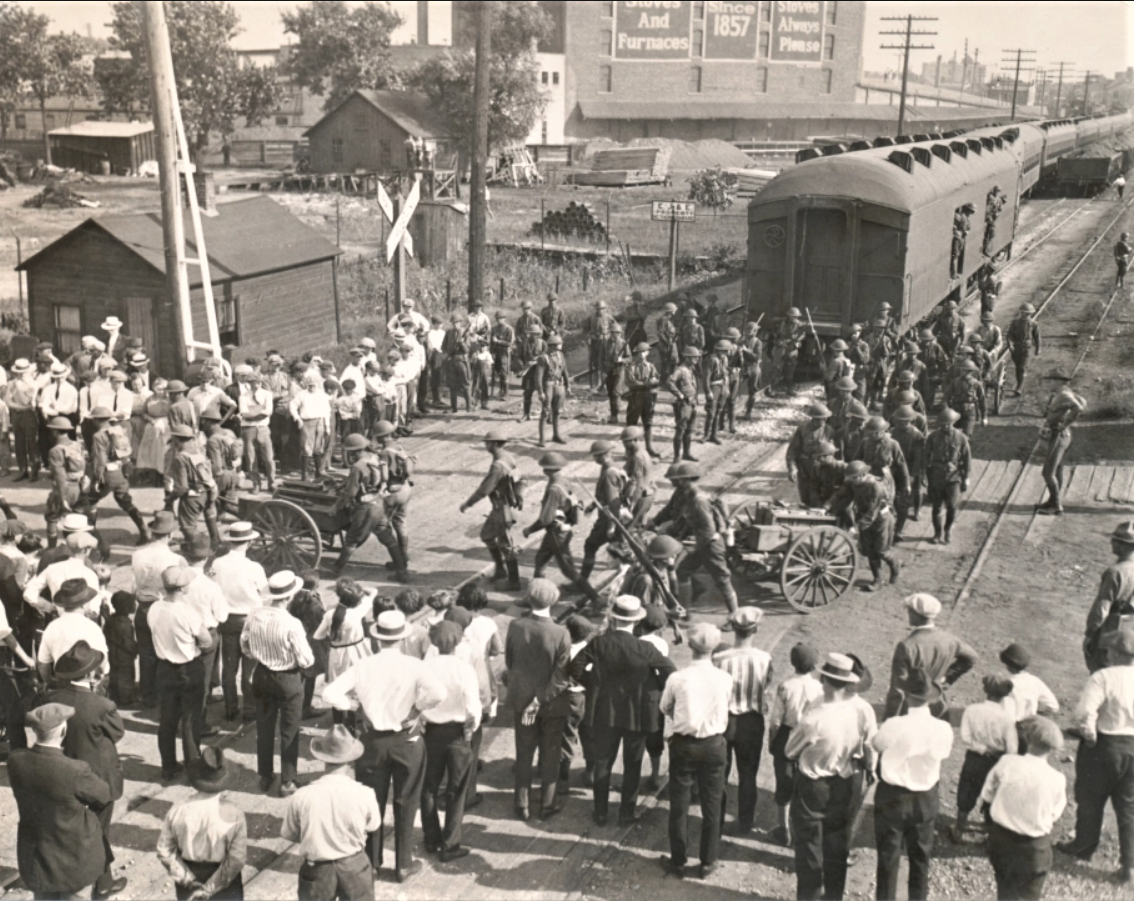
A statement from the T.U.E.L. to participants in one of the largest strikes in U.S. history, and one whose impact is still very much felt today, 400,000 workers, or around half of the 16 rail unions, walked off in a massive and militant strike on July 1, 1922. The National Guard, police, and gun thugs killed around ten strikers and family members over an epic two months of mass mobilizations and struggle. There remain a dozen divided rail unions a century after the strike and the call for amalgamation.
‘Railroad Workers, Stand Together’ from Labor Herald. Vol. 1 No. 6. August, 1922.
AT last the great crisis has come! Finally, Railroad Labor, exasperated beyond endurance by inhuman wage cuts and the infliction of slave conditions, is striking back at its tormentors. As we write 400,000 workers have laid down their tools and the great railroad shops of the country have come to a standstill. The bitter struggle of exploited against exploiters, brewing for the past two years around conference tables, has now broken out into open conflict. The very life of the unions and the standards of living of our families are at stake. It is a fight to the finish.
Entering upon this crucial struggle, it will pay us well to examine carefully the organization of the two great opposing forces. As for our enemies, the capitalists, this is easily done. They present an imposing array of solidarity and power. Rich and powerful beyond measure, the companies are united in their opposition to us from one end of the country to the other. Moreover, they have the united support of the business interests generally, the Government, the Courts, and the Press. In a word, all the exploiters’ many institutions are functioning efficiently as one great machine to beat us. It is a united front of the entire capitalist class to crush militant Railroad Labor.
Capital United: Labor Divided
But how pitiful the showing when we compare our own scattered forces with the mighty organization and unshakable solidarity of our enemies. Organized Labor as a whole, with its invincible millions, does nothing to help us, but stands around twiddling its thumbs and passing sterile resolutions of sympathy. And even Railroad Labor itself is split forty ways. Instead of acting as one united body, in accordance with one common interest, we have division everywhere. While one group of unions is making the fight, which will settle the fate of railroad unionism for years to come, the others, blind to their true interests, are calmly staying at work and helping to break the strike. It is a picture of demoralization. Where all should be unity there is division; when there should be solidarity and concerted action, there is separation and mutual betrayal. It is indeed a tragic situation for the workers.
How unfit our 16 unions, fighting singly and in detachments, are to withstand the mighty combination of the companies, is made clear as day when we compare our forces to an army. What would become of an army which, faced by a modern military force, should send its infantry into battle alone, while its cavalry, artillery, air force, etc., stood by inactive; and then, when the infantry was defeated, send in the other branches one after the other to meet the same fate? Such an army would be useless, and fortunate indeed if it were not annihilated. Yet we railroaders are following exactly this stupid course when we allow the shopmen to fight alone, while the running trades and the others take no part in the struggle. Being such bunglers, is it any wonder that we do not win?
But we do even much worse than that. What kind of an army would it be which not only followed the foolish practice of utilizing only one branch of its forces at a time, but also permitted the others to have signed agreements with the enemy that they would not help their embattled fellow workers? Or what kind of a military power would this country have been in the late war, if several of the States had had treaties with Germany, agreeing not to war against her when the rest of the United States did? Such tactics would be incredibly stupid, suicidal nonsense, you say. And you are right. But it is just this foolish way that Railroad Labor “fights.” In this hour of supreme crisis, when our utmost strength is needed, have not many of the unions signed treaties with the enemy, and are not others dodging around trying to peddle the interests of the striking trades so that they, too, may secure similar treasonable agreements?
Again, what sort of an army would it be that allowed some of its divisions to line up with the enemy to defeat their own forces? That is what Railroad Labor’s army is doing in this great battle. The issue is that the strikers are trying to stop the railroads and the companies are trying to operate them. Whichever achieves its goal will win. It might be thought, therefore, that all Railroad Labor would unite to bring the roads to a standstill. But the unions at work are directly helping the owners to run the roads, and thus to break the strike. They are as soldiers who have loaned themselves to the enemy so that their own comrades, and therefore themselves, can be defeated. Can folly go further?
The Employers Command Our Unions
Yes, folly can go further, and we railroaders have found the way to make it do so. Can you imagine a state of affairs where the commander of an army permitted the opposing general to dictate to him which of his troops he should use, and when he should throw them into battle, or pull them out of it? Such an army would be only a ridiculous caricature of a fighting force, and its commander would be cashiered instantly as an incompetent. But it is exactly thus that the railroad workers’ army operates. For all practical purposes of the struggle, we have abandoned the main command of our forces into the hands of the companies. They are the ones who determine which of our battalions and regiments shall and shall not fight. They directly control and manipulate the extent and breadth of our strikes. Now let us see how they do it.
Our organization is split into many fragments of single unions or groups of unions. Being autonomous and imbued with an individualistic spirit, these do not recognize the common interest of all, nor do they rally to each others’ support. They fight only when their own individual interests are involved, only when pressure is put upon them directly. Aware of this fact, the railroad monopoly, operating through its agent, the Railroad Labor Board, plays them against each other just as it pleases, selecting whichever ones it wants to do battle with and whenever it chooses. The real command of our unions is thus in the hands of the enemy.
Never was this more clearly illustrated than in the present crisis. The Railroad Labor Board, which, we repeat, is nothing but the willing tool of the companies, slashed the wages of the Maintenance of Way to the bone. When the Board did this it virtually ordered this organization into battle, with dissolution as the penalty if it dared disobey the Board’s instructions. Moreover, the Board commanded it to fight alone, for it knew very well that the other unions, hopelessly divided against each other, could not rise to the heights of making common cause with the trackmen. It was just as though General Von Hindenburg had sent this order to General Foch:
“Now we are going to attack your 4th Army as we are ready to whip them. But be sure to keep your other troops out of action until we say the word.” Can you imagine Foch or any other general with an ounce of brains obeying such a command from the enemy? Yet that is exactly what our railroad union generals did when they allowed the companies to single out the trackmen for slaughter and did not rise in protest against it.
Very well, the Railroad Labor Board, realizing its control of the situation and not greatly fearing the power of the Maintenance of Way, decided they could extend the fight profitably–for the deflation of Railroad Labor must proceed as rapidly as possible. So they slashed the wages of the Shopmen and the Clerks, thus throwing these bodies into the fight as directly as though the Board had wired their headquarters that they had either to strike or dissolve. But, not wishing to take on too big a contract, the Board decided that the train service unions should be kept out of the struggle until it is better able to trim them. So it just tells them to wait around a few months until it has the time and opportunity to settle their hash. And they obligingly do so. It is like Von Hindenburg sending this order to Foch and getting away with it: “Now send in your 2nd and 3rd Armies. We can take care of them as well as the 4th Army, which you delivered promptly as per instructions on the ‘steenth. But do not fail to keep those heavy shock troops of yours, the Brotherhoods and Telegraphers, in reserve. We will let you know in due season when to bring them onto the field of battle so that we may dispose of them with the fewest possible casualties to ourselves.”
And now that the battle is on, the Railroad Labor Board has by no means lost command of our forces. Should the situation become threatening, it can pull out of the fight just whichever sections of our army it deems necessary. All it has to do is to grant a few concessions to the group which is wants to pull out of action, and the job is done. Obediently they will join forces with the employers and thus help beat the rest whom the Railroad Labor Board has decided must stay in the fight.
Let’s Seize Our Own Command
Can anybody deny that the foregoing is a true picture of the situation? Who can dispute the fact that the Railroad Labor Board is playing checkers with our unions, throwing these into battle and pulling those out, just as it sees fit by cutting wages here and withholding wage cuts there? Could a situation be more unfavorable for us, with the practical command of our forces in the hands of our enemies? And is it not high time that we put a stop to this ruinous condition by seizing command of our own organizations, so that we, and not the Railroad Labor Board, shall determine the number of troops we shall bring to bear against our opponents at any given time?
And we can seize this command only by amalgamating our many unions into one. So long as we are divided into many sections, the bosses will be able to play one against the other, as they are now doing to our sad detriment. Only when we are all in one general railroad union, only when the whole body of us will rally to the support of every section of us that may be in trouble, will we actually have charge of our own unions. Now they are controlled in their most vital function by the bosses.
In the present great struggle, two supreme tasks confront us. One is to win the strike. We must and will carry that to victory, regardless of obstacles. This can be done, as the panic of the employers now shows, if we hold fast and extend the strike. In spite of our serious divisions we have delivered a smashing blow, which if followed up relentlessly cannot fail to bring a favorable result. And the other task is to point out to the railroad workers the need for united action by all of us against the companies, and also to show them that this unity can only be secured by amalgamating our unions together. In one gigantic union, built up of our 16 craft organizations, embracing all classes of railroad workers, lies the only remedy for the division and lack of solidarity which is costing us so dearly in this struggle. Amalgamation and victory, should be our slogan.
Railroad Workers’ Section.
Trade Union Educational League.
The Labor Herald was the monthly publication of the Trade Union Educational League (TUEL), in immensely important link between the IWW of the 1910s and the CIO of the 1930s. It was begun by veteran labor organizer and Communist leader William Z. Foster in 1920 as an attempt to unite militants within various unions while continuing the industrial unionism tradition of the IWW, though it was opposed to “dual unionism” and favored the formation of a Labor Party. Although it would become financially supported by the Communist International and Communist Party of America, it remained autonomous, was a network and not a membership organization, and included many radicals outside the Communist Party. In 1924 Labor Herald was folded into Workers Monthly, an explicitly Party organ and in 1927 ‘Labor Unity’ became the organ of a now CP dominated TUEL. In 1929 and the turn towards Red Unions in the Third Period, TUEL was wound up and replaced by the Trade Union Unity League, a section of the Red International of Labor Unions (Profitern) and continued to publish Labor Unity until 1935. Labor Herald remains an important labor-orientated journal by revolutionaries in US left history and would be referenced by activists, along with TUEL, along after it’s heyday.
Link to PDF of full issue: https://www.marxists.org/history/usa/pubs/laborherald/v1n06-aug-1922.pdf

