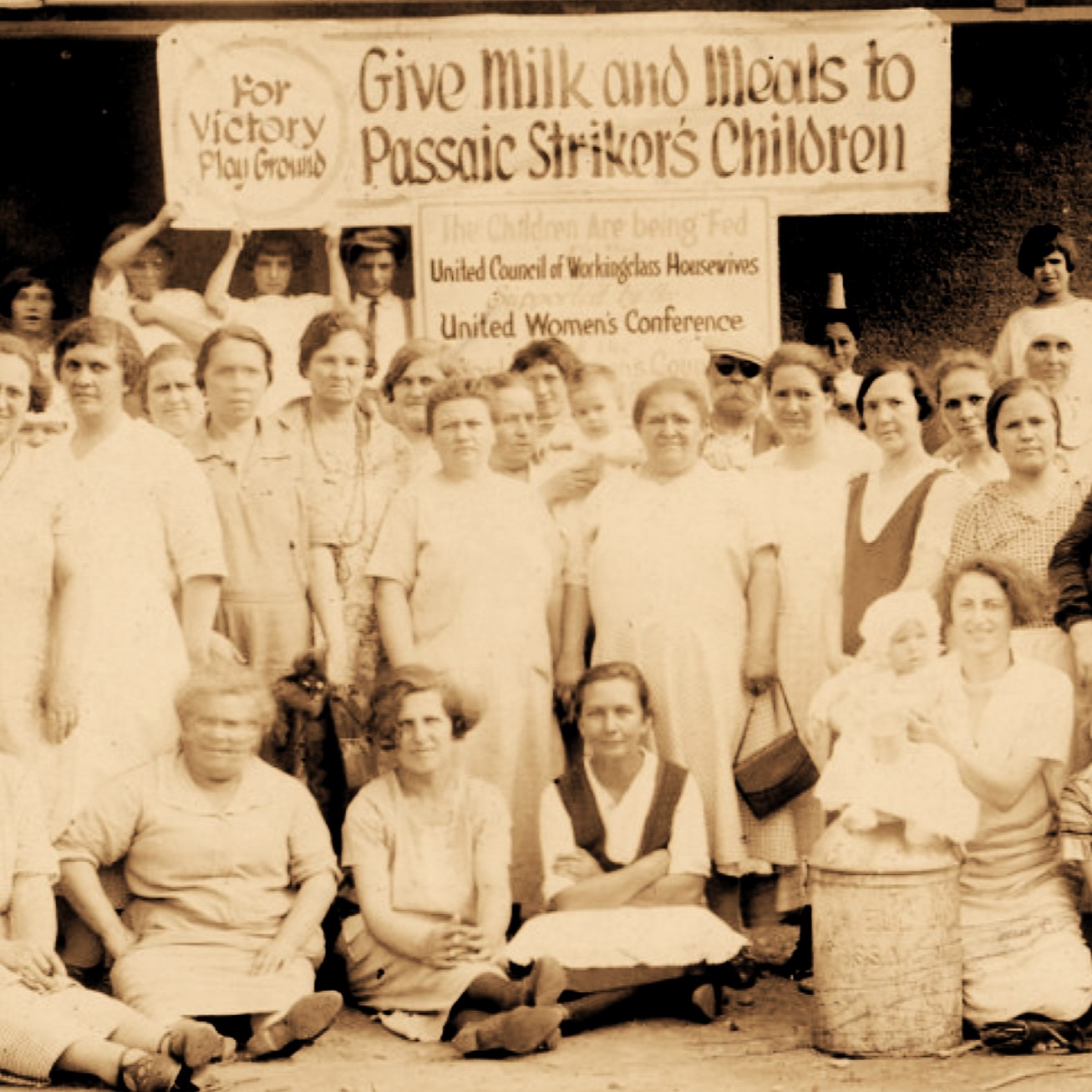
It is fair to say that the old Socialist Party saw a more robust discussion of women’s issues, practically and theoretically, including critiques from its women members for what we would now name sexism in the organization, than the equally male-dominated early Communist Party ever did. The ‘anti-feminist’ approach of the early Communist movement was in contradiction to the fact that women, including working class women, frequently organized themselves into separate organizations despite the fact that the Communist Party thought they should not. One way to fudge it was to utilize the Soviet experience of calling ‘delegate conferences’ of non-party women to discuss issues relating to women. Which might work if you are in state power, but not if you are 20 comrades in Cleveland. The largest of those experiments became groups like the United Councils of Working Class Housewives. While there would never be a woman’s Young Communist League, whereby women would have their own Communist organization, or the equivalent of the League of Struggle For Negro Rights which would serve as a vehicle for the Party’s women’s liberation work, the large variety of organizations built by women, from union auxiliaries to grocery cooperatives, became centers for the Party’s community-based work. Here the Secretary of the Party’s New York District Women’s Committee on issues then raised in ‘women’s work.’
‘Communist Work Among Women’ by Margaret Undjus, from The Daily Worker Magazine. Vol. 2 No. 17. January 31, 1925.
THERE are many comrades who conceive of special work among women by a Communist Party. Many women comrades do not take part in this special work, because they fear that they will be considered feminists. Comrades would not take this attitude, if they really did understand what this kind of work means for the party. It is true that our knowledge and experience in Communist work among women here in America is very limited and we must look for guidance to our comrades abroad with their mature knowledge in this kind of work.
The reasons which compelled the Communist International to give special attention to work among women are easy to find. The contrasted experience of the two revolutions in Russia and Hungary of themselves give reasons.
In Russia the active support of the women helped to save the revolution, in Hungary their passive resistance helped to destroy the revolution. Capitalism has perfected its machinery so, as to make women in the mass a bulwark of conservatism and reaction.
Situation Among Women.
First, the women are mentally and emotionally separated from the men; then their isolation is used to intensify the economic subjection which they share with the men; their inferior position is used as a means of setting them into antagonism against the men; finally their separation as a sex is used to make them active for reaction against the workingmen active in the class struggle.
The weakness of the mass of women from the point of organization makes them a serious menace in almost every fight, as the capitalist ideology imparted to them from the school, pulpit and press fosters a parasitical outlook which leads to the acceptance of low wages. The woman tramping in search of work is threatened with danger from which men are free and more easily submit to exploitation. The thought of her children going hungry also compels the mother to accept low wages. Add to this the jealousies and dislikes arising from their sex competition with each other for marriage mates–itself a by product of their economic conditions, the comparative inactivity of women in the trade unions and their easy delusion by bourgeois agencies is all too terribly explained. The maternal functions of women place them: in a position of utter dependence and very often into humiliation unspeakable.
Women are very susceptible to influence by the bourgeois feminist organizations. These feminist organizations are a machine for manufacturing a counter-revolutionary psychology which the women in turn impose upon their children and men folks. The bourgeoisie see the importance of special work among women. The bourgeoisie are exerting much effort to divert the proletarian women from their class interests thru these feminist organizations. We, the Workers (Communist) Party are only now waking up to the realization of this important work. The working-class possesses in its women powerful forces which are not yet mobilized. These forces if systematically employed, would be capable of exercising a decisive influence on the issue of the class struggle. It is the duty of our party to start this work.
Destroy Feminist Ideas.
The constant worsening of the position of the working women creates favorable conditions for work among them. The task of the party is to give Communist direction to the discontent among women if the working-class study the prejudices and traditions that still shackle her, bring home to her the lesson that she is one with the world’s workers. We must raise slogans that will appeal to the working women. We must destroy the feminist ideology and win them over to the side of the workers in the class struggle. Special means must be devised to win the attention of the women to the significance of the Communist message to them. We must get the women to understand how suicidal it is for them to tolerate a miserable rate of pay because they hope to escape from the factory by the door of marriage. She must be made to understand that by acting as strikebreaker, she is, helping those who are fighting against the working-class for the preservation of the bourgeois social system. The Workers (Communist) Party must do its utmost to overcome the sluggishness, the individualistic psychology of the working women and to awaken feelings of class solidarity among them.
Because of the peculiar situation of women, because of their political backwardness, a special means of approach must be used. We have a special department of youth (the Y.W.L.) because we know that in this way our Communist work will be more effective among the young workers.
The Y.W.L. constantly brings before the party special plans for more effective work among the youth of the country. We organize unemployment councils during acute unemployment periods; we organize protection of foreign-born councils, etc. Acute unemployment comes with the reoccurring capitalist crisis, but the problem of the women of the working class is continual. It is necessary to have a special apparatus in this work. In Russia, after the overthrow of the bourgeoise, we see the important and effective work carried on by the special women’s departments of the Russian C.P. The fact that the C.I. has instructed all of its sections to create a apparatus for work among women, in itself is evidence enough to prove the necessity for special work among women. The women’s department in the party will take the initiative in pressing for action on questions relating to Communist work among women.
Do We Need a Separate Women’s Organization?
Some of us believe that the Communist message applies to women in a very peculiar way. “The women of the working-class will not enter a Communist Party, but they will become members of a separate women’s organization independent of the party,” say some of our comrades, “therefore, it is necessary to carry on our Communist work among women thru such separate women’s organization.” First, a separate women’s organization cannot have the will to action, the centralized organization as that of a Communist Party. Second, how can we expect to win the sympathies of the women of the working-class for our party, if we (the party) work with these women on issues related to their very life in the name of an organization other than the Workers (Communist) Party? This separate organization will absorb all the sympathies and gain all the influence of these women, because it will take up the issues related to their very life. It has been the experience of our comrades in other countries, that women become the ardent advocates of Communism, once they realize that the Communist Party is with them in their daily needs. The Comintern is opposed to the formation of separate women’s organizations. The following is an extract from the theses of the Third Congress of the C.I. on women’s work: “Being earnestly opposed to the separate organization of women into all sorts of parties, unions, or any other special women’s organizations.” Also from the theses of the third conference of Communist women: “In Holland and Norway the remaining separate organizations of Communist women were successfully liquidated.”
Forms and Methods of Work.
The C.E.C. of the party made a decision that all political work among women be carried on in the name of the Workers (Communist) Party: that every unit of the party beginning with the branch up to the C.E.C. immediately appoint a committee for work among women. This is the correct policy. It is in spirit with the decisions of the C.I. The comrades in these women’s committees must acquaint themselves with the latest theses of the C.I. on work among women, as our work must be based on these theses.
Work among women in Industry.
This must be the most important phase of our work among women. “The experience of the revolutionary struggle of the working-class shows the mightiest form of organization to be the centralized organization closely bound with the working masses and having its basis in production, that is in the workshops and factories.” Our party is starting out to make this the laboratory for mass work of the party–we are beginning to reorganize the party on the shop nuclei basis. The starting for mass work among women should also be in the factory and shop. Our shop nuclei where ever organized, should have an organizer for work among women. Our trade union groups must have a comrade responsible for work among women–to get the women into the left wing in the trade unions, etc. Women workers’ committees may be organized in the shops and factories. Where there are existing shop committees, the women must be organized into such committees and no separate committee must be organized. All this work must be carried on in collaboration with the general party women’s departments having jurisdiction. Some of the slogans for work among the women in the shops and factories may be: Equal wages for equal work in every branch of industry; abolition of piece work; employment of women in all branches of industry except where it is detrimental to their health; abolition of night work and overtime; protection for women workers, mothers and infants; working wages to be paid in full during absence because of confinement; against dismissal during pregnancy and nursing; against the dismissal of married women, etc.
Work among the housewives. The housewife is an important factor in the class struggle. The housewives are not in the trade unions, nor are they organized politically. The co-operative is the organization capable of comprising these masses of women of the working-class, it will also bring the women in the factories and shops into organization with the housewives. The co-operative movement will draw the proletarian women into the whirlpool of political and economic activity. It is the task of the party to direct the proletarian women, to make it their endeavor to make the co-operatives a weapon for the Interests of the working class. The party should stand for carrying out initiative proceeding from the women organized in co-operatives and aiming at a Communization of daily life. As for instance, the establishment of dining halls, kindergartens, nurseries, etc. We shall work for the realization of the active participation of the co-operatives in class warfare by means of opening of dining halls, for strikers, unemployed, provision for their wives and children, etc. Our women comrades in Coney Island are preparing to carry on work of this kind. Care must be taken that this kind of work is not given a humanitarian character. As for instance, the feeding of the unemployed must be dealt with in relation to the general question of unemployment.
Fight for Everyday Needs.
The party will not limit its work to the factory and the home. We must carry on propaganda by written word and by personal contact. The party must take the initiative in raising slogans on burning issues that will ap peal to the working women. Mass meetings must be arranged for on these issues. Local councils may be formed when the situation demands. (Such as the control councils in Ger many during the economic crisis). We must establish united fronts by calling local conferences with delegates from existing women’s organizations, shop committees, trade unions, co-operatives, local councils, Workers Party, etc. We must have these conferences take up questions that will appeal to the working women generally, such as unemployment, high food prices, high rent, child labor, etc. All these questions must be taken up at the time the Workers Party launches united front campaigns on these issues. It is the duty of the W.P. members in these conferences to see that work on these issues is based on the W.P. program for that specific issue. We must always have a comrade deliver a Communist talk at these conferences. We must acquaint the women attending these conferences with what the Soviet government of Russia has done to improve the conditions of the working women in Russia and compare same with their own conditions both in the factory and home. We must see that these conferences accept resolutions of greeting to the women in Soviet Russia. We must always keep before these women the fact that all the improved conditions for women in Russia came about thru the work of the Communist Party of Russia. The work of relief for the workers and their children in other countries and for relief of political prisoners should be taken up at these conferences. Where appropriate, we must have women representatives at these conferences from the farms. These conferences are called whenever necessary. They must be representative conferences. By no means must we allow these conferences to develop into a separate individual membership organization. These local conferences will be under the leadership of the Workers Party.
Simultaneously with this work, we must immediately start building the party machinery for work among women. Every unit of the party must establish its own women’s department. The C.E.C. of the party is preparing a special program for this work. We must be ready to give life and flesh to this program. It is very important, that the women comrades be fully aware of the fact that it is they who will have to play the role of Intermediaries and interpreters between the Workers (Communist) Party and the masses of working women. To give these women’s committees a non-feminist character, men comrades must be appointed on these committees. To carry on this work more effectively, our women comrades must be drawn more into the general party work. In the course of our work new methods of work must be elaborated. Account must be taken of our experiences. Our progress will be lower than we wish, but it will be sure. We will gain influence and members for the Workers (Communist) Party.
The Saturday Supplement, later changed to a Sunday Supplement, of the Daily Worker was a place for longer articles with debate, international focus, literature, and documents presented. The Daily Worker began in 1924 and was published in New York City by the Communist Party US and its predecessor organizations. Among the most long-lasting and important left publications in US history, it had a circulation of 35,000 at its peak. The Daily Worker came from The Ohio Socialist, published by the Left Wing-dominated Socialist Party of Ohio in Cleveland from 1917 to November 1919, when it became became The Toiler, paper of the Communist Labor Party. In December 1921 the above-ground Workers Party of America merged the Toiler with the paper Workers Council to found The Worker, which became The Daily Worker beginning January 13, 1924.
PDF of full issue: https://www.marxists.org/history/usa/pubs/dailyworker/1925/1925-ny/v02b-n017-supplement-jan-31-1925-DW-LOC.pdf

