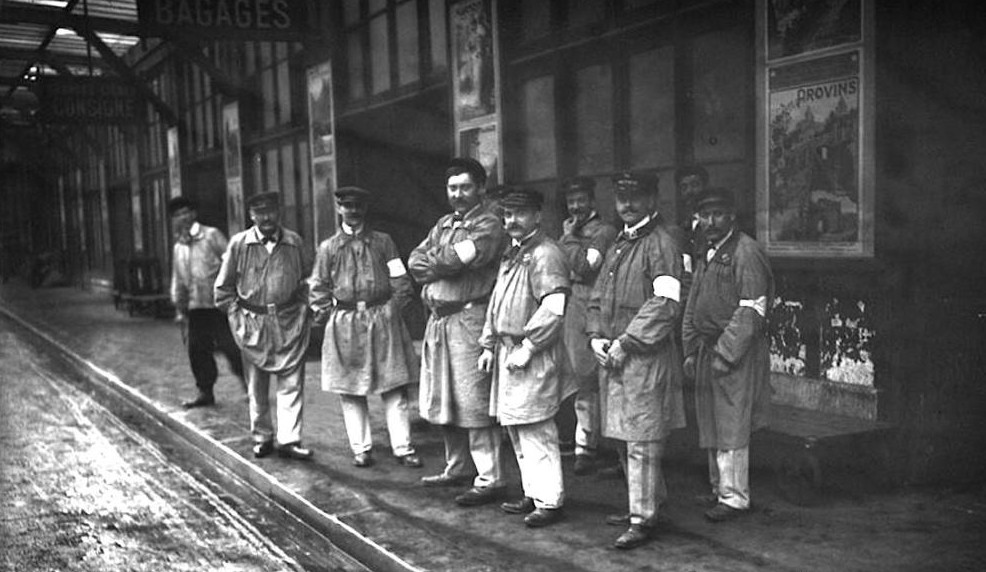
Foster on his long sojourn in France reports from the midst of the massive C.G.T. rail strike of 1910, the “grève de la thune.”
‘The Big Railroad Strike in France’ by William Z. Foster from The Industrial Worker. Vol. 2 No. 33. November 2, 1910.
Paris, Oct. 13, 1910. The long threatened railroad strike has struck France like a cyclone. At present writing the whole French railroad system is demoralized and the strike is still spreading. I have no idea as to when you will get this letter, if ever, but the mail system here is naturally bodily nipped by the strike, but I will chance it and send it anyhow.
On Monday, two days after the close of the C.G.T. congress at Toulouse, like a bolt of lightning from a clear sky, came a general strike order to the employes of the Chemin de fer du Nord (North R.R.) It was issued by the strike committee of the Federation of Engineers and Firemen and the National Syndicate of Railroad Workers. The response was quick and in 24 hours the road, owned largely by the Rothschilds, was completely tied up. The Chemin de fer de l’ouest (the State road) was the next to get the order, and at present writing its service is demoralized. After this a general conflagration began and now every road coming into Paris is more or less crippled and the strike is still spreading. Accounts from outside points as to conditions prevailing there are very vague as immediately the strike was declared the “saboters” got to work and clipped the wires in every direction, as they had been long advised to do by the militant revolutionists. This feature of the strike has roused the most heated protests of the capitalist press. They refer to the strikers as being in open insurrection. While on the other hand the revolutionary papers, La Guerre Sociale in particular, are laughing over the matter and encouraging the strikers to cripple the railroad system as much as possible. “La Guerre Sociale” bids the strikers to be of good cheer, as the same good fairies who “saboted” the telegraph and telephone lines so well in the recent postal strike will no doubt soon be as busy again at their task. As yet there has been but little violence. The situation in Paris is one of intense expectancy. Everyone is wondering what will happen next. Most of the great depots are closed and tenanted by lounging scissorbill soldiers, while about the streets are thousands of curiosity seekers gapping at the buildings and staring in at the windows in morbid curiosity. About the bulletin boards of the big dailies crowds of people serge, reading the delightfully vague bulletins posted thereon. At the Bourse du Travail the strikers are holding meeting after meeting. Hundreds of gendarmes and cavalry men are stationed at the building during these meetings, the cavalrymen being drawn up in line just across the street from the entrance to the building, ready to make a charge on the workers coming from the building if it is deemed advisable. The government, true to its instinct, has early taken a hand in the matter against the workers. Briand, the renegade, the socialist president du counsel or prime minister, fills the position to which the work of oppression falls in this affair and The is demonstrating his willingness to serve his masters faithfully. He is taking active steps to crush the “rebellion.” In an interview given to the press this class-conscious socialist says the following:
“The government don’t find itself in the presence of a strike in the true sense of the word, but by the conditions in which the movement of the railroad workers has been prepared, by the first acts by which it has been accompanied, it finds itself in the presence of a criminal enterprise of violence, of disorder and sabotage. The movement has nothing of a professional nature; it is purely insurrectional. It escapes entirely the personnel of the railroads, who will not be slow to perceive this fact, but too slow for their own welfare, as they will have been led on to the worst excesses. Whatever pretext the organizers will use to justify what they term their strike, in the mind of the public, will not succeed. The strike has been declared without any just reason, in fact, it was declared on the day following that on which the delegates of the Federation of Engineers and Firemen and the National Syndicate of Railroad Workers had had an interview with the minister of public works, none other than our socialist friend Millerand, and myself in my cabinet. In the course of this interview it had been decided that the workers would send to me their demands, not vague and indefinite, such as they announce in their manifestos, but clear and precise and particularly so in regard to what refers to an increase of salaries; with these indications sufficiently detailed as to permit of a discussion officious and reasonable. I had agreed with the minister of public works to transmit these demands to the directors of the companies and to invite them to reply. I was to communicate these responses to the representatives of the workers. I had informed the delegates that after they had stated definitely their demands and those on which both parties did not agree had been isolated that it would be possible to arrange an interview with the directors of the companies. I offered to preside at this meeting.”
Briand tells of further negotiations and of great exertions that he and his man Friday, the minister of public works, had made to help the poor but deserving railroads. Then he continues:
“There is the state of affairs when the strike was brusquely declared and at once it has taken the course that you know. The faithful workers have been menaced everywhere, deeds of violence have been done, criminal acts of sabotage have been committed. In one word, the plan of violence prepared and announced in the previous meetings by the instigators of the present movement have been put into execution. Ah, well, that will not continue. The government finds itself, I repeat, not in the presence of a strike, but of a criminal enterprise. (Pugh would call it a “criminal conspiracy.”) It hopes that the vast majority of the railroad workers will not identify themselves with the authors of such a situation. The government has decided to protect the “right to work” (he might have said “sacred”) by all possible means. It is armed with the penal code, the law of 1845 and that of 1881 against the guilty ones.
“I have seen fit to receive the delegates in my cabinet and listen to their grievances. They have not paid attention to my advice nor considered the good will of the government in their cause. So much the worse for them.”
Monsieur Briand, as the revolutionists like to style him, professes to be astonished and shocked at this abruptness of this strike. A few words will explain the situation. The railroad syndicates are members of the C.G.T. The C.G.T. had very important business to transact at Toulouse at its congress. It would have been folly to declare a strike and tie up the railroads and prevent the delegates from going there. The strike committees stalled along with the government, well knowing from past experience that nothing was to be gained in that quarter; the congress was finished, the delegates scattered to their homes and lo this inexplicable strike occurs. The C.G.T. decided to operate the French railroads long enough to accomplish its business at Toulouse; that finished it was decided to tie them up to accomplish some more working class business, “the bettering of the conditions of the railroad slaves.” M. Briand is getting a taste of direct action. This explanation of the strike seems reason able to me, yet I have failed to see or hear anyone else connecting the strike with the congress at Toulouse in this manner. Briand quickly followed up his threats by definite action. The law (?) gives him the right to put the railroads under military law during time of war or of any other unusual disturbance. This means the mobilization of the workers, who must remain at their posts or suffer a severe penalty. In the present unusual disturbance Briand has issued the order to mobilize the railroad employes, the order to take effect in 48 hours, that is, on Oct. 114th, and to continue in effect for 21 days. Thousands of letters have been sent to the railroaders telling them to be at their posts on that date or they must be prepared to take the serious consequences. In all the syndicalist halls of Paris rousing meetings are being held and the determination is to ignore the scab-herding order.
The following statement has been drawn up and posted all over Paris:
Against the Mobilization.
Comrades, the government is lending itself to measures of violence against the railroad workers. After the dismissal of workers that preceded the strike the government yesterday discharged our comrade, Toffin. Today the newspapers publish the order of mobilization, which is to be the prelude of still more numerous dismissals. The order of mobilization is illegal. All the measures that it will engender with it will be illegal, null and void. The government has not considered that the law of June 9. 1837, Chapter 5, article 230, provides that in time of peace the men mobilized have 15 days in which to respond to the mobilization order. As the governmental measure is illegal it is also in vain, for none of you will respond to the notice that will he addressed to you. None of you will let himself be influenced by the menaces or by the letters of dismissal. There are thousands of you, neither the government nor the great companies can resist your just claims, if, strong in your might you have all together, the wills to make it triumph. None of you will let himself be troubled by the combined accusation of M. Briand and M. Sartianx that our strike is “political and revolutionary.” Our claims are co-operative and it is to our co-operative action alone that we can appeal for success.
Comrades, the strike has been declared on all the roads. Public opinion that knows our misery is with us. Let us struggle for our right, to the end, to the last energy (ditch). You will not respond to the mobilization order. Vive la Grieve,
The Strike Committee.
***
The renegade Briand has also other laws at his command that he has threatened to us liberally in this affair. One of these is one making the instigators of acts of sabotage accomplices in the crime. Quite a nice conspiracy law of the usual elastic nature. La Guerre Sociale that has all along advocated the saboting of the railroads dares Briand to put his threats into execution. On Briand’s threat to put this law into action the strike committee notified him that they could be found at the office of Humanite, Jean Jaures’ paper. Last night (Wednesday, 12th) a party of gendarmes, led by the notorious Lepine chief of the Parisian police, paid a visit to “Humanite” and put the committee (five men) under arrest. The visit was expected and Jaures and some dozen other socialist deputies were present to witness this dirty work. Even they, long since dead to the real working class movement, were aroused by this piece of Briand’s work and they unmercifully guyed the chief of police and the slaves accompanying him. One of the strike committee when arrested was sitting in the old editorial chair of Briand, the one in which the latter wrote his well known plan of the general strike. Secretly Briand is proving a treasure to the direct action movement of the world by showing how completely even a radical revolutionist can forget his principles when enmeshed in the devitalizing influence of political action. The arrest of this committee has not hindered the prosecution of the strike in the least, as there are provisional committees ready to come forward whenever their services are needed.
Hundreds of arrests are being made all over France. Briand has issued an order to his subordinates to place every known militant direct actionist under surveillance and to arrest them upon the slightest pretext.
The tie-up has effected the prices of food stuffs already in Paris and the problem of getting provisions into the city is pressing. The plan now being advocated is to take advantage of the fine canal and river system and bring food in that way. Now if the employes of the canal could develop a little class solidarity and refuse to carry any freight to Paris the strike would soon be settled. Four million hungry stomachs in Paris would force the government and private railroad companies to come to time in spite of the few thousand soldiers and gendarmes that the latter have at their disposal.
The railroad strike has fanned into flame the smoldering protests of other workers and a veritable epidemic of strikes of minor proportions has occurred in the last 24 hours all over the country. Not a single Parisian paper has yet published an estimate of the number of men on strike. The number is either so great as to forbid it being made public or else the telegraph and telephone system are so disorganized that no trustworthy estimate can be made.
Judging by the spread of the strike during the last 24 hours the future looks bright for the long-meditated general railroad strike. Let us say in hearty accord with the railroad workers, “Vive la Grieve.”
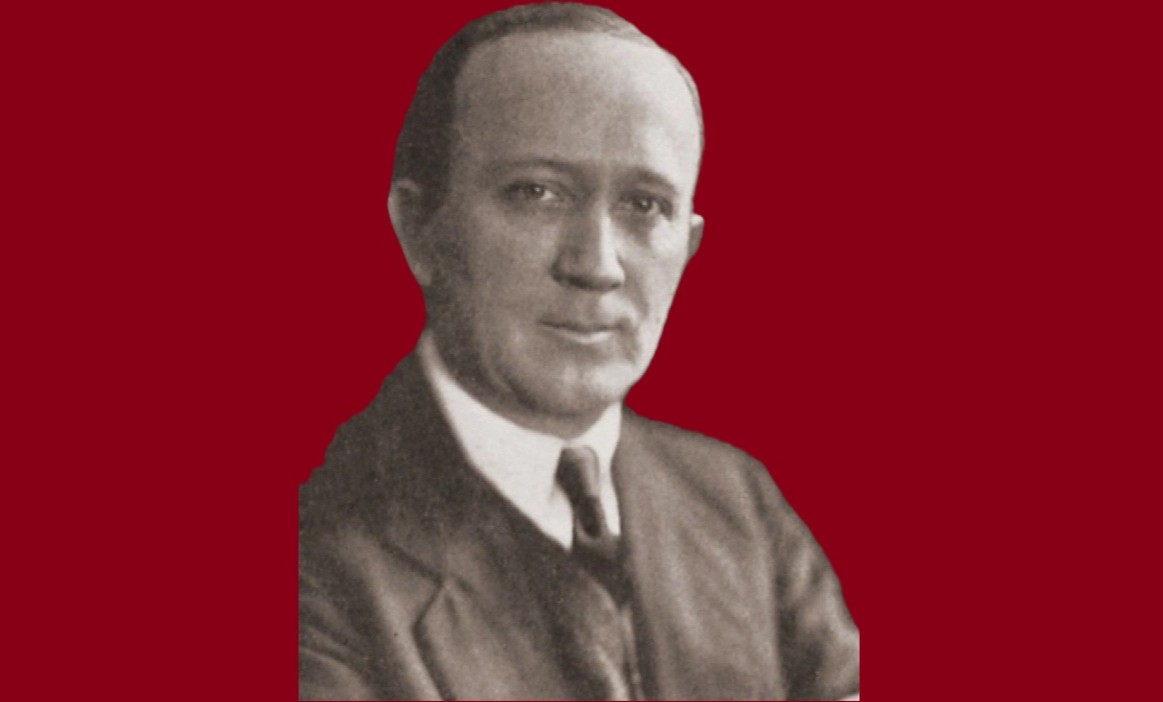
W. Z. FOSTER.
The Industrial Union Bulletin, and the Industrial Worker were newspapers published by the Industrial Workers of the World (IWW) from 1907 until 1913. First printed in Joliet, Illinois, IUB incorporated The Voice of Labor, the newspaper of the American Labor Union which had joined the IWW, and another IWW affiliate, International Metal Worker.The Trautmann-DeLeon faction issued its weekly from March 1907. Soon after, De Leon would be expelled and Trautmann would continue IUB until March 1909. It was edited by A. S. Edwards. 1909, production moved to Spokane, Washington and became The Industrial Worker, “the voice of revolutionary industrial unionism.”
PDF of full issue: https://www.marxists.org/history/usa/pubs/industrialworker/iw/v2n33-w85-nov-02-1910-IW.pdf

