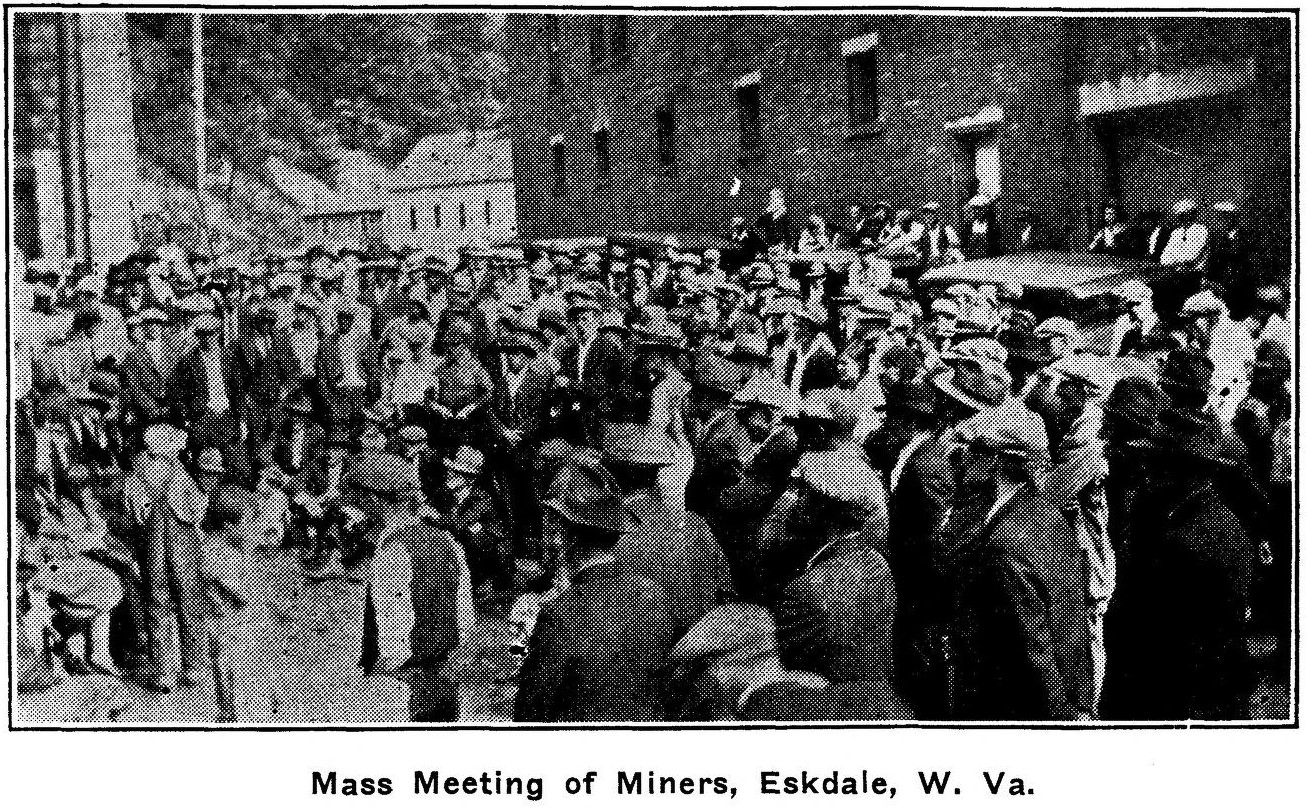
Helen Norton, journalism instructor at the Brookwood Labor College, spent much time reporting from West Virginia in the early 1930s as Frank Keeney led an attempt to bring unionism back to the coal fields lost a decade previous. At the back of their demands were empty bellies, as poverty while in work was replaced by destitution while on strike. Real hunger stalked the hollers. The miners and their families were brave enough to stick, but they needed first food to eat and money to buy it. Norton describes their plight in this plea for aid.
‘Sooner Starve A-Strikin’ Than Starve A-Workin’’ by Helen G. Norton from Labor Age. Vol. 20 No. 8. August, 1931.
THE strike of West Virginia mine workers, foreshadowed in the last issue of LABOR AGE, began July 6. On that day, reports from 23 communities showed 4,108 men on strike and 474 scabbing, with 14 mines completely closed and all but three of the others badly crippled. There are now between 7,000 and 8,000 on strike and coal production is badly crippled. Exact figures cannot be obtained because of the difficulties of communication. Telephones are almost non-existent, postoffices in company stores are closed to strikers, and the only way many committees can report is to walk I5 or 20 miles into Charleston. Local secretaries are too busy signing up new men to turn in a complete roll of their members. The strike has been fairly quiet. That is to say, men are arrested every day, families receive eviction notices or are evicted every day, company guards and state troopers interfere with picket lines every day, new members are signed every day, the importation of scabs is attempted every day, people are starving every day, and the piles of reserve coal at the mines grow smaller every day. But aside from the killing of two scabs in Putnam County—by company gunmen the union claims—there has been no sensational violence to make big news in the papers.
To be sure, Mrs. Charles Seacrist of Hugheston is in her grave with her unborn child because she saw a constable kick and knock down her neighbor, Mrs. Chris Deviti, who objected to having her furniture thrown out on the road, and Mrs. Deviti herself is still in danger of having a miscarriage; but coal miners’ wives aren’t important and have no business being shocked to death at due process of law. Relief, a big problem in any strike, is paramount in this one. Company stores, the sole source of supply in many camps, are, of course, closed to the strikers. Since the only money they ever have is company “scrip,” they cannot buy elsewhere or even get credit. They are completely dependent upon the union for food. The union during the first two weeks of the strike spent nearly $10,000 for food alone. And this means barely enough to sustain life in people accustomed to live at the edge of starvation. A family of five is entitled to 10 pounds of flour, 4½ of fat salt pork, 4½ pounds of pinto beans, a pound of coffee, 2½ pounds of sugar, a little baking powder and salt. Try feeding your family on this for a week and see how far it goes. Yet multiply these amounts by 7,500, the approximate number of men on strike, and see what enormous quantities of food the union must buy each week. And there are more families of six to 11 than of five or less.
Soup kitchens and relief depots are out of the question. The strike area lies in a radius of 40 miles in all directions from Charleston. Relief trucks are going day and night, chugging over the mountains, snorting up the “cricks” and “hollers” to desolate little camps where crowds of half-starved, anxious men and women and children have been waiting for hours, straining their eyes at each cloud of dust that betokens an approaching car. With what anxiety they watch the local relief committee apportion the supplies, and with what disappointment they often hear that this is not the whole order and some must still go hungry!
Milk For the Babies
Milk for the babies is an additional problem. Not pasteurized milk, if you please, or Grade-A milk fresh from contented cows, but canned milk—condensed milk, vitamine-less milk, which is all the children of West Virginia miners ever see. Put your baby on a scanty diet of canned milk with a bacon rind to chew and a spoonful of brown beans now and then. But throw away your weight-chart first, and blind your eyes to the pale cheeks and spindley legs. Throw away all your baby’s layette but two old dresses and two flour-sack diapers. Let her play on the coal pile and around the garbage can where flies are thickest.
Learn to regard soap as a forbidden and coveted luxury. Then perhaps you will see why, when miners say, “We’d sooner starve a-strikin’ than starve a-workin’,” their gaunt wives nod grim assent, knowing hunger that, even when their men-folks work, there is an ever-increasing debt at the company store; knowing that from every car of coal their men-folk mine, the company takes its toll in short weight and dockage; knowing that the service of the company doctor, for which every miner is docked each month, may be withheld at the whim of the all-powerful company; knowing that the very roof over their heads, leaky and tottering as it is, is theirs only at the pleasure of the company and that any day the dread “house notice” may come which means that unless the union can interpose legal delays, their shabby beds and straw ticks, their shaky tables and cracked dishes will be thrown out on the public road or the creek bottom before the week is over.
This is a strike in despair. Seven years ago, these miners of West Virginia made good wages as wages go. Harry Mooney of Sharon showed me payslips for 1923 running $80 and $90 for two weeks’ work. His last two weeks, at the same job, brought him $10.40.
Blame the change on the world situation, blame it on inevitable technological changes, blame it on the capitalist system—the coal miners of West Virginia know only that when they had a union with Frank Keeney as district president, they could live like human beings, even in the feudalistic company towns; and that since John L. Lewis and the coal operators between them have destroyed the union, they live like slaves—except that under slavery, masters took care of their aged and injured workers. Now that Frank Keeney and others of their old leaders are attempting to build up a union once more, they rally to the cause. And when they were asked to vote as to whether they would strike to compel the operators to negotiate with the union or whether they would abandon the idea of unionism altogether, they voted to strike. And they are striking.
Only one thing can defeat them— Only one thing can relieve hunger—food. Only one thing will buy food—money.
Labor Age was a left-labor monthly magazine with origins in Socialist Review, journal of the Intercollegiate Socialist Society. Published by the Labor Publication Society from 1921-1933 aligned with the League for Industrial Democracy of left-wing trade unionists across industries. During 1929-33 the magazine was affiliated with the Conference for Progressive Labor Action (CPLA) led by A. J. Muste. James Maurer, Harry W. Laidler, and Louis Budenz were also writers. The orientation of the magazine was industrial unionism, planning, nationalization, and was illustrated with photos and cartoons. With its stress on worker education, social unionism and rank and file activism, it is one of the essential journals of the radical US labor socialist movement of its time.
PDF of full issue: https://www.marxists.org/history/usa/pubs/laborage/v20n08-Aug-1931-Labor%20Age.pdf

