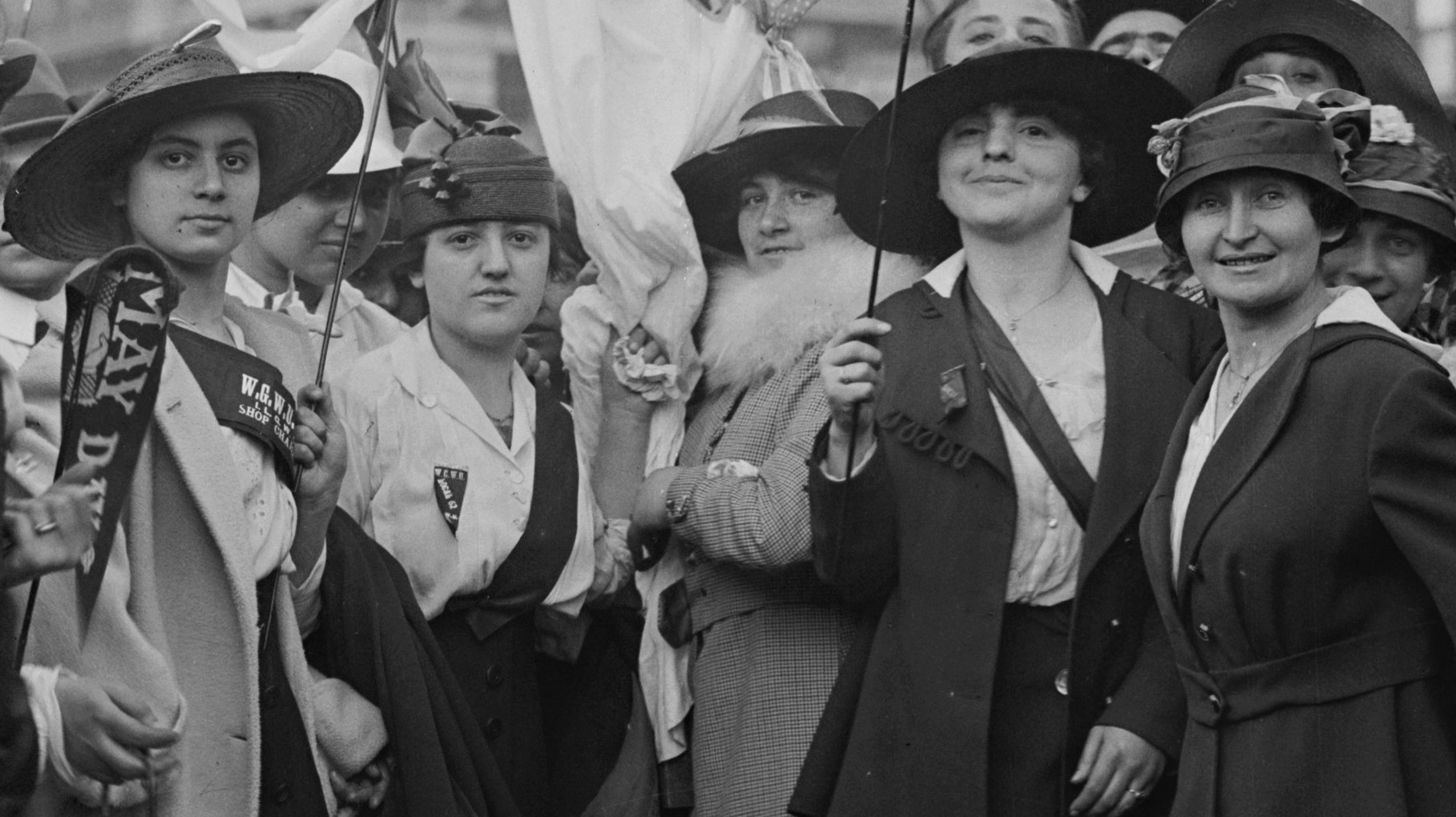
If you have ever been on strike, you know that it can be a defining, life-changing experience. A decade after 1913’s massive garment workers’ strike in New York City and a worker remembers.
‘The White Goods Girls’ Strike’ by Jennie D. Carliph from Industrial Pioneer. Vol. 1 No. 11. March, 1923.
WELL, I don’t know if I can tell it. There is much connected with this little tale that must be felt and experienced in order that it be appreciated. However, in the year 1913, February 21st, a call to strike was issued by the White Goods Workers’ union in New York City.
There had been talk of a strike for some time, and mass meetings had been held for that purpose, and the day was set and strike called. The New York Call, socialist daily at the time, assured all who wanted to believe that there would be pickets lined up on the streets leading to the dry goods centers, intercepting workers who attempted to go to work in the white goods factories.
The factory I worked in was located in the Masonic Temple building on West 23d street, one of the busiest streets and thoroughfares of the city of New York. On the morning of the strike, I walked leisurely from the subway to the factory, a willing subject, ready to be caught and held.
But, to my chagrin, nobody apprehended me, and so I reached “my” factory without halt or hindrance in the anticipation that a committee would call during the morning and “take us down.” My hopes later proved in vain. No committee came that day.
A Mean Winter’s Day
The next day was a mean winter’s day, and feeling too sick both physically and at heart, I did not go to work that morning. Being too impatient to stay at home, I went to work that afternoon again, and on arriving was told by the girls that the boss said that a committee of strikers was there, waving a red cloth; that a few of the girls fainted, and that the committee was put out by the boss. The girls did not see that committee themselves, but the boss had told them so. With all that, this was an excuse for the boss to place plug uglies at the door and to take “his” girls home under guard. Well, that was the limit. I could work in that place no longer; so I went on strike with one other girl, whose father was a union man all his life long, and would not let her scab. It was now impossible to take any of the other girls along as the boss, foreman and family, kept the closest watch and sent the girls home in small batches earlier to avoid any possible chance of contact with any inflammatory strike material that might be smouldering in that factory.
As for me, I had been watching the preparations for the strike and even attended some of the meetings, but, having some knowledge of the “labor leading” gentry in charge of the arrangements, I had no desire to take part in their activities but expected that when the strike was called the union would “pull” our shop too and so I would go along with them. In the meantime, I talked to some of the girls and prepared them as much as possible for the event. The few that I could speak to promised to join the strike. Some of them said they would come out, “if the rest of the girls came out.”
A Lone Striker
But the alleged call of the strike committee killed all prospects of the girls going out on strike and the one girl who came out with me left for Philadelphia on a visit to her well-to-do relatives. And so I was alone on strike in a factory of 150 girls. The situation was getting grave, and I decided to go up to the union and see the leaders. Mr. Shorr, the strike leader, was a very busy person. First of all his newly-apportioned office had to be set in order. Desks were being put in and doors and gates made. However, I finally succeeded in explaining the situation. Here was a factory centrally located, doing a fine line of work and employing 150 girls at that time. What would the union do about it? Why had it not been pulled out before this? Mr. Shorr promised to send up a committee and “pull the shop.” There were other white goods shops in that building and none of them were on strike.
Well, to make it brief, nothing was done by the union. They had a few shops tied up and that was all they seemed to care about. However, they advised me to go up to the Woman’s Trade Union League. I knew what I could expect from the dear ladies, but went and spoke to Miss Rose Schneiderman. She, too, was very busy, and after pestering her for some time she finally told me she could do nothing, as the place was policed and they could not get in.
Fortunately, my boss had joined the boss’ association and I knew then, that if the strike should be won our shop would be included. So I abandoned my own shop and went on the picket line with some of the girls I knew in other struck factories. My boss, frightened at the two girls going out on strike, and, perhaps, expecting that many more would join us, became a member of the boss’ association.
The Picket Line
The picket line was a study in itself. Workers who are accustomed to strikes by men perhaps know little about heroic deeds by mere girls. Arrests and jails in freezing weather, on the picket line, with bare heads and no gloves on their hands, is only part of the picture.
Such was the condition of affairs as I found them on the picket line. I was well or warmly clad myself; but most of the rest of them were scantily clad and frozen numb. Police were lined up on the sidewalks and the girls were only permitted to walk up and down, and any slip on their part meant certain arrest. Some of them had already pelted the police and the scabs with some unpleasant objects and had been imprisoned and fined for it. And a close watch by the police was now kept.
I left the picket line and went home to get some warm coverings for the most needy girls. Brought them some gloves, shawls and caps, anything I could lay hands on that might help to keep the cold out. I went on the picket line day after day at the various factories. The strike lasted about five weeks and was finally settled.
Terms of Settlement
The girls were to receive a dollar a week increase in pay and they were to have a 54-hour week. The gains were trivial, and what is more the conditions agreed upon were not strictly and fully observed. Repeatedly did I go to the union, telling them that the dollar promised was not given to all the girls, and that some of the girls were obliged to work later than the union hours on Saturday afternoon, but to no avail. The “leader” was seen in the office of the boss, and whether it was true or not that he “carried packages out from the office,” I don’t know, but nothing was done for the workers. Finally, the two girls who struck were found fault with and fired, and our protests to the union and a mock trial of the boss, because of his violation of the agreement, resulted in only the re-instating one of us and that without pay, for time lost; which the girl thus favored, refused to accept and left the shop for good and aye.
In order to understand conditions in a large city and a modern factory, one must take into consideration the peculiar arrangements of a large city that confront one, its peculiar topography as well, We girls who worked in that factory on the ninth floor on the corner of 23d street and 6th avenue, lived miles out of town. So far as I was concerned, I knew but one address of the girls in the entire factory, and that girls I visited many times in my efforts to induce her to join the strike, but to no avail. All she would tell me was, “What’s the use of my coming out, when the rest of the girls will remain working?” and that was true. There was no use expecting that she would be out of wages for as long as the strike would last the same as I was. There was no help from the union. The officials were busy lining up members, collecting dues and sending out appeals for funds. But, contrary to all A. F. of L. statements, they paid no strike benefits.
The union office on the corner of Second avenue and First street grew and prospered. It became a regular office, with rooms and doors and gates, and to approach the officials was no more an easy matter. Well, the strike was at an end, and the agreement signed between the union and the boss’ association, and we were to go back to work.
I went to see the girl who had left for Philadelphia, and found that she had come back that Sunday and was ready to go to work. Monday, the last of the strikers were to return to the factories. And we, too, returned.
A Triumphant Return
For all the anguish and suffering and disappointment we passed through during the long and tortuous weeks of the strike, there was one compensation in store for us, and that was the return to work as winners Little as that winning was worth, it was a victory just the same. It was a gain; something wrenched from the bosses; something they hated to give us. Not the one dollar increase, not the shorter day; each of us individually might have gained that much. But it was the power to force them to do something, that galled them. It’s that puny little victory, to come back as winners, that they begrudged us. And that was the only hour of my life. It was glory to me.
Can you picture my little, undersized foreman Jesse, to himself the greatest person in creation, and the brother of a member of one of the finest ladies’ lingerie and silk underwear houses in the country and the bully of the shop, standing in a side room and calling me in, to ask me if I spoke to Mr. H., of B. & H., if I can come back to work. He was shaking from head to foot when I told him that I did not ask anybody to come back, that Lina and I have come back because Mr. H. had signed the agreement as a member of the boss’ association. I said: “Did he not?” and he said “I did.” I told him that if that is the case, it was all the better, so he knew that the strike was settled and that the girls had won. And in the factory, the little painted blond who scabbed in my place, on seeing me, slunk back to her own corner at the next table and my place as head worker of my department and my table, were again in my domain as before the strike.
A Victim of Class War
As stated above, they got the best of me in the end. My summer’s vacation with pay was cut off. My former hours were actually increased, as now I made it my business to live up to union conditions and come to work in the morning on time and not an hour later as I used to come to work before the strike; and get paid for it, too. And before I knew it, the bosses discovered that they were paying me too high wages: that they could not afford and on that account discharged me. This was a violation of the agreement with the union and I brought pressure to bear that the boss be tried and he was tried with the already mentioned results. I lost my job because of the strike and that was all I gained. But it was all worth while. There was but a little fight and it was poorly done, but when the material is taken into consideration, i.e., poor basic principles, non-class conscious young working girls and weak, incapable leadership, not to say dishonest, the gains were worth the efforts. Given correct principles, competent leadership, a class-conscious spirit, and infallible industrial union organization, coupled with a vision of a future society and the deductions must be clear to any who are willing to see—a world won for the workers, and a sacrifice that every member of our class must be proud to make.
The Industrial Pioneer was published monthly in Chicago by the Industrial Workers of the World from 1921 to 1926. The precursor of the Industrial Pioneer was the One Big Union Monthly. Heavily illustrated, the journal included arts, prose, and poetry along with historical articles and analysis.
Full issue PDF: https://www.marxists.org/history/usa/pubs/industrial-pioneer/Industrial%20Pioneer%20(March%201924).pdf
 Revolution's Newsstand