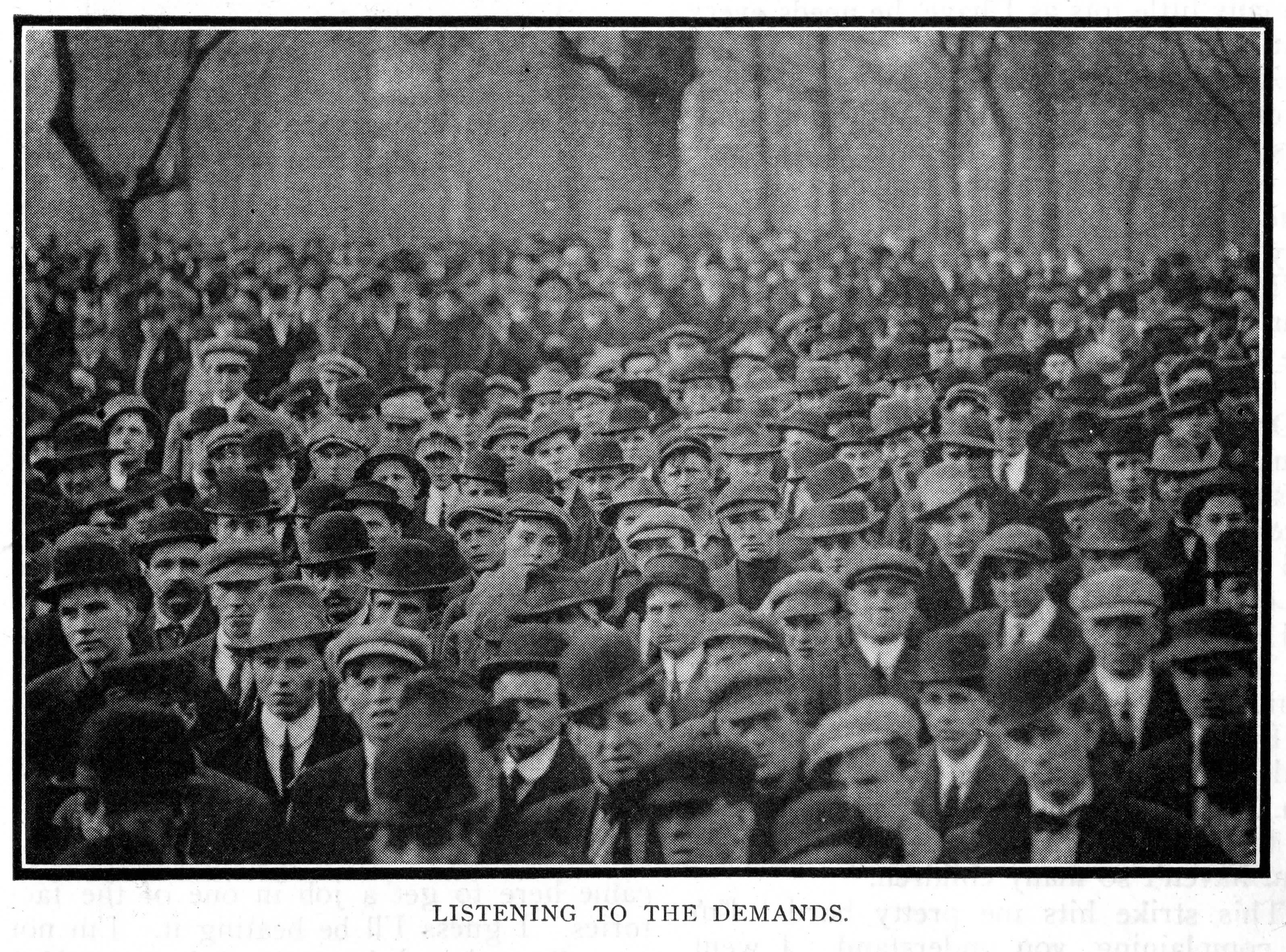
Haywood’s speech to thousands of Akron rubber workers during the ultimately failing struggle of 1913. It would be over two decades until the union won in Akron.
‘To the Akron Rubber Strikers’ by William D. Haywood from Solidarity. Vol. 4 No. 12. March 15, 1913.
The Akron Times” reported a recent speech of William D. Haywood’s to the striking rubber workers of that city, Haywood said in part:
I hardly knew whether or not to stop off in Akron. I had read in the papers that there were only about 200 workers on strike in this city. Judging by this tremendous crowd there is a strike on in Akron, and it is a strike of determined men and women, who have made up their minds to get better conditions for themselves, not next year, but today. This is the thing that you have announced to your bosses, and to the probe committee, to the state of Ohio, and the nation. You want an eight-hour day. Eight hours is long enough to work at any kind of work, and much too long to work in these hell boles of rubber factories. An eight-hour day is the chief object of this strike. You are demanding better pay. Yes. Why? Because you cannot live decently on the wages you are now receiving. Out here in the hills the rubber barons are building mansions, such as kings and queens were never allowed to live in. And they are building these mansions, not out of rubber, but out of the blood and sinew of you men and women. They are building these mansions at the expense of your children.
Every pound of rubber that is manufactured in these factories is soaked in blood from the time that it is gathered in the forests of Congo and Pera until the finished tires run over the innocent child in the street. Blood from the beginning to the very end. Workingmen, do you realize that in the process of gathering rubber slaves have been gotten together and a task imposed upon them. They must” bring to the warehouse a certain amount of rubber every day, and in the event of their failure to bring this amount they punish these men and women who work in the rubber forests. They do not imprison them; they do not impose a fine, but the rubber barons, through their agents, direct the tools to cut off the hands of the children of the rubber gatherers. They cut the feet off the children, making them permanent cripples, because they do not gather enough rubber.
The unspeakable King Leopold, now dead, but no less a scoundrel, because he is dead, was one of the side partners of Ryan of New York, who is directly interested with other kings here in Akron, Ohio. And this condition prevails to degree in the rubber factories. If you don’t do exactly as the rubber barons wish you to do, they deprive you of a living. They do not take off the hands of your child, but they do what is just as bad. They will take the food out of your child’s stomach. You must be a slave and you must turn out the amount of work or you and your family are denied the right to eat. And to bring this thing about they do not have human butchers. They have soul butchers. They work in the shape of spies. The factories are honeycombed with spies.
You are slaves, wage slaves of the rubber trust, simply because you have not been organized. Individually they are able to put their brand on you. But from now on there is a different story to be told. You will say to the rubber masters:
“We are free men and women. You have always asserted that labor and capital should go hand in hand. We denied it and you have belied it, because labor never went anywhere with capital, but what the capitalist bad his talons sunk deep into labor’s throat. Now, Mr. Rubber Baron, our day has come. This is our day. You can no more make rubber than you can tell the truth. You own the factories, we will admit that for argument’s sake, but we own the muscle and the brain, which turn all the wheels of industry. When we left your factories for a good and sufficient reason, every factory stopped running. There is nothing that can make them run, until we go back and put our hands to the wheel.”
Now, fellow workers, this is not an American strike This is not an Italian strike. This is a rubber workers’ strike, that includes every nationality and everyone in the factories. This is what the I.W.W. means in the way of organization. Organize them all and bring them all together into one big union. With the I.W.W. you can lick all the bosses in Akron, if you stay together. The organization of them all is the machine that means eight hours, the machine that means better pay, the machine that put down the American woolen trust in Massachusetts. We had 27 nationalities there. Now if we can whip the American woolen trust, we can whip the rubber trust.
The most widely read of I.W.W. newspapers, Solidarity was published by the Industrial Workers of the World from 1909 until 1917. First produced in New Castle, Pennsylvania, and born during the McKees Rocks strike, Solidarity later moved to Cleveland, Ohio until 1917 then spent its last months in Chicago. With a circulation of around 12,000 and a readership many times that, Solidarity was instrumental in defining the Wobbly world-view at the height of their influence in the working class. It was edited over its life by A.M. Stirton, H.A. Goff, Ben H. Williams, Ralph Chaplin who also provided much of the paper’s color, and others. Like nearly all the left press it fell victim to federal repression in 1917.
PDF of full issue: https://www.marxists.org/history/usa/pubs/solidarity-iww/1913/v04n12-w168-mar-15-1913-solidarity.pdf

