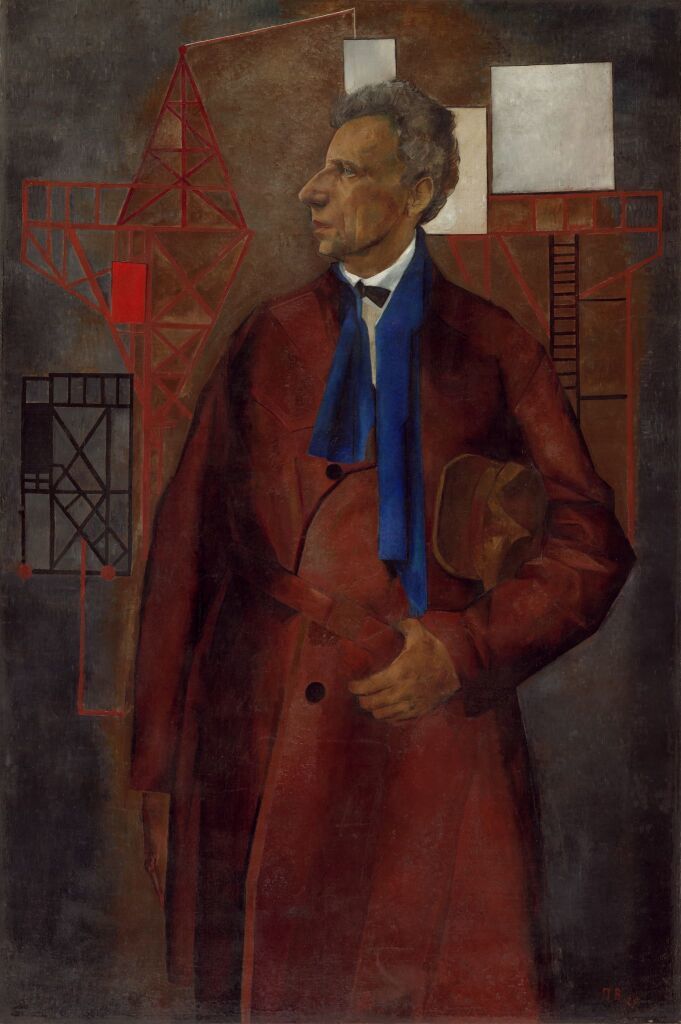
Kennell, who spent several years in Soviet Russia writing mainly on its theater, with a look at what sounds like an extraordinary experience: Meyerhold’s 1926 production of the anti-imperialist play ‘Roar China!’. Vsevolod Meyerhold was, both before and after 1917, the central figure in a crowded room of Russian theater arts and an international pioneer of many elements of modern theater, a number of which are still very much in the vanguard as Meyerhold’s ethos sought to break down barriers between audience and performance. Though world-renown, the Meyerhold Theatre and Meyehhold himself would be victims of the purges. The theater was closed by order of the Politburo in January, 1938 as ‘Socialist Realism’ became the sanctioned artistic genre. And in 1939, Vsevolod Meyerhold, one of the great artists of the 20th century, was arrested on the ludicrous charge of being a ‘British and Japanese spy’ and shot on February 2, 1940.
‘The Meierhold Theater in Moscow’ by Ruth Epperson Kennell from The Daily Worker Magazine. Vol. 3 No. 216. September 25, 1926.
FOR contrast with the old literary forms of the conventional written drama, we turn to the Meierhold theaters, where an entirely new theatrical art is in process of development. The avowed purpose of the director, Meierhold, is to make the theater a living part of the people’s lives; not to produce the literary works of men of letters, but to be a dramatic chronicle and interpreter of social events. Art has only an incidental value in the social purpose of the theater. Therefore the plays produced here are not printed dramas, read by the public—they are simply events which live on the stage and which in many cases have only a temporary interest. Striving to satisfy that need which is driving the people of the west from the theater to the cinema, Meierhold employs the devices of film art on the stage. His theaters are in theatrical circles what the Communist Party is in political circles—agitator for and constructor of a new society.
During the celebration of the twentieth anniversary of the 1905 Revolution in January the Theater of the Revolution presented a play, “The Barometer Indicates a Storm,” which vividly depicted scenes from that bloody period. The Meierhold staging was particularly effective for this subject: the great curtainless stage and on it plain wooden walls with steps leading above, which could be anything from a factory to a railway station, and contained within their mysterious depths interiors of the winter palace, offices, meeting halls and other scenes disclosed when a section of the wall opened, or when a set came rolling out on a platform with the actors placed for action.
Such devices, including a screen on which were flashed stirring slogans and photographs of the heroes, made possible the rapidly shifting scenes and swift action essential to the reproduction of 1905 events. The incident of Bloody Sunday was made a living reality again. The workers, led by the Priest Gapon, carrying ikons and portraits of the czar and singing hymns, passed across the stage on their way to the winter palace. A moment later sounded the rattle of machine guns and the people came running back, only to fall dead or, wounded, to be lifted and carried away by their comrades. At last, the terrifying rattle of the machine guns gave way to the sprightly music of a military band. Then followed the futile deputation of the czar, the removal of the senile old general from his post, the forming of the Petersburg Soviet, a stirring meeting of the central committee at which Trotsky was chairman, and as a climax the arrest of the central committee, who sang the International as they were led away. The production was viewed by tens of thousands of Moscow workers.
***
AT the Meierhold in January appeared a new play which is decidedly the most artistic Its ingenious director has produced. If one marvels at the mechanical construction of the Meierhold stage, at the rapidly shifting scenes and the acrobatic feats of the actors, at the combination of motion picture technique with the spoken drama and the profligate use of the spotlight (which is sometimes indiscriminately directed at the audience as we’ll as the actors, in characterize disregard of the former’s comfort), one feels that here is an art as yet in its experimental stage. But in “Roar, China!” there is a toning down and discriminate use of all these elements to create something beautiful. The one set used throughout—that of a British battleship at dock in a Chinese river port, with a body of real water lying between the dock and the steamer—lends itself admirably to the changing action which in one scene Is on board the ship and in the next on the dock (effected by the transfer of light from the front to the back of the stage), making possible a striking contrast between the degenerate rich foreigners on the deck and the Chinese workers on the dock. The scenes with the Chinese are poetically realistic, catching the sympathetic natures of the people, but on board the steamer Meierhold’s usual exaggerated burlesque of bourgeois society expressed is jazz and the fox trot, vulgar display and senseless chatter, strikes a jarring note, for it is not possible to contrast realism with burlesque.
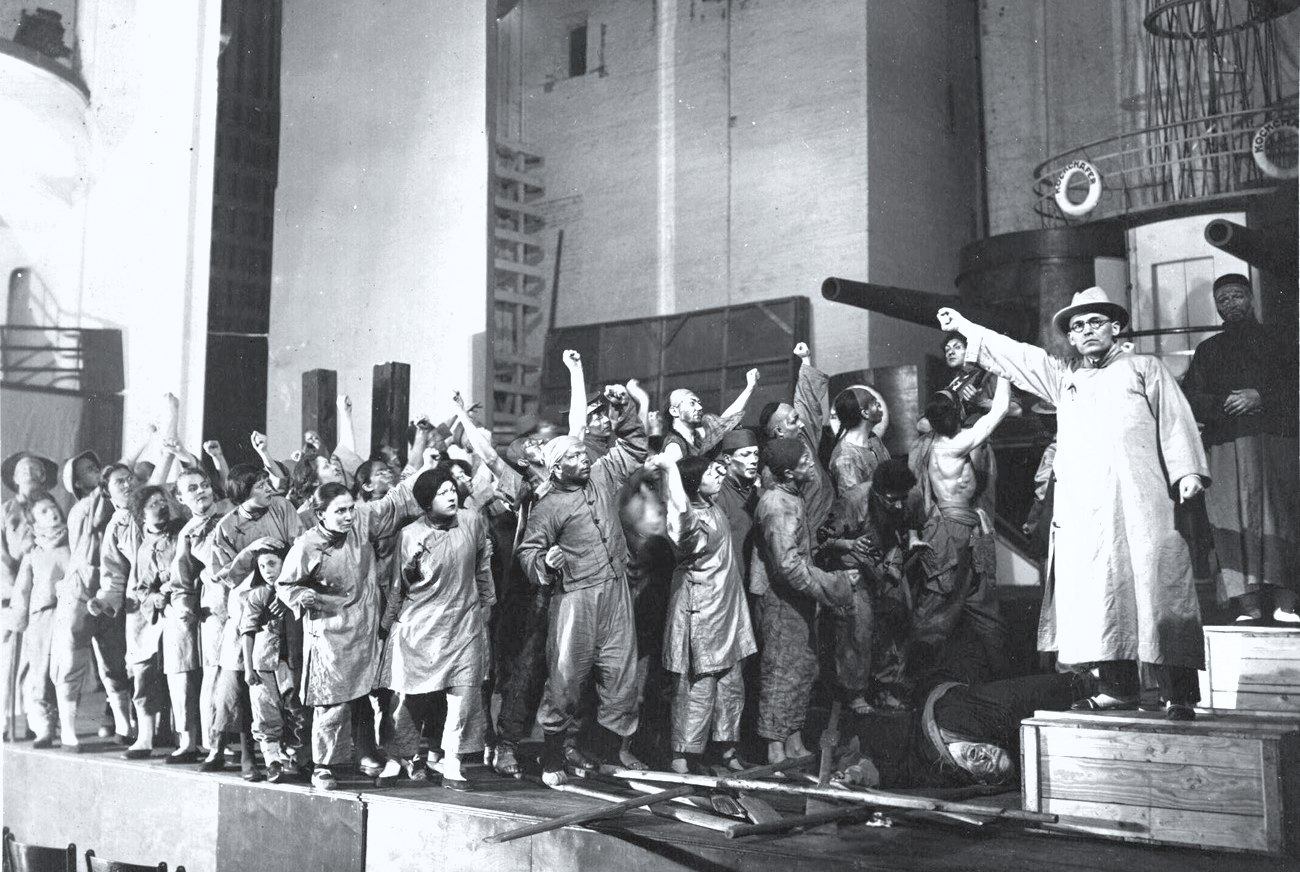
A British battleship is unloading its cargo, which is in charge of an energetic American. The coolies, directed by a cringing Chinese foreman, are carrying the heavy bundles on their backs, in an endless procession of bent, straining bodies. A strange jargon rises as they speak in their own tongue. The foreman drones out his orders, the workers take up the cry and make it into a song, and in rhythmic motion they move the heavy machines. Finally the dock is cleared and the perspiring laborers are ready for their pay. But the American haggles with them, finally refusing their demands, and in scorn tosses them a few coins.
On deck, the fat lady and her extravagantly dressed daughter are trying to amuse themselves. The orchestra, in queer Scotch kilts, is playing above and the girl and her mother dance with the American and young officer; glasses clink and champagne flows—in short, a typical Meierhold scene. Thru the doors leading to the deck slips a white-clad figure, the little Chinese cabin boy, with a face like a flower. Across the water, off stage, shouting is heard: it is the rising murmur of the discontented workers. The cabin boy is called upon to interpret it: the dock laborers demand more money; they threaten. The officer draws his revolver, and the cabin boy falls on his knees and begs him not to shoot his people.
It is night and the ship looms up in the shadows. The American is on the dock bargaining with an old boatman to take him across the narrow stretch of water. On the docks are lounging several of the disgruntled workers, who watch the altercations with sympathetic interest. The American refuses the boatman’s price. The boatman, in turn, sits on his airs and refuses to move. The American attacks him, the boatman lifts his oar; there is a struggle, a splash, and darkness hides the scene. A little later the workmen fish out of the water the American’s funny panama hat and laugh at it. The alarm la sounded—the American has been drowned. The crowd grows, the Chinese police appear and the boatman escapee in the crowd. A long, still form wrapped in a sheet is carried in. The terror-stricken people try to creep away, but are held back by the British marines, who have quietly assumed command of the town The mayor of the town comes on board the ship with his interpreter, a Chinese student, to offer regrets and apologies for the accident. The captain will accept no apologies; moral recompense must be made for this outrage to the British flag. “But he is an American,” suggests the student.
It is all the same,” replies the captain, “he is ours.” He demands that two of the dock laborers be executed in punishment for the murder; if this demand is not accined to by nine o’clock the next morning the ship’s guns will be turned on the city.
Again the wailing siren call which heralds each scene–the dark, curtainless stage grows light. The workers are sitting about eating bowls of rice Street fakers, peddlers, beggars and opium vendors pass to and fro. An old peddler, his wares dangling, comes down into the audience. The student appears with the terrible news: two of them must die. But why? They have committed no crime. And which two? They try to hide from one another, to escape. The student resolves to send a telegram to Shanghai for help, but two marines bar the way. Meantime, the foreigners in the town are taking refuge on the steamer and all is being prepared for the bombardment.
Once more the mayor and his interpreter board the ship, bringing a rich silk robe as a present. The robe is accepted, but their efforts at conciliation fail. As the dawn approaches the white figure of the cabin boy appears on the forecastle. He is singing a plaintive, almost inaudible lament, while adjusting a rope about his neck. With a sigh he slips over the railing and hangs lifeless before the door of the cabin. But his sacrifice is in vain.
The workers on the dock finally decides to draw straws. The two selected for the sacrifice by this agonising method are a young man and old man. The young man has a wife and child whom he cannot bear to leave, and life seems just as sweet to the old man.
With all the ceremony of a religious rite the executions take place on the dock next morning. All the foreigners are there, including three sisters from the mission, an English clergyman, an American girl in smart knickerbockers and a tourist with his camera ready to take the most harrowing scenes. The wife comes with her child to plead for mercy. “Tell her to ask God for help,” suggests the captain. “I will not tell her,” replies the student, but as if she understood, the woman tears from her neck the crucifix which she received at the mission and tramples it on the ground. The stocks are removed from the necks of the prisoners, who make a last effort to escape. Then calmness comes at last and they submit to being tied to the posts; covers are drawn over their heads, mercifully hiding their faces. When the grewsome details are carried out to the end, the mood of the Chinese workers begins to change. A subdued roar rises. At this moment, a telegram is brought to the captain–summoning his ship to Shanghai, where an uprising has taken place. With drawn revolvers, the captain and his crew back off the stage followed by the workers, who brandish their oars threateningly.
The Saturday Supplement, later changed to a Sunday Supplement, of the Daily Worker was a place for longer articles with debate, international focus, literature, and documents presented. The Daily Worker began in 1924 and was published in New York City by the Communist Party US and its predecessor organizations. Among the most long-lasting and important left publications in US history, it had a circulation of 35,000 at its peak. The Daily Worker came from The Ohio Socialist, published by the Left Wing-dominated Socialist Party of Ohio in Cleveland from 1917 to November 1919, when it became became The Toiler, paper of the Communist Labor Party. In December 1921 the above-ground Workers Party of America merged the Toiler with the paper Workers Council to found The Worker, which became The Daily Worker beginning January 13, 1924.
PDF of full issue: https://www.marxists.org/history/usa/pubs/dailyworker/1926/1926-ny/v03-n216-supplement-sep-25-1926-DW-LOC.pdf
 Revolution's Newsstand