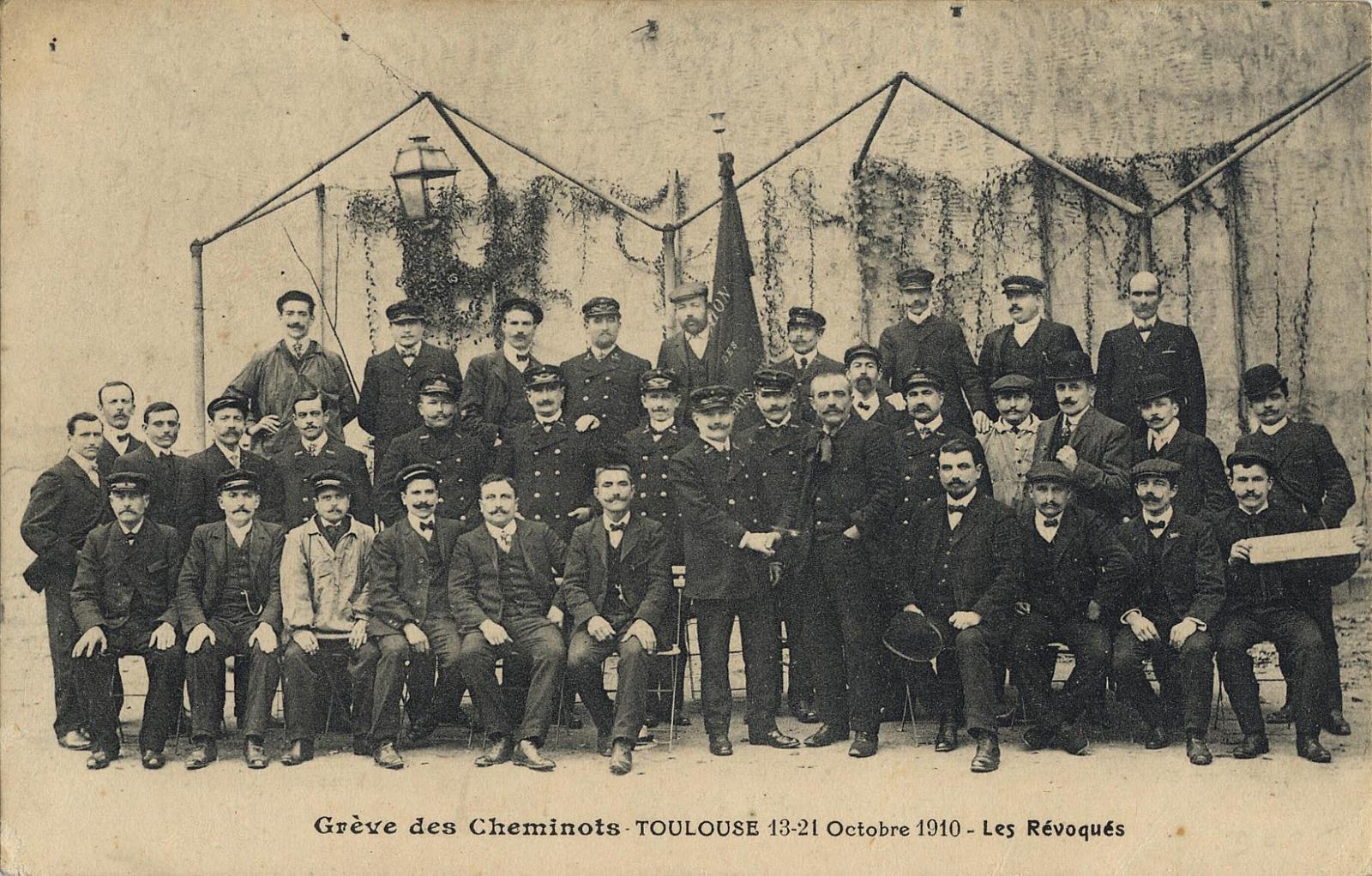
Just preceding the massive rail strike of 1910, the “grève de la thune,” the convention of the Confédération Générale du Travail saw the revolutionary element win victory after victory. Foster with the details.
‘The Conference of the Confédération Générale du Travail’ by William Z. Foster from Industrial Worker. Vol. 2 No. 33. November 2, 1910.
Hartwell S. Shippy,
Toulouse, Oct. 10, 1910.
Fellow Worker and Friend.
The 17th National Co-Operation Congress (11th of the C.G.L.) opened Monday, October 3d, to the strains of “The International.”
There were about 500 delegates present, representing a total membership of 354,000. In addition to these there were three foreign delegates–Lassenbach, representing the general commission of the German unions and Appleton and Gee, representing the Federal Trades Unions of Great Britain. Before proceeding to the regular order of business, the foreign delegates were accorded the floor. Appleton, the British delegate, brought the usual greetings and wishes for greater international solidarity. Lassenbach, on behalf of the German Unions, invited the C.G.T. to send a delegation to Germany to participate in the monster meetings to be organized there during the coming year. Later the congress accepted the invitation and instructed the Confederal Committee to correspond with the Germans in regard to the matter. After these preliminaries were disposed of the matter of admitting the press representatives to the congress came up for consideration, and after much discussion it was decided to admit all except those representing four of the leading capitalist dailies of Paris. This was intended as a rebuke to the latter, for their anti-working class attitude.
This step provoked many sneers from the excluded papers, who laid their troubles at the doors of the revolutionary element. They gloatingly anticipated being revenged, however, as they believed and hoped that the reformist element in the congress would prove strong enough to balk some of the most cherished projects of the revolutionists. They encouraged the political element to hinder the direct action element as much as possible and, figuratively speaking, stood by with mouths watering waiting for the choice morsel of the C.G.T. Congress split by dissensions.
After the exclusion of the press representatives an amusing incident occurred. The Toulouse section of the Radical Socialist Party sent a letter of welcome to the congress, but amid a tumult of jeers it was tabled without reading.
The trouble between the two contending factions of reformists and revolutionists started early to manifest itself. The verification of credentials offered the excuse, as there were many contested delegates.
The reformist element wished the admission of the delegates of the many more or less yellow unions that had failed to fulfil the obligations that would have entitled them to representation at the congress, while the revolutionary element wished to pursue a rigorous course of exclusion for all delinquents. The case of the delegates of the Cooks’ Union of Paris was the most bitterly fought. For several hours confusion reigned supreme, with business at a standstill. The meeting escaped from the President’s control entirely—a hundred men were singing “The International” and for a time it looked as though the prophecies of the capitalist papers would come true–the C.G.T. Congress could not transact any business because of the two contending factions of reformists and revolutionists, or of the politicalists and direct actionists, or of Socialists and Anarchists (take your choice). Finally after threatening to suspend the session the President secured what people of a Latin race might consider a semblance of order and the delegates of the Cooks’ Union were refused seats.
Many other similar struggles occurred during the two days that were devoted to the verification of credentials, but the issue was always favorable to the direct actionists. In all 18 Syndicates and the Bourse du Travail of Nice were excluded.
Though somewhat chastened by the defeats suffered by them, the reformists rallied strong under the next order of business. Reports of committees and commissions, and they tried to discredit the so-called “Anarchist” administration of the C.G.T. The matter on which they counted most was the Levy-Grifluelhes controversy.
The Bourse du Travail at Paris is owned by the government and is loaned to the various labor organizations in order that they may have a place in which to air their grievances. Several years ago the C.G.T. bureau, because of its anti-governmental activities was, as an organization, expelled from the building. However its syndicates or unions still have the privilege of holding meetings there. This step forced the C.G.T. to secure new headquarters, but as the government intimidated landlords into refusing to either sell or rent to the organization this proved a difficult task. In this crisis the commission in charge of the matter took to acting secretly, and, although accepting funds from the organization, refused to render an account of what had been accomplished. Finally, by deceiving a landlord as to the nature of the business they were going to establish, the commission secured a location and the headquarters of the C.G.T. was established.
The airing of this matter was expected to furnish excellent material for the reformists to work upon, but they were disappointed, as Griffuelhes, the man most responsible for the tactics pursued, in a three hours’ speech so clearly explained the necessity for taking the course that had been taken that his action was indorsed almost unanimously, after 12 hours’ discussion: The “Moral” report, or report of progress and activities of the Confederal committee, was the next excuse for a struggle. Liorhon refused to vote for it because the committee is Anarchist, anti-militarist and everything but simply syndicalist. His speech caused a fresh outbreak of disorder, and after about a dozen speakers had argued the matter pro and con, Niel, ex-secretary of the C.G.T., mounted the platform.
Neil was formerly a revolutionist of the same stamp as Yvetot, Jouhaux, etc., but of late years he has become more reactionary and is commonly referred to as a leader of the reform element. In a brilliant three-hour talk that was listened to with rapt attention Neil laid bare the workings of the Confederal committee from his point of view, and accused its members of having made life so miserable for him as reformist secretary of the C.G.T. that he had to resign. He said that for the present Confederal committee, Anarchism and Syndicalism are synonyms. His attacks were largely directed against Yvetot, who is a sort of devil to the reformists, as they usually blame the wayward course of the C.G.T. upon him.
Although it was long past the usual time for adjournment when Neil finished speaking, Yvetot asked for five minutes in which to reply to him. He talked for an hour, however. Yvetot unmercifully scored the parliamentarians and said it is not his fault if Anarchism and Syndicalism have the same end in view. He described the state as an arch enemy of the working class and said it is one of the first duties of a Syndicalist to be an anti-statist. Neil writhed beneath Yvetot’s eloquence and interrupted him with: “Since you are opposed to the state, have at least the courage to say so in your statutes.” Yvetot answered by saying that as yet in the class war we must be hypocrites; that the workers must first be organized for immediate benefits and to educate afterward. When this is accomplished then it will be possible to wage the struggle openly. He explained many of the seeming presentations of Neil and attributed the latter’s downfall to his unfortunate tactics in the Postal strike. Yvetot descended from the platform amidst vociferous applause.
The editorial policy of La Voix du Peuple–the official organ of the C.G.T.—was also strongly criticized by the reformists, who claimed in effect that the paper was simply an anti-militarist sheet. Of course, the direct actionists made ready rejoinders and argued the great necessity for anti-militarist propaganda.
The question of the adoption of the report (Confederal Moral) was a true test of the strength of the two contending factions. The report was adopted by a vote of 1087-97. Thus did the C. G. T. Congress indorse the so-called “anarchist” tactics of the Confederal committee. The question of the fusion of the Federation of Machinists with the Federation of Metal Workers was the next matter acted upon. The machinists’ delegates strenuously protested against the proposed fusion and urged all the principal scab arguments for craft autonomy. Failing to convince the congress by these he took to begging for “liberty” for his organization, but the so-called impractical “anarchists” were in no mood to listen to his entreaties and the Federation of Machinists will be required to fuse with the Metal Workers if it desires to remain a part of the C.G.T.
By Friday noon the Congress had finished with but two orders of business and as five still remained to be considered it was feared by many that they could not all be dealt with fully. However, the Congress had voted so strongly revolutionist in the preceding fights that the opposition was considerably lessened and it was able to transact business a little more rapidly.
At the opening of the afternoon session a telegram from Gompers was read, in which he regretted that the A. F. of L. hadn’t been notified in sufficient time to send a delegate to the Congress. After the reading of this telegram the important matter of old age pensions became the order of business. A short history of the old age pension question in France a necessary in order that the average American reader can understand the situation. Realizing that the burdens of the working class are becoming so heavy as to render the more militant workers desperate and to drive them into effective labor organizations of distinctly anti-governmental tendencies and tactics, the French capitalists, through their government, have decided to throw the working class a sop in the shape of pseudo old age pensions. The scheme is aimed not only to lull the workers into a feeling of false security for their old age, but also to stimulate them into securing more “reforms” through political activity. The English and German working classes have been so successfully stung in this manner that it must needs try it in France. Therefore an old age pension law was enacted. While the law was pending passage the C.G.T. waged a vigorous campaign against it, but in vain, the “friends” of the working class would have their way. The law goes into effect in July, 1911. The provisions of the law are substantially as follows: The worker who is so fortunate as to reach the age of 65 years will be entitled to a pension of 6 cents a day for the balance of, his or her life, provided that for 30 years he or she has paid the required assessments. These assessments are 9 francs (about $1.76) per year for men, 6 francs (about $1.17) per year for women and 4 francs (about 88c) per year for minors over 18 years of age. To make the scheme more palpable to the workers the law also provides that the employers pay the same rate for each worker employed and that the government also contribute a sum equal to one-half of that taxed from the employers. The whole sum to be put in one fund and loaned out at a moderate rate of interest.
It has been calculated that if the French working class can be hoaxed into paying its share of the tax that at the end of the thirty years that must elapse before any pensions have matured a sum of twelve billion francs will have been accumulated. What a tidy sum to borrow at “a moderate rate of interest” to speculate with or if needs be to wage a war with.
In the face of the general demand for some kind of old age pensions and this miserable makeshift of a law, the C.G.T. Congress found itself in a rather ticklish situation. As one speaker put it, it would be well to consider the law thoroughly before rejecting it, because if they refused to accept the law it would be said that the C.G.T. would take the bread from the hands of old worn-out workers. The discussion of the matter was lengthy; all the speakers agreed, however, that the law was a very poor one and the general expression was in favor of a law, if there must be a law on the subject, that would avoid the 30 year capitalization feature, one that would entitle the present superannuated workers to the assessments paid by the present generation of active workers instead of forcing the workers to pay in this active working period the actual sums from which he was later to draw his pension.
As usual the congress divided on the matter, the politicians wishing to accept the law and the revolutionists to reject it entirely. Once again Niel, the ex-secretary of the C.G.T., took the platform and urged the acceptance of the law, imperfect as it is, in lieu of a better one. He said “the millions of French workers want old age pensions and if the C.G.T. refuses to aid in securing them they will say the C.G.T. is not our organization.” In spite of Neil’s warning the revolutionary element condemned the law entirely, Yoctot, Jouhaux and others characterizing it as simply a gigantic fake. Two propositions were placed before the Congress, one by Neil to accept the law under protest and the other by Jouhaux (secretary of Confederal Committee) to refuse it absolutely and to call on the workers to hinder the collection of the assessments by every means in their power. The result showed a vote of 1001 for the Jouhaux proposition and 251 for the Neil proposition. The C.G.T. has again flung the gage of battle to the government.
At present the government is considering the proposition of passing an obligatory arbitration act, with the usual decoration of penalties for unions that dare to go on strike without having first secured permission and for unions that dare to break contracts forced upon it by an unfair board of arbitration. The discussion on this matter threatening to consume too much time, the Congress referred it to committee. This committee brought in a report condemning all such legislation root and branch and urging the workers to resist as strongly as possible any attempt to force arbitration upon them. Report adopted by a vote of 1229-11. The reform element had given up in despair.
The matter of accidents to workers was the next order of business. It didn’t provoke a great deal of discussion, as the time for adjournment was close at hand. It was decided to agitate against the unfairness of the judges who decide damage suits and to insist on the enforcement of the present laws for the protection of workers which are being “saboted” by the judges. The question of the shortening of the working day was disposed of shortly. It being decided to request the subordinate organizations of the C.G.T. to send to headquarters detail accounts of the situation in their various vicinities preparatory to beginning a vigorous campaign for an eight-hour day. Several other matters of minor importance occupied the attention of the Congress for a little while and after these were disposed of it was decided to hold the next Congress at Havre in 1911. At 6 p.m. Saturday the Congress adjourned and the delegates left the hall singing the International.
W. Z. FOSTER.
P.S. Please excuse lead pencil, as I have no pen; writing on both sides of the paper, as I have but little change and postage comes high. Owing to a peculiar combination of circumstances I have had to write just as fast as I know how, so please overlook the even worse than usual grammar and utter lack of punctuation. Cut, slash and rearrange to suit yourself. If my report isn’t as full and concise as it might be, I hope you will overlook that also, as I have been laboring under the greatest of difficulties in not speaking the language. Many questions were discussed at the congress the past history of which everybody knew but me and I have had a hell of a time digging out what little information I have about them. Am sending a copy of the dope to Solidarity. Gave Williams the same instructions as you. Regards to all.

