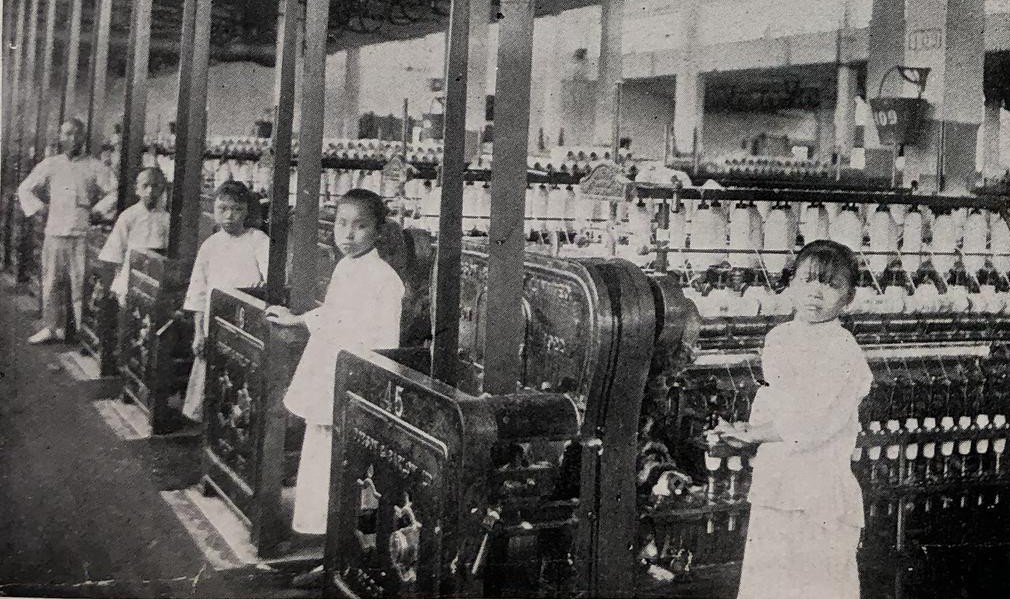
The terrible old days of work in a Shanghai textile mill producing cotton and imperialist’s profits in the 1930s as described by a woman worker in a letter to the Chinese Communist Party’s ‘The Red Flag’ newspaper.
‘The Life of the Women Workers in Shanghai’ by Amao from International Press Correspondence. Vol. 10 No. 44. September 25, 1930.
The following article, written by a woman textile worker in Shanghai, is taken from the central organ of the Communist Party of China, “The Red Flag”. It is to maintain the frightful conditions described in this article that the British Labour Government sends its warships to China. Ed.
As a result of the increased offensive of the employers, who are more and more discharging male workers and employing women and children in their place. The number of women workers engaged in the light industry in the province of Kiangsu already amounts to 70 per cent of the staffs of all the textile mills owned by native as well as foreign capitalists the adult men, and even the adult women, are being dismissed and their places taken by young girls and children. These young workers are not only cheaper objects of exploitation for the capitalists, but at the same time they are quite defenceless in face of all the tricks, chicanery and insolence of the employers and foremen.
In the textile industry the workers work twelve hours a day. The journey to and from the mill in most cases takes two hours, so that the working woman is away from home for 14 hours. As there is no break during the twelve-hour day the workers are compelled to snatch a bit of food while the machines are running. If they do not do this quickly enough they are either fined or dismissed. The greater part of the women mill workers suffer from stomach trouble as a result of the dust with which the atmosphere is laden. The employers of course never think of doing anything to change this status of affairs. When a worker is used up, he or she is simply thrown out onto the street and another engaged. Even the time allowed to go to the lavatory is strictly limited and determined by the employer.
In many textile mills, as for instance, in the weaving department of the Lau-I-Cha textile mills, even 16 to 18 hours a day are worked. The women workers in these mills, many of whom in addition have the extra burden of washing and cooking at home caring for their little children, begin work at 3 o’clock in the morning and do not knock off until 9 o’clock at night.
This terrible misery is still further increased by the rising food prices. The price of rice, for example, has risen by 60 per cent. On the other hand, wages are being cut.
In the Sen-chin, Tafun, Yun-an and Tun-I textile mills the night shift lasts from 12 o’clock Saturday night to midday Sunday. The next night shift begins at 3 o’clock in the afternoon and lasts until 3 o’clock the next morning. Any working women who during these inhumanly long hours of tiring work closes her eyes for a moment is immediately fined. Thus five working women in the Tun-I mills who at 2 o’clock in the morning nodded from sheer weariness, had 20 cents deducted from their pay. When the working women thereupon gathered in the lavatories and voiced their protest the employer demanded a whole week’s pay as fine.
In many mills the working women have not even the opportunity of warming up with hot water the cold boiled rice which they bring with them from home. Thus, for instance, the 7,000 working women employed in the Chi-Ho textile mill have to eat cold rice. In return for their long and arduous work in the mills the women receive as a highest wage 70 cents a day, and as lowest wage 10 to 20 cents per day (ten cents is worth about three halfpence at the present time.) There are very few women workers, however, who earn 60 cents a day; the average wage is 30 to 40 cents a day. The measures of exploitation and oppression adopted by the employers are becoming more shameful every day. Every newly employed woman has her photo taken, thus enabling the mill owners to keep an effective black list of any work women they wish to victimise.
As a result of the misery of the workers the mass struggles are naturally increasing daily. The employers have recognised this danger and are resorting to fresh measures of repression. Every newly employed worker must furnish a surety by owner of a shop or business, who is held responsible in the event of a fight against the capitalists or a strike on the part of the women workers. This means that the working woman is not only in the hands of the employer, but is at the same time under the control of a petty bourgeois shopkeeper of business man.
In the silk mills the working hours are over fourteen a day. Formerly, work commenced at 6 a.m., but now 4 a.m. The children who have to prepare the cocoons for the workers work even longer than the adults. They have to work the whole day in rooms full of hot, stifling steam; they already have sad and worn-out faces. The figures relating to accidents are particularly high in regard to children. Cases in which the hands or the whole body are scalded occur every day. They are often beaten by the overseers. The crying of girls is to be heard in the mills the whole day. In a mill in Ja-pe an overseer punished a girl who had not prepared the cocoons sufficiently well by throwing the hot cocoons on to her hands, thereby severely scalding them. This cruel punishment has become usual.
But the women workers of Shanghai are standing firm under the leadership of the Chinese Communist Party and of the red trade unions in order, in the revolutionary fight, to abolish this rule of the exploiters. We shall follow the example of our sisters in the Soviet Union and fight shoulder to shoulder with our brothers for the establishment of the Soviet Power in China.
International Press Correspondence, widely known as”Inprecorr” was published by the Executive Committee of the Communist International (ECCI) regularly in German and English, occasionally in many other languages, beginning in 1921 and lasting in English until 1938. Inprecorr’s role was to supply translated articles to the English-speaking press of the International from the Comintern’s different sections, as well as news and statements from the ECCI. Many ‘Daily Worker’ and ‘Communist’ articles originated in Inprecorr, and it also published articles by American comrades for use in other countries. It was published at least weekly, and often thrice weekly. A major contributor to the Communist press in the U.S., Inprecorr is an invaluable English-language source on the history of the Communist International and its sections.
PDF of full issue: https://www.marxists.org/history/international/comintern/inprecor/1930/v10n44-sep-25-1930-inprecor-Virginia.pdf
 Revolution's Newsstand