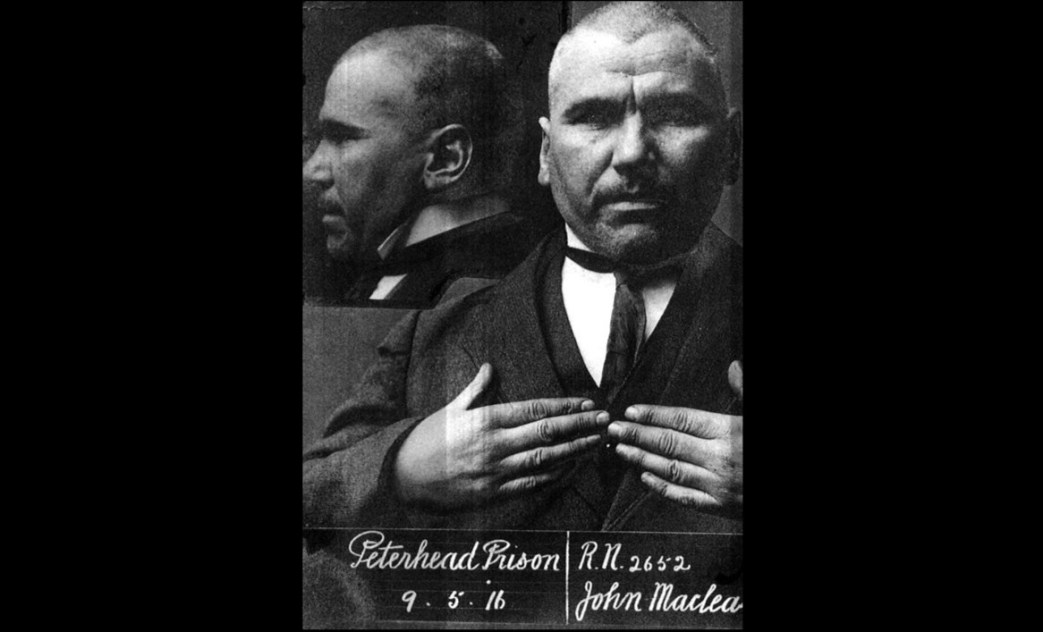
After the cataclysm of the First World War, a wave of revolutions threatened to engulf much of Europe and Asia. Maclean, here in deadly earnest, and not long from prison, was not alone in seeing the Final Conflict opening in 1919 when he made this call to fully join in the fray.
‘Now’s the Day, and Now’s the Hour’ by John Maclean from Truth (Duluth). Vol. 3 No. 9. February 28, 1919.
We are witnessing what all Marxists naturally expected, the capitalist class of the world and their governments joined together in a most vigorously active attempt to crush Bolshevism in Russia and Spartacism in Germany. Bolshevism, by the way, is Socialism triumphant, and Spartacism is Socialism in process of achieving triumph. This is the Class War on an international basis, a Class War that must and will be fought out to the logical conclusion–the extinction of capitalism everywhere.
The question for us in Britain is how we must act in playing our part in this world conflict. Some are suggesting a general strike to enforce a withdrawal of British troops from Russia and, I suppose, from Germany as well. That to some of us on the Clyde is too idealistic. Were the mass of the workers in Britain Revolutionary Socialists they would at once see that their material well-being depended on the peaceful development of Bolshevism in Russia and would in consequence strike for the withdrawal of British forces, at the moment attempting the downfall of Russian’s Social Democracy. But the workers are not generally of our way of thinking, and so are unable to see that their material interests are bound up with Bolshevists stability in Russia. It necessary follows that we will have no success in urging a strike on this issue especially as the Government has the majority of trade union leaders in the hollow of Its hand, and can easily manipulate them against us–with comparative safety to the leaders at that.
Some of us on the Clyde, therefore, think that we must adopt another line, and that is to save Russia by developing the Revolution in Britain no later than this year. We Socialists know that the capitalists can only realise their profits by selling a great part of their goods abroad. If the mass of wealth produced at home is trebled as compared with pre-war times (and that is a modest estimate) it must be quite apparent that a vastly extended market must be found abroad. We know that America is in exactly the same predicament as Britain, and we further know that America intends to assume the supreme economic position in the world that Germany has just failed to attain. If it is true, as well-informed commercial papers assert, that in 1918 America built more ship-tons than Britain we may take it that America is in a position to lick Britain in the “navy race.”
In five years’ time such will be the glut of goods on the market that fear of Revolution through unemployment and hunger may force these two Powers into war. If capitalism lasts, then, war is inevitable in five years; yes, and a war bloodier than the present one. Humanity is in a very, very tight corner, and so those who will be called on to kill in the next war have to make up their minds whether they will accept present wage-slavery with its murderous consequences or fight capitalism to death this year.
The saving of one’s life calls forth great exertion, and it must be our business to see that that exertion is scientifically directed towards Social Democracy.
The next question for us is the start of the fight. How can we get the mass on the move and pulled onward by the young, who wish to save their lives. We have the opportunity at hand. The demobilisation has already created a menacing unemployed problem. We can get the support of the unemployed if we can suggest a means whereby they can get a living. The only possible solution is a drastic reduction of hours per week. This reduction will appeal to the employed if they are assured of at least the pre-war standard of living. Here we have the economic issue that can unify workers in the war against capitalism.
The Miners’ Reform Movement in South Wales and Scotland, in view of this, adopted as their immediate program the Six-Hour Day, Five Days a Week, and One Pound a Day.
On the Clyde and amongst the miners the cry was, “All eyes on Southport.” It should be borne la mind that the Clyde Workers’ Committee has issued a leaflet urging the Thirty-Hour Week, and pledging its support to the miners. The Miners’ Reform Movement had decided that, if the Miners’ Federation at the Conference at Southport on Tuesday and Wednesday, January 14th and 15th, did not make up its mind to have the program enforced, they would call a strike about the middle of February. Thanks to the advance guard, the M.F.G.B. has at Southport agreed to the Six-Hour Day. The Government is asked to enforce it by amending the Eight-Hour Act. My good old friend, Bob Smillie, at the Conference pointed out that “We can produce enough in less than a six-hours day if we were not producing to make millionaires.” The Executive Committee has now to interview the Prime Minister and the Government, and falling satisfaction, must convene another conference. From our point of view that is all to the good. The onus for a strike is thus thrust on the Government, and will add to the fierceness of the fight when it comes off as we know the government will never concede the miners’ demands. This will also give the Reform Movement time to expand their propaganda in the various coalfields and knit up more closely than ever.
It is now the business of all other Workers’ Committee to accept the same program and prepare the workers by leaflets circulated inside the workshops.
If no Workers’ Committee exists in your town or urban area, seize the chance at the first Socialist meeting to ask the fighters to remain behind and form the nucleus of a committee. Do it now, tomorrow may be too late.
To convince the simple-minded workers who believes his master ought to have a profit, I am providing my audience with the following illustration:
The chairman of the Daracq Motor Company at the annual meeting stated that since August, 1914, their employees had increased fourfold, but that their output had increased sevenfold. That means that one worker now in four hours producing as much as formerly in seven. Seven sevens are forty-nine. Add two and that makes fifty-one, a very common pre-war number of hours per week. Seven fours are twenty-eight. Add two and that makes thirty. So that in thirty hours the Darracq workers are doing as much now as formerly in fifty-one hours.
Once we get the mass on the move on this issue we shall be able to put them on to the run owing to the chaos this capitalist war has produced.
With a determined revolutionary minority we shall be able to take control of the country and the means of production at once, and hold them tight, through disciplined production under the workshop committees and the district and national councils. Through the Co-operative Movement we shall be able to control the full distribution of the necessaries of life, and so win the masses over to Socialism.
All revolutions have started on seemingly trifling economic and political issues. Ours is to direct the workers to the goal by pushing forward the miners’ program and backing up our “black brigade.” The condition of the army, the navy, and even the police strengthens us in the fight. Capitalism is in the last ditch. Let us this year cover over this dripping monster and prepare the way for Human Solidarity on a sound world-wide workers’ owned and controlled Economic Solidarity.
Truth emerged from the The Duluth Labor Leader, a weekly English language publication of the Scandinavian local of the Socialist Party in Duluth, Minnesota and began on May Day, 1917 as a Left Wing alternative to the Duluth Labor World. The paper was aligned to both the SP and the I.W.W. leading to the paper being closed down in the first big anti-I.W.W. raids in September, 1917. The paper was reborn as Truth, with the Duluth Scandinavian Socialists joining the Communist Labor Party of America in 1919. Shortly after the editor, Jack Carney, was arrested and convicted of espionage in 1920. Truth continued to publish with a new editor J.O. Bentall until 1923 as an unofficial paper of the C.P.
PDF of full issue: https://www.mnhs.org/newspapers/lccn/sn89081142/1919-02-28/ed-1/seq-1

