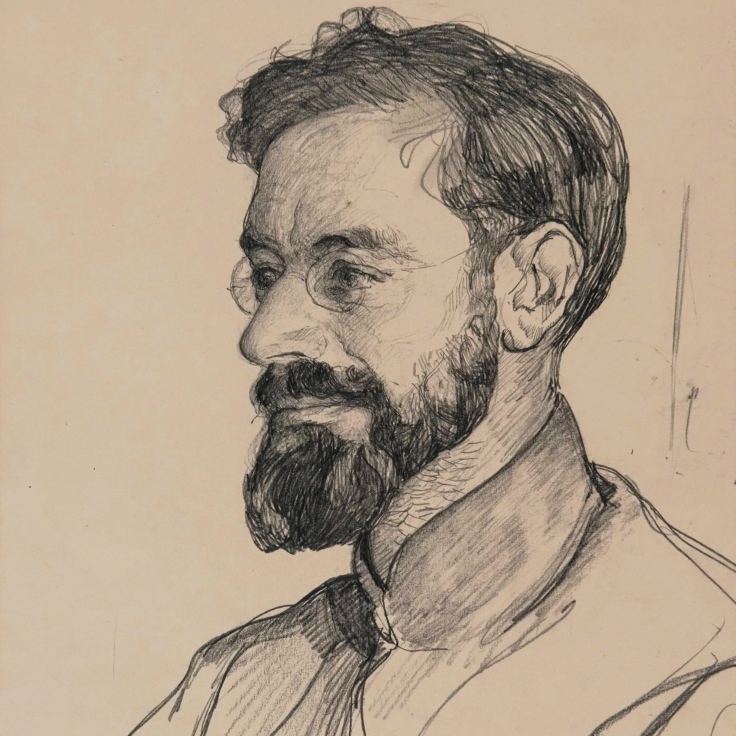
In this appeal for his fellow leader of the Bulgarian C.P. and long-time collaborator in Balkan Socialism, Kolarov gives a valuable biography of veteran Marxist Khristo Kabatchieff. Arrested after 1923’s failed anti-fascist September Uprising, for which Kolarov was an organizer who had escaped to Russia, Kabatchieff was jailed for several years before his release in a larger 1926 amnesty. Eventually settling in Moscow, Kabatchieff lost his positions in the Party and the International during 1928’s power-shift in the Comintern. Finding work teaching at the Marx-Engels-Lenin Institute, he spent years researching and writing histories of the Bulgarian workers movement. Though arrested during the Purges, he was later released to die in Moscow in 1940 at age 62.
‘Free Kabaktchieff—Bulgarian Workers’ Leader’ by Vasily Kolarov from The Daily Worker. Vol. 3 No. 43. March 3, 1926.
On December 21, 1925, the case of the central committee of the Bulgarian Communist Party was examined in the Sofia appeal court, the charge being that of preparing, declaring and leading the September armed rising. For reasons of procedure, the case was postponed to another date.
To the White Guard government and the whole Bulgarian bourgeoisie supporting it in the struggle against the Communist Party and the revolutionary movement in the country the moral significance of this trial now is that by means of inflicting a sentence on the central committee, it must justify the provocative policy of the propertied class power which led to the September events.
Of all those charged, only Comrade Kabaktchieff is in the hands of “justice.” The man, who for years has been the teacher and leader of the Bulgarian workers, must rot for many more years in white guard exile and is subjected every day to the threat of being shot.
Comrade Kabaktchieff is a valuable hostage in the hands of Zankov bands. Their swords continuously drawn above his head, these bands necessarily threaten the life of one of the front line fighters of not only the Bulgarian Communist Party, but of the whole Communist International.
Kabaktchieff, who, in spite of his 47 years has completely preserved his youthful faith in the inevitability and proximity of the victorious international revolution with stoical firmness and unshakable spirit has already for two and a half years tolerated in prison the heavy trials to which are subjected the fighters in the Communist Party.
Edited Teachers’ Organ.
Entering the ranks of the fighters against the capitalist social order after a thorough study of the principles of scientific socialism, he has preserved his learning for theoretical deepening of problems of the labor movement right up to the present day. No sooner had he left the high school when he became the ideologist of the socialist left in the Teachers’ Union and edited its organ. Progressive teachers are to a large degree indebted to Kabaktchieff in that from the early days of the movement he went hand in hand with the proletariat and actively participated in the revolutionary struggle of the latter.
The student years in France and Switzerland, enabled Kabaktchieff to deepen and extend his theoretical knowledge and to study directly the socialist movement in the west. It was here that he was being molded into a future proletarian leader, who understood the significance of the theory of scientific socialism for correct leadership of the labor movement and at the same time was permeated with the conviction that Marxism can be inspired and well-assimilated only by means of active participation in the proletarian struggle.
Edits Party Papers.
He did not experience any attraction whatsoever for his profession as lawyer, which he took up after leaving the university. He left this profession at the first invitation of the central committee of the party to join the editorial board of the party organ Rabotnitcheski Vestnik (Labor Herald). During the period that he was assistant editor, and from 1910 as editor, he directed the central party organ right up to the time of its prohibition by the government in September, 1923.
Kabaktchieff was one of the regular contributors also of the scientific organ of the party Novy Vremya, edited, by the late D. Blagoeff.
In the historical struggle between revolutionary socialism on one hand and opportunism on the other which to a large extent predestined the prevalence of revolutionary tendencies in the labor movement that was being born in Bulgaria (1903), he was on the side of the “close socialists” (revolutionary wing and did a great deal to help to disperse the thick theoretical fog with which the opportunists were energetically shrouding heads of workers.
Fights Social-Democrats.
In all the subsequent party crises caused by attempts of petty-bourgeois intellectuals to distort the revolutionary ideas of the socialist and the proletarian nature of the party, Kabaktchieff retained with ability and erudition the party position on the fundamental principles. He also wrote a number of polemical pamphlets in which he revealed his worth as a forceful dialectician and talented publicist.
Kabaktchieff always linked up his theoretical work with the definite practical tasks of the party. When in 1910 the Balkan socialist parties put forward the slogan of a Balkan federated republic and began forming a Balkan socialist federation, Kabaktchieff in a special pamphlet presented the theoretical basis for this important practical step and in another pamphlet investigated the ideas of old Bulgarian revolutionaries with regard to a Balkan federation. Later, in connection with the struggle of Bulgarian socialists against the war, he wrote a special book on “Imperialism in the Balkans.” These works of his also spread his ideological influence to other Balkan socialist parties.
Preached Anti-Imperialist Policy.
During the war Kabaktchieff was one of the most zealous and consistent defenders and preachers of an irreconcilable anti-war and anti-imperialist policy. After the Russian revolution he quickly came over to the side of Communism and bolshevism and the central committee entrusted him with drawing, up the basis of a new program for the party. Later, the central committee commissioned him to draw up the final party program which was presented for the endorsement of the Fourth Congress of the Comintern.
In 1905, Kabaktchieff was elected member of the central committee of the party. He has been continually elected to this post till recently. In 1923, he was temporarily the political secretary of the party. Since the Balkan war he was regularly elected as parliamentary deputy, and his calm and well-constructed speeches were distinguished by their well-sustained principles and political implacability. He was opposed in principle to all compromises in politics. He was elected deputy while doing penal servitude after the September rising. He remained faithful to the Communist Party even after it was outlawed. The government did not consent to his remaining in parliament and at the commencement of 1925 it annulled his deputy’s mandate by virtue of the exceptional laws against Communists.
At the Basle international congress (1912) Kabaktchieff was a delegate n of the Bulgarian “Closists” and there defended their revolutionary position. In 1920, he sailed across the Black Sea in a little sailing boat in order to take part in the second congress of the Comintern. He was a delegate of the Communist Party of Bulgaria to the Fourth Congress of the Comintern. At the time of the Fifth Congress, when he was elected a member of the International Control Commission, he was already a captive in the hands of the Bulgarian white guards.
Free Kabaktchieff.
One of the oldest fighters of the Bulgarian Communist Party, to which he devoted his inexhaustible energy and rare industry, Kabaktchieff soon understood the great error of the party on June, 1923. He acknowledged it openly in a manly speech before the court, branding the provocative policy of the white guard bourgeoisie. Despite the serious defeats of the party, he completely preserved his bold spirit and warm faith in the cause of Communism. By liberating him from capitalist servitude the international proletariat will return to the Bulgarian and international revolution one of the best fighters devoted heart and soul to the movement.
The Daily Worker began in 1924 and was published in New York City by the Communist Party US and its predecessor organizations. Among the most long-lasting and important left publications in US history, it had a circulation of 35,000 at its peak. The Daily Worker came from The Ohio Socialist, published by the Left Wing-dominated Socialist Party of Ohio in Cleveland from 1917 to November 1919, when it became became The Toiler, paper of the Communist Labor Party. In December 1921 the above-ground Workers Party of America merged the Toiler with the paper Workers Council to found The Worker, which became The Daily Worker beginning January 13, 1924. National and City (New York and environs) editions exist.
PDF of full issue: https://www.marxists.org/history/usa/pubs/dailyworker/1926/1926-ny/v03-n043-NY-mar-03-1926-DW-LOC.pdf

