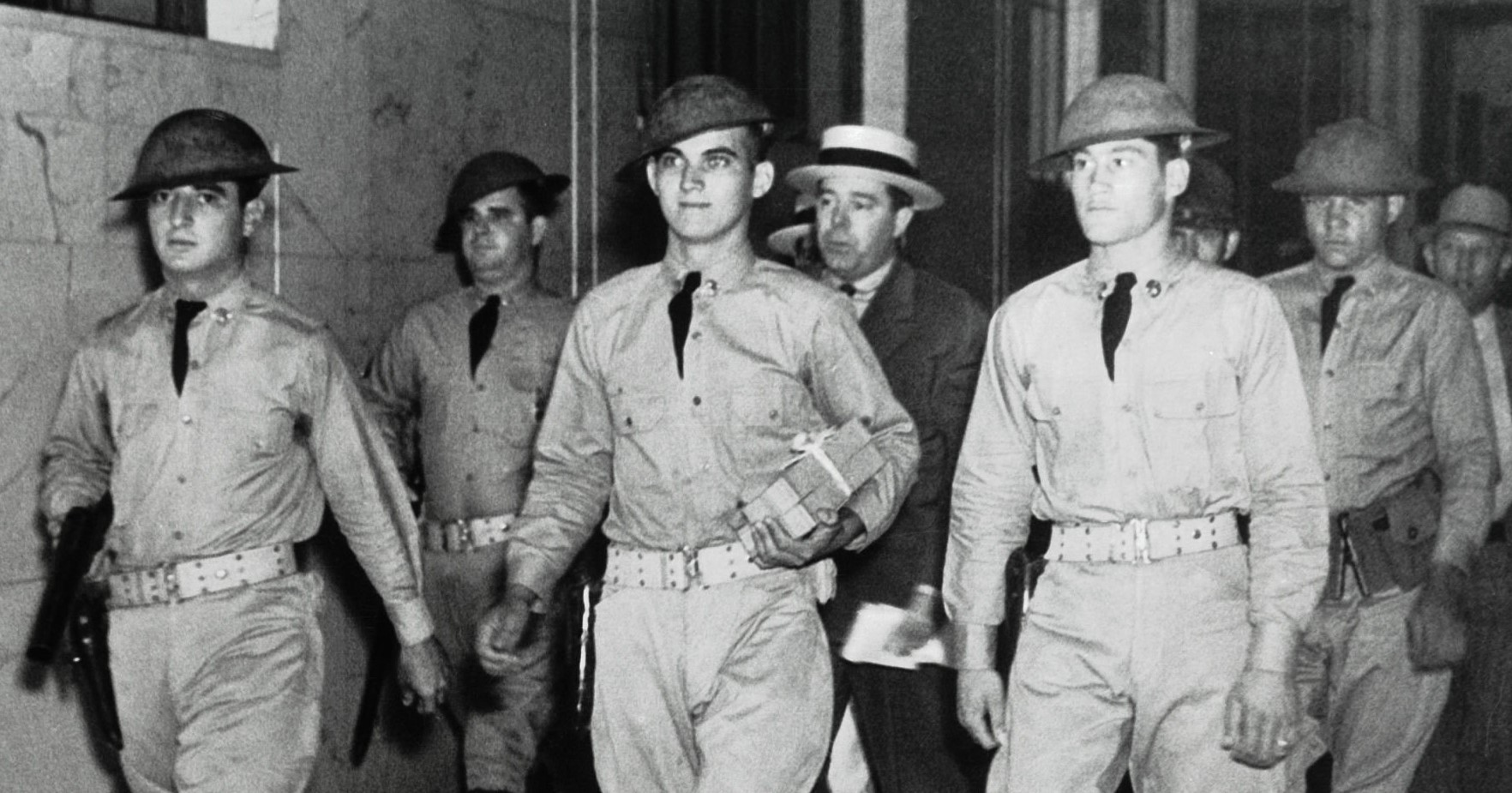
Fascistic Louisiana power-broker Huey Long’s ‘Share-the-Wealth’ doctrine was all bullshit. Leading one of the poorest states, with the highest rates of illiteracy and child mortality in the country, which Louisiana remains to this day.
‘The Life and Death of Huey Long’ from Socialist Call. Vol. 1 No. 26. September 14, 1935.
Huey Long lived as he died–by the gun and wise-crack. After 17 years of cheap, rotten politics, Huey finally reached his height–an all-powerful dictatorship over the state of Louisiana–and died from an assassin’s bullet.
Huey was born in the red clay hills of Central Louisiana seven years before the World’s Fair at Chicago marked the turn of the century. Raised as a devout member of the Baptist Church, he remained until his death a loyal member of that church, despite his political use of profanity.
Huey began his political career at the age of 25 years, when he was elected to the State Board of Railway Commissioners in Louisiana. Brilliant in Tulane University, he completed a usual three-year course in seven months and passed a special bar examination to become a law-partner with his brother, with whom he was later in his life to quarrel bitterly.
Early seeking popular issues, he declared “war” in his early political years against Standard Oil. Taking advantage of a Standard squeeze which isolated and eliminated independent operators, Huey traveled through the bayous and swamps of Louisiana demanding that pipelines be declared common carriers, under the jurisdiction of the railway commission.
Begins in Politics
Using his office as railroad commissioner–equivalent to a public service commissioner in many states–Huey began a clever campaign for the “rights of the people” against the monopolies. In 1923–four years after he entered politics he entered the gubernatorial elections and was defeated by only 11,000 out of 230,000 votes.
He kept up an “open fight” against the utilities, while secretly accepting campaign funds from such firms as the Southwestern Gas and Electric Company, with the result that he was elected Governor of Louisiana in 1928 with a plurality of 45,000 over his nearest opponent. Using his appointive power as governor, Huey began a house-cleaning–not against graft but against anti-Long appointees. Soon every appointive office in the state was filled by a man that swore fealty to only one man and that man was Huey Pierce Long, Jr.
Rise Is Rapid
From then on, his rise was rapid first as governor and then as United States Senator. Throughout his career, he was met on all sides by accusations which earned him impeachment trials by his own legislature and investigation by the United States Senate. He was at various times accused of gross misconduct in public, carrying firearms, using the militia to subordinate civil authority, misapplying funds, attempted bribery and other like acts.
Elected to the United States Senate in 1931, Huey jumped on the Roosevelt bandwagon, and was able to wield a remarkable influence at the 1932 Democratic national convention. He early saw which way Roosevelt would go with the masses, and in 1934, he definitely broke with the administration in Washington to form his own “Share-the-Wealth” organizations throughout the country.
Meanwhile, in Louisiana through his yes-man, Governor Allen, Long was setting himself up as absolute dictator in the various parishes of Louisiana. Not since 1917 has a third party been allowed to appear on the ballot; Long fought the Socialist Party at every opportunity for he recognized in the Socialist Party the most dangerous opponent to his semi-fascist theories of demagogy. Although appearing on the floor of the Senate in Washington as pro-Labor, Long with absolute power in his home state has been as reactionary as Talmadge of Georgia. In Louisiana, social security and social responsibility are at the lowest form and the state ranks at the bottom of educational lists.
More than 100,000 families have been removed from relief rolls in Louisiana during the past year with no increase in employment. Child labor still exists in the state and there is no unemployment insurance. Old-age pensions are a farce. In common with other southern states, Negroes work as a “lesser race” and Long has consistently refused to sponsor any anti-lynching legislation,
Early this month when Norman Thomas, prominent Socialist, announced an “invasion” of Louisiana to tell the people of that state of the dangerous tendencies that Long represented, he was met by Long’s sneer that “perhaps Roosevelt had sent him.” Thomas replied that he was as eager to hit F.D. as he was to “deflate” Long–but the Kingfish issued orders and the arrangements committee for the southern tour discovered that every sound truck owner had been ordered to beware of Thomas.
Thomas had previously met Long in a debate in New York. City which had ended, according to popular applause, in victory for the Socialist.
Long’s last act was typical of his entire career–for he last hit the headlines while indulging in a Senate filibuster that denied to the White House any appropriations for relief funds. Returning to Baton Rouge, he immediately summoned “his” legislature into session to pass any number of acts which declared Congressional laws “unconstitutional”.
While at the capital, he was met by Dr. Carl A. Weiss, physician and Long-hater, who declaring, “This has been too Long,” fired the fatal shots into Long Weiss was immediately killed by Long’s bodyguard.
Socialist Call began as a weekly newspaper in New York in early 1935 by supporters of the Socialist Party’s Militant Faction Samuel DeWitt, Herbert Zam, Max Delson, Amicus Most, and Haim Kantorovitch, with others to rival the Old Guard’s ‘New Leader’. The Call Education Institute was also inaugurated as a rival to the right’s Rand School. In 1937, the Call as the Militant voice would fall victim to Party turmoil, becoming a paper of the Socialist Party leading bodies as it moved to Chicago in 1938, to Milwaukee in 1939, where it was renamed “The Call” and back to New York in 1940 where it eventually resumed the “Socialist Call” name and was published until 1954.
PDF of full issue: https://www.marxists.org/history/usa/pubs/socialist-call/v1n26-sep-14-1935.pdf

