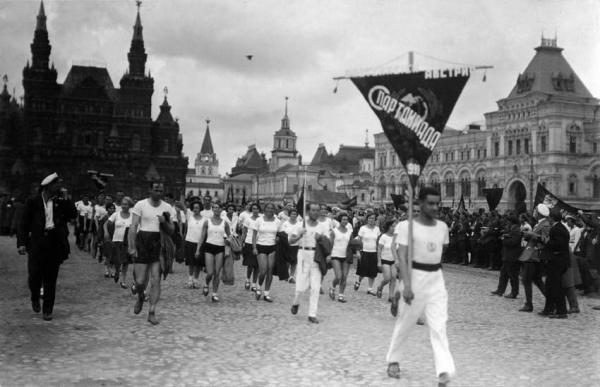
The role of the Red Sport International and the relationship to other working class sporting societies from the 1924 World Congress.
‘The Sport Question’ from Resolutions adopted at the Fourth Congress of the Young Communist International, 1924.
I.
1) The Third World Congress and the Fourth Bureau Session gave the Young Communist Leagues great tasks on the field of sport activity. The Leagues were given the task of supporting the formation of workers’ sport federations; they were to demand that the sportsmen of the working class leave the bourgeois sport organizations and enter the workers’ sport organizations; they were to carry on work inside the sport organizations thru the formation of communist fractions; they were to build red blocs and lead them thru the fractions; they were to create sport departments in the leading bodies of the Leagues and take up work in the shop and factory sport leagues.
2) These tasks have only been carried through by the Young Communist Leagues to a very small degree. Most Leagues have not gone further than the formation of departments for sport work. Only a very few of the Leagues have worked upon this field with success.
3) The Fourth World Congress ratifies the decisions of the Fourth Bureau Session on the sport question. It declares that the work in the workers’ sport and physical culture organizations having regard to the world political situation remains of great importance. The workers’ physical culture and sport organizations must be brought to take their part in the fight against Fascism, bourgeois militarism and reaction. This is their chief political task in the immediate future.
The Young Communist Leagues must work so that:
a) The workers’ sport and physical culture organizations struggle ideologically against the bourgeois sport organizations as the reserve of Fascism, and the support of bourgeois militarism and reaction, and that they fight also against the “neutral” declaration of the workers’ sport organizations, because this is becoming a cover for counter-revolutionary activity. The ideological fight against Fascism and bourgeois militarism must not be confined to the red sport and physical culture organizations and their members, but must be extended to the broad circles of the proletariat engaged in sport and must be carried out in full agreement with the Communist Party and the Young Communist League in the form of enlightenment work.
(b) The Red Sport and Physical Culture Organizations must be of organizational assistance in the struggle of the communist organizations. The organizational support of the struggle of the Communist Parties and the Young Communist Leagues against Fascism is carried on within the general proletarian defence organizations, through the entrance of the members into the general formations. In no case should special organizations composed of members of the physical culture and sport organizations be formed. Thanks to the physical education obtained by them in the workers’ sport and athletic organizations, the red athletes and sportsmen will form a hardened kernel of the proletarian defence organizations. The workers’ sport and athletic organizations as such must put all their strength into the service of the defence struggle.
4) The Fourth World Congress gives the Young Communist Leagues the task of taking up the work in the workers’ sport and athletic associations much more strongly. These organizations must become organizations of the proletariat class war through the work of the Young Communist Leagues. In order to attain this the Young Communist Leagues must carry out the task set them by the Third World Congress and the Fourth Bureau Session; they must form their sport departments in all the leading bodies of the Leagues, they must build fractions and red blocs and take the initiative in the formation of workers’ sport organizations, where such are not already in existence. Further, the Young Communist Leagues must work for a centralized leadership of the sport movement, for the unification of all existing organizations for sport, athletics, etc. in one united organization on a national scale, and they must also work for the further development of these organizations into a mass organization. The workers’ sport and physical culture organizations must embrace wide circles of the working class youth, but nevertheless may not be regarded by the Young Communist Leagues as “bridge” organizations.
II.
On the question of the so-called culture organizations, it was shown that in the ranks of those who sympathize with the communist movement and even in the communist movement itself, incorrect and dangerous opinions upon the necessity of a special red culture movement and organizations exist. These tendencies which propose the creation of the so-called “Third Column” of the working class movement for “the leadership of the struggle against bourgeois culture” are the signs of a heritage left by social democratic opinions upon the class-war and revolution, and must be sharply fought.
2) The chief cover of this uncommunist ideology is to be found just in those associations the formation of which is attempted under the title of “culture organizations”. This grouping of various self-educational organizations, social organizations and theatre and singing associations under the general title of “culture”, and still more the actual unification either for themselves or for the “Red Culture and Sport Movement” would mean to create a firmer ground for this ideology.
3) On this ground and also because most of these organizations have absolutely no connection with the proletarian class-war, the unification of the so-called culture organizations with the Red Athletic and Sport Organizations must in general be rejected.
The unification of individual organizations which busy themselves with physical culture or have definite connection through this with the workers’ sport and athletic associations, is not thereby put out of the question, but can also take place after an examination of the work and composition of the organization. The affiliation of other educational organizations, social unions, theatre and singing associations and hygienic organizations should not be accepted. The Young Communist Leagues will regulate their relations with these organizations from case to case according to circumstances. The question of the utilization of these organizations during illegal periods by the Young Communist Leagues is not affected by this decision.
4) An important means in the struggle against the petty bourgeois influence of these organizations on the working class youth is the carrying-on of the communist mass educational work of the Young Communist Leagues, which cannot set itself the task of giving a “substitute” for the activity of these organizations. The Young Communist Leagues must arouse an understanding in the masses of the working class youth that in the present period of struggle the basic political education, the knowledge of Marxist and Leninist theory and of natural science, is more important than the satisfaction of various needs which other organizations make their aim.
5) In countries where unity through amalgamation or in the form of sport and culture blocs is already carried out, the Young Communist Leagues must give the main part of their activity to the sport and athletic associations and not support the “culture organizations” affiliated to them. The Young Communist Leagues must support the workers’ sport blocs as the transformation period to a united workers’ sport and athletic organization on a national scale.
So far as these tendencies fought by us, seek to make themselves felt in the Red Sport International it will be the task of the latter to oppose them.
III.
1) The Young Communist International and its sections work inside the Red Sport International and its national Leagues through the fractions of the League. As the overwhelming majority of the members of the Red Sport International are young workers, so the Young Communist International is particularly interested in the work of the Red Sport International. To co-ordinate the work and to support the political activity of the Red Sport International the Executive Committee of the Young Communist International sends a representative to the Executive Committee of the Red Sport International who works with it regularly. This work is carried on under the direct leadership of the E.C. of the Y.C.I. and in agreement with the Comintern.
2) The Young Communist Leagues have to support the work of the Red Workers’ Sport and Athletic Leagues. The Young Communist Leagues work in the national sections of the R.S.I. through their fractions to give it the character of the class-struggle and to make it powerful in the struggle against Fascism, bourgeois militarism and reaction. The Young Communist Leagues send representatives to the National and Local Committees of the Red Sport and Athletic Associations to co-ordinate and support their work.
The Young Communist Leagues must see to it that the enlightenment work carried on in the sport and athletic associations has a revolutionary class character and is carried on in agreement with the mass educational work of the Leagues, and that the educational work goes as far as is necessary to awaken the class-consciousness of the members of the Red Sport and Athletic Association and bind these latter up with the class-struggle. Further, the Young Communist Leagues must work so that the Red Sport and Athletic Organizations become mass-organizations and embrace broad masses of the indifferent youth. All tendencies which seek to limit these sport organizations to purely communist organizations and the circle of their work to the communist proletariat must be fought.
PDF of full book: https://www.marxists.org/history/international/young-communist-international/yci-4th-congress-resolutions.pdf

