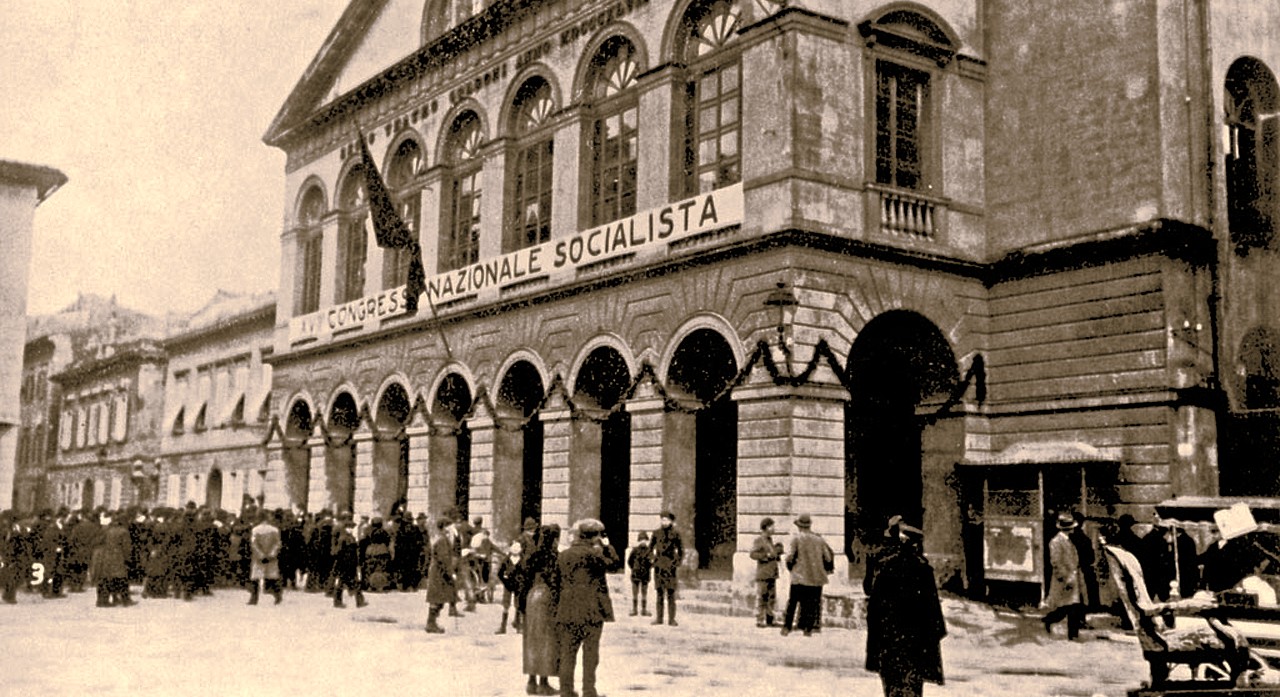
Cannata on the split at 1921’s historic Italian Socialist Party Congress that created the Communist Party.
‘Two Conventions of Italian Labor’ by Giuseppe Cannata from Industrial Pioneer. Vol. 1 No. 3. April, 1921.
IN THE WEEKS beginning January 15th and February 28th of the present year, the Italian Socialist Party and the General Confederation of Labor, its economic reflex, held their national conventions in the socialist municipality of Leghorn. The importance of these conventions to the Italian people and to the world labor movement cannot be overestimated; one Leghorn daily declared that they were the most important single events since the armistice in their potential influence on the destinies of the Italian nation.
The Socialist Party delegates, to the number of over three thousand, met in the Goldoni Theater. They represented the strongest single party in Italy, with over 210,000 members, 156 deputies in the Chamber, and the most important industrial municipalities and provinces under their political control.
Still the glory and pomp of power could not conciliate the most heterogeneous gathering of “socialists” imaginable. The metallurgical workers’ agitation of last October had bared to the view of the Executive Committee of the Third International, and to a large body of Italian workers, the essentially conservative soul of the loud-spoken, phrase-mongering politicians. When the moment for revolutionary action came, the Maximalists of the Bologna Congress, the men who had been to Soviet Russia and had attested their revolutionary faith before the officials of the Third International, deliberately sabotaged the workers’ movement and sent the Italian proletariat reeling back into the depths of disillusion and despair. When the Revolution reared its unkempt head brusquely before them, the politicians refused to recognize it.
A heated, controversial correspondence with Moscow followed; Zinoviev reproved Serrati, the Centrist leader, bitterly and to the point of offense; the party disintegrated into a half-dozen groups of varying views, which merged into three main divisions: the extreme Left, led by Bordiga, Bombacci, Terracini; the Centre, with Serrati, Baratono and Lazzari; the Right, with the old and crafty politicians Turati, D’Aragona, Modigliani, etc.
It was the general feeling that the Leghorn Convention could have but one outcome: a complete split. The popular expectations were verified, the only surprise being occasioned by the completeness with which the ambiguous and fluctuating elements of the Centre gave themselves into the arms of the Extreme Right when they faced the inevitable alternative. The essential opportunism of all politicians was here unmistakably revealed; two years ago the Centrists of today steered their Socialist Party into power and prominence on a program which satisfies the popular demand for Revolution and Soviets; today they renounce Revolution and substitute the formation of Soviets with the more convenient task of conquering more offices in the bourgeois political structure. It is to the great credit of the Moscow Communists that they have finally seen thru this duplicity: they state clearly in their telegram to the Convention that “the general revolutionary circumstances (in Italy) give them the External Appearance of being more to the Left than the Centrists of other lands.”
The Third International was represented at the Convention by the Bulgarian Communist, Kabaceff, who made known to the delegates the views of the Central Committee in no uncertain terms. On the first day of the Convention the following telegram from Moscow was read:
“Dear Comrades: The attempts of our representatives, Zinovieff and Bukharin, to participate in your Congress have not had the results hoped for thru no fault of ours (they were barred out by the Italian Government). Moreover, Comrades Serrati and Baratono, who had declared their intention to come to Russia, have not come. Therefore we send to you with this telegram our fraternal greetings and the following message:
“We have followed thru the columns of your journals the struggle of the last months between the diverse tendencies of your party. Unfortunately the actions of the Communist Unitarians, at least the actions of the heads of the faction, have confirmed our most unfavorable expectations. In the name of unity with the reformists, the Unitarian leaders are as a matter of fact ready to separate from the communists and also from the International.
“Italy is crossing at present a revolutionary period, and it is for this reason that the reformists and the centrists seem to be more to the Left than those of other lands. Day by day it has appeared more clearly to us that the faction headed by Comrade Serrati is in reality a faction of centrists, to which only the general revolutionary circumstances give the external appearance of being more to the Left than the centrists of other lands.
“Before knowing how the majority at your Congress will be constituted, the Executive Committee declares officially in an absolutely categorial manner: the decisions of the second world congress of the Communist International obligates adherent parties to break with the reformists. They who refuse to effectuate this schism violate an essential law of the International and put themselves outside the ranks of the International. All the Unitarians in the world cannot convince the International that the editorship and the inspiration of that arch-reformist review, the “Critica Sociale” (Turati’s journal), are favorable to the dictatorship of the proletariat and to the Communist International. No diplomacy will convince us that the faction of the concentration is favorable to the proletarian revolution. Those who wish to bring the reformists into the International wish in reality the death of the proletarian revolution. They will never be of us.
“The Italian Communist Party must be created at any odds (in ogni modo). Of this we have no doubt, and to this party will come the sympathy of the proletariat of the entire world and the warm support of the Communist International.
“Abbaiso il reformmmo! Viva il vero partito comunista italiano!”
After six days of heated discussion in which the gulf between the contending factions widened increasingly, the matter came to a head with the vote on the motion to join the Third International under the conditions outlined by Kabaceff—strict observance of the 21 points, including expulsion of the reformist wing of the party.
The vote on the motion was as follows:
For (Communists). 58,000
Against (Center and Right). 111,000
Abstained from voting. 50,000
The Communists abandoned the convention and proceeded to hold one of their own in which the Italian Communist Party came to life.
***
At the convention of the General Confederation of Labor about 1,750,000 workers were represented, of which almost a million are embraced in the powerful Agricultural and Metallurgical Workers’ Federations. Transportation is the Confederation’s weakest point for neither the Syndicat of Railway Workers nor the Federation of the Toilers of the Sea belong to it; these are extremely radical and efficient independent industrial unions.
The struggle which materialized at the Leghorn Convention of the Italian Socialist Party had its counterpart in the Convention of the G.C. of L. Communists and moderates fought for supremacy and the latter won out in the test vote. On the motion of the Communists to withdraw from the Amsterdam International and join the Third International, the vote stood 1,300,000 against and 418,000 for. The convention approved the closest cooperation between the Confederation and the Socialist Party, the withdrawal from the Amsterdam International, and possible co-operation with Moscow on the basis of national autonomy in the policies to be pursued in the future. Here also the ambiguities of Centrism triumphed. That socialism which seeks the conquest of the bourgeois governmental mechanism for its own purposes of political dominion has again fooled a large section of the Italian workers into believing its revolutionary protestations.
A very competent appraisal of the significance of the split in the socialist forces from the pen of Angelo Faggi (formerly editor of the Italian organ of the I.W.W. and at present acting secretary-treasurer of the powerful Italian Syndicalist Union) appears in “Guerra di Classe,” of January 29th, 1921. This is Fellow Worker Faggi’s comment on the situation:
“Evidently the Communist Party is destined at its birth to meet great sympathy and powerful support in the ranks of the Italian workers. Nursing the hope of imminent revolution, they find themselves today suffering bitter disillusion. Still, their general tendency is to rebel against their betrayers, and, veering instinctively towards a more precise and decisive stand, they naturally sympathize with whoever preaches the most extreme doctrine. From this point of view, the Communist Party will have a large following, especially because of the fact that on the political field it will be the authorized representative of the Third International.
“To what extent the new Communist Party can satisfy the hopes of the proletariat, it is difficult to foretell at this early stage. It is better to see it in action before hazarding a judgment which may be either too pessimistic or too rosy.
“As to the influence that the new party will have in the ranks of the General Confederation of Labor, it is impossible to foretell. It seems that the Communist Party, thru its most authoritative leaders, has expressed the determination to support this organization in order to gradually conquer and transform it. It is a fruitless labor that the Communists are attempting, to our way of thinking. Still we have read with pleasure the writings of many members from the rank and file of the party who sustain the only clear road in the economic field it outside of the G.C. of L., and precisely in the Italian Syndicalist Union. If, then, the split in the Leghorn Congress will not have an immediate repercussion in the ranks of the G.C. of L., to the point of causing a secession of the forces controlled by the Communists, some effect of this nature it will surely have, especially as the G.C.L. is bound to follow the Socialist Party in an increasingly conservative policy, all. communist efforts to the contrary notwithstanding.”
If we were politically minded and believed that the fate of the Italian workers was entirely in the hands of the warring political sects and factions, the situation would indeed appear dark to our anxious eye. But fortunately such is not the case; the Italian workers are developing thru continuous warfare on the economic field a remarkable capacity for independent action; almost one million workers in the Italian Syndicalist Union and the railwaymen and seamen’s unions, repudiating all political tutelage, are a living example of this new spirit. The metallurgical workers’ movement of last October is an indication of the possible future tactics of Italian labor, and the workers have learned a great lesson from that memorable uprising.
Norman Matson writes in the March Liberator:
“In the first great industrial struggle they took over the now famous 500 factories, and holding them, turned to their previously unconsulted leaders for advice. Out of the maze of contradictory, ambiguous accounts of that tense moment, one remembers the story of the night of waiting. In the factories of Turin and Milan not a red worker slept. Would their political and industrial advisers—Serrati, D’Aragona & Co.—tell them to hold, the line or retreat? The order — formulated by the men who now lead a party purged of bolsheviks—was “Retreat—evacuate!” A young Torinese told me: “The disappointment crushed us. Some of us wept that night.”
Today Italy is practically rent by civil war; in the first week of March, the Italian workers, goaded by the bourgeoisie’s white guard, the “fascisti,” have been driven to retaliation. General strikes, riots, and a guerilla warfare in which the troops have used machine guns and three-inch cannon, have spread from Trieste in the North to Bari in the extreme South. The dead on both sides number close to one hundred; the wounded reach many times that number; thousands have been arrested. Still the Socialist Party maintains that the time for revolution is not yet at hand.
To the millions of Italian workers surging forward under the impellent urge of hunger, unemployment and reaction, the Italian Syndicalist Union alone has a virile message of hope and deliverance; to them it says constantly:
“Do not weep; do not retreat; do not wait for orders; keep right on fighting on your own initiative and the world shall be yours, and the riches thereof.”
The Industrial Pioneer was published monthly in Chicago by the Industrial Workers of the World from 1921 to 1926. The precursor of the Industrial Pioneer was the One Big Union Monthly. Heavily illustrated, the journal included arts, prose, and poetry along with historical articles and analysis.
Full issue PDF: https://www.marxists.org/history/usa/pubs/industrial-pioneer/Industrial%20Pioneer%20(April%201921).pdf

