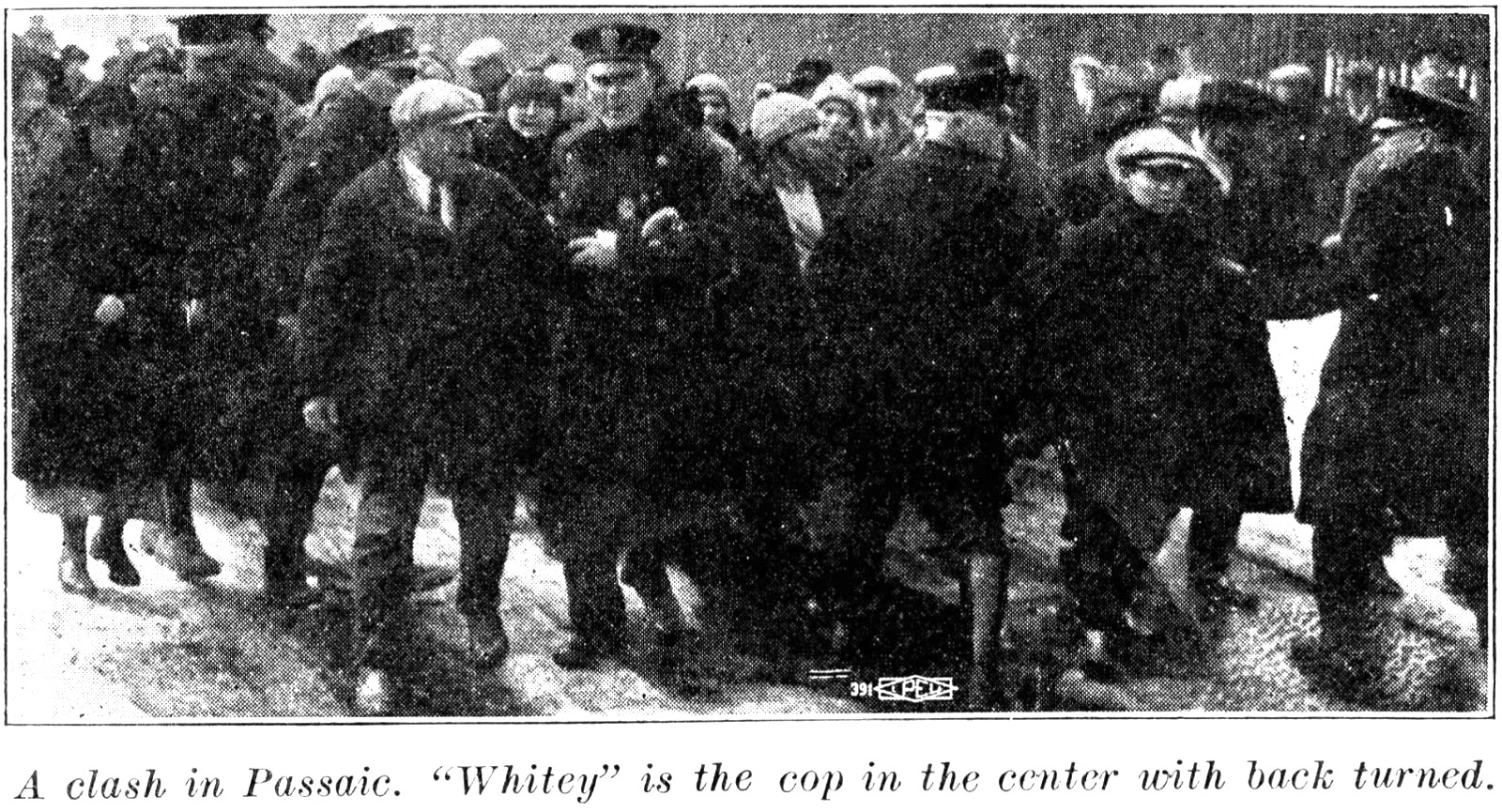
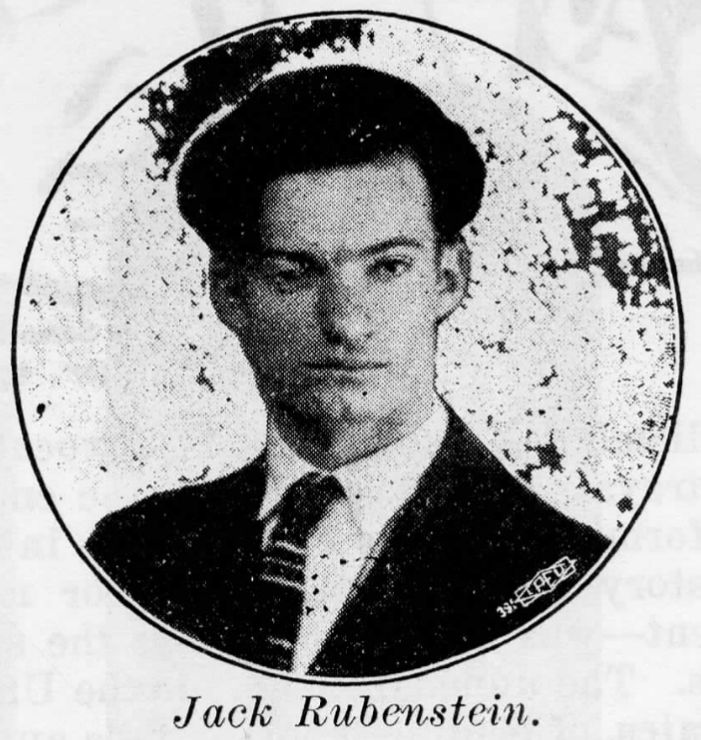
The contrasting plights of Passaic strike leader Jack Rubenstein and the cop most responsible for arresting picketers, ‘Whitey’ Adamchesky as
‘Jack Rubenstein and ‘Whitey’ Adamchesky’ by Hollace Ransdell from Labor Defender. Vol. 2 No. 6. June, 1927.
THERE were two young men who used to meet many times during the months of the Passaic Textile Strike, on opposite sides of the battleline. The coal-black head of one was seen continually at the head of picket lines in front of the gates of the various mills. The yellow-white hair of the other was known as a danger signal to thousands of strikers.
“Whitey” Adamchesky probably had the distinction of having arrested more strikers during the struggle than any other cop. And Jack Rubenstein was certainly arrested oftener. Next to Albert Weisbord and possibly Sheriff Nimmo, these two, the tall, slim Rubenstein and the short, stocky Stephen Adamches’ky tearing around madly on his motorcycle arresting strikers, were perhaps the best known characters of the strike.
And so it was that two bits of news which by a strange coincidence came almost at the same time created more excited comment among the former strikers than any other news since the strike was settled. Jack Rubenstein and “Whitey” Adamchesky who had met so often on the battle line were destined to meet again long after the strike was over–in jail. And on the same side of the bars this time.
On April 28, 1927, Rubenstein was sentenced to six months in the county jail and fined f 500, on a strike charge which originated more than a year ago. A day or two later “Whitey” was arrested, charged with robbing a garage.
For a brief time the Bergen County jail, presided over by the famous little Sheriff Nimmo, held these two renowned strike figures. The strike may be over but the drama still goes on. Adamchesky is reported by the police to have made a confession of his crime. Another ironic touch appreciated by those who are familiar with the third degree confessions which Adamchesky used to help torture out of strikers. This confession was obtained in the same police court about which the strikers tell such gloomy stories.
With the jail aa the setting then, these three interesting characters enter the scene—the dark, gentle young Jewish idealist, the white-lashed, brutal, twisted-minded police officer and the scrawny, noisy despotic little Sheriff whose hatred of strikers has become almost a madness.
The exit of one of the three, however, was quick. Adamchesky was released on bail within a day or two. But Rubenstein is still in, and Sheriff Nimmo still struts supreme.
What is this charge for which Jack Rubenstein received six months in the county jail and was fined $500? The case started more than a year ago, on March, 1926, when Jack Rubenstein led a picket line of 800 strikers to the National Silk Dyeing plant in East Paterson, and was sentenced later to 90 days on the personal charge of Sheriff Nimmo. March 19 he was released on bail pending the appeal of this case, but was rearrested immediately afterward on a charge of assault and battery made by one of the jail keepers–Hubert LeFevre. The keeper claimed that Rubenstein assaulted him when he tried to stop an argument between Rubenstein and another prisoner. After this alleged assault, Rubenstein was kept in solitary confinement until called to court.
What really happened, as Rubenstein, himself, tells it was this : During certain hours of the day the doors of the cells are left open. Rubenstein was taking a nap on the cot in his cell with the door open, when he was awakened by an awful rumpus in the cell next to his, occupied by two prisoners not strikers. Rubenstein got up and walked to the door of this cell where two men were quarreling. Just then the keeper ran up the stairs and with no explanation began cursing and striking Rubenstein who raised his arms to protect his face and head from the blows. In some such way as this, arise most of the charges against strikers of “assaulting the police.”
On March 22, 1926, Rubenstein was released again on $3,500 bail pending the trial. In May he had a trial by jury. It was at the height of the strike when prejudice against strikers was intense. The jury apparently felt that to be good citizens they should bring in a verdict of guilty. However, the evidence of the prosecution was flimsy and Rubenstein’s account sounded convincing so they tried to compromise.
Joseph Feder, the attorney, who handled the case for the defense tells how the jury returned and asked the judge if they could not bring in a verdict of guilty of simple assault, instead of assault and battery, which carries a more severe sentence with it. According to Mr. Feder, the judge replied to the jury that the indictment read assault and battery, and if they could find him guilty of simple assault, why couldn’t they go back and find him guilty of assault and battery? This the jury, being timid and obedient, did.
The judge remanded Rubenstein for sentence after the verdict was brought in as requested, and bail was continued until sentence. This was the sentence of six months and $500 fine which was given on April 28, 1927, more than a year after the case started.
Money is the only thing that is holding up the appeal of Rubenstein’s case. The attorney says that the conduct of the judge in sending the jury back was certainly prejudicial and basis enough for an appeal. Besides this there are a number of other good grounds on which an appeal might be made. The Rubenstein case is clearly another frameup and should be appealed, not only for the sake of Rubenstein, but also to discourage the courts from trying to jail some of the numerous other strikers whose cases are still pending.
Labor Defender was published monthly from 1926 until 1937 by the International Labor Defense (ILD), a Workers Party of America, and later Communist Party-led, non-partisan defense organization founded by James Cannon and William Haywood while in Moscow, 1925 to support prisoners of the class war, victims of racism and imperialism, and the struggle against fascism. It included, poetry, letters from prisoners, and was heavily illustrated with photos, images, and cartoons. Labor Defender was the central organ of the Scottsboro and Sacco and Vanzetti defense campaigns. Editors included T. J. O’ Flaherty, Max Shactman, Karl Reeve, J. Louis Engdahl, William L. Patterson, Sasha Small, and Sender Garlin.
PDF of full issue: https://www.marxists.org/history/usa/pubs/labordefender/1927/v02n06-jun-1927-LD.pdf

