
Fresh from the sit-down led victories at GM and Chevrolet, a confident new U.A.W.-C.I.O. meets in congress and sets its sights on the theretofore impenetrable domain of King Henry in what would become a test for not just the U.A.W., but all of unionism. Though they here see victory by the end of the year, it would not be until the history-making strike of April, 1941 that those walls were finally breached.
‘The Auto Union Aims at Ford’ by DeWitt Gilpin from New Masses. Vol. 24 No. 11. September 7, 1937.
Consolidating its ranks in convention, the youthful U.A.W.A. makes ready for one of the most crucial battles in labor history
“We say,” declared President Homer Martin, as he looked down upon some eleven hundred delegates representing four hundred thousand union auto workers, “Henry, if you intend to make and sell cars in America, get ready to put a union label on those Fords.” Without further ado the eleven hundred delegates to a man swung into one of the many exuberant and deafening demonstrations that occurred whenever the question of organizing the plants of the Ford Motor Co. was raised at the second annual convention of the United Automobile Workers of America.
They danced and paraded. They overturned tables and beat upon them with chairs. They roared and sang—sang with the same resounding vigor those words that rang throughout the strike-bound plants of General Motors and Chrysler last winter: “Solidarity forever, for the union makes us strong.”
Up in the balconies, the audience caught the enthusiasm and staged a show of its own. Hats and programs came sailing down upon the arena floor as President Martin announced that the demonstration represented “the beat of the funeral dirge of the open shop in the auto industry.”
Such demonstrations, which occurred several times daily, indicated better than anything else the energy and interest of the delegates in their youthful, democratic union which, in the words of David Dubinsky, was created and is governed on the basis of the slogan of “One for all and all for one.”
In keeping with its progressive record, the union, placing the major emphasis upon the organization of Ford’s plant, adopted at its convention a program that is an important contribution to the most advanced section of the American labor movement, headed by the C.I.O.
In the biting language that the auto workers developed in assailing the open-shop policies of the motor barons, they denounced police terror and the rising vigilante movement and called upon the federal and state government to outlaw and disarm all antilabor bands.
Where vigilante groups, such as the Ford service system, operate under the guise of legality, they asked Congress to immediately take steps to end such practices. Police terror, widespread throughout the steel strike, was condemned forcefully.
Placing a kick squarely in the rear of the fat gentleman who represents Wall Street in the cartoons, the delegates reaffirmed the use of sit-down strikes.
Pointing out that the cry raised against them does not come from the fact that the tories consider the organization of the union a step towards revolution, but because “the strikes were so effective and they were unable to operate their plants with strikebreakers,” the sit-down strike, said the resolution of the convention, “will remain labor’s most effective weapon against the autocracy of industry.”
Cuffing the capitalist press around roughly, the delegates dedicated themselves to the task of making possible a daily newspaper to replace the present weekly, and then yelled until the reporters of the American Newspaper Guild in the press box stood up and received a cheer. With the informality that characterized the convention, the delegates asked a lot of embarrassing questions of the news-hawks who weren’t carrying a union card.
The convention aimed a blow at the merchants of death, when it called for cooperation with all peace movements. Also directed against the munitions makers was a resolution asking Congress to prohibit the sale and storage of guns and tear-gas to corporations to be used in the “murder of their employees who dare protest their working conditions.” Half the color of the convention appeared not on the floor of the auditorium but outside on the streets of Milwaukee. The delegates, the men wearing various-hued union caps and the women in the green and red capes and hats of the auxiliaries, paraded endlessly day and night on the streets of the downtown area.
They took over hotel lobbies and night club floor shows, and entertained their audiences by singing union songs, many of which were composed by amateur lyric writers when they were sitting tight within the domains of Sloan and Chrysler. It was a victory convention, and the delegates acquainted the residents of Milwaukee with that fact.
Building a union from thirty-five thousand to four hundred thousand in one year is something to shout about, and the delegates did so without restraint. Inside the convention, with festivities forgotten, the delegates applied themselves seriously to the business at hand. Probably no more touching moment occurred than when the convention, without instructions from the chair, voted unanimously to give Tom Mooney ten thousand dollars to aid him in his fight for freedom. More recent victims of an anti-labor frame-up—the eleven C.I.O. miners in Galena, Kan., who face murder charges—were also assisted financially. The Red-scare, which certain nondescript reactionary elements had hoped to introduce as a political maneuver, was hopelessly crushed by the progressive actions of the delegates.
From the moment that President Martin declared from the chair that William Green had called him a Communist by inference, but that “Green didn’t know communism from rheumatism” because he had been out of touch with workers for so many years, any hope of using this weapon in the convention for the purpose of disruption was denied the reactionary grouplets.
David Dubinsky, speaking to the convention as a representative of the C.I.O., further clarified this issue when he declared that not only do Communists belong to unions, “but that they also belong to the activities of the unions, they belong to the responsibilities of the unions, and as long as they will serve the workers and the organization I have no quarrel with Communists.” John L. Lewis, burly leader of the C.I.O. and hero of the delegates, was accorded an ovation that included a parade boasting two bands. Grim and unbending at first, Lewis, touched by the tribute, smiled and waved his heavy arm as delegation after delegation passed in review. In his speech he reviewed the history of the Auto Workers’ Union and of the C.I.O. and laid before the convention the perspective of completing the job of organizing the unorganized. Lashing out at Green and his “Little Lord Fauntleroy” organization, he compared the A. F. of L. chief to the betrayers of the Irish and British labor movement and referred to him as a “contemptible traitor.”
But in analyzing the tasks ahead, Lewis declared that Henry Ford “will be a tired old man one of these days if he keeps believing that he is bigger than the automobile workers.” Lewis’s speech definitely ended a possibility of success for the policy of excluding outstanding international officers of the union in the elections of the convention. This policy, put forward by a tiny band of the followers of Jay Lovestone, aimed to drive out all elements except those over which they could establish influence. In making his position clear on the question, Lewis said: “Just what do you expect of officers? As a matter of fact, I think that the fabrication of this great union of yours in a year’s time is one of the outstanding accomplishments that labor anywhere in the world has ever seen. I think that the officers of this organization that led you through that enterprise are worthy of your consideration.”
Inwardly in the union, Lewis’s speech strengthened the unity of the organization and established a closer relationship between it and its parent organization, the C.I.O.
Through Lewis’s address and through representatives of the C.I.O., the union problems of the constitution, powers of the president, and the autonomy of locals were solved in such a manner that the U.A.W. remains second to none as a democratic union. The most important resolution of the convention, that which deals with the organization of the Ford plants, details a complete plan of work through which the union will tackle the last of the “open shoppers” in auto. The union will utilize house-to-house canvassing, posters, and radio advertising to reach the Ford workers, Neighborhood and foreign language groups are to be utilized for support as are all “other agencies of support.” Inside the Ford plants themselves, department committees and building committees are to be set up. Initial funds are to be placed in a “war chest” and four hundred thousand dollars are to be raised immediately by a special assessment of one dollar per member. At the convention speaker after speaker took the floor to urge the fullest possible support of the Ford drive until the delegates began to shout in unison for Walter Reuther, popular red-thatched leader of the strong West Side local in Detroit, whose district includes the huge River Rouge plant.
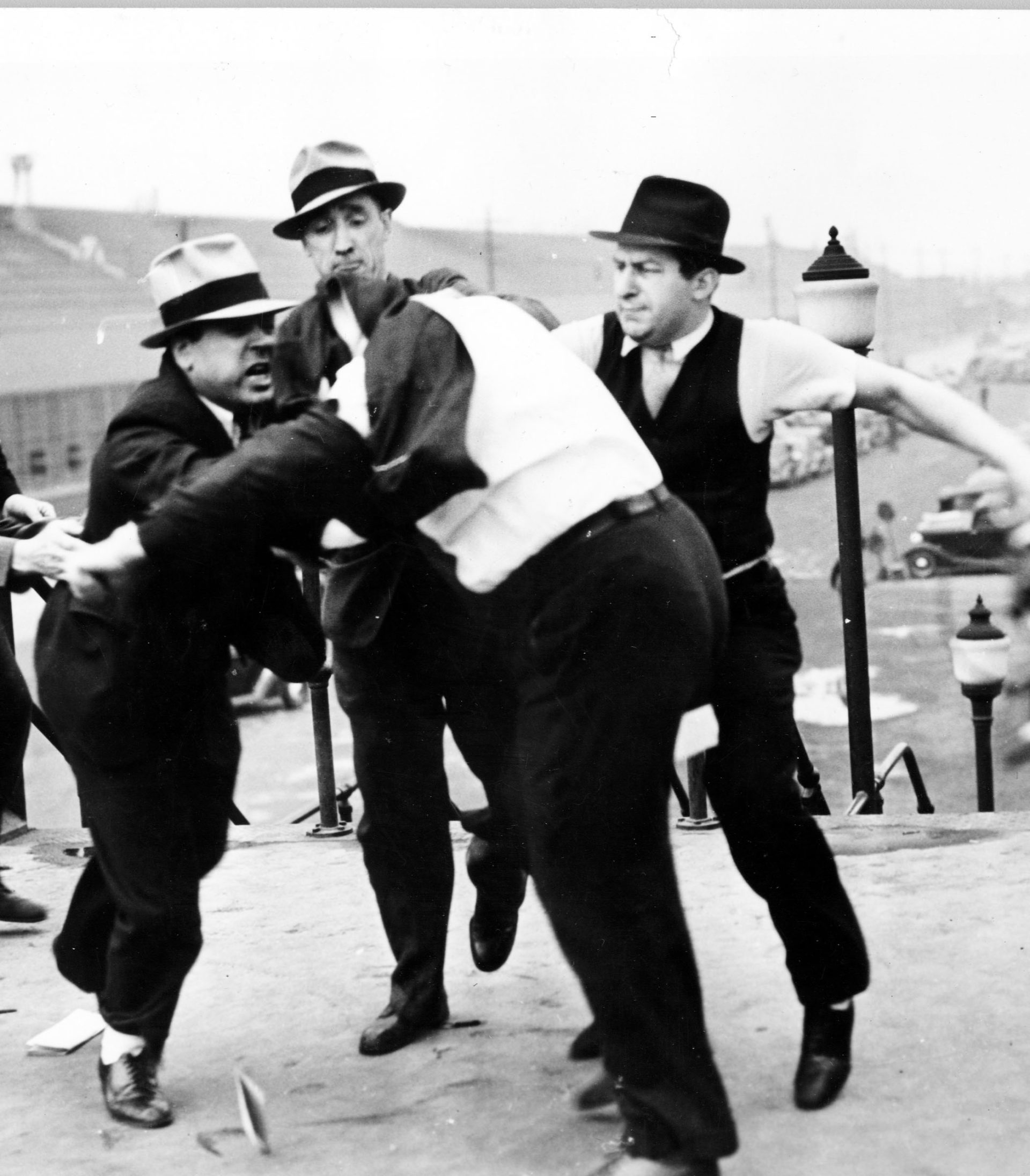
Recovered only recently from the terrible beating given him by Ford service men, Reuther stepped to the microphone but refused to make a speech. “As a worker who has been a slave for seven years and at one time one of King Henry’s slaves, I have only this to say. Once we went to the Ford plant and were beaten up. Then we went again and weren’t beaten up. Why? Because the workers of Detroit, knowing what Ford is now, turned out and outnumbered the service men ten to one. That is the way it must be done. Every auto worker must help organize Ford’s. Every worker who can must help.” Reuther paused. The crowded auditorium, sensing something dramatic, delayed its applause. “At this time,” Reuther continued, ‘I would like to introduce a Ford union member from the River Rouge plant, a man who is daring stool pigeons and service men to appear before you, a man who risks his livelihood. I will not give his name. I ask that he be protected from photographers.”
The Ford worker, his union cap at a jaunty angle, stepped to the microphone in a silence so great that a drop of a pin would have sounded like a boom of a big Bertha and spoke these few words: “The. Ford workers of America expect this convention to back us 100 percent, so that at our next convention we can report we are organized 100 percent.” Bedlam reigned again. Around the hall went the delegates, raising a deafening din that the “tired old man” in Dearborn must have heard if he were listening. United behind a representative leadership headed by Homer Martin, the United Automobile Workers of America are marching again, this time toward Ford’s. They have their work cut out.
“Before another snow flies,” said President Martin, “Henry Ford or somebody for him, will sign on the dotted line.”
The New Masses was the continuation of Workers Monthly which began publishing in 1924 as a merger of the ‘Liberator’, the Trade Union Educational League magazine ‘Labor Herald’, and Friends of Soviet Russia’s monthly ‘Soviet Russia Pictorial’ as an explicitly Communist Party publication, but drawing in a wide range of contributors and sympathizers. In 1927 Workers Monthly ceased and The New Masses began. A major left cultural magazine of the late 1920s and early 1940s, the early editors of The New Masses included Hugo Gellert, John F. Sloan, Max Eastman, Mike Gold, and Joseph Freeman. Writers included William Carlos Williams, Theodore Dreiser, John Dos Passos, Upton Sinclair, Richard Wright, Ralph Ellison, Dorothy Parker, Dorothy Day, John Breecher, Langston Hughes, Eugene O’Neill, Rex Stout and Ernest Hemingway. Artists included Hugo Gellert, Stuart Davis, Boardman Robinson, Wanda Gag, William Gropper and Otto Soglow. Over time, the New Masses became narrower politically and the articles more commentary than comment. However, particularly in it first years, New Masses was the epitome of the era’s finest revolutionary cultural and artistic traditions.
PDF of full issue: https://www.marxists.org/history/usa/pubs/new-masses/1937/v24n11-sep-07-1937-NM.pdf

