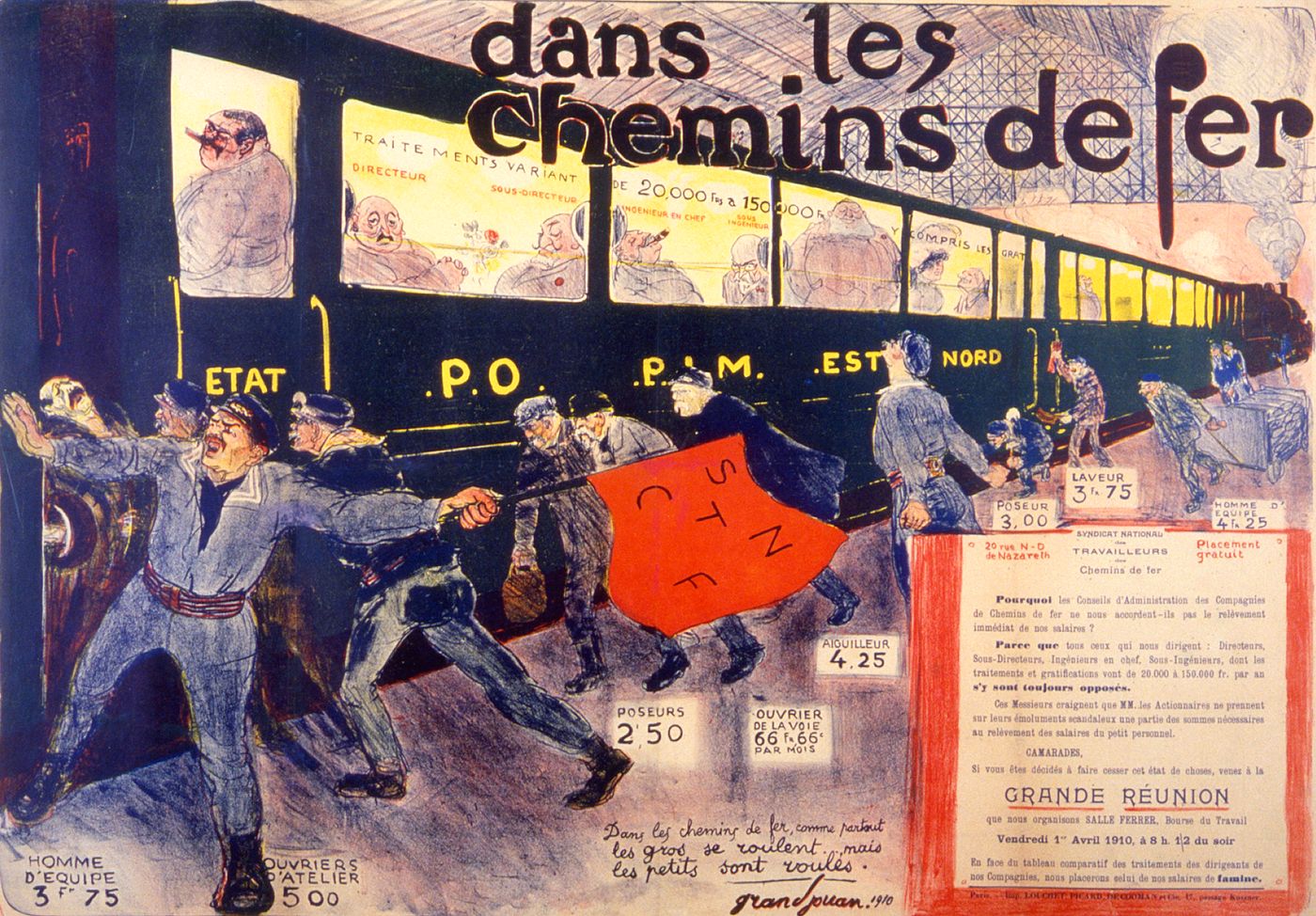
Foster continues his report from the picket lines of the “grève de la thune,” France’s massive 1910 rail strike.
‘Latest News of the G.G.T.’ by William Z. Foster from The Industrial Worker. Vol. 2 No. 34. November 9, 1910.
PARIS, Oct. 16, 1910.
H.S. Shippey, Fellow Worker:
During the past few days the situation has cleared itself somewhat and one is able to judge the extent of the strike. It seems that the railroads most effected are the North R.R. and the West R.R. State. These two are almost completely tied up. The balance of the roads don’t seem to be much effected, although here and there the workers have quit. No official figures of the number of workers on strike are published, though it will probably reach a total of between 50,000 and 75,000.
In Paris the Federation of Building Trades have voted a general strike, and the great majority of the workers have answered the strike order by quitting work.
On Thursday evening the electricians went! on strike and threw a severe jolt into the smoothly running order of things. Just after it had gotten nicely dark, all of a sudden half of the electric lights of Paris went out and the trolley cars came to a standstill, the electricians had quit work and were busy saboting the machinery. Half the town was left in darkness–even Briand’s light went out. The proprietors of hotels, cafes, theaters, etc., hurriedly procured candles or lamp or closed their places. Curses on it, Potaud, the secretary of the Federation of Electricians, or “The King of the Electricians,” as the papers dub him, was at his tricks again. This strike, coming so soon after the general strike on the railroads, threw Paris into intense excitement. Soldiers and police seemed to spring out of the ground, and heavy guards were thrown around the public buildings and power houses. Then, the following day, Briand, the Socialist man on horseback, the French fairly got busy. She filled the places of the striking electricians with soldiers, and these hoosiers, under the surveillance of a few scab electricians, managed to relieve somewhat the pressing demand for power, and incidentally forged their own fetters a little tighter. It is pleasant to note, however, that several of these enlisted scabs have been seriously injured while patriotically endeavoring to steal the bread from their fellow workers’ mouths.
Certainly these soldiers are heroic figures, something to grow patriotic over. They are the result of a governmental fine-comb search of the revision bill communities of France for lunkheads with which to garrison the cities. The city workers, who have some education and an inkling of working class principles, are sent to country posts or to Africa, where they will be out of harm’s way in case of labor trouble. Like all working class patriots, the farmers are in a state of satisfied ignorance which is so gratifying to the government that a couple of days ago a workingman was sentenced to two months’ imprisonment for talking anti-militarism to one. He was debauching the virgin purity of the session hill’s mind. which at present in Paris is almost as serious an offense as to interfere with the sacred right of the workers to work.
These enlisted slaves, scabbinb, or scabs by taking strikers’ places without even being paid for it, are properly despised by their masters. They are herded like cattle, without being given as much consideration. A couple of nights ago a bunch were stationed outside of a building where a strike meeting was being held, and because of someone’s forgetting them they had to stand all night in the chilly weather.
The army is not alone in its scabbing propensities, according the Briand. The navy is some class also. Briand offers to furnish the railroads 1500 navy engineers and firemen if the situation seems to demand it.
Briand has discovered a plot. He says, through his mouthpiece, that the campaign of Sabotage was planned before heard, that the initial committee of the Sabotage is at Paris, and had it not been that the government had taken such prompt action and placed guards about the valuable spots in the railroad system that France would have experienced a reign of anarchy such as Europe has never known. This will serve as a good excuse to jail many militant of the C.G.T. if the strike is a failure. Gustav Herve, who was already in jail, has been placed in solitary confinement and not permitted to see even his attorney. This as punishment for his activities while in jail. Two assistant editor of La Gaere Sociale have been arrested and the copy intended for the paper destroyed. Only one French paper protested against this outrage, and that is a royalist paper. Hundreds of other revolutionists or live spirits are being either arrested, if on strike, or discharged if still at work.
Briand’s famous mobilization order has failed to force the striking railroaders back to work. These are to be given three days grace, and at the end of that time, if they still refuse to scab on themselves, they are liable to arrest and punishment as military deserters.
The scabs on the striking roads and the men on the roads not yet on strike are wearing the mobilization badges, a canvas band worn about the arm and bearing the number of company or section to which the slave belongs.
Surely it is a disgusting sight to see workers shamelessly wearing these badges of their slavery.
In spite of the thousands of troops and police about the railroad property, the Sabotage goes on in ever increasing volume, whilst La Guerre Sociale howls in glee and urges the strikers to throw a real scare into the companies and the government.
Wires have been clipped in hundreds of places, signals destroyed, etc. Several accidents were narrowly averted at points where the rebels had removed rails. Many scabs have been “beat up.” A bunch of strikers in one place got hold of a scab fireman, and forced him to eat a meal of the coal from the engine he was firing. He was made to wash down his gritty meal with a cool draught of engine oil.
Many are criticizing Toffin, the President of the Federation of Engineers and Firemen, for having first declared the general strike without first having ascertain by referendum the sentiments of the workers on the other roads. Below is the strike order:
The National Syndicate of France and the Colonies informs the workers on all the roads that the tieup is complete on the North R.R. It also informs them that since the time of the dismissal of Comrade Toffin, President of the Federation of Engineers and Firemen, that the government has been giving articles to the press which constitute arbitrary and illegal menaces against the railroad workers, who are claiming their rights. In the presence of this situation the National Syndicate has decided to appeal to the workers on all the railroads to declare a general strike.
In consequence, all are asked to put into execution with the least possible delay after receiving this communication the measures that are indispensable to the success of the movement.
ALBERT ELMOINE TOFFIN,
Pres. Fed. of Eng. and Firemen. When the strike had been declared and the workers showed an inclination to answer it in force, the Parisian papers simply worked themselves up to a frenzy. One would almost think from their howls that the end of society had arrived Now, when there seems to be at least a temporary lull in the matter, these worthy opinion moulders have recovered their equanimity and have entered upon a thoroughly organized campaign of scientific lying in order to not only prejudice the public against the workers who are on strike, but to prevent other workers from joining them.
The hand of Briand is seen in this also, as the campaign of lying was started simultaneously by all the papers. These papers control the news situation, and it is impossible to learn just how extensive the strike is. It must be a serious one, though, from the frantic efforts of the government to break it. The papers now take the stand that the strike is over and are holding up revolutionary tactics as horrible examples of a labor movement gone wrong. They are encouraging a wholesale desertion of the C.G.T. and a return to the beautifully orange unionism of a few years ago.
The situation is one of such a nature that it is difficult to analyze it or to prophecy as to its possible outcome. However, the French working class, through the recent great increase in the cost of living, are literally being driven into a corner, and this railroad strike may yet cause an industrial war beside which the present one will sink into insignificance. Yours for the I.W.W.,
W.Z. FOSTER, Poste Ristante, Place de la République.
The Industrial Union Bulletin, and the Industrial Worker were newspapers published by the Industrial Workers of the World (IWW) from 1907 until 1913. First printed in Joliet, Illinois, IUB incorporated The Voice of Labor, the newspaper of the American Labor Union which had joined the IWW, and another IWW affiliate, International Metal Worker.The Trautmann-DeLeon faction issued its weekly from March 1907. Soon after, De Leon would be expelled and Trautmann would continue IUB until March 1909. It was edited by A. S. Edwards. 1909, production moved to Spokane, Washington and became The Industrial Worker, “the voice of revolutionary industrial unionism.”
PDF of full issue: https://www.marxists.org/history/usa/pubs/industrialworker/iw/v2n34-w86-nov-09-1910-IW.pdf

