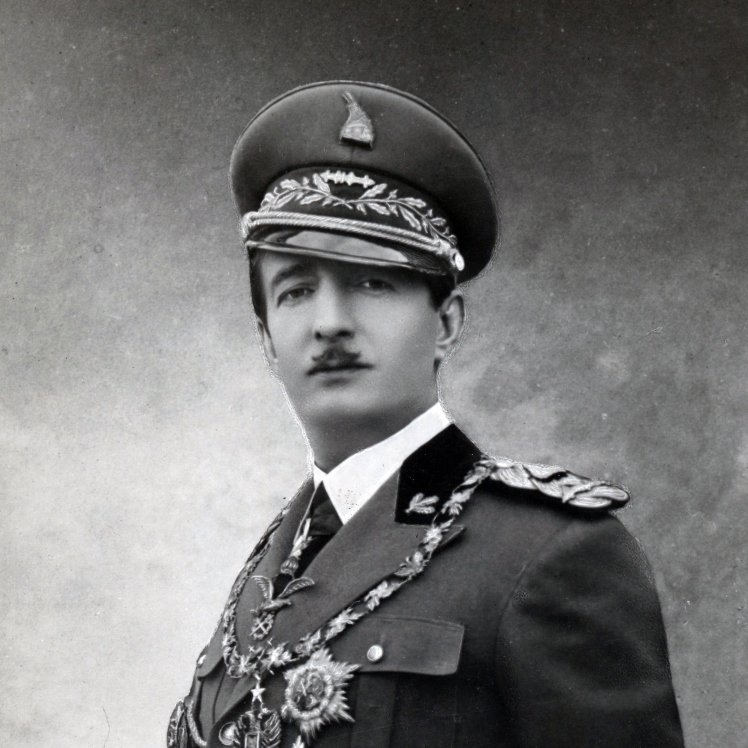
Fascist Italy’s designs on Albania began with their ascension. In 1926, after significant economic investments, the First Treaty of Tirana is imposed on the Albanians.
‘The Fight for Albania’ by M. Tanin from International Press Correspondence. Vol. 6 No. 90. December 23, 1926.
An insurrection has broken out in Albania; Italy has concluded a defensive treaty with Albania and has sent warships to the Albanian frontiers; confusion reigns in Athens; the semi-official French “Temps” is raising an alarm about the Italo- Albanian treaty…
It is only necessary to report these events in order to realise at once that great international complications slumber in the bosom of the alarming Albanian events. As a matter of fact, little Albania is the button in the Balkans which need only be gently pressed for the whole of Europe to ring with alarming signals which call attention to the danger of a military conflagration. The geographical situation of this unprotected country alone makes it the object of the greed of the large imperialist States of Europe and of the neighbouring small Balkan States (Jugoslavia, Greece); those who possess Albania, especially its northern port of Skutari and its southern port of Valona, rule over the commanding heights of the Balkan peninsula and have in their possession the key to the Adriatic and to the naval bases which facilitate the control of the great waterway the Mediterranean. Albania is all the more a tempting morsel for the imperialists because it possesses naphtha-wells and great possibilities for the cultivation of cotton.
Moreover, the internal condition of the country is such as always to give a suitable excuse for intervention: the peasantry, groaning in semi-serfdom under the yoke of the great feudal beys often resorts to revolts which are further intensified by religious contradictions (three quarters of the population numbering 850,000 is Mohammedan, the rest Orthodox and Catholic).
One of these insurrections was the rebellion of the tribe of the Mirdites. A number of factors indicate that independently of the agrarian character of the movement, certain threads link it with Rome. In this respect it is indicative that at the head of the revolt is an Italian priest. Don Lora-Ciecca, who entertains connections with the Albanian circles with an Italian bias, and with Fan-Noli, the former chief of Albania, who fled to Italy after Achmed Zoga Bey, the present President, had seized the power. Judging by the events which followed, the object of the secret intervention of Italy was to force Achmed by blackmail to sign the “treaty of friendship” on November 27th, which has just been made public. This treaty contains a clause according to which Albania pledges itself to sign no political or military treaty which is directed against Italy. It is quite clear that, in view of the existing relation of forces between the two parties, Italy can interpret this point in so elastic a way as to establish a protectorate over Albania.
In recent times the economic and political penetration of Albania by Italian imperialism has proceeded at so rapid a pace that the country would actually seem to be an Italian colony. The Italian company “Selemida” has received a naphtha con cession, other companies a railway concession, a group of banks headed by the “Credito Italiano” has founded the Albanian. National Bank only in name, the Italian company “Svea” has spun a network of various undertakings over the whole country. At the same time the Italian diplomatic and military missions have supplemented the economic exploitation by political and military penetration. The present “treaty of friendship” is the crowning point of this policy of Fascist expansion in Albania. Fascist diplomacy has taken its revenge, it has almost achieved that which the other, imperialist States were compelled at one-time to promise Italy at the Council of Ambassador’s (November 1921) the protectorate over Albania.
This forging ahead of Mussolini’s is creating a very tense situation in the Balkans and outside their borders. The most recent telegrams from Jugoslavia, which makes pretensions to Northern Albania, reveal great excitement in the political circles of Belgrade. The Albanian “excursion” of Fascist imperialism will have a similar effect on Greece. And yet, only a short time ago, there was talk of the “cordial friendship” which Mussolini had established between Italy on the one hand and Jugoslavia and Greece on the other hand.
France has been seized by no less excitement than have Italy’s Balkan neighbours. The semi-official “Temps”, in commenting on the Italo-Albanian treaty, remarks with indignation, that it signifies the subjugation of Albania by Italy. In view of the generally increasing tension in Italo-French relations and in view of the French support of Jugoslavia, which at the present time is being hard pressed by Italian imperialism, this circumstance will necessarily reuse the greatest alarm in Paris and lead to further intensification of the relations between the latter and Rome.
The question naturally arises as to what is the attitude of England, the third participant in the former Entente, towards the attack of Fascist diplomacy. This question is all the more important because, apart from general political interests, English imperialism has considerable material interests in Albania. The Anglo-Persian Oil Company has a naphtha concession of 200,000 hectares in the district of Valona; other English companies are financing the construction of roads: furthermore English capital is showing an interest in the possibilities of cultivating cotton in Albania. At the same time England has succeeded in ensuring her political influence in Albania by taking over the “civilising” task of organising the gendarmerie for Achmed Zoga, which is to make it easier for him to suppress the peasant revolts.
This makes it clear that English and Italian interests must clash. In contrast to the French Press, however, we have up to the present seen no hostile commentary in the English Press with regard to the Italian assault on Albania. On the contrary, in April of this year, the English conservative journal “The Nineteenth Century” actually published an article by Colonel Sterling, the very officer who is organising the gendarmerie for the President of the Albanian beys and who speaks in a sympathetic tenor of Italy’s interference, remarking that “commissioned by Europe, it will pacify this district of eternal unrest which is threatened by Bolshevist propaganda”. This is undoubtedly a consequence of an Anglo-Italian agreement which was concluded in Livorno and which is directed against the Balkan peoples, Turkey and the U.S.S.R.
In view of all these events, we are involuntarily reminded of the forced departure of Comrade Krakoviecki, the Soviet representative in Albania at the end of 1924.
As is well known, the representatives of England and Italy in Tirana had exercised heavy pressure on Fan-Noli and demanded that he should dismiss the representative of the U.S.S.R. on the pretext that he was “a threat to the safety of Albania”: The same gentlemen are now concluding an agreement which amounts to handing over the Albanian people to the bankers of Rome (and possibly also of London) and to destroying the independent Albania, a fully privileged member of the League of Nations that protector of the small peoples!
Even more important than this self-revelation of the imperialists is the fact that the Fascist advance against Albania intensifies the danger of war in the Balkans and in Europe altogether; for, if, according to the traditional saying, the Balkans are the powder magazine of Europe, Albania is one of the slow-matches which lead to it. And the Fascist imperialists are now setting light to this slow-match.
International Press Correspondence, widely known as”Inprecorr” was published by the Executive Committee of the Communist International (ECCI) regularly in German and English, occasionally in many other languages, beginning in 1921 and lasting in English until 1938. Inprecorr’s role was to supply translated articles to the English-speaking press of the International from the Comintern’s different sections, as well as news and statements from the ECCI. Many ‘Daily Worker’ and ‘Communist’ articles originated in Inprecorr, and it also published articles by American comrades for use in other countries. It was published at least weekly, and often thrice weekly. A major contributor to the Communist press in the U.S., Inprecorr is an invaluable English-language source on the history of the Communist International and its sections.
PDF of full issue: https://www.marxists.org/history/international/comintern/inprecor/1926/v06n90-dec-23-1926-inprecor.pdf

