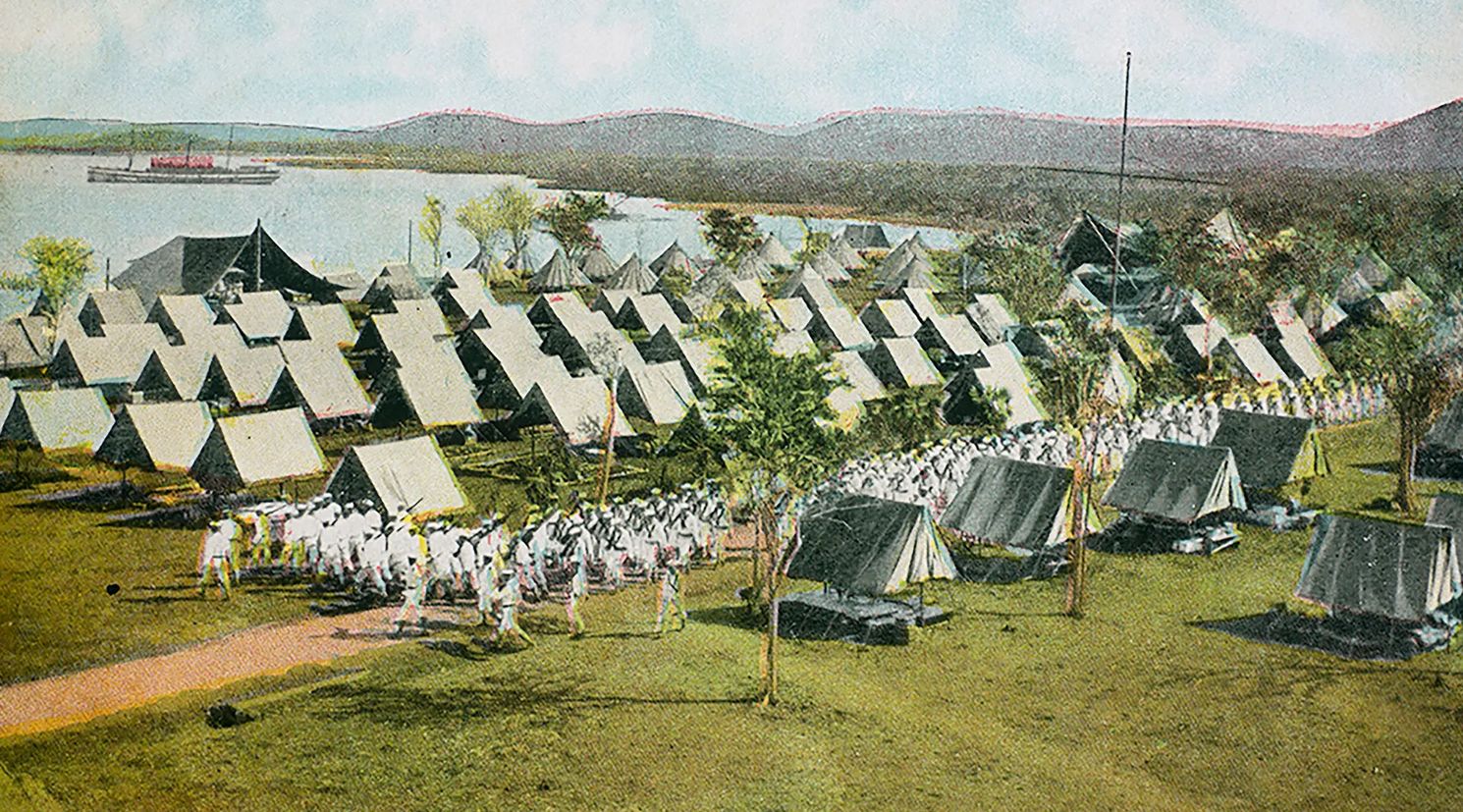
Cuba under the “Platt Amendment.” Before 1959, every major issue was decided for Cuba in the interest of U.S. capital and its lackeys. It was not just the U.S. military with its important Guantanamo Bay base, the sugar barons, the tobacco trust, National City Bank, and later the mob, but every facet of politics and economy on the island was eventually dictated by relations with the United States. To accomplish this against widespread resistance, the most brutal practices were institutionalized in what became a generations-long police state.
“Our Colony of Cuba” by Jorge A. Vivo from The Daily Worker. Vol. 6 No. 339. April 8, 1930.
Under this title given above, a liberal of the United States, Leland Jenks, has written a work in which is studied situation in Cuba, the neighboring country that is going through an important political crisis and in which the recent strikes reveal a strong anti-imperialist movement, a struggle against the native agents of Yankee imperialism. Cuba is one of the countries of Latin America that is most submitted to the influence of the White House. “Emancipated” from Spain by means of the “generous” aid of the United States, which even in those days had sufficient “interests” there to use military force with the end of guaranteeing them, Cuba later fell under the absolute domination of Wall Street.
During the “republican” period of “independent life of the country, as the bourgeoisie calls the epoch following U.S. intervention of 1898, imperialism has profited every opportunity presented to assure its decisive and absolute influence in the economy of Cuba. The result of this economic policy of imperialism has been very fruitful. All the so-called “national” industries are actually manipulated by companies founded in the United States.
“A Yankee Plantation.”
Thus, more than 80 per cent of the sugar industry, with an estimated value of $100,000,000 belongs to Yankee trusts intimately linked with the National City Bank. The Tobacco Trust, which controls both the manufacture of tobacco products and the export of raw tobacco, is founded in New Jersey. The railway system is principally run by American companies and those which are British are subjected to the convenience of the American companies. Fruit production, mining (gold, copper, iron, manganese, asphalt, etc.), the telephone system, the street-cars, electric companies, and even amusement places and important hotels are in the hands of great U.S. trusts which also furnish 80 per cent of the island’s imported commodities.
The Cuban bourgeoisie, formerly master of the large part of means of production, is now really minority shareholder in the economy of the country, a mere appendix of imperialist economy. The National City Bank of New York and the Royal Bank of Canada, the most important banking institutions, have nearly one hundred and fifty branches in the country, through which all the economic life of the country is controlled. Recently, the Chase National Bank and some others are playing an important role as controllers of the Cuban treasury. Practically, these banks, all of the United States, control all finance and economy. Subjected to such an aberrant economic submission, the island is really a colony of imperialism, its political life directed from the White House. The Platt Amendment, a permanent treaty imposed on the Constituent Assembly that prepared the advent of the “republic,” is a treaty that confirms this submission and assures the strict carrying out of the policy of penetration and hegemony of the United States contained in the Monroe Doctrine.
The “Platt Amendment.”
According to this “Platt Amendment.” The Cuban government is unable to contract debts with other nations than the United States if the U.S. “considers” that such obligations cannot be paid by the ordinary income; the U.S. Government can intervene in Cuba whenever “sanitary conditions,” “personal security” and “individual property” may not be sufficiently “guaranteed”; and, among other clauses of such kind as make this alleged “republic” a Yankee “protectorate” the Cuban government is obliged to cede ports of strategic value for the establishment of naval and military bases—a thing carried into practice and which has permitted the important port of Guantanamo to be ruled under the stars and stripes.
At present the chief imperialist agent in Cuba is Gerardo Machada, internationally known as an assassin and sbare-holder of the General Electric Company, who was put in the post of president of the “republic” by means of loans made by Yankee concerns which bought this magnificent political position for their lackey (Machado is paying great sums monthly to other politicians that opposed him in the election in which he was “elected,” sums guaranteed by commercial payments underwritten by imperialist agents).
The U.S. proletariat already knows the policy of the Machado government, characterized by the bloodbaths given the workers and peasants and the most barbarous attacks against the revolutionary organizations.
Machado—The Infamous.
The assassination of working class leaders, the massacre of agricultural workers, the jailings, deportations, the “original” method of feeding the bodies of militant workers to the sharks of Havana Bay, crimes against Cuban emigrants abroad such as the murder of Julio Mella, and other means used daily by Machado and his big gang, have made Machado’s regime known to the whole world proletariat as one of the most brutal that history records in the oppression of colonial and semi-colonial peoples. Machado and his followers have scrupulously and slavishly served the interests of Yankee imperialism and its appendix, the Cuban bourgeoisie. The name of this criminal, an example of our class enemy, is the symbol of a regime of oppression, of plunder and robbery that world imperialism’s agents in China, that the fake “revolutionary” regime of Rubio-Calles and Portes Gil in Mexico, likewise carry out. The exploitation of the wage workers of Cuba who, according to an estimate of 1919, number 1,000,000 among a population of 3,500,000, and among which million of workers are not only men but many women and to move without reckoning on the Cuban hangman of Yankee imperialism. Yankee imperialism could not benefit from its rule of this small rich country did it not count upon a whole apparatus of oppression that guarantees its investments. The accession of Machado to power marked the period in which the White House acquired complete economic hegemony in the country, which necessitated its complement, complete political hegemony.
Machado is merely the governor of the colony of Cuba, practically only another state of the American Union, subjected to barbarous exploitation of Yankee imperialism.
The Daily Worker began in 1924 and was published in New York City by the Communist Party US and its predecessor organizations. Among the most long-lasting and important left publications in US history, it had a circulation of 35,000 at its peak. The Daily Worker came from The Ohio Socialist, published by the Left Wing-dominated Socialist Party of Ohio in Cleveland from 1917 to November 1919, when it became became The Toiler, paper of the Communist Labor Party. In December 1921 the above-ground Workers Party of America merged the Toiler with the paper Workers Council to found The Worker, which became The Daily Worker beginning January 13, 1924.
PDF of full issue: https://www.marxists.org/history/usa/pubs/dailyworker/1930/v06-n339-NY-apr-08-1930-DW-LOC.pdf

