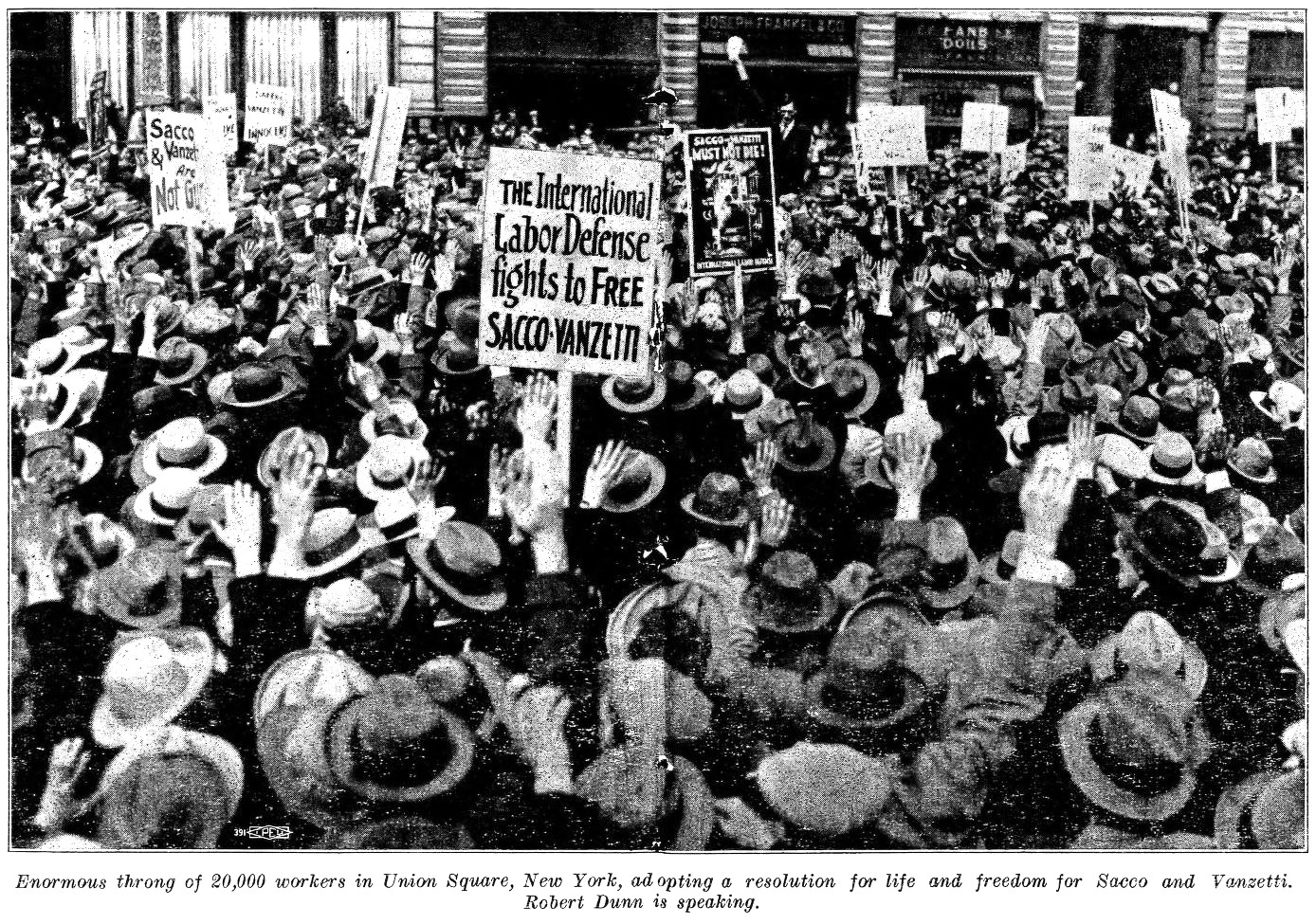
Speech by the International Labor Defense leader to a Chicago mass meeting as the appeals process nears its end for Sacco and Vanzetti, leaving only extralegal options for preventing their state murder.
‘Sacco and Vanzetti Must Not Burn on the Electric Chair’ by James P. Cannon from Labor Defender. Vol. 2 No. 6. June, 1927.
A speech held at the Sacco-Vanzetti Mass Meeting in Chicago on May 18, 1927
THE Sacco-Vanzetti case has been a part of American labor history in the making. It is seven years now since Sacco and Vanzetti have been in the shadow of the electric chair. I do not believe that history knows of a similar case to this. I do not believe that we could find anywhere a case of such prolonged torture as the holding of the sentence of death over the heads of men for seven years and at the end of that time we can come together for a meeting and not know yet whether that sentence is to be executed or not.
The cause of Sacco and Vanzetti demands of us, of the entire labor movement, militant, unhesitating and unified support. We may have different opinions on many problems, but there is one thing that we have become sure of in these seven years in which we have said our word for Sacco and Vanzetti. We have become absolutely convinced that the case of Sacco and Vanzetti, the case of these two Italian workers in Massachusetts is not the case of two hold-up men or bandits. We have become convinced that it is the working class against the capitalists. We have become convinced that Sacco and Vanzetti are not only innocent of this specific crime with which they are charged, but that they are innocent of any crime except that of being victims of exploitation by the capitalists of the masses.
Their case is a universal one indeed, and it has gone so far that we do not need to discuss it from a legal standpoint; but for those who are interested it has been set forth by Mr. Holly and we can say for others, that recently a book was published by Professor Felix Frankfurter in which he comes to the conclusion that there is no case against Sacco and Vanzetti.
But the case of Sacco and Vanzetti has a far bigger significance than any legal procedure. Sacco and Vanzetti began in this case as two employes, obscure fighters of the working class, but they have grown in these years until their personalities have made their impression not only in Massachusetts, not only in the United States, but all over Europe and America.
Sacco and Vanzetti have grown as the great symbols of the whole labor movement. They stand for the upward struggle against oppression and exploitation, for fearless defiance of the enemies of labor with which the best representatives of the working class are instinct.
Everyone today knows why the bourbons of Massachusetts arrested, imprisoned and tried Sacco and Vanzetti. Had they not been scrupulously loyal to the cause of the working class they would not now be faced with the grim march to the death chair. Had they remained silent while their brothers and comrades around them suffered persecution and oppression, had they not made the ideal of the liberation of the working class their own ideal, there would not today be a Sacco-Vanzetti case. Had they, in court, begged for mercy and renounced their cause and their past, they would have been freed to achieve obloquy.
But they did none of this. Despite the hundreds of interminable nights and days of imprisonment, with the ghastly thought of execution constantly in their minds, they have remained as simply true to the workers’ cause as they were before this infamous frame-up was conceived in the minds of the Massachusetts reaction. Yes, their persecution has even steeled their convictions and history has already bound them inseparably with the history of the American labor movement.
After seven years they come to court for sentence, and I wish that every worker in America could read the speech that Vanzetti made there. After seven years of torture and seven years of fighting by friends and comrades with the death sentence, this man stood up in court not as one guilty, not as one afraid, but turned to the judge on the bench and said to him:
“You are the one that is afraid. You are the one that is shrinking with fear, because you are the one that is guilty of attempt to murder.”
Vanzetti called his witnesses there, and not merely legal witnesses. He marshalled before Judge Thayer’s attention the thousands who have decided to hold mass meetings such as ours, and men of our period like Anatole France, Maxim Gorki, Bernard Shaw, Henri Barbusse, Albert Einstein. He pointed to the many millions who have protested against the death-hunt of two labor fighters.
He turned to Eugene Victor Debs and other men in America. Let us not forget that we should measure guilt and innocence not by formal evidence in court alone, but by higher values than that. Let us not forget that the last thing that Eugene Debs wrote publicly was an appeal to the workers of America for Sacco and Vanzetti, an appeal whose stirring language aroused with renewed vigor the protest of hundreds of thousands in this country, and brought again the million-voiced demand for life and freedom to these two valiant fighters, and condemnation of their persecutors.
It is hard to speak with restraint. I, like Comrade Chaplin, also had the honor of speaking with Vanzetti. Everyone that has seen and spoken with him comes away with the feeling that he has stood in the presence of one of the greatest spirits of the time.
It is hard to speak with restraint when one is pressed by the thought that the vengeful executioners of Massachusetts are consummating their hideous plan to press the switch that will forever remove from our ranks the persons of these two men who we feel are so much a part of labor and its cause. Our impassioned determination to mobilize all of our strength and power to rescue Sacco and Vanzetti from their blood-lusty jailors must be communicated thruout the land if we are to save them from the fate that has been prepared for them.
While I believe with the statements of Fitzpatrick that our meeting should disassociate itself from irresponsible people, let us not forget the year 1916 when Joe Hill was killed in Utah. We must remember that when the wave of working class protest began to rise in protection of Joe Hill, gangs of detectives began to frame-up fake letters. After the heart of Joe Hill had been pierced by the bullets of the death squad, it was exposed that frame-up letters had been used. This must be a lesson for us and for those who are the friends of Sacco and Vanzetti.
There is no need to threaten the governor or anyone else because the protection of Sacco and Vanzetti is far stronger than any personal act. The protection of Sacco and Vanzetti is the job of the working class of the world, which is knocking on the door, not with the hands of irresponsible individuals, but with the titanic fist of the workers of the wide world because they believe in the innocence of Sacco and Vanzetti. We say to you, our friends and our chairman, before they turn on the switch, that the real aim is not to burn Sacco and Vanzetti in the electric chair but to burn the labor movement in America.
If the workers of America and the workers of the world are determined enough and encouraged enough, we can yet save Sacco and Vanzetti. And it is in that spirit that we meet here tonight. We do not meet here to resign ourselves to their fate. We meet as another stage in the fight for Sacco and Vanzetti. We believe that the workers assembled here will go back to their organizations and their jobs and raise again the battle cry for Sacco and Vanzetti.
Let us demand not only the liberation of Sacco and Vanzetti. Let us demand also the impeachment of the monstrous judge who tried and sentenced them. Let us consider ways and means of making our protest more effective. From this great movement, from the words of Sacco and Vanzetti, let us draw inspiration.
We have hope, and we have faith in the workers of America, and in the workers of the rest of the world who have so often and readily responded to the calls for solidarity and aid for Sacco and Vanzetti. Every worker in the land must be made to realize the monstrosity and significance to the whole labor movement of this crime. Every worker must stand shoulder to shoulder with his brothers to build a solid wall of defense for the victims of the Massachusetts bourbons who are bent on their bestial revenge Only the great and inspiring solidarity of the whole working class will succeed in snatching Sacco and Vanzetti from the chair of death.
Labor Defender was published monthly from 1926 until 1937 by the International Labor Defense (ILD), a Workers Party of America, and later Communist Party-led, non-partisan defense organization founded by James Cannon and William Haywood while in Moscow, 1925 to support prisoners of the class war, victims of racism and imperialism, and the struggle against fascism. It included, poetry, letters from prisoners, and was heavily illustrated with photos, images, and cartoons. Labor Defender was the central organ of the Scottsboro and Sacco and Vanzetti defense campaigns. Editors included T. J. O’ Flaherty, Max Shactman, Karl Reeve, J. Louis Engdahl, William L. Patterson, Sasha Small, and Sender Garlin.
PDF of full issue: https://www.marxists.org/history/usa/pubs/labordefender/1927/v02n06-jun-1927-LD.pdf

