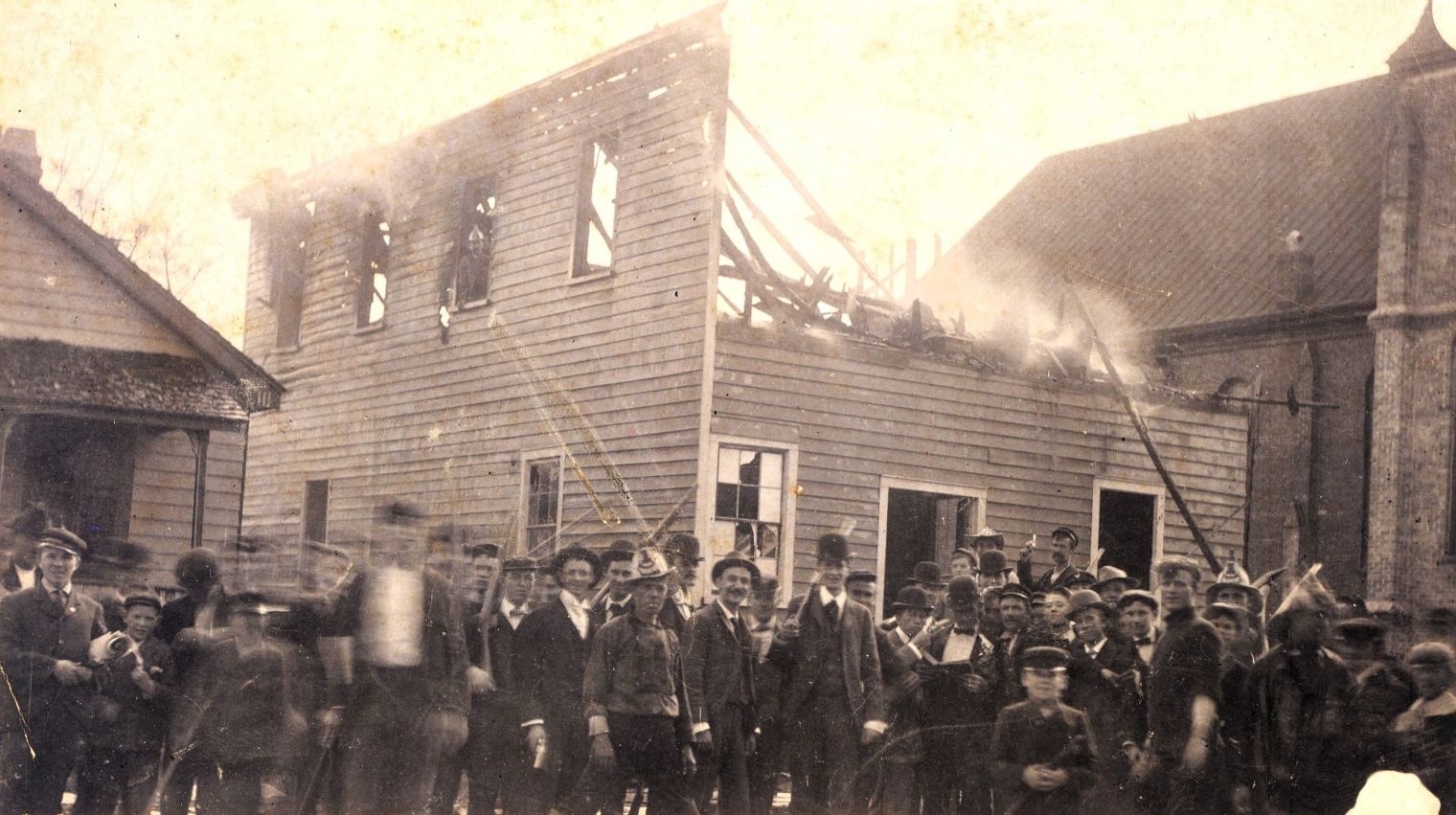
A brief insight into the workings of race-class in the United States from the experience of overthrow and massacre of Wilmington, North Carolina’s Black dominated government.
‘The ‘Color Line’ Develops into the Class Struggle’ by B.F. Kolmard from The People. Vol. 9 No. 5. May 1, 1899.
The meaning of the “color line” has been fundamentally changed. Instead of “race riots” being as formerly outbursts through which hostile Northern and Southern material interests found vent, now they are means of expressing the “irrepressible conflict” between united capitalists (Northern, Southern and European) and the wage workers (here predominantly negroes). “Color” plays no other part than that of locally expressing the class line, while at the same time obscuring it to the workers, just as with the nationality issue in the North.
The best example of these outbreaks is that of Wilmington, N.C., where capitalist interests, bringing to their service racial prejudice, etc., ousted the whole negro Government from its previously supreme control, the real ground being that the rule of this “improvident,” “non-taxpaying.” etc., etc., element had “disturbed and paralysed business.”
First; Democrats, and white Republicans at the suggestion of Republican Governor Russel, united unanimously upon an exclusively business men’s ticket. Second, the whole business fraternity, impatient and enraged, drove out the negroes by armed force, the Chamber of Commerce with its President, a New England Republican, dominating. To quote a special investigator present, an intimate of McKinley: “In the presence of what they believed to be an overwhelming crisis, THEY BRUSHED ASIDE THE GREAT PRINCIPLES THAT DIVIDE PARTIES AND INDIVIDUALS AND STOOD TOGETHER AS ONE MAN.” The whole capitalist class, North and South, Democrats and Republicans, Bryan and McKinley, have since endorsed this in numberless ways.
The old, anti-capitalist, South is gone; the new, capitalist, South is here, “loyal,” “patriotic” and boisterously applauds the unctuous McKinley when he Jubilates over “the unification of the ‘sections'” and its “blessings.” “Jubilate Deo” while you may: the real sections, the working class, are also uniting under the banner of the S.L.P., and merging all their local, nationality, color, sex, and occupation fractions of the class line into one simple, enormous, iron line to crush wage slavery and send it to join its predecessor, chattel slavery, forever.
New York Labor News Company was the publishing house of the Socialist Labor Party and their paper The People. The People was the official paper of the Socialist Labor Party of America (SLP), established in New York City in 1891 as a weekly. The New York SLP, and The People, were dominated Daniel De Leon and his supporters, the dominant ideological leader of the SLP from the 1890s until the time of his death. The People became a daily in 1900. It’s first editor was the French socialist Lucien Sanial who was quickly replaced by De Leon who held the position until his death in 1914. Morris Hillquit and Henry Slobodin, future leaders of the Socialist Party of America were writers before their split from the SLP in 1899. For a while there were two SLPs and two Peoples, requiring a legal case to determine ownership. Eventual the anti-De Leonist produced what would become the New York Call and became the Social Democratic, later Socialist, Party. The De Leonist The People continued publishing until 2008.
PDF of full issue: https://www.marxists.org/history/usa/pubs/the-people-slp/990501-thepeople-v09n05-maydayspecial.pdf

