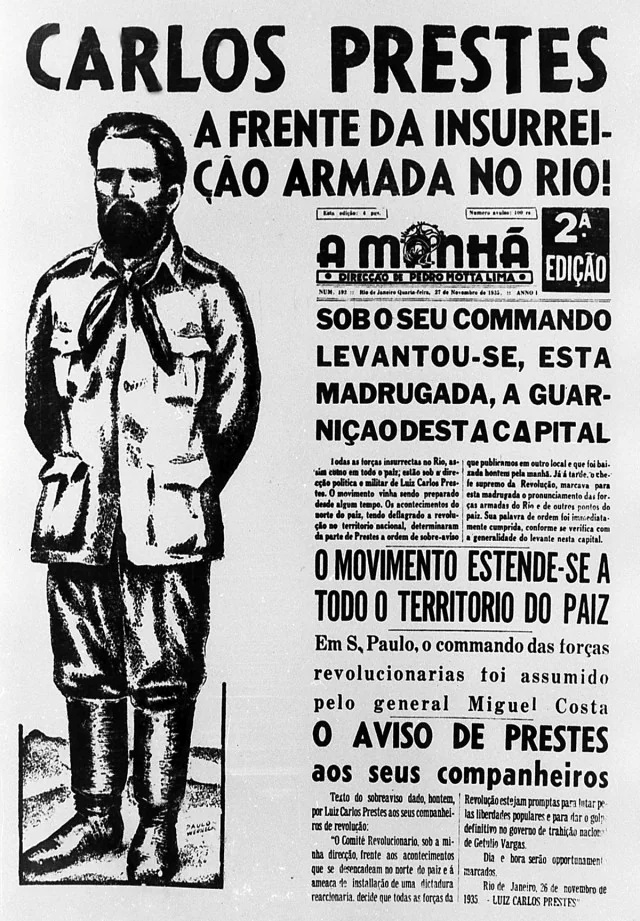
This early (for a U.S. audience) explanation of Brazil’s history is also interesting for its ‘Third Period’ critique of the previous policy of the country’s Communist Party. Shifting for several years from the colonial ‘national democratic revolution’ to a contest for power by ‘class against class,’ the experience of the tenentismo junior officer’s movement personified by Luís Carlos Prestes’ 1920s armed revolt is criticized. Prestes, of course, would soon become a leading figure in Brazil’s Party. I am unsure of the author’s identity, perhaps a pseudonym? If anyone knows…
‘The Political Situation of Brazil’ by Armando Guerra from The Communist. Vol 9 No. 11-12. November-December, 1930.
(This article was written for the September issue of THE COMMUNIST but translation delayed printing until this present issue. The recent revolt placed Vargas in the presidency.—Editor.)
WE have before us the letter of General Luis Carlos Prestes, one of the military chiefs of the petty bourgeois revolt of 1924-1926. The letter is interesting and merits our comment, but first it is necessary to say a few words about Brazil, which to many comrades appears only as an African jungle where still hangs the monkey and exists the tropical zoo.
a) The Petty Bourgeoisie and Feudalism. The political history of Brazil has arisen from the struggle between feudal agrarian capitalism with modern characteristics, and the petty bourgeoisie nurtured by local industrialists. This struggle has almost always been underground and the lack of a subjective factor which might analyze and make it obvious, has not always permitted it to be clearly seen—this “invisible” struggle, disguised with compromise and temporary alliances. Yet at times the struggle became open with noon-day clarity, acquiring the aspects of violence that was frequently armed.
Contrary to the other South American republics, which from the declaration of “independence from Spain” (that is to say, from the metropolis), acquired a bourgeois republican system of government, Brazil adopted the monarchist system at its “independence” from Portugal. The republican system was not attained until 1889, when the abolition of Negro slavery was declared. This republican movement was headed by English industrialists who brought the railroad. The railroad determined the “republic” in Brazil. The social slogan of the British railroaders was the liberation of the Negro, the abolition of slavery. Here it would have an element to assure itself of a military force, a basic force against the feudal elements of Brazil.
But the Englishmen who laid the first railroad ties were taking another turn; those who expected the industrialization of Brazil found, shortly, that the industrial conquerors were turning into planters, proprietors of great areas of land, of plantations of coffee, sugar, cotton, wheat, livestock, etc. The railway was but an element of easy locomotion and rapid transport. Here industrialism in the real sense of the word died. Only light industry advanced; textile for local consumption (and not even to satisfy that), shoes, glass, paper, etc.
The extension of the world market for coffee enriched the planters, especially the British, who were more powerful and with greater credit in the metropolis, and also gave a basis for coffee playing a more dominant role in national economy. Coffee, the product of decisive importance, and the coffee interests exercised political hegemony in the country.
Thus we see that in Brazilian politics, two predominant states took turns in presidential leadership, both with agrarian characteristics and, moreover, dedicated to coffee: Sao Paulo and Minas Geraes. As time went on, Sao Paulo was the state which, in the inter-imperialist struggles localized in Brazil, would be held by the English, while the Yankee imperialists, who followed this local vein, intrenched themselves in Minas Geraes to the point of having invested in the late months of last year around $200,000,000 in mines. But we must follow the story historically a bit more.
Agrarianism, better said modernized feudalism, due to the factor of coffee, took or retook positions. Light “industrialism” took strength from financial capital and the struggle continued, taking violent proportions at times, at others mutely disguised.
This struggle localized itself in Brazilian history in the following manner: The attempt to restore the monarchy in 1893; anti-protection tariffs in 1890-1893, 1905 and 1920; the successive stabilizations of coffee prices, and even the social legislation granting national lands to European colonists, initiated in 1914. In 1922 there appeared the tendency to combat the great feudalist with the tax against the great proprietors who managed to smother the revolt that was then agitating the country.
b) The revolt of July, 1924. The Brazilian army, by its social composition if we refer to those at its head, is typically petty bourgeois. This army class of the officialdom would support in an armed movement “such industrialism” (of the petty and light industry type) in the security that the petty bourgeoisie would be permitted to transform itself into a governing national bourgeoisie. This revolt may also be characterized as the inter-imperialist struggle localized in Brazil. This revolt, by its predominant factors, has the same characteristics that shortly afterward were shown in the revolt of Gonzalo Escobar against Portes Gil-Calles in Mexico in 1929.
From Yankee capital that in 1914 had no invested value, in 1918 the government of Brazil asked and obtained $150,000,000. And from this date the inter-imperialist fight is shown electorally at times, violent and armed at others. In 1918 Epitassio Pessoa passed from the presidency to be representative of the Yankee bank notwithstanding the weakness of American investment compared to that of the English. In the election for president for the four-year term 1922-1926, an armed revolt solved the question favorably to British imperialism in the person of Arturo Bernardez; it was supposed that by a rotation the presidency would fall to a chief of the state of Minas
Geraes, today in the hands of Yankee imperialism (American Smelting Company having invested at the end of the past year around $200,000,000 in mines.)
A few days after the first revolt of July, 1922, the Communist Party was born, with active elements previously anarchistic. From that moment the Party lived in illegality or semi-legality.
A partial economic crisis came in 1924, The elements, previously termed “Industrialists” (today gathered in a political party called “liberal”), attacked the positions of British imperialism, on the excuse of a lack of electoral democracy, a lack of liberty.
Industrialism returned, as in the former revolt, to lose its starting point, which was naught but the petty bourgeoisie of the states of Rio Grande do Sul, Sergipe, and part of the industrialists of Sao Paulo (especially the textile industry.)
But this time there was displayed a force that showed itself very obscurely, very tenuously, as a political force capable of meriting a temporary alliance with us. This was the force of the Division General, Isidoro Diaz Lopes. But, more than this, from the division of this general there stood out a column that was then commanded by Captain Luis Carlos Prestes, that by its size would allow him the rank of colonel, and which a little later was to transform itself into a general’s column.
General Isidoro Diaz Lopes was in possession of the city of Sao Paulo, that is to say the most important city of Brazil (a million inhabitants and more than $80,000,000 in banks). The federal forces, that is, those of British imperialism, sent into this zone 97 per cent of all the armed forces of the Brazilian army, because the revolutionists had made themselves strong in that city. Militarily, the city of Sao Paulo offered magnificent conditions for the defense, and the fact that the federal forces were coming from the Northeast, left the revolutionists with the Southwest open for all sorts of food and supplies, besides the fact that popular sympathy for them provided them with necessities.
Politically, the Revolutionary Military Committee did not have control of a national force that might give them political direction of a governmental form in the towns which they might take. The Communist Party of Brazil, new and as a party of Latin America always tending to proceed “jointly” with the petty bourgeoisie without recognizing, establishing and clarifying to the proletariat and peasantry what a temporary alliance with the petty bourgeoisie means; this brother party, keeping the traditions of the other parties in the colonies, remained more than in the rear-guard, but in the ultra rearguard, that is to say, disturbing the strategic retreats of the proletariat.
The brother party of Brazil maintained a dependent position, rather than one as a politically independent class force. That is to say, for our brother party, the revolt was nothing more than a permanent alliance with the petty bourgeoisie. At bottom it was something else.
The military council of the petty bourgeoisie decided to abandon Sao Paulo, because it was a crime, according to these “chocolate” soldiers to destroy the “beautiful” city which the forces of the federal government, that is to say, the government of the great coffee planters, were already bombarding. (Behind the revolutionary forces were Henry Ford and the General Electric Company.)
When they abandoned the city, they left with it the $80,000,000 in the name of honor, and in the name of the same “honor” the army went shedding feathers like a moulting rooster, without a cent in the administrative committee; without a popular political force among the mass of disillusioned soldiers. One of the generals, Joao Franscisco, who had to cover the retreat of the revolutionaries, attacked two banks, took $7,000,000 and conducted himself in a sense opposed to the revolutionary forces that he had to cover.
The revolutionists retired from Sao Paulo, delivered the place to the government forces and went to await the enemy in the surroundings of the city of Borges. One morning, while the revolutionary troops slept, patrols were seen approaching the outskirts of the city. Thinking that they were the forces of General Joao Francisco with 5,000 soldiers, they were allowed to advance unchallenged. The federal forces thus took the revolutionists by surprise and cut their army to pieces.
Colonel Luis Carlos Prestes was able to reform his column and went by forced marches toward the woods of Matto Grosso. With him went the few active political and military forces of the Communist Party of Brazil. With him went 7,500 soldiers, workers and peasants altogether.
The petty bourgeois revolution was destroyed for two fundamental reasons:
1) For a political reason, the failure to deliver the city of Sao Paulo to a council of workers, soldiers and sailors that might administer it (the members of the Party in the column of Prestes should have attained this) to the end of obtaining the majority of Sao Paulo; a) there was no political direction that might give the masses (of the places the column was taking) the assurance that a fundamental change was being made with respect to the constituted government; b) a lack of independent policy of the Party with respect to the army of the petty bourgeoisie and merciless criticism toward the petty bourgeois revolution; c) a lack in the subjective factor, the Communist Party. The Party, in fact a social democratic party in its acts, was not able to be head of the leadership.
(2) A total lack, absolutely, of military strategy, despite the fact that the leaders of the petty bourgeois revolt were military technicians.
It is clear that in all the literature, in all the appeals to the people published by the petty bourgeoisie with the idea of popularizing their movement, a program was lacking, slogans that would have made the movement to adequately be felt as popular were lacking. But when the petty-bourgeoisie declared that it would break up the great coffee plantations and feudal holdings, restore private property to the small proprietors, create new cultivated zones in the west, and give freedom of press, action, and propaganda, although these were not slogans for a revolt, our party should have organized its cadres to lend itself to the defense with the forces which it then reckoned among the proletariat of Rio de Janeiro, Sao Paulo, Santos, Bello Horzonte, and part of Rio Grande do Sul. (It must be remembered that Brazil has 1,140,000 workers and more than 7,000,000 agricultural workers.)
Undoubtedly this movement was revolutionary in the same way as that of the Kuomintang of China in its first moments, which then had the support of the C.I. and the proletariat of the city and country of China. Should we or not have supported that movement? When they had on their banner, “Division of Land, Breaking up of Feudal Holdings, Independence in National Policy;” we Communists in the colonies, could we desert this banner? Certainly this alliance, temporary and independent was not able to last a long time. We could have had two perspectives: One that the revolt might be crushed, as it was, and the other that the movement might develop as a National revolutionary movement of the Mexican type. Before this last perspective, our task was to make it develop more and more as a worker and peasant revolt, really anti-imperialist, and to seize leadership, Undoubtedly, our forces organized in trade-unions would have had to fight against the small proprietors, against the so-called “Industrialists” which are nothing but the few forces of the national bourgeoisie holding unimportant and light industry. The peasants of Matte Larngheiras, great plantations of South America tea, were struggling against their bosses (the principle stockholders of this company were paying the revolutionists whom they regard sympathetically because the government had not attained real political unity of Brazil and these revolutionists promised it.) But it is undoubted that in all parts where the revolutionary forces passed, our movement was growing little by little, and it grew rapidly in relation to the places where the government had instituted a regime of persecution and deportation.
It is clear that the above slogans are not sufficient with which to enter an armed movement. The workers followed this movement but were in no condition to impress upon it their class, proletarian seal; the subjective factor, political capacity of the Communist Party, of the vanguard of the Brazilian proletariat was lacking. For this reason our position was in the rear guard. When we awoke we found that Luis Carlos Prestes was leading his column to the distant wilds of Brazil to save and conserve its forces; we lost our influence and contact with the column; the Communist Party was turned by factionalism into a social-democrat or liberal party.
Leonides de Rezende at the head, who is now a Trotskyist, was without perspective of regaining the lost trade-union forces. Really he spoke very little in favor of being in the vanguard. The leading organ of the Comintern in South America was in the hands of Penelon, the Argentine Lovestone who today has “his own party,” who never gave concrete and discreet instructions about the Brazilian revolution.
Finally we managed to liquidate all these people; to organize our trade-union center in Brazil (the only one in the country and which counts 120,000 workers, not on paper but in the factories.) Besides this we must reckon with the organization committee of the Landworkers Federation; two members in the Rio de Janeiro city council; a party with more than 5,000 active members distributed among and with influence in almost all the states of Brazil; five trade-union papers, though working in semi-illegality; and that which is important at present, with the letter of General Luis Carlos Prestes.
3. The letter of General Prestes.
What says the thesis of Lenin approved at the Second Congress of the C.I., about the colonial question? It is there clearly said that when in the colonial and semi-colonial countries, in the countries of backward economy, when there develops a revolutionary movement of national character against foreign imperialism, and the bourgeoisie has in it an active function of open struggle against the capitalism of foreign countries, the working class must support this movement. The working class must take part in it and gain direction of it. (J.R.P., captain, and secretary of General Isidoro Diaz, and chief of the general staff of the revolutionary Military Council, today an active member of the Party told me in P.A. that the General Electric Co. (Yankee) had offered them $40,000,000 for five thousand hectares of land, whose value was no more than $20,000, located at the Cataracts of Iguazu—according to the geography these rank with Niagara Falls as the greatest in the world—and that the revolutionists could use this land until they would win out. He also told me that the military chiefs of the revolt refused the offer as insulting and answered the General Electric Co., that they were fighting to give Brazil to the Brazilians.).
In the book concerning the Brazilian revolution which this comrade was writing, there stood out a tropical romantic concept of latent revolutionism which has clarified to us the technical conditions that brought about its failure. In armed revolts and within them, political slogans and concrete instructions are not enough; it is necessary to have sufficient tacticians in order to know how, and to be able to attack the weak points of the enemy; to gain the first victories in order to demoralize the enemy forces among the popular mass.
For two years the column of Prestes crossed Brazil, from one extreme to the other of the republic, without being conquered. The slogans of this general already were most concrete: “Freedom for the peons of the coffee plantations,” “wage increases,” “legality of all political parties” (referring to the Communist Party), etc. But the Communist Party gave him its support in such a manner that it was amalgamated with him, miserably confusing the tasks of the petty bourgeoisie with those of the Communist Party.
Thus came the elections of March, 1930. For this event there was formed a group of liberals (headed as we said before, by those from the state of Minas Geraes—Yankee imperialism) of the parties of all the states. This alliance of Liberal parties challenged the governing Conservative party, which had nominated the lawyer Julio Prestes, governor of the state of Sao Paulo, as candidate for the presidency; today he is President-elect.
The Liberals nominated Getulio Vargas and Jose Pessoa, the latter a brother of the president who in 1918 helped inaugurate American imperialist policy in Brazil. The first was from Minas Geraes; the second, now assassinated, was from Parahyba. The Communists broke from them, but were not sufficiently energetic in its later campaign. The horizon was filled with storm clouds; constantly there was the threat to solve the problem of presidential succession with armed revolt. On its part the government fortified itself, changing battalions, regiments and commanders who were suspected, to other places and posts. Forts were dismantled in sectors where the Liberals had some force. Meanwhile, the Coffee Exchange of Brazil, especially that of Sao Paulo, declared itself unable to solve the coffee crisis of “excess of production” without markets. Julio Prestes triumphed and the revolt which the Liberal Alliance had announced did not appear.
Brazilian coffee represents about seventy per cent of foreign exports. Of the $1,500,000,000 that constitutes the total banking movement of Brazil, $740,000,000 corresponds to the banking business of Sao Paulo (concentrated in only one state) and the economy of this state depends on the Bank of London, whose branches in Santos and Sao Paulo City, handle all the state’s banking operations. In this state of Sao Paulo alone there are 200,000 unemployed in a population of 3,000,000 inhabitants. Sao Paulo produces 1,162,860 tons of coffee; the total of all Brazil is 1,740,000 tons; the world production of 1929 was 2,500,000 tons. The value of all the coffee production of Sao Paulo has been estimated at $222,979,648. Last year the total of Brazilian exports were $661,161,666, while in the first six months of this year exports were reduced to $200,000,000. And one must remember that Brazil’s exports are larger in the first months of the year than in the latter half. In the figures for June and July a falling off is already shown.
Brazil produces rubber; better said, this Brazilian rubber is Henry Ford’s. Upon every thousand tons of rubber, Ford pays Brazil one dollar. Real slaves gather this rubber in the unhealthiest regions of America and possibly of the world. Yellow fever, typhus, pellagra, malaria, leprosy, are among the plagues that strike down the naked and starving army of Henry Ford in the tributaries of the implacable Amazon.
Not yet has there come to this place the organized army of the proletariat, neither the Communist Party nor the trade unions. This task the Party must carry out. Ford, however, has not escaped wholly. Five months ago 2,500 workers of the Ford rubber plantations arose in arms and fought alone, without leadership, against the imperialist enterprise.
Brazil has more than 900,000 unemployed. There are no national statistics, but by those of Sao Paulo and Rio de Janeiro one may estimate this figure as a minimum. All sectors of the national economy are shattered. A national crisis grips all Brazil, especially aggravated since the election of March, 1930. Starvation haunts the most vital and densely populated regions.
It is confronting this situation that General Luis Carlos Prestes, after the March, 1930 presidential elections in which British imperialism triumphed, has issued an open letter to the column he led. What says Prestes in this open letter?
He says: “To the suffering proletariat of our cities, to the oppressed toilers of the ‘facendas’ (ranches) and plantations, to the miserable starving masses of our countryside, and especially to the sincere revolutionists, to those disposed to struggle”…“there was no one, in the Liberal Alliance, who during the last electoral campaign, would so much as protest against the brutal police persecution which victimized the proletarian organizations of the whole country…” He continues, analyzing the general situation and self-criticizes the previous struggle: “We remained silent before all these facts, sacrificing the moral prestige of the revolution, believing always in the miracle that the outcome of an armed struggle between the two conflicting currents might be that, between the two, perhaps a third would appear which really would satisfy the great needs of the people, pauperized, sacrificed and oppressed by a half dozen feudal senores who, proprietors of the land and of the means of production, judge themselves the elite, able to rule an illiterate and destroyed people—according to their own opinion…“ Many kinds of error were committed, and we must publicly clean it out, attaining full clarity and without fear of any kind, to find the real road to follow to carry forward the revolutionary banner that today, more than ever, we must sustain.”
He criticizes in the letter the action of the agents of Yankee imperialism in Brazil, saying of them: “The Brazilian revolution cannot be carried out with the anodyne program of the Liberal Alliance. A simple change of men, the secret vote, promises of electoral liberty, administrative honesty, respect for the constitution, stable money and other panaceas, by no means interest the majority of the population without whose aid any revolution which might be made will have the character of a simple fight between dominant oligarchies.” “Our blows must be directed against the two strongest points that support economically the present oligarchies; against the great landed property and against Anglo-American imperialism. These are the two fundamental causes of political oppression in which we live and of the successive economic crises from which we suffer.” “We live under the direct yoke of the bankers of London and New York.” “All our resources depend upon English or American capitalism in whose power are also the most important public services, transport and industry in general. The latifundias themselves are passing into the hands of foreign capitalism.”
Analyzing the world economic and political situation, Luis Carlos Prestes says: “The international situation is, on its part, filled with great difficulties for the capitalisms that dominate us, difficulties that are linked to the most serious problems of internal order, such as the unemployment of great masses of starving people of city and country.” “The real fight for national independence must, therefore, be against the great senores of the land, against the imperialisms, and only can be able to be carried out by the national armed insurrection of all the toilers. To sustain the demands of the revolution that we propose, the only revolution that we judge useful for national interests, the new government must arise out of the real toiling masses of city and field.”
As a consequence of this letter of Prestes, the Liberal Alliance has definitely broken with the chief of the Prestes Column. The letter of the Presidium of the Communist Party of Brazil attacks the Prestes Column because the officers of this Column, instigated by the Liberal Alliance, have named Juarez Tavora as new chief of the Prestes Column. About 4,000 are said to still follow Prestes.
We finish with the letter of Prestes and take up the letter of the presidium of the Communist Party, published concerning the Prestes letter. In one of its paragraphs it says, “The fact requires no search, but it is due to the fact that the Prestes column never had a real and clear revolutionary program, never knew how to link its fight to the fight of the workers and peasants for the vital demands of these latter, and also to the fact that it represents the petty bourgeoisie of the cities that vacillates between the bourgeoisie and the masses, between the revolution and the reaction.”
Our brother Party of Brazil underestimates its own role when it says, “…never had a real and clear program” and when it affirms that it (the Prestes column) never knew how to link its fight to that of the workers and peasants for their vital demands. This is more evident when it is added that the Column represents the petty bourgeoisie. The petty bourgeoisie is that which knows not how to link up anything because it is, properly speaking, not a class, but an inter-class, limited by the positions of the national bourgeoisie, by imperialism, despoiled by it, and either proletarianized or made into the governing bourgeoisie when it takes power; but in the struggle itself it is unable to lead, except perhaps technically, the revolution. From the moment in which the national revolutionary class passes to the taking of power, it ceases being such to transform itself into a national reformist class.
And further on, the letter of the presidium of our Brother Party of Brazil says, “And this revolution only can be realized by the worker and peasant masses, by the revolutionary alliance of workers and peasants under the leadership of the proletariat.” If it had said: And this revolution can only be realized by the workers, revolutionary soldiers and peasant masses under the political leadership of the Communist Party of Brazil, the resolution of the presidium would have been more realistic and would differentiate itself more seriously from the letter of Prestes, which says, “Only a government of the toilers based on councils (that is to say, Soviets, we must say.—A.G.) of toilers of the city and country, soldiers and sailors, can carry out this program.”
The Party puts the question of who will lead the revolution. This question is somewhat beside the point; it must be demonstrated to the workers by taking away hegemony from the petty bourgeoisie. But an important part of the letter of our Brother Party is in this paragraph: “Each revolutionary action of Luis Carlos Prestes for realization of his program will be actively supported by the Communist Party.”
Undoubtedly, before this new aspect of the real situation in Brazil, problems of fundamental importance in its political life are planted before our brother Party. It must profit from the experience of the Chinese revolution, of Chiang Kai-shek, of Calles and Obregon, of Sandino perhaps, in order to show that it is the vanguard of the proletariat. The masses will follow the Party to the measure that it, passing through action, learns how to take up a correct position before the petty bourgeoisie in revolutionary action. But it is not required that the Party let itself be dragged by the petty bourgeoisie in order to aid it.
Not only must the Communist Party support this movement but it must enter into a united front with it to attain the leadership. Prestes is popular and is believed a hero from the fact of having maintained his column during more than two years without suffering even one defeat. Indeed his column is known as the Invincible Column. While such a section of the petty bourgeoisie of Brazil follows an open fight of insurrectional character against foreign capitalism, against imperialism and its native allies; during all this stage the proletariat must support these movements of national revolutionary character.
If this alliance and this revolutionary acceleration is not produced on the part of the cadres of the Party, we run the danger that while the movement develops we remain isolated from it, we will not have entered into the popular current of revolt against imperialism, against the feudalists, against reaction and against the militarists, and it will then be impossible to exercise upon it a decisive influence, an influence determined by the heat of struggle which must carry us to complete control of the struggle.
We are able to exercise that influence. The subjective conditions are much better in Brazil in 1930 than in Mexico in 1925-1927, and in ways better than in China from 1926 to 1929. There is a Party with masses, with trade union control. If we do not have the majority plus one, which “socialists” claim, we have the best worker elements of Brazil. Our Party has liquidated the opportunism that was corroding its ideological formation; perhaps there is a tendency here and there of opportunism, but not sufficiently dangerous to liquidate the Party in such a movement. If now we do not take leadership of the movement, if now the Party does not prepare the masses for raising the banner of revolution, we will fall in prestige with the masses; they will say of us, “revolutionary chatter-boxes”; they will repudiate us.
Our Party must combat with continued and renewed energy the sectors of the petty bourgeoisie with which it has made its alliance; to create in the bosom of the forces of Prestes its own forces, the points of support which permit us to exercise in the decisive moment a decisive influence. Our brother Party must know how to evaluate the disposition of forces in order that then they might be favorable for us. When the poorest strata of the petty bourgeoisie with Prestes at the head pass to the camp of counter-revolution, we must have all the posts taken for retaining the leadership. We must struggle for the organization of the councils of cities, such as Prestes promises in his letter, ruled by workers, peasants, soldiers and sailors.
Most of all we must build our own movement. We must establish our hegemony by consistent organization work, by building up broad mass organizations under our leadership, by carrying out the strategy and tactics of the united front from below, by carrying on the every-day struggles for the immediate and partial demands which express the burning elemental needs of the masses, of the Negroes of the coffee plantations, the “mensu” of the estates of Matte Larngheiras, the Indians of the rubber “siringas” of the Amazons, the slaves of the sugar “usinas,” the textile workers, and the 120,000 workers who make up the General Confederation of Labor.
There have been workers of the factories of Matte Larngheiras, unorganized, who have called the Party to lead the struggle, promising the Party that if it did not do so, they would enter the struggle without it. While Penelon was at the head of the South American Secretariat of the C.I., the Parties of that sector of the International were occupying unfailing, the position of indecent rearguards. These elements have been liquidated.
If we do not come forward decisively as the real leaders of these masses now, we will be unworthy of calling ourselves the vanguard of the proletariat; we will have demonstrated that our Party finds itself incapable for any mass movement, that we are deprived of a strong ideological tradition, capable of standing the hardest proofs to which capitalism subjects us; we will have demonstrated circumstantial incapacity to struggle against the bourgeoisie; we will have put ourselves on the same plane as the social democrats of other times.
We deal with a sector of the world revolution that cannot be crushed notwithstanding all the forces of international capitalism and its native allies. Meanwhile, we workers of the metropolis must offer the comrades of Brazil the guarantee of our internal struggles against Yankee imperialism, as a force, as a class, in view of the fact that the Brazilian revolution is our own revolution; in view of the fact that the Brazilian movement signifies much to the perspectives of our own movement.
There are a number of journals with this name in the history of the movement. This Communist was the main theoretical journal of the Communist Party from 1927 until 1944. Its origins lie with the folding of The Liberator, Soviet Russia Pictorial, and Labor Herald together into Workers Monthly as the new unified Communist Party’s official cultural and discussion magazine in November, 1924. Workers Monthly became The Communist in March ,1927 and was also published monthly. The Communist contains the most thorough archive of the Communist Party’s positions and thinking during its run. The New Masses became the main cultural vehicle for the CP and the Communist, though it began with with more vibrancy and discussion, became increasingly an organ of Comintern and CP program. Over its run the tagline went from “A Theoretical Magazine for the Discussion of Revolutionary Problems” to “A Magazine of the Theory and Practice of Marxism-Leninism” to “A Marxist Magazine Devoted to Advancement of Democratic Thought and Action.” The aesthetic of the journal also changed dramatically over its years. Editors included Earl Browder, Alex Bittelman, Max Bedacht, and Bertram D. Wolfe.
PDF of full issue: https://www.marxists.org/history/usa/pubs/communist/v09n11-12-nov-dec-1930-communist.pdf

