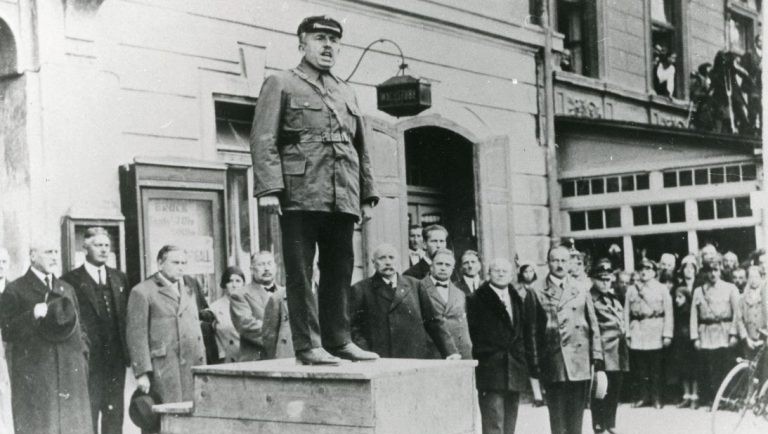
Possibly the best piece of writing you will read all week. The Jewish German Communist and novelist Anna Seghers follows the last days of the Austrian Social Democrat as he leads a rebellion against the fascist suppression of Red Vienna and the country’s workers’ movement, heading to the hills to fight a guerrilla war when he was caught and executed on February 19, 1934.
‘Koloman Wallisch’s Last Journey: In the Footsteps of The Heroes of the Austrian Uprising’ by Anna Seghers from International Literature. No. 5. 1935.
Ten weeks after they hanged Koloman Wallisch in Leoben. I traveled on a weekday morning from Graz to Bruck an der Mur. A wealth of lilac and chestnut sprawled over the Austrian landscape.
It is hot and crowded in our compartment—peasants, craftsmen, a lumber dealer from Bruck, two traveling salesmen, and I. The salesmen ask the lumber dealer how business is getting on. The lumber dealer slowly turns round and crowds us all with his broad leather back. He complains. The damage done his mills by the shooting has not yet been compensated. It’s true, of course, the mills stood idle before. Possibly the treaty with Italy will set them going again. We stop at Frohnleiten. The sunny, green quiet of the mountainside enters our compartment and reaches even the lumber dealer. He says, “How quiet it is everywhere, and how noisy it was.”
The tall traveling salesman says, “Here’s where he roared away, that man Wallisch, till they tightened a rope around his throat. Freedom, he roared, that man Wallisch. They twisted freedom out of his mouth and packed sand in instead.” The shorter traveling salesman says, “One thing you must grant the man: he had courage in dying.” The lumber dealer is annoyed. “Why shouldn’t he have courage in dying when he drove the others to their deaths; such an agitator as that man was, such a Communist, such a Bolshevik.”
The people watch the lumber dealer cautiously, out of drawn eyelids, some agreeing, some sullen; some amused, others gloomy. (This morning in Graz in the white-walled kitchen of my comrade, while his wife was spreading plum jam on our bread, we hunted through old newspapers to find one—Hyenas of the Labor Movement. This, I believe, is what Wallisch wrote against us when the Society of the Friends of the New Russia was holding its last meeting here in Graz. “What a Communist eater he was, that man Wallisch, what an anti-Bolshevik.”)
The lumber dealer tells a story of a Catholic priest in Bruck who came to him to order a fence for the cemetery, not around the cemetery, but straight across it to separate the Catholic dead from the Protestants; he didn’t know that the lumber dealer expected to find his final resting place on the other side of the fence. The lumber dealer noted down everything and then demanded a huge sum for the job. The priest was scared and left the dead together. Everyone in the train laughs, even the Catholic peasants.
The lumber dealer and I get off at Bruck.
Wallisch had promised the people in Bruck to come over from Graz as soon as things got serious. Word of the general strike was passed along. Wallisch called his wife, and they set out. In Bruck the general strike was complete, the powerhouse was at a standstill, the people of Bruck had walled in weapons in their cellars and their houses since January, armed groups were in readiness; barricades grew up in front of Pernegg.
The river keeps one from entering the city at once, a mountain stream unusually fast and loud flowing, combed into a smooth stream here and there by the mills. On the main street I still see the lumber dealer from behind, his heavy-set figure, the childish, heart-shaped leather patches on his sleeves, at the elbows. Laughing, he remains standing before a group of people who laughingly watch a number of young fellows cleaning the street with huge brooms. Gendarmes, rifles grounded, smilingly guard the street cleaning. No need to ask anymore—one sees it in many of the provincial towns—they sweep together the paper swastikas that they themselves scattered about the evening before, or convert the swastika symbols painted everywhere into gates, by adding a few strokes.
The large red house back of the chestnut trees is the People’s House. The gendarmes, rifles grounded, do not smile. They force me to take a roundabout route; one can’t get close to it. The men arrested in Bruck in February are locked up in the People’s House. All too coolly these People’s Houses thrust their big, tidy facades in among the splendid old buildings: the churches, theatres, and court-houses. In Leoben, in Bruck, in all the provincial cities, the smalltown bourgeoisie now locks up its prisoners in the People’s Houses.
The riddled gendarmie barracks show that the orders were different in Bruck from the other cities: attacking not entrenching. But the “Go-Betweens” functioned badly. Lackner, the only one who knew where the weapons were hidden, was still in prison in Frohnleitnen; the Schutzbundlers were bleeding to death in a fruitless attack. On the church doors are large signs: Catholics of Bruck! Everybody join the pilgrimages to Mariazell! This year you have more reason than ever to offer thanks.
Over the roofs stands the Schlossberg. Whoever had the Schlossberg had the city and its approaches. On Tuesday night, the thirteenth, it was stormed by soldiers and Heimwehr, cannon against guns. Wallisch gathered his men on the left band of the Mur. He planned to outflank the enemy and attack the artillery from the rear.
I buy a map of Upper Styria. “The evil spirit of the whole undertaking”— compare the map with the report of the indictment, the report that closes with the news that sentence had been executed—”the evil spirit of Upper Styria, Koloman Wallisch, had discussed the matter with the Schutzbund leader, Ruhs, and now it was up to Wallisch to draw together in, Bruck the troops from outside. Ruhs, supported by Wallisch, ordered one company to storm the gendarmerie barracks, another the forestry school, still another the Felten and Guilleaume office building…”
When the situation grew untenable, Ruhs and Wallisch together with the Schutzbundlers marched off along the left bank of the Mur, on the morning of February 13th, towards the Utschgraben and climbed towards the Hochanger.
While the road towards Kapfenberg lay under fire, Wallisch had to make his way here with his wife and four hundred men. The snow lay a meter deep on the mountains. Wallisch hadn’t learned to ski—he hadn’t become that much of a native since coming here in ’21. “The ideal of a Soviet dictatorship lay before him as he had experienced it in Hungary, and as he had wanted to set in up in Bruck in ’27,” the prosecuting attorney believed. (But what did Wallisch believe?)
I cross the railway tracks and come to the lumber dealer’s cemetery. I don’t find my way about all alone in the cemetery on a weekday morning. I don’t find the graves of the dead. It’s harder to find the February dead in the provinces than in Vienna. In Graz they sewed them into sacks in two’s, pressed them into shallow ditches anywhere, trampled the graves down with their shoes, they forbade name plates or flowers to be placed on the graves. By oneself one can’t tell whether these patches of grass are graves or not. On the highway I ask a bicycle rider where Utschgraben is. He’s going the same way and pushes his bicycle along. This small, limping twenty year old boy in torn shirt and spotted trousers is the unemployed son of a railway worker. He frankly tells how he spent the rest of February in the woods. He doesn’t live in Bruck either, but some place outside on a farm. He had been lucky.
The Struggle
“My father is a decent man, but he didn’t take part in the thing. He didn’t have any confidence in it.” Just before, the railwaymen had lost their big strike. “They sold out on us, and they’ll sell out on us again this time. Wallisch? We urged him all year to start the attack, but he didn’t want to shed any blood. Blood was shed anyway, at the wrong time, and the wrong blood. We said to him, ‘You’re no compromiser by nature; why do you trust them and their pacts? Make the first attack, Comrade Wallisch, then Bruck will be the first to attack. Now it’s turned out,” he says standing still, “that we in Bruck have the highest percentage of dead. Just as they caused the most blood shed here, they could have gotten their first licking here.”
The street continues. Wallisch’s men had a sharp wind blowing in their faces. They were hot from pulling. They had not reached Utschgraben when they realized that the Schlossberg had already been taken. They wanted to break through to Frohnleiten, free Lackner, fight on with fresh weapons.
“Wallisch had a following in this neighborhood, and among the peasants too, which had always been hard for the party. What Wallisch would do now, if he had had more than one life? Would he be sitting in Brunn with the others? Would he also be selling out? I don’t think so. There was much of us in the man.”
Here the snow was still endurable. Wallisch’s men could grapple with it; their marching feet tramped it down.
The thin white swastikas under our feet have already been converted into barred windows. “The Nazis? We have a few who are joining them now, a few dumb kids who were never worth much; there are the athletic fellows, for instance, who go over to them because the Nazis still have gyms. And ours are closed. And the Nazis let them swing on their horizontal bars. Others feel, if things start going, devil cares with whom so long as Dollfuss gets one on the head. As if the Nazis wouldn’t open the prisons in the morning just for show, and lock up the same people again in the evening.”
“The best among us have gone. We were always opposed to Vienna. There used to be forty or fifty Communists in Bruck.”
“What always bothers me is the thought that Wallisch would have come out of it alive if his wife hadn’t been with him. She had the habit of being with him always at meetings, and she wanted to be with him at the end, too. He should have left her in hiding with us somewhere. Because of her he couldn’t get through the mountains in the snow on foot. Because of her he had to take an auto.”
Near the big wood pile I must climb along the brook that drops down here to meet the Mur. Wallisch’s men got their first taste of climbing. They dragged their legs out of the snow. Under no condition were they willing to leave their machine guns behind. They climbed and pulled, their arms weak with hunger and cold. They already had days and nights of fighting behind them.
At the entrance to the narrow Utschgraben a village begins. In front of an attractive house, freshly painted a strong old fellow sits among the lilacs and smokes. Above the door is the text:
I built this house
But I can’t live in it forever.
Who follows me must leave it, too,
Death won’t spare him either.
And after him comes number three
O tell, whose house will this house be?
Untouched by fear of his death house the rightful owner enjoys his lilacs, his pipe and his morning sunshine.
I ask for the inn. But at this inn on weekdays there is neither beer nor milk, neither bread nor butter. At the end of the village near an idle mill is a house where a peasant woman sells bread and white cheese. There are six grown-up men in the room, and the peasant woman, their pretty sister, heavybraided and pleased with her own beauty. On the wall hang antlers, a mirror, an oil painting of the mother of God. One of the men says, “So you’re a German, eh? How is it there? One hears such different stories. One fellow was there and he says it’s just like in the Bible, same as everywhere: to him who hath it shall be given and from him who hath not it shall be taken, Wallisch? Yes, he came through the Utschgraben. Yes, about four hundred men. Yes, his wife, too.” Nothing else is said. In this silence there is no crack through which one can see what is hidden beneath. The peasant woman is happy when I pay. She even steps up to the door, twists the apron round her hand, and shows me the way.
The snow reached up to the chests of Wallisch’s men. They could feel how the mountains to which they were clinging wanted to shake them off. Their frozen jaws were forming the first, “Impossible.” Wallisch laughed and told them nothing remained but this march. It did remain, too, long after the span of their lives.
After an hour’s mountain climbing through the forest—back of the village there is only one big farm, high overhead on a projection on the mountainside with many white, twisted fruit trees crippled by the wind—comes a hut on a fenced-in plot of grass. Seated around a table, out in the open, are a red-bearded peasant, a man in hunting clothes, a man in uniform with a pistol holster, and a woman in a white shirtwaist. It’s not an inn, but they immediately invite one in. “A German?” They fetch Rhine wine from the cellar, pour it into Styrian porcelain jugs. The hut has a well-stocked cellar. The red-bearded peasant is only the keeper. The lord and master is hunting grouse on the Hungarian border tonight. Quiet, quiet, thank God, quiet all over the mountains. In the city below the godless pack has been forced into quiet. Yes, of course, even in the villages here there were Social Democrats. You can tell it in the way the children greet you; yes, you can see it in the men, even from behind. High up on the Alps you can tell by looking at a man whether he climbed up from a Christian Socialist village, or out of a Social Democratic one. Wallisch and his wife and men came along the very same road in February as the honored lady. They threw their weapons here in the snow, where there’s grass now. His wife lay down to rest a bit. Wallisch ordered milk—he couldn’t even drink, the good-for-nothing. Then they went on to the mountain shelter, where the figure of the Holy Mother used to stand. But the sons-of-guns don’t take care of anything; they destroy everything. There they turned off, opposite the Hochanger, towards Frahnleiten; they found the government already on the Hochanger, and in Frohnleiten too; and Wallisch. had to beat it, and many of his men got lost in the mountains. Who knows if some of them aren’t still hidden there. Now his agitation is over, the agitator, the evil spirit of Styria.
“His agitation is over,” says the gendarmerie captain. He is gay, and a bit drunk, and grabs hold of his young wife. “I was there myself, in Leoben, when they hanged him on the gallows. He had courage, all right,” he says suddenly, quite astounded, as if the idea had never occurred to him before, “although it was used against us and ours. Good God, where he ever got the courage, I don’t know. I myself simply couldn’t believe he was dead; he’d just been shouting freedom; that was Wallisch all right. And then two fellows, right and left, were hanging on his shoulders. They clung to the hanged man’s shoulders, you understand, to make him heavy enough. You understand, honored lady, so that the rope chokes him properly. What a sadist he was, that man Wallisch, a regular Bolshevik. My, but it’s nice that the honored lady is a German, and came right to our hut. It must be grand in Germany, must be swell in Germany. Ssh—don’t tell on me, a man in uniform, but I know deep down in my heart that life in Germany is altogether different, and rather today than tomorrow.”
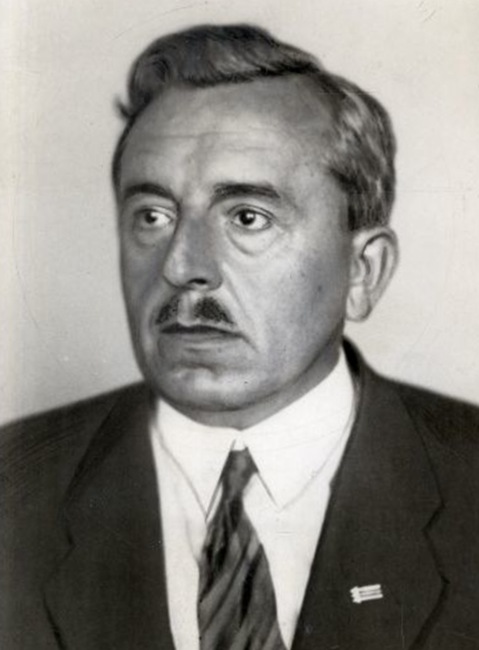
I go up, further up the brook, a blameless little blue thread on the map. The snow reached as high as the breasts of Wallisch’s men. Many trickled off to Bruck and the surrounding villages. The three machine guns always had to be pulled out of the gulleys. Wallisch urged his men to keep together at any price. In Vienna the uprising was gaining. They had to break through to Frohnleiten, and keep on fighting, with new weapons and auxiliary troops.
Where Wallisch Climbed
There were no more houses for a long stretch. The sound of wood chopping can be heard from a distance, now and then. But here on the mountainside logging is over. The giant trunks of felled fir trees hang over the mountain slopes, the cut surfaces shine brilliantly in the sunlight and give the mountains a peculiar light all their own. Then the woods recede, the brook gets more pebbly, more sandy. Pasture land begins; animal stiles bar the way. On the grassy slope stands a slanting house, bare, without steps. I enter; The table and baking oven are the most important things in the large, bare room. The floor is without boards, rough, sandy. The peasant woman’s small child wears only a flannel shirt. Behind the table sits an engaged couple holding hands. We all play with the child. I let them show me the stove that is heated from outside. The grownups are talking about the pilgrimage posted on the church doors in Bruck. The women arrange to go. Where do I come from? So, I had gone past the hunting lodge? So, he was shooting grouse? I say, “They told me down in the hunting lodge that Wallisch had stopped there in February and gotten milk to drink.” The wife calls out quickly, “From them? No, he got nothing to drink from them. They gave him nothing, those people there. It was at our place that he got milk.” The bridegroom back of the table says, “Milk and three loaves of bread. They were weak with hunger. But they paid before taking a bite. They laid their money on the table before they reached out for the bread.” The wife said, “If you spend the night on the Hochanger, you’ll be in time to see them drive the cattle up the mountains early tomorrow morning.”
I climb on towards the Iron Pass. Wallisch’s men had crumbled away until only a hundred were left. Their only hope now was to get across the border to Jugoslavia with their weapons in their hands.
After midday tomorrow the hillside will ring with bells. Now the silence is unbroken. Smoke still rises from the herdsman’s hut. In many spots, where a tongue of the forest stretches into the pasture land there is still snow. The mountainside is warm. After a while someone comes climbing up, the bridegroom from the peasant hut. He, too, wants to go to the Hochanger; he wants to be there tomorrow morning when the cattle come up. His brothers are lumbermen. His father has some land and cattle in Frohnleiten. Yes, he was in the neighborhood in February too. How did Wallisch get his following among the peasants? Through the tenant protection law. Wallisch at the time made the tenant protection law and allowed nothing to change it. The tenants couldn’t be driven from their land; the fixed rent couldn’t be raised. He was a lawyer through and through, that man Wallisch. If you went to him, if you asked his advice, he had all the paragraphs at his finger tips. He knew such paragraphs for the poor man that they couldn’t put anything over on him. Now, of course, they’ll tear up the laws that contain such paragraphs.
We reach the open shelter huts. On the left is the way up to the Hochanger. The deep valley back of the Hochanger is encircled by a thick forest. On the right is the way to Frohnleiten, a two or three hour journey. Ruhs volunteered to go out scouting. The men had a breathing spell and waited. Ruhs never came back. He got to Graz by a roundabout route and made a complete confession to the director of public safety. The Schutzbundlers in the mountains sent out new scouts. Now they learned everything: Ruhs’ treachery, the defeat, the court-martial. Wallisch hammered away, urging them to believe in their victory, not their present victory, but their final one.
“They were a long time trying to ferret out where Wallisch spent that night,” said my escort. He lay down there in the valley, in the herdsman’s hut. The government stood up on the Hochanger and asked whose hut it was. “Whose should it be, a herdsman’s hut like that. K, the cashier, has rented it for skiing. We saw to it that no smoke came out of the chimney.”
We pass around the valley. The forest ends; we reach pasture land again. Suddenly the house on the Hochanger is closer to us. On the other side of the furrowless hillside, smoothed by the evening light, came the first skirmishes with the Frohnleiten gendarmes. Wallisch’s men, only a small group, about forty by now.
The host on the Hochanger had been expecting my escort. He is surprised at finding two of us. There are a few older lumbermen in the room, besides us. We get bread and soup. “They set five thousand shillings on Wallisch’s head, and who couldn’t use that much! But we told our wives and daughters not to look down in the valley, so there’ll be no chance of seeing the man and having their consciences bother them. If you got the money, and bought yourself a pair of pants with it, and if they were too tight across the bottom, you’d see the gallows right away. If you bought a sheet for your bed, and got into bed with your wife, you’d also see the gallows right off.”
Early in the morning we walk a bit towards Bruck to meet the cattle. We sit down on the grass; the ground is warm, even at this hour. Deep down in the forest the faint tinkle of bells can be heard. “The people of Bruck are forbidden to enter the forest on the First of May. On Hitler’s birthday the Nazis lit up the mountains. I won’t let myself be blinded. The stories they used to tell about Italy. I decided to go down to Italy myself last year. The first day I could find no one who was willing to give me any information. Then I found someone who took me by the hand, took me quite a way out, sat me on a chair, told me this and that, and showed me what nobody is shown. I won’t let them put it over on me. I’m saving my money; next year I’m going to Germany. There I won’t look where they turn my head to look; I’ll look where I please.”
Going down I get in among the cattle coming up. From Bruck to the Hochanger a line of brown cows’ backs wind along. Here and there among them are pigs. All living things come up out of the stalls for the summer.
A few hours later I stand at the railway station in Leoben. The freshness of the mountain is gone; a stale, musty, provincial smell lies over the railway station. On the evening of February 17th a young man stepped out of the railway station up to a taxi chauffeur and arranged to have him come to Oberaich Sunday morning. Perhaps the traitor, the little railwayman, sighed on the way to the inn as he looked at the five thousand shilling poster. He had no idea how soon his own life would be tied up and lost with the others. Sunday afternoon the triumphal procession drove through the city of Leoben, enjoying its roundabout way round the streets. Wallisch and his wife sat on an open bus, chained, soldiers and police before and behind them, the citizens lined up on the curb, left and right. Citizens showed their wives the chained pair in the bus. The women stare at the chained woman in the green dress who had followed her husband into the fight, and finally through days, and nights of flight through the mountains.
As I enter the city, a sentry drives me from the sidewalk in front of the large corner house. From the small barred cellar windows over the pavement come shouts. The February prisoners in Leoben are stuck in the cellar of the Chamber of Workers and Clerks.
Immediate Sentence
“The sentences in Leoben are hard and hateful,” the unemployed say in front of the county court in which the public offices are also housed. “We were locked up here when they dragged Wallisch and his wife in. At night there was a certain restlessness about the place. We prisoners felt that something unusual was happening, but we never dreamed that they were hanging our Comrade Wallisch. Twice a terrible cry pierced the whole prison. That was when they brought Paula Wallisch to her husband and then dragged him away.”
The hangman was a pork butcher from Vienna.
At the trial the whole neighborhood was roped off by Alpine troops.
That was the Eleventh Regiment from Klagenfurt.
You have to finish high school to be in the Alpine Regiments.
Shortly before the trial, the jurors were standing together here, for they were taken in together from here. Suddenly a man drove up on a motorcycle, pressed! a letter into each one’s hand and was off. The letters were from the Red Aid. The letters read: “The jury must stand solid with the defendants.”
After some trouble I succeed in getting a peep into the courtyard out of an office window. The gallows has been taken down. Three meters deep the prisoners had to dig the hole into which the post was set. From here you can see far over the flat land, over to the distant mountains. The dirty courtyard is full of wood and straw. Criminals are filling sacks.
The endless hot street to the cemetery is marked here and there with swastikas. Hammers and sickles can be seen on wooden fences and on the backs of houses. After these days more and more are seen on the wooden fences, on forest paths and highways.
I go to the hot cemetery and look around for men and women who look as if they are visiting the grave. The Leoben cemetery is spied on like the Vienna cemetery. The Wallisch grave is flatter then earth, covered with grass. A few crushed buttercups lie on it. “They trampled it with their boots,” says a visitor to the grave who stares down at the crushed flowers with furrowed brow as if they were an inscription. “Anyone who lays flowers on it, gets fourteen days in jail.”
I think to myself—this is the end of Wallisch’s journey. But the visitor io the grave says. “What lies here is only the trunk. They say because Wallisch had been active in Soviet Hungary, Dollfuss sent his head to Horty.” In the afternoon, five or six of us are sitting in a small inn not far from the main street. White and red chestnut blossoms dot the tables and fall into the glasses. Today Leoben expects the Italian officers whom Dollfuss has invited to Vienna for the First of May, to change the name of Matteotti Hof to Gio Hof (“Gio murdered by Marxists in the town council of Bologna”) The highways were covered with nails for these guests; they had to change tires ten times before they reached Semmering.
“The freedom we mean now is an altogether different kind of freedom from that they choked out of Wallisch’s throat. Democracy is dead, yes, dead and choked and trampled on by shoes; it mustn’t rise again.”
“How can you speak that way about a dead—”
“But he was a compromiser. And if he had to bleed, it’s always been that way: you have to sign pacts with your own blood.”
“For you to talk like that about the dead,” says someone else, “that’s just like you. Have you the faintest idea who Wallisch was? From his childhood he fought, first as a mason’s apprentice at home, and later in the guilds’ strike in Trieste; he was party secretary in Szegedin and he fought for Soviet Hungary. And then he started things in Marburg. You don’t know anything. Then he fled on foot to Graz, he and his wife.” We are interrupted by the hum of the Italian motors. A few withered hands flutter over the thin cordon of citizens lining the curb.
“And a dead man who lived as he did and died like him…”
“Stop, he’s not that dead, that man Wallisch; Wallisch isn’t so dead and buried, so dead that you can’t argue with him, that you can’t find out where he fought, and where he compromised, where he was wrong, and where he was right. I know, without your telling me, that the man was flesh and bone of the working class that they tortured; that it was our neck they strangled, that the red marks are on our neck. And because it’s so, and because we know it’s so, that’s why the man is not dead and holy, but subject to error and alive.”
Translated from the German by Anne Bromberger
Literature of the World Revolution/International Literature was the journal of the International Union of Revolutionary Writers, founded in 1927, that began publishing in the aftermath of 1931’s international conference of revolutionary writers held in Kharkov, Ukraine. Produced in Moscow in Russian, German, English, and French, the name changed to International Literature in 1932. In 1935 and the Popular Front, the Writers for the Defense of Culture became the sponsoring organization. It published until 1945 and hosted the most important Communist writers and critics of the time.
PDF of full issue: https://www.marxists.org/subject/art/literature/international-literature/1935-n05-IL.pdf

