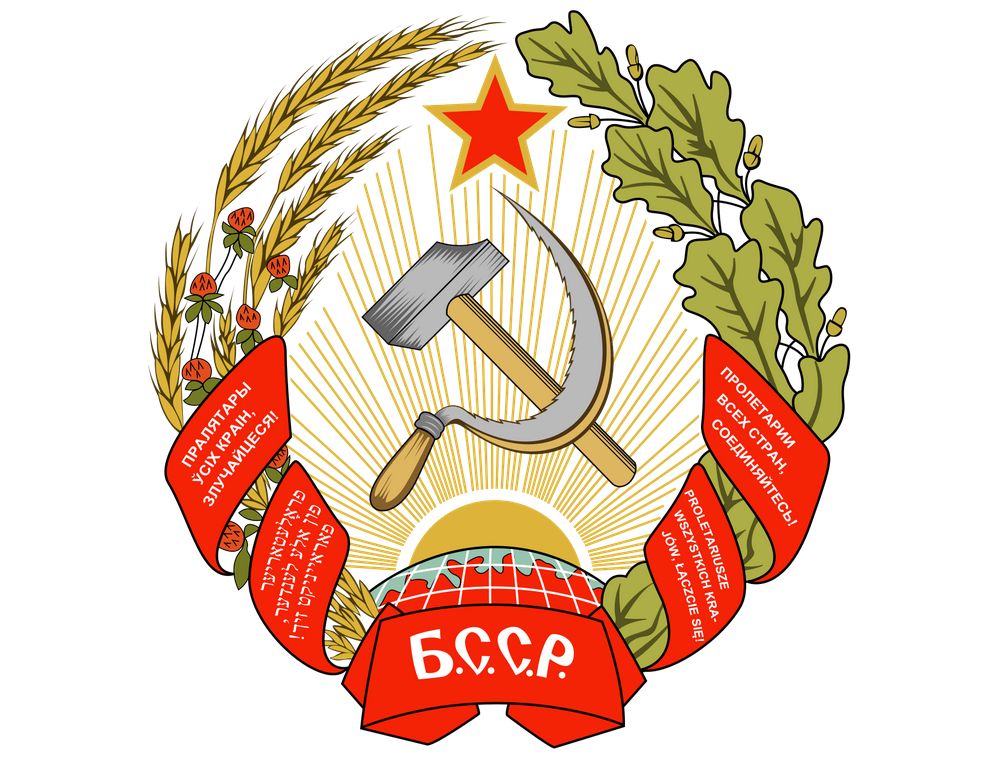
A look at the political and economic conditions of today’s Belarus, the Byelorussian Soviet Socialist Republic after it was (re)established in part of historic ‘White Russia’ with the end of the Polish-Soviet War and division stipulated in the Treaty of Riga.
‘Soviet White Russia’ by V. Ignatovsky from International Press Correspondence. Vol. 6 No. 66. October 14, 1926.
White Russia is the former “North-Western Borderland” of the Czarist Empire, a land where in 1863 Muraviev “the hangman” operated, and where afterwards the policy of russification of the borderland was conducted. Even the miserable zemstwo which formerly existed in Russia was lacking here. Only just before the war was a kind of zemstwo granted to the Eastern provinces of White Russia. This is where the Jews had been artificially driven into the “pale”, and were suppressed by the “provisional” regulations of 1882″ in town and village; they were forbidden to take up agriculture in rural districts. The White Russian peasants engaged in agriculture on small narrow strips of land surrounded on all sides by large estates. The little towns and villages crowded with poor Jews were unable to absorb the surplus free labour power of the landless peasants. The czarist authorities on the basis of the situation they had created endeavoured to incite the White Russian masses in the villages against the Jewish masses in the towns; they organised Jewish pogroms.
Meanwhile they were Russifying this country. The village population spoke the White Russian language which was recognised as the jargon. Both these languages which served the majority of the White Russian countryside, country towns and cities were an object of persecution and ill treatment. In the same position were the Lithuanian, Polish and Lettish languages used by the other national minorities of White Russia. The Russian language was grafted by force on everyone as was also the official Russian culture. There were no higher schools in White Russia. Nikolas I distinguished himself after the Polish rising of 1883 by punishing White Russia with the closing down of the Vilna University.
This country was in an extremely difficult position. Increased emigration in search of bread commenced. This emigration was caused both through general causes and also by the fact that the towns of White Russia and Ukraine were artificially crowded thanks to the “pale” and the “provisional regulations of 1882”. Emigration proceeded to far Siberia and to still further America.
The imperialist war ruined this borderland still more. White Russia became one of the cock-pits of the world war. Lines of trenches cut the land practically in half and from these trenches destruction and death was on both sides. The fields grew wild, the forests were chopped up for military purposes, villages and towns were burned and the mounds of the graves of the cannon-fodder of the imperialist powers grew higher and higher. The wave of refugees swept out of White Russia, which had become a desert. Nearly a million inhabitants left the land. The poor peasants left on horses; all roads were choked with refugees wagons. The fields by the way-side were filled with the single or collective graves of the refugees who had fallen from disease. Even now one can follow the winding path of the refugees by these graves.
Such was the position of White Russia when the revolution of 1917 came. The revolution affected only the part that was on the Russian side of the front. The February Revolution merely raised those problems which the great October Revolution afterwards solved. In time the revolution came to White Russia, concentrating its forces in Minsk. White Russia began to revive; the workers and then the peasants began to build up a new life. But… the triumph of October only lasted a hundred days. The Brest-Litovsk peace did not stay the imperialist lust of the German junkers. The German army moved forward in an offensive and by February 1918 almost the whole of White Russia was under German occupation. Increased exploitation commenced. The landowners and factory owners driven out by October returned and redeemed their losses at the expense of the workers and peasants of White Russia. Only the German Revolution which commenced in autumn of 1918 liberated White Russia from the occupation. In December 1918 a workers and peasants government was organised in White Russia and on January 1st 1919 the White Russian Soviet Socialist Republic was proclaimed. Great October victoriously moved further forward to the West. Soon the Soviet Republic was set up in Lithuania. Both Republics unite their forces and form a Lithuanian-White Russian Soviet Republic. But the worker and peasant masses of Lithuania and White Russia cannot work at putting into force the ideas of October for long. In the autumn of 1919 White Russia fell into the hands of Poland. The eleven months of Polish occupation was absolute torture for the country. Whereas the German occupants gripped the country very close, the Polish occupants absolutely bled it dry. Only in the summer of 1920 did the Red Army, together with the rebellious workers and peasants, liberate White Russia from the Polish White Guards. On August 1st 1920 Soviet White Russia was restored, comprising the Eastern part of ethnographical White Russia.
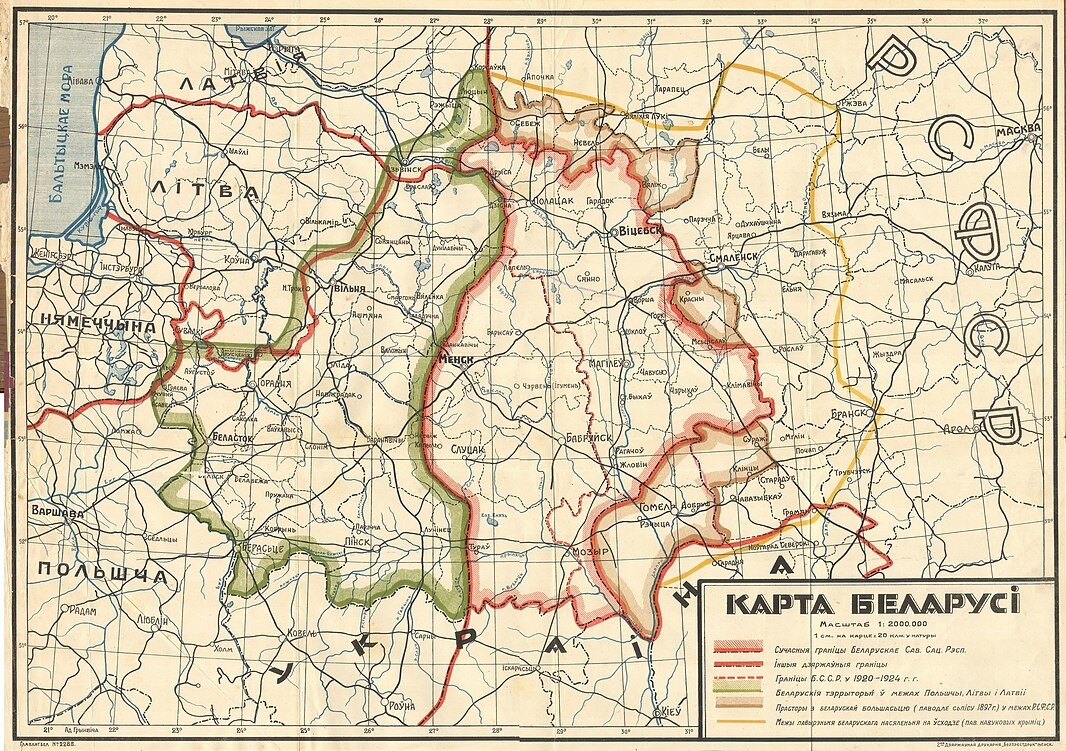
By the Riga Peace Treaty, the western half of White Russia remained in the hands of imperialist Poland. It awaits its October. The position of the working and peasant masses in western White Russia are indescribably difficult. Landowners’ Poland is conducting a policy of violence and unceremonious plunder. This part of Poland is experiencing a tense life and is like a gunpowder magazine ready to go off.
Soviet White Russia is experiencing a different life. Here the workers and peasants are building a new life. The land which has been ruined by war and various occupations is being built up again. The ruin is so great that many branches of production have had to be started right from the beginning on bare foundations.
Soviet White Russia occupies a territory of 110,000 square kilometres (in the former Minsk, Mogilevsk and Vitebsk provinces). The authorities have already succeeded in dividing it into districts on the basis of economics, number of population, climate. etc.; it is composed of ten regions, 100 districts and 1,202 village soviets. The division into districts has considerably aided the normal development of the economy of this borderland and the restoration of the economic position.
The population of White Russia according to the calculation of August 1, 1925 comprised 4,254,000 people. The increase of population during the last few years in connection with the restoration of economy is greater than pre-war. Before the war the increase of population was 18-20 per thousand, while during the last few years the growth of the population has been 23.21 per thousand. On the basis of this one can estimate the present figure of the population of White Russia at about 4,350,050 people. The population of White Russia is composed of various nationalities. In percentage proportions it is composed as follows: White Russians 70,7%, Great Russians and Ukrainians 15.5%, Jews 11%, Poles 2.1%, and others 0.7%. All these, except the Great Russians are former oppressed nationalities, who after the February Revolution were released from national oppression. The Soviet constitution ensures normal fraternal relations between the toilers of various nations. The languages of all nationalities populating White Russia are recognised with equal rights; the main language is White Russian, as it is most widely diffused. The majority of institutions in the republic have already adopted the White Russian language, commencing with institutions closely connected with the White Russian countryside. But in these institutions communications with the population of White Russia of various nationalities is also ensured in all the local languages. In those places where a national minority in White Russia lives in a compact mass and comprises the majority of the population, national village soviets are organised. These are gradually being set up and there are now 22 of them in White Russia. In these national village Soviets, the chief language is the language of the particular national minority. One of the chief measures in the national question is the liquidation of the consequences of the czarist policy towards the Jewish masses who were artificially kept off the land. The Government of White Russia has been the first to adopt the policy of allotting land to the Jews. The growing desire of the Jewish poor for land is being satisfied. By January 1925 there were 79 collective farms organised and 7 settlements of Jewish agriculturalists. Altogether 10,000 dessiatins have been distributed. The work in this direction has only commenced, but the results are tremendous.
The economics of the country are being restored. The peasants who have received the land of the banished landowners (1,327,271 dessiatins) have settled down to free labour. The productivity per dessiatin has increased during the last three years and remains higher than the pre-war. Agricultural machinery has been set going and the adoption of grass crops and the introduction of the crop rotation system has become a feature in the peasant farm. Bog lands are gradually being drained. During the budget year 1924-25 alone, 31,553 hectares of marshes were drained. Cattle breeding which was destroyed during the previous years of war and occupation is now being energetically restored. It has already reached the figure of prewar development.
Industry is also developing despite the enormous damage suffered during the preceding years. During the war and occupation entire factories and works were removed to the depths of Russia or destroyed during the military activities. Certain forms of industry have had to be constructed all over again: premises have had to be built and repaired, machinery ordered equipment installed and special lists secured. Now there is an extensive development of those forms of industry which are connected with agriculture, cattle-breeding and forestry. At the present time the production of industry in White Russia is 65% of pre-war. The number of enterprises by October 1925, increased to 202 while the number of workers engaged rose to 17,820. The majority of enterprises are in the hands of the State. Out of 17,020 workers, 14,541 work in State enterprises. The handicraft industry is also developing. There are 15,000 people engaged in it in towns and villages. Cooperation which was practically unknown in White Russia under czarist Russia is developing in the towns, and is now beginning to penetrate into the remotest corners of the countryside. By October 1, 1925 there were 546 consumers cooperative unions with 224,578 shareholders and 404 agricultural coop unions with 5,000 shareholders. Besides this handicraft industry, housing and invalid cooperative also began to spring up. The cooperatives get State credit.
In respect to culture, White Russia has grown almost beyond recognition. This border land, which under czarism did not have a single higher school, now has a State university, a Communist university, an agricultural academy and veterinary institute, etc. The university has a Jewish section. The agricultural academy provides for the training of students in connection with allotting land to toiling Jews. A supreme scientific-cultural institution–the Institute of White Russian Culture–has grown up out of nothing; it is beginning to be formed into an academy of sciences. Attached to the Institute of White Russian culture is a network of investigation organisations which embrace all districts of White Russia and study the life of all national minorities of the country. The interests of the national minorities are ensured in the institute by the existence and work of the Jewish and Polish departments. Beginning this winter a Lettish department will be organised. Before the October Revolution there was absolutely no vocational training in White Russia, but during the past few years it has developed extensively. There are 24 technical colleges and 23 trade schools. Particular attention is devoted to the training of teaching and agronomical staffs. Teachers are trained for work both in White Russian schools and also in the schools of the national minorities. Schools for social training are organised on the basis of the labour principle and serve the many nations inhabiting the country in the native language of the children. The children’s homes and kindergartens are organised on the same basis. There are 237 seven-year schools in White Russia, 4,042 four-year schools and 581 stations for liquidating illiteracy. Year by year the network of schools increases and at the same time the cultural demands of the toiling masses also increase.
That is how the Republic of Soviets of White Russia. daughter of October, is living and developing. Every year brings more and more accomplishments. The Union of Socialist Soviet Republics renders constant support in the economic and cultural work of the Young Republic. And on the other side of the cordon, under the chains of imperialist Poland, western White Russia is languishing. Nevertheless, the workers and peasants of both White Russias live in the hope of unification within the frontiers of the U.S.S.R. The great liberator of the oppressed October will come eventually, also for western White Russia fettered in the chains of Polish imperialism.
International Press Correspondence, widely known as”Inprecorr” was published by the Executive Committee of the Communist International (ECCI) regularly in German and English, occasionally in many other languages, beginning in 1921 and lasting in English until 1938. Inprecorr’s role was to supply translated articles to the English-speaking press of the International from the Comintern’s different sections, as well as news and statements from the ECCI. Many ‘Daily Worker’ and ‘Communist’ articles originated in Inprecorr, and it also published articles by American comrades for use in other countries. It was published at least weekly, and often thrice weekly. A major contributor to the Communist press in the U.S., Inprecorr is an invaluable English-language source on the history of the Communist International and its sections.
PDF of full issue: https://www.marxists.org/history/international/comintern/inprecor/1926/v06n67-oct-14-1926-Inprecor.pdf

