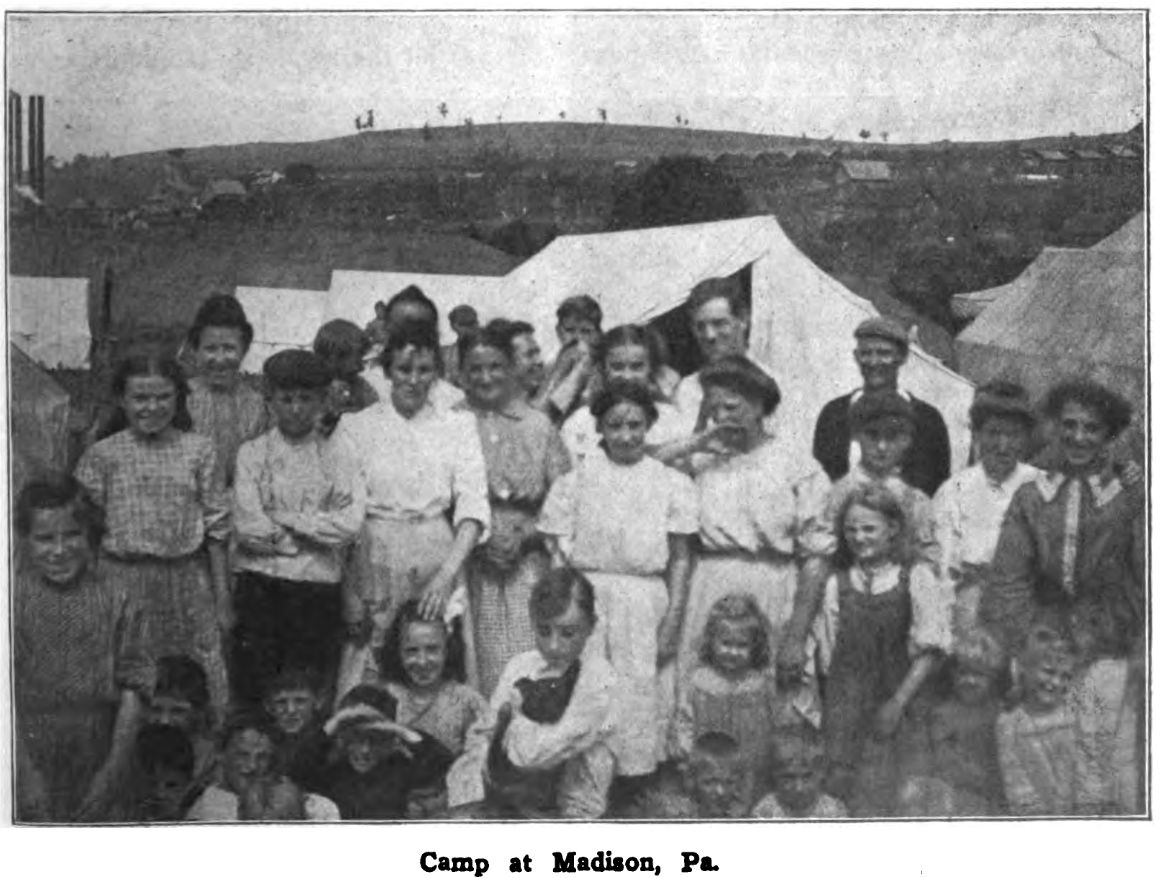
The kind of reporting that made the Review such an potent magazine. A powerful two-parter by Tomas Kennedy, writing from the storm0center of the sixteen month effort to bring the United Mine Workers to the Irwin coal field east of Pittsburgh, Pennsylvania. Thousands of families were evicted, living in 25 tent colonies in the region in a stubborn, ultimately unsuccessful, drive in the face of extreme and violent resistance. Kennedy sees, at the time, the sea change in U.S. labor towards industrialism personified in the strike, calling it a war. And war it was.
‘The Irwin Strike: Class War in the Coal Field’ by Thomas F. Kennedy from International Socialist Review. Vol. 11 Nos. 2 & 3. August & September, 1910.
I. The Irwin Coal Strike
THE fourth startling shock sustained by complacent, self-satisfied American Plutocracy within ten months is the strike of 20,000 or more miners in the Irwin coal fields in Westmoreland county, Pa. It is a shock not because of its magnitude or duration, but because of the feeling of absolute security enjoyed for years by the operators. They convinced themselves that their kingdom was strikeproof. They had established a perfect quarantine against labor agitators from the outside. Numerous failures of small strikes extending over a long period of years clinched their convictions that they had established ideal labor conditions. They felt as secure as the ancient slave masters, the Feudal barons or Schwab when he drank that toast to “The best, most contented and CHEAPEST labor in the world,” meaning of course the workers in his private Siberia at Bethlehem.
The first of the four tooth-loosening shocks was the unorganized, spontaneous revolt of the workers at McKees Rocks in June 1909. The second was at Bethlehem, and the third the general strike at Philadelphia.
The fourth, the strike in the Irwin field presents some features that were absent in all of the others.
First there was a feeling of distrust between workers in different sections of the field. This began when the Greensburgmen refused to join the Latrobe men in a strike some ten years ago. This feeling of distrust has grown with every failure of local strikes.
Although the organizers of the United Mine Workers had been working all through the field the first mine to be closed was at Greensburg. When the Greensburg men and the organizers visited other mines they were met with the cry: “You fellows would not join us when we wanted to strike, now you can go to H—”. In spite of these first repulses those that first came out remained out; continued the agitation and within a month had the field pretty well tied up. At this writing (July 15) the field is practically idle.
Another feature that distinguishes the Irwin strike from the other three epoch marking strikes of the last year is the wide area covered by the mines involved.
At McKees Rocks all worked for one company in one enclosure and entered through the same gate. Six hundred determined men quit one day and next morning planted themselves at the entrance gate, and as thousands of the workers were eager to join them anyhow the strike was on and within 48 hours the works were idle. At Bethlehem the situation was similar and the same tactics were practiced but not with the same success. The car men at Philadelphia were organized. They had the backing of what labor organizations there were and the sympathy of the whole working class and some of the middle class. And almost all of them lived in a city having an area of only about 100 square miles.
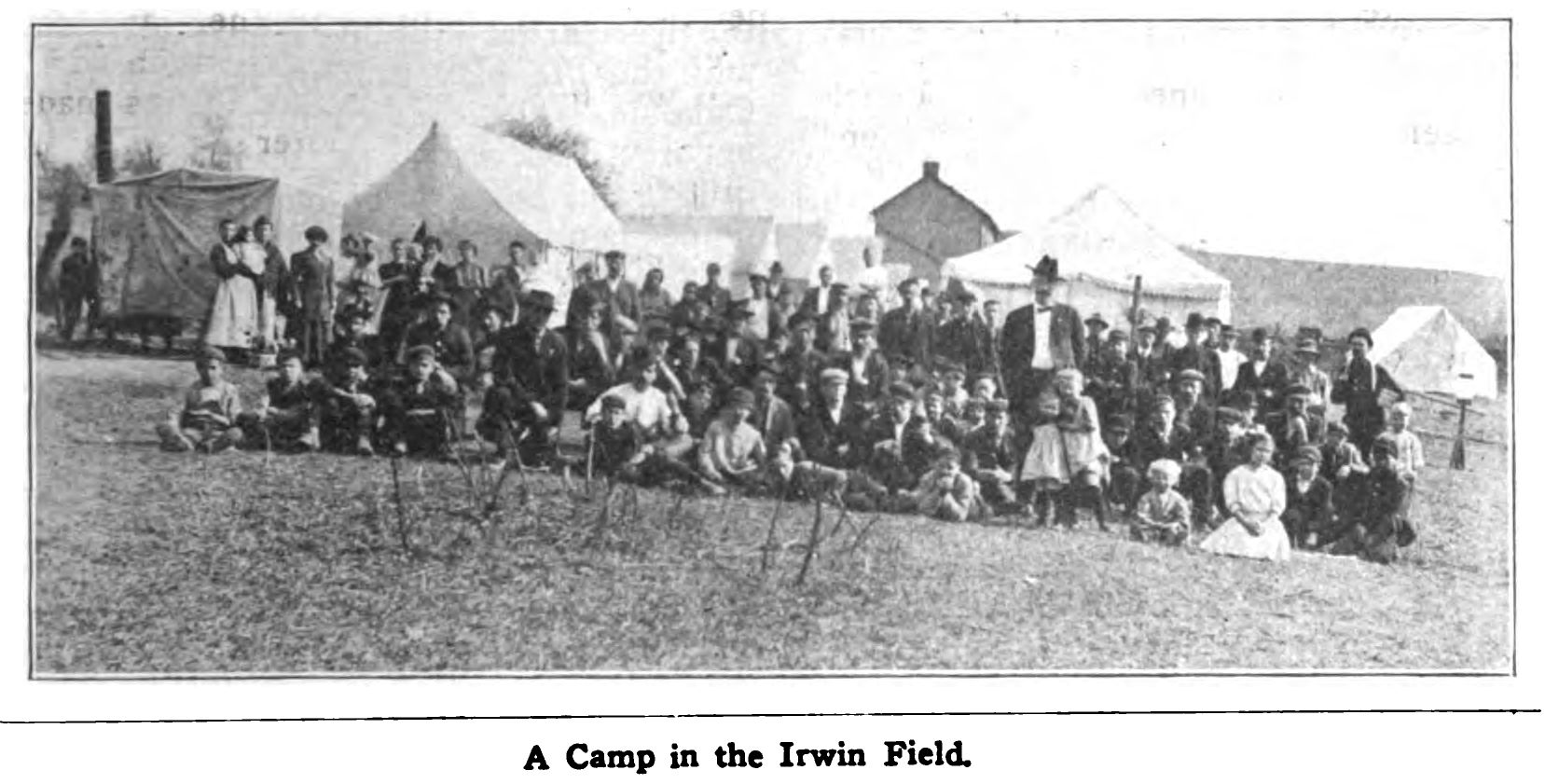
Westmoreland Co. has an area of 1060 square miles, and the strike affects nearly half of it. The whole anthracite field has an area of less than 500 miles so that the Irwin strike extends over a larger area than the anthracite region. From Export on the North to Herminie on the South, is twenty miles as the crow flies, but 25 by rail. Bradenville on main line of P.R.R., 43 miles east of Pittsburg, is the eastern limit of the strike belt. From Export to Bradenville is 35 miles, and from Herminie to Bradenville 25 miles.
Twenty-seven years ago this summer the miners along the Pan Handle R.R. west of Pittsburg went out on strike. The railroad mines all came out, but the mines at Castle Shannon and Allentown, which supplied the Pittsburg domestic market and some of the mills remained at work.
With an American flag, a fife, a tenor and a bass drum they marched boldly from Mansfield (now Carnegie) to Castle Shannon through Allentown. The contingent from my old home (Fort Pitt) returned in a few days footsore and bedraggled but rejoicing at the success of their expedition. Some of the men that took part in that demonstration will surely see this. Jim Croughan who played the bass drum still lives near Carnegie, and the fife player John Riley lives at Oakdale. The coal companies began to import “black legs,” as scabs were then called, and on a rocky bluff near my old home, commanding a good view of the two mines at Fort Pitt, tents were erected and a camp maintained until the strike was settled.
In the early days of the present strike in the Irwin field the miners adopted the same tactics practiced with such good results by their fellow craftsmen on the Pan Handle over a quarter of a century ago. They gathered in large bodies and marched past the mines that were working and past the homes of the miners that refused to join them in the battle. They offered no violence to person or property. But messages written in letters of blood could not have had such magic power to move those that remained at work as did these silent bodies of marchers. The purpose of the marchers was not to slug, not to intimidate, not to antagonize their fellow craftsmen, but to win them to the support of the strike.
While they were not immediately successful in every instance, the operators viewed these peaceful demonstrations with dread and alarm. They rushed to the court, demanded and secured immediately a temporary injunction forbidding the marching on the public highways of Westmoreland county. After listening to testimony from both sides, and after the operators had been compelled to admit that all the disorder had been caused by the thugs who were acting as deputies, the judge made it permanent.
The contest in the county court over the granting of the permanent injunction together with several brutal murders committed by agents of the operators and the thugs employed as deputies gave the strike wide publicity. The injunction trial and the murders created more sentiment in favor of the strike amongst all classes than could weeks of preaching and marching.
The injunction was so sweeping, all-inclusive and all-embracing that when one of their number died the “injuncted” miners who wished to walk on the public highways to attend his funeral to avoid being thrown into prison for contempt of court, had to get a special dispensation.
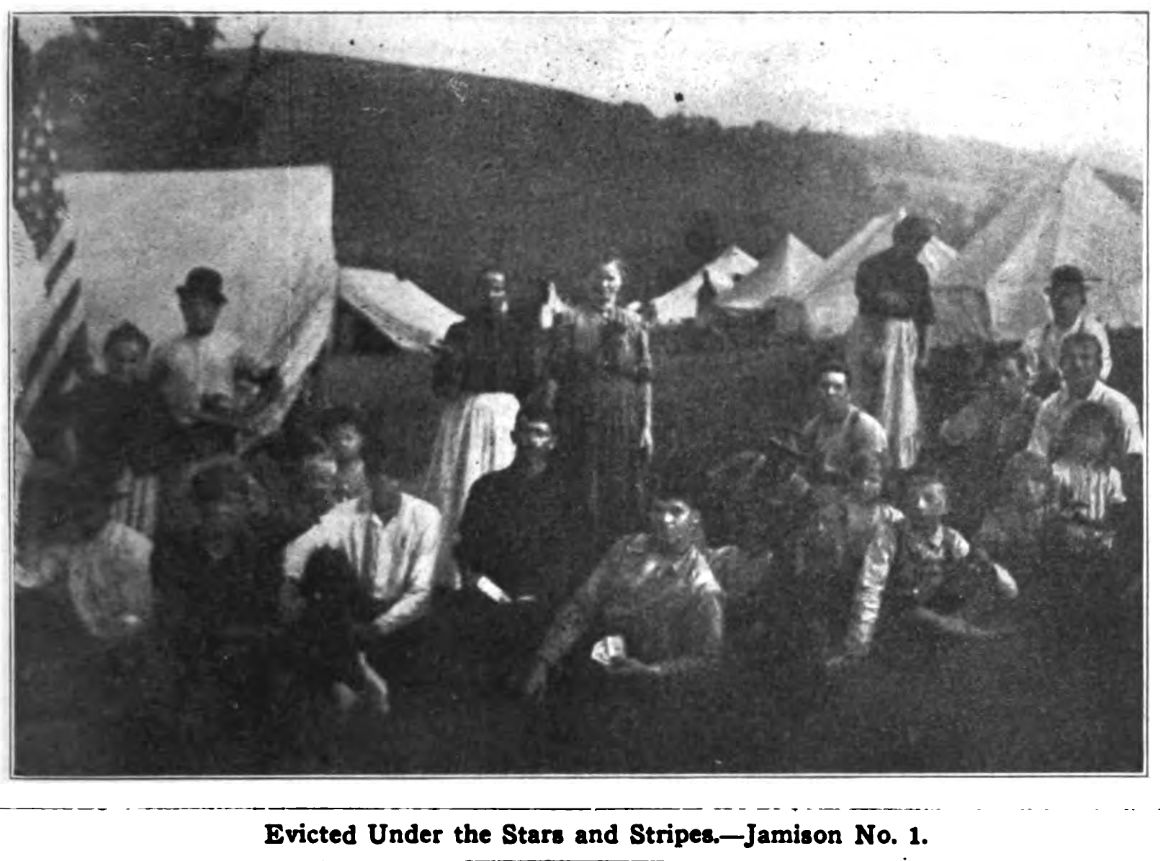
The dead man, John Cambell, had been a member of the celebrated 10th Pennsylvania regiment and had distinguished himself in the Philippine war, and very properly an American flag was carried at the head of the funeral cortege. When passing Jamison No. 2, Tom Jamison, one of the Jamison Company, backed by armed deputies, ordered the American flag lowered. When the mourners were returning from the funeral, they were not allowed to follow the most direct route but were compelled by the deputies to take a roundabout road.
Having secured the injunction, the operators commenced evicting workers from the shacks in the company camps. The United Mine Workers who have been providing food for those that needed it from the inception of the strike promptly leased land from farmers and supplied the evicted miners with tents. The camps at each mine are the best kind of an advertisement that there is a strike. Strikebreakers secured by employment agents through misrepresentation on seeing the camps are bound to have their curiosity aroused and thus become informed of the strike. Strike-breakers wishing to desert are welcomed at the camps and given food and shelter until they get their bearings and determine what to do. In every case they tell of brazen, bare faced lying by the employment agents, and of being held at the works by force when they found out how they had been deceived. The sheriff of the county promised to investigate numerous cases where men have sworn to being held by force at the mines after they wished to leave. No one has yet been arrested upon these sworn charges of peonage, and it is a safe guess that no operator will ever go to prison for this offense.
Pay for “dead work,” 8 hours, checkweighman and recognition of the union are the principal demands. And even though they do not force a single one of these concessions from the operators, a great victory has been gained.
The immediate gains at McKees Rocks were trivial, but the lesson it taught, the inspiration it furnished, the hopes it raised and the impulse it gave, marked it as the beginning of an epoch in the labor movement of America. So it is with the Irwin strike, concession or no concession. To have organized even a partial strike in the Irwin field would have been a notable achievement. To stop production as it is now stopped is a signal victory. It will convince the workers that the masters are not invincible. It will nourish their hopes and strengthen their resolution.
It will show the masters that their position is not impregnable. In future, though the apparent victory may rest with them at the end of this struggle, they will be more careful in taking their pound of flesh. The heroic battles fought by miners in surrounding fields has checked somewhat the rapacity of the Irwin operators. So this battle may prevent many a Shylock from giving the screw another turn.
One thing that greatly favored the strikers is the immense amount of Socialist sentiment throughout the district. There are 10 branches of the Socialist Party right in the Irwin field. There are three branches of the Workmen’s Sick and Death Benefit Fund of America right in the thick of it. When the organizers of the United Mine Workers were trying to hold meetings in March, the operators approached every hall owner in Irwin and cautioned them upon peril of giving mortal offense not to rent halls to the miners. The only hall the miners could secure in or around Irwin was the little hall that is the property of this society.
***
After one murderous shooting up of a town by the deputies, the proof that it was entirely their fault was so overwhelming that the sheriff was obliged to arrest 40 of his own deputies and lodge them in jail.
***
At a Socialist meeting at Jamison No. 1 on the evening of July 8, three well-known scabs walked up and took seats on the grass in the middle of the crowd. Several armed deputies were also present, and we heard later that a large body of these cut-throats were concealed nearby. The purpose of course was to irritate the strikers so they would attack the scabs and use this as an excuse for wholesale murder. They were disappointed because the scabs were not molested, except for the scourging usually given scabs and deputies by the speakers.
***
Not a single beer keg, beer case, beer bottle or whiskey bottle around any camp that I have visited. Not a sign of intoxication. This is one of the gratifying features of the strike.
Numerous dynamite explosions have occurred throughout the district during the strike. No one was injured and no damage to property resulted. If experienced miners accustomed to using explosives had been guilty of such folly there would be somebody or something destroyed. I have not the slightest doubt about declaring that this is the work of the operators or their agents, or of deputies who want their $5.00 day jobs to last and who perhaps are doing it without the knowledge of the sheriff or his employers, the operators.
One of the noteworthy features of the strike is the sympathy displayed by the farmers. And it is no mere lip sympathy either, but takes the good substantial form of defying the coal corporations and permitting the strikers to erect tents on their farms right under the noses of the scabs.
At Blackburn the company houses front on the public road. A farmer who owned the land on the other side of the road allowed the strikers to erect tents for those that had been evicted. So the tents of the strikers lined the road directly opposite the company houses occupied by the scabs. The superintendent approached the owner of the land and told him the tents were entirely too near the houses and that he should compel the strikers to move them back. The farmer replied promptly, “I thought of that too and was going to ask you to move the houses.” The tents were not and will not be moved.
Between 18,000 and 19,000 have quit working. Fully 10,000 of these have left and gone to other fields, some never to return. As soon as the Irwin men showed any disposition to fight, the organization of District 2 donated $2,000 and District 5 (Pittsburg) $8,000. For the last two months the National organization has been financing the strike. They were to have put in $20,000 a week, but they are hampered for cash by the strikes in Illinois and Kansas and have not been able to put in the full amount every week. A special assessment has been levied and the men who are out will be cared for so that no man can plead hunger as an excuse for returning to work.
Scabs came from all over the United States, but according to their own stories the great bulk of them are unskilled laborers hired in Chicago, New York and Philadelphia. One large vestibuled car was brought from New York loaded and taken down the New Alexander branch the most isolated part of the region. They were told that they were to work in a new mine and that they could make $6.00 a day with free board, and free beer and whiskey.
About forty of this load deserted in a few days and walked all the way to Irwin, eighteen miles. There were a few French and a number of Germans in this load. Some of them were Socialists and wore the party emblem. They declared that when they discovered how badly they had been deceived and what they were doing, they were ashamed to stop and talk to the strikers.
At a good many mines they have as many deputies as they have men working. The companies pay the deputies $3.50 a day and expenses. The scabs get free board and free beer and whiskey. So that the coal being mined now in the Irwin field is real black diamonds.
How it Started.
A miner from Greensburg came to the Miners’ headquarters in Pittsburg urging some organizers to come out, that he had a meeting arranged. As a forlorn hope the organizers went, and were agreeably surprised to find a big turn out and before they left they had organized a local.
The very next day about too men were discharged, 20 or so from each mine. The men had no notion of striking at that time, but immediately sent committees to demand the reinstatement of the discharged men. The operators refused to even see the committees. The men at Greensburg struck, and the strike spread to its present proportions.
The strike is being managed almost entirely by local men though the speakers and organizers are nearly all from outside districts. Many of the strikes of the Mine Workers have been hampered by bickerings and petty jealousies amongst the leaders. Some one wanted to shine and corral all of the glory. If there is any of this spirit present during this strike it is not apparent even to one who has a good opportunity to observe.
West Virginia Next.
When the operators of other districts were approached by their workers for concessions they always said, “Get after Irwin with whom we must compete.” They never dreamt that the miners would or could get after Irwin as they are now after it.
West Virginia is the other bugaboo that the operators always spring when the miners demand concessions. Now when Irwin can be stirred to strike, why can’t West Virginia? Nothing is impossible after the Irwin experience.
II. Class War in the Coal Field
“THE Strike” are the words most appropriate to designate an article dealing with the situation in the Irwin coal field, because it is the strike of the year if not of the decade. There was nothing out of the ordinary about any of the other strikes that have occurred so far this year. The biggest strike in point of numbers and duration is that of the Illinois miners. It has been since its inception strictly orthodox, including the conflict of authority between the district organizations and the National Board and President Lewis. In Illinois both sides were, and had for years, been organized. All of the arts of diplomacy and bargaining were exhausted before the strike was declared. It is warm, pulsing stomachs against steel safes full of gold.
The Irwin strike is rashly unorthodox. Excepting the formal declaration it has all of the characteristics of a violent revolution.
More persons have been killed, injured and taken prisoners than in many of the bloody uprisings in the Balkans or South America which are so regularly exploited on the front pages of the “Joinals.”
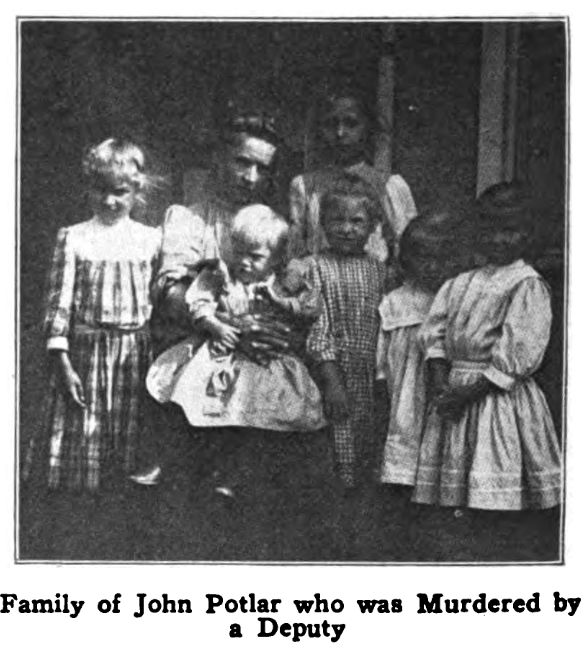
Fifteen persons, two of them women, have met violent bloody deaths. Some of these were killed in open conflict, others in skirmishes, but most of them were brutal, cold-blooded murder of men who dared to tell a prospective scab that there was a strike on.
Nobody knows how many strike breakers have been killed at work owing to inexperience and their bodies burned or secretly buried at night. When a big mine is running with experienced men there is hardly a day passes without some being killed or badly injured, but if there are any accidents now nobody ever hears about them. Of course they are killing men and like wise of course they are burying them secretly, probably with the connivance of the county authorities.
Some of those arrested were deputy sheriffs. One is in jail for the most brutal, cold-blooded murder in the criminal annals of Pennsylvania. Three others are out on bond charged with murder. One operator is out on bond for having kicked and killed a pregnant woman.
Some of the strikes that received so much notoriety from both the capitalist and socialist press were but child’s play alongside of this. The waist maker’s strike in New York was a case in point. Proximity of course had much to do with it. The capitalist papers could safely excoriate the little capitalists that are engaged in the waist industry. They did not own the papers. They did not furnish any of the advertising and gave the “Jionals” a chance to prove to the workers how they love them.
For shocking sensations, intensely dramatic incidents and solid elemental tragedy this Irwin strike surpasses anything since Homestead.
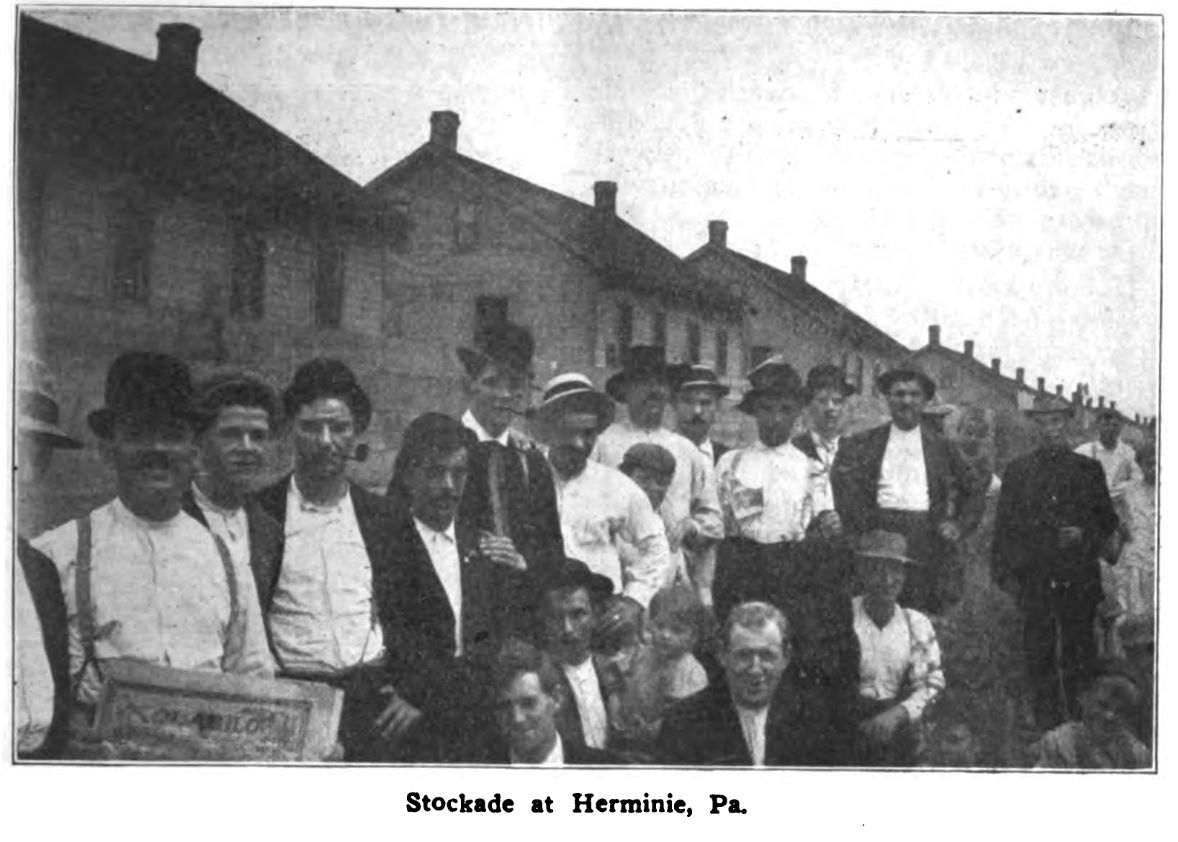
There were not fifteen killed in the skirmish of the waist makers, no three hundred injured, no 1100 prisoners taken as has been the case in Irwin. There were no fourteen foot stockades to keep strike breakers in and strikers out. There was no regiment of “Black Hundreds” collected from the slums and barrel houses of Pittsburg and other cities, armed to the teeth and sworn in as deputy sheriffs. There were no evictions from company houses and an enforced life in over crowded tents like nomads of the desert.
The whole labor press of America have neglected not only their duty but their opportunities in this Irwin strike. While they are discussing craft autonomy and shouting with joy about Bucks, one of the greatest battles of the class war is raging and they don’t even seem to know it, excepting in Pittsburg.
The Greensburg Argus, a Democrat organ published in Greensburg has done good service in exposing the insolent, drunken thugs that parade around armed to the teeth looking for trouble and if they can’t find it—making it. The Washington Labor Journal edited by William Black, a printer and published or edited in Washington, Pa. has published every word it could secure about the strike.
When the deputies commit an especially vicious act of villainy in true bandit style, they always cut the telephone wires so that the first report that reaches the rest of the world is their own cooked up account.
Of course the operators being the most powerful and wealthiest capitalists in Pennsylvania can easily muzzle the capitalist press. They have muzzled it and only very small harmless items appear in their inside pages except in the “Leader.”
They are offering $6.00 an oven for men to pull coke. A man can pull three ovens a day so that they are offering $18.00 a day for strike breakers. They are offering all kinds of minor inducements such as free fare, free furniture moving and free rent. The regular price for pulling coke in the Irwin field is about 75 or 85 cents an oven.
The Union War Chest.
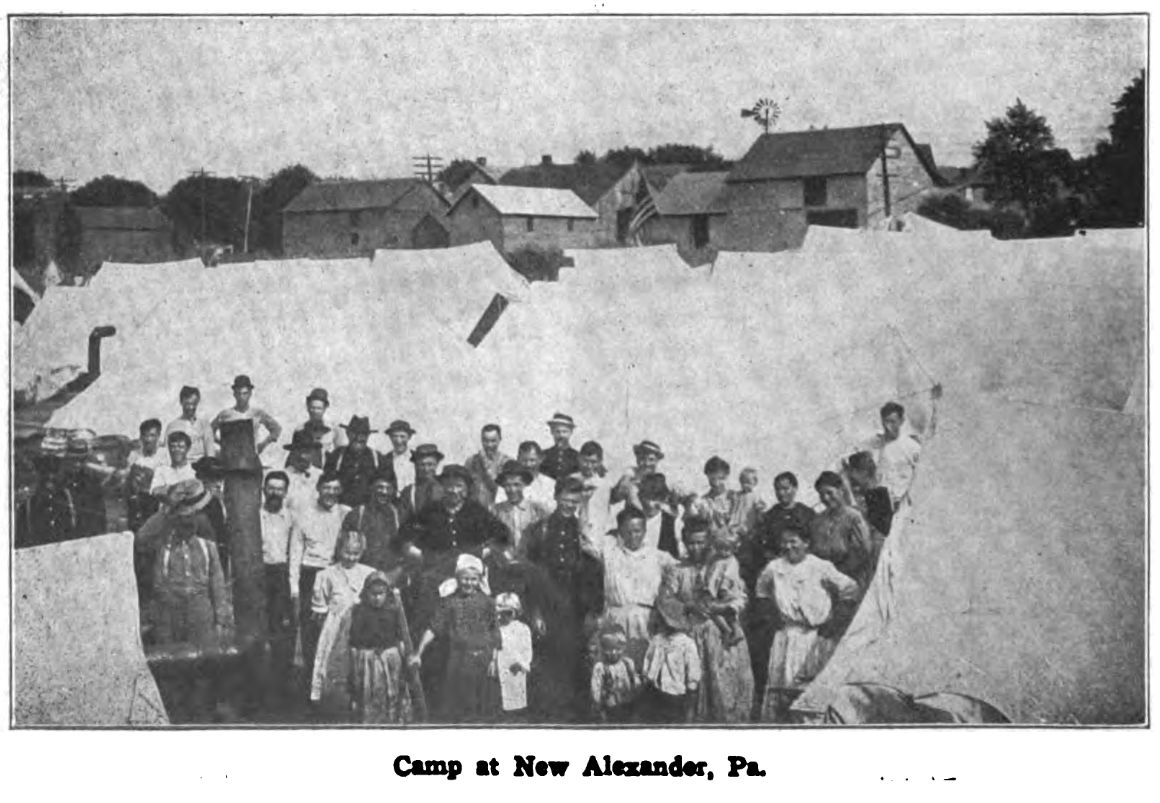
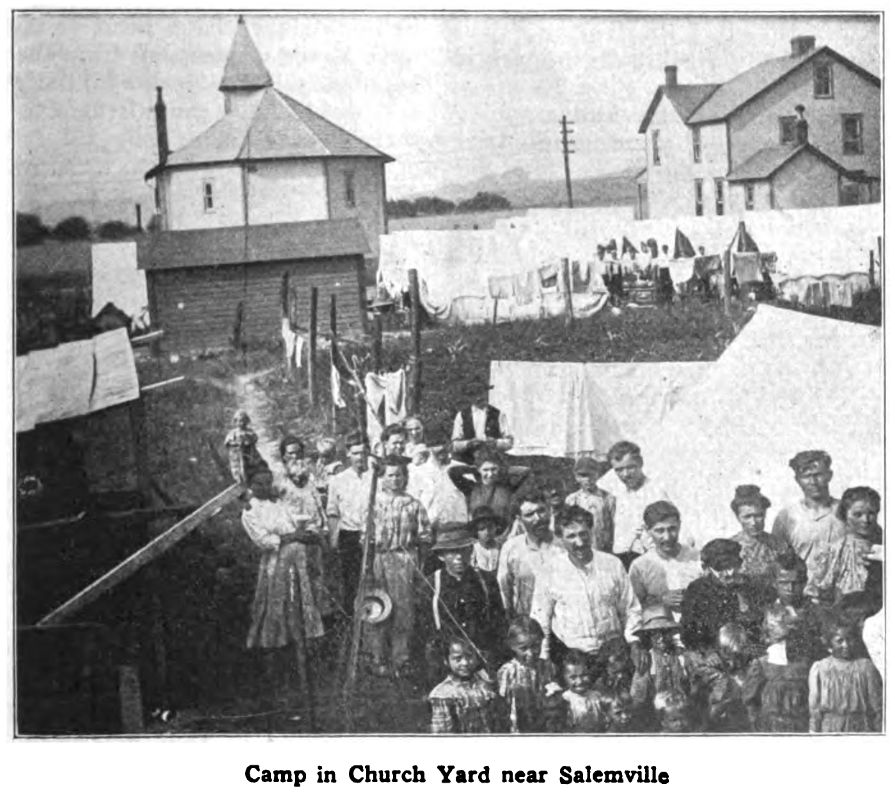
The Syndicalists can scoff at the war chest, but had it not been for the war chest of the Miners’ Union, the strike would be but a memory. As soon as the slaves revolted they were ordered out of the company houses. Had the strikers been obliged to get out of the district there would have been no difficulty about getting and keeping strike breakers. But in anticipation of the evictions the officials of the Miners Union ordered 400 tents used in Alabama and bought 100 more, making 500 tents now in use. In many cases where a man rents from a private individual or owns his own home as some of the miners do around the larger towns, the men and boys occupy the tents while the women and smaller children sleep in the houses.
The camps are a constant reminder that there is a strike. The stupidest strike breaker is bound to discover the meaning of the camps before he is very long on the job. So long as there is one single striker’s tent in the Irwin field the strike is not over.
At first living in the camps was a picnic and was the first holiday some of the miners and their families have had in their lives. But now summer is on the decline. Already the nights are chilly and crisp October is only a month ahead so the strikers are chaffing and growing impatient. The growing frequency of clashes with guards and scabs is evidence of their growing desperation.
The scab hunters tapped a rich vein about the middle of August. In 1903 the Meyersdale region was swamped with new importations to break a long drawn out and bitterly contested strike. The Union was annihilated and the strikers driven out and pursued with a relentless black list. The scabs were never white washed and never forgiven but were treated by the survivors of 1903 as traitors and enemies. For several years the operators in the low coal of central Pennsylvania have been so hard pressed by competition with the cheaply mined coal of West Virginia that the mines have been idle or partly idle. For several years work has been slack and times hard around Meyersdale so that it was not difficult for the scab hunters to prevail on those that had scabbed in 1903 to scab again.
They know what they are doing too. They are not being deceived as are so many. They are going to stay. They are going armed and to a comrade who spoke to a batch of them going to Latrobe, they said they would shoot the first man that dared to attack or molest them even so much as by telling them there was a strike. These are the first experienced miners that have been brought in to take the places of the strikers. They are foreigners and of the same nationality that is the backbone of the strike in the Irwin field. These fellows should be able to get at least $10.00 a day and I have no doubt they will.
Cossacks vs. “Black Hundreds.”
Brutal as the state constabulary have shown themselves on numerous occasions the testimony on all sides is overwhelming that compared with the thugs and bums engaged as deputies by the coal companies the State Police are gentlemen.
One of the odd developments is the cordial dislike of the State Police for the deputies. The State Police are not backward about declaring that practically all of the rioting and killing has been caused by the deputies. You must understand that economic interests are at the bottom of this feeling of these two forces for each other. The rank and file of the Police get $60.00 a month and board, no matter what is doing. When all is quiet they get their pay for patroling some country road on a well groomed saddle horse. If there must be a strike they would much rather see a nice quiet orderly one where there are no riots.
But the deputies are in a different boat. If all were quiet they would have no occupation. So to make their jobs secure they must keep something doing all the time. They explode a charge of dynamite under the corner of an unoccupied house, fire a lot of shots some night or when they meet an unarmed striker on the highway slug him or arrest him. When there is any real duty to perform, when there is a batch of strike breakers expected who must be prevented from talking to the strikers the first thing they do is fill up with whiskey. At one hotel where a bunch of them stopped, six drinks of whiskey in their stomachs and a half pint in their pockets was the regular ration, before going out on any special duty.
Who They Are.
Not only every race but every combination and every cross of every race that ever came from Europe is represented from the Arctic Ocean to the Persian Gulf and from the Caspian Sea to the Bay of Biscay. Around Bradenville and Latrobe there are a great many Italians, the staunchest and most resolute group engaged in the battle. At Claridge and Export there are large numbers of Poles. John Potlar of Claridge who was brutally murdered by one of the “Black 100’s” was a Polish Catholic. Around Greensburg, where the strike started, there are many Americans and Americanized Germans. At Madison on the Hempfield branch, I saw more Scotch and Irish miners than I have seen since I worked in the mines on the Pan Handle 27 years ago. The Arena mine, where these men work, has not turned a wheel since the first day of the strike. A car has stood half loaded since the last day they worked. Not even one man has deserted at Madison.
Alert and Suspicious.
In the early days of the strike the Socialists at Greensburg engaged a big hall and advertised a meeting of striking miners for Sunday and had John Slayton make an address. The bills did not say anything about who was calling the meeting and as soon as the strikers, especially the foreigners, arrived they wanted to know, “Who calla that meet?” They admitted after the meeting that they suspected that it was the bosses had called it to make some move to disrupt the strike. They were delighted when they found it was a working class political party wishing to give them instruction and encouragement.
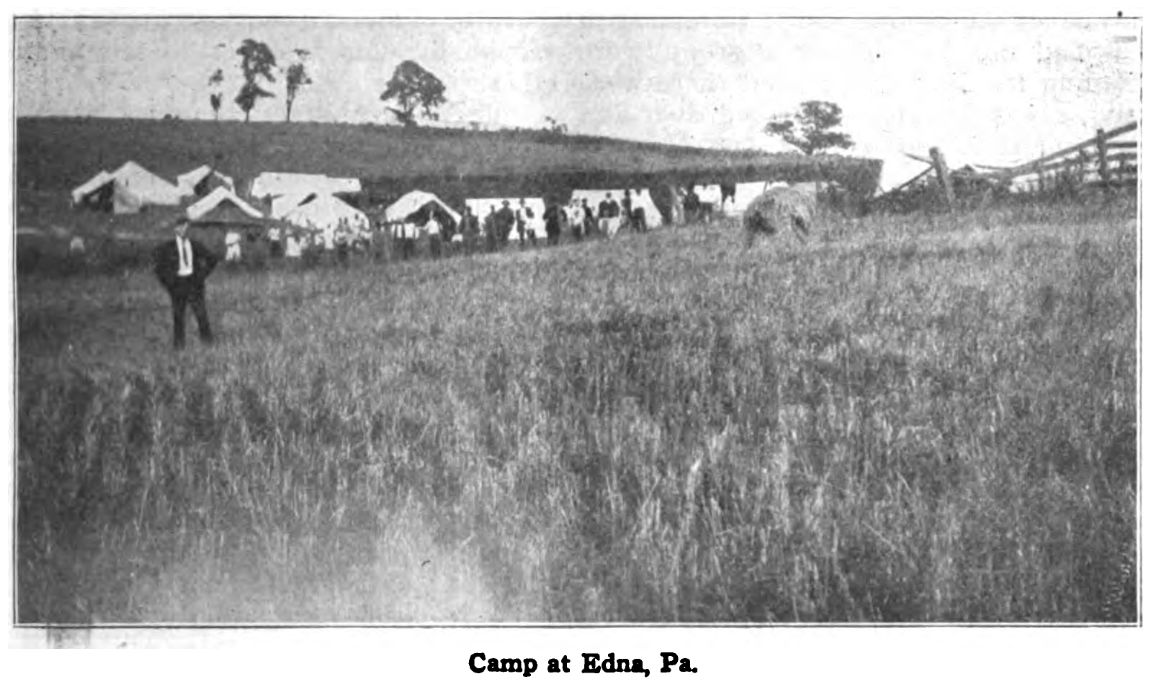
It is really dangerous for a stranger to enter the mining camps alone without something to show, some pass or some credential. I was rash enough to venture out along the New Alexander branch visiting the camps at New Alexander and Salemville. An organizer or some officer of a local went with me or I knew some one at all the camps I visited excepting those at New Alexander. The “Black Hundreds” and the state police eyed me suspiciously.
When I got to one camp, I stopped in the road opposite where a group were standing inside the fence, but there were only scowls for me. I walked over and made as if to enter when one of them asked in a low, menacing tone, “What you want?” The instant I saw the first scowl I knew I was under suspicion. I did not in the least resent it. In fact I was rather pleased to find that these latest recruits (they were the last to join the strike) were so alert that they suspected anyone that even spoke to those whom they looked upon as enemies of their class. The fellow that acted as spokesman while I was squaring myself and proving that I was not a spy nor a scab is holding the paper in the photograph. The paper is the charter of the newly organized local. This experience taught me not to visit camps without a conductor. Both the strikers and the guards are suspicious of strangers.
The Injunction.
The injunction is sweeping. It forbids marching in bodies anywhere in Westmoreland County. It forbids the strikers from coming anywhere near the mines, and is such a thoroughly workmanlike job that when the strikers wanted to attend a funeral they had to get a permit from the judge and then the deputies violated the terms of the permit and Tom Jamison compelled the man that carried the American flag to lower it passing Jamison No. 2.
This No. 2 manned by the same kind of foreigners thousands of whom are on strike, is one of the mines that the strikers have not been able to close or even cripple. It is a coke plant and many of the workers work outside. Jamison felt that it would have bad moral effect on his submissive slaves who refuse to revolt to have the American flag carried along the public highway, so backed by his armed retainers like a feudal baron of medieval times he ordered the AMERICAN FLAG LOWERED. I wonder what some of these patriots think of it, some of these fellows who are always waving the old flag until they dull the points on the stars.
The injunction of course forbids the strikers under penalty of imprisonment for contempt of court, to speak to any strike breaker in order to tell him that there is a strike.
After the injunction was secured and especially after it was made permanent, the operators with a child-like faith in its efficacy began to send strike breakers in on the regular trains. The strikers either ignored the injunction or never heard of it. Anyhow I have seen them on train and trolley scanning faces and sizing up passengers and when they suspected one, ask him for a match or a light or find some excuse to engage him in conversation. Nobody will ever know how many men have been turned back by these scouts. Lately, however, the companies have been waiting until they collected a car load or part of a car load and then they would have a special haul the car in at day light in the morning. The strikers have ignored and dodged the injunction, but hundreds of them have been arrested and held for court.
The Storm Centre.
Although only one killing has occurred at Export it has gained the most notoriety. The few sensational items that have appeared in the capitalist press of Pittsburg have nearly all borne an Export date line. The biggest mine of the Westmoreland coal company employing over 1,000 men, is located at Export. It is a wretchedly dirty, straggling settlement twenty-eight miles from Pittsburg on a branch of the P. R. R. that runs up from Trafford City along the winding banks of Turtle Creek.
The company made desperate efforts by means of threats and cajolery to operate a big mine at Export, but the best they have ever been able to do was about ten per cent of the normal output.
They erected a big searchlight on the tipple and kept swinging it around all night. The searchlight was threat, menace, irritant and challenge all rolled into one. Some persons began to shoot at the light. Strikers of course were suspected but there was no proof against them. It may have been deputies to keep up the excitement and make their jobs secure. It may have been farmers or other sympathizers. Whoever it was they were good shots because they fired from the different points on the hills always a mile or more distant. They broke the light a number of times and made it so hot for the operator that he skidooed and left the light to penetrate the night in one direction. The sharp shooters were always very considerate and fired a big charge of powder or dynamite as a warning to get out of range before the shooting began. In addition to the searchlight they perforated the shacks erected for the scabs called scabtown, but no one was ever hurt. It was a sort of retaliation for the insolence and brutality of the deputies. Most of the alleged dynamiting was done around Export.
The Scabs
The few scabs that have remained at work from amongst the strikers at the few mines that are running are not working for the sake of the trifle of money they expect to earn during the strike, but for rewards in the form of soft snaps after the strike is over. They are usually disappointed in this.
‘Andrew Carnegie is the only man that ever rewarded his scabs, or has his hirelings Schwab and Corey do it. And by the same token he pursued the strikers the most relentlessly.
The fellows who go in to scab expecting and being promised “Something good when it is over,” are by long odds the most dangerous. They are usually the fellows who believe what they have been taught by their capitalist masters that there is a chance for every man to rise in this glorious land of liberty. And they mean to rise even though they have to cut a few throats to get there. They are the fellows who accept that delicious bit of lickspittle, sucker philosophy attributed to Fra Albertus that “Only those that do more than they get paid for ever get paid for more than they do.”
The other kind of scabs are men who never work only during a strike. Men who do not want a steady job. Men who could not keep a steady job for any length of time. Some of these fellows that come in really don’t mean to injure the strikers but want to work for a stake.
The International Socialist Review (ISR) was published monthly in Chicago from 1900 until 1918 by Charles H. Kerr and critically loyal to the Socialist Party of America. It is one of the essential publications in U.S. left history. During the editorship of A.M. Simons it was largely theoretical and moderate. In 1908, Charles H. Kerr took over as editor with strong influence from Mary E Marcy. The magazine became the foremost proponent of the SP’s left wing growing to tens of thousands of subscribers. It remained revolutionary in outlook and anti-militarist during World War One. It liberally used photographs and images, with news, theory, arts and organizing in its pages. It articles, reports and essays are an invaluable record of the U.S. class struggle and the development of Marxism in the decades before the Soviet experience. It was closed down in government repression in 1918.
PDF of full issue: https://www.marxists.org/history/usa/pubs/isr/v11n03-sep-1910-ISR-gog-Corn-OCR.pdf

