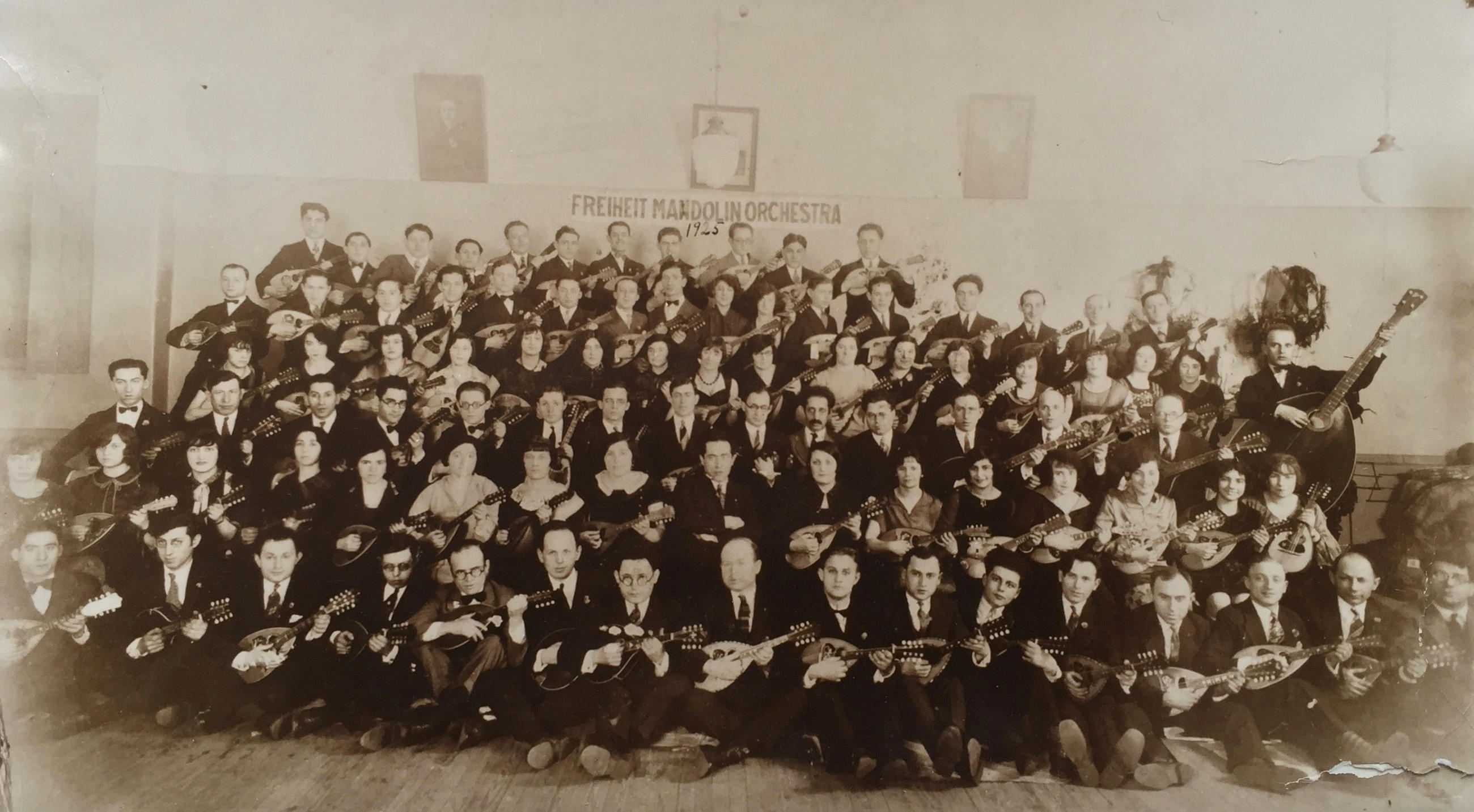
A leading theorizer, critic, and organizer of the Workers’ Theatre movement with a conscientious and illuminating assessment of a recent evening of multi-lingual performances from such collectives as the Prolet-Buehne, The Workers Laboratory Theatre, Japanese and Finnish physical troupes, the Freiheit Mandolin Orchestra, the Swedish Dram Section, and a Hungarian and Finnish Workers’ choirs.
‘The Lessons of a Cultural Evening’ by A. Prentis from Workers Theatre. Vol. 1 No. 10. January, 1932.
We must start with the premise that a worker’s audience comes to a play or a concert not only to be entertained or amused but also to prepare and train itself culturally or otherwise for the class struggle. With this premise we have a basis for analyzing the cultural evening at the Finnish Club at which 4 types of groups performed: sports, music, choral and dramatic groups.
To begin with the sports groups–one a Finnish, performing calisthenics, and the other a Japanese, showing Jiu Jitsu–did the audience learn, say, how to develop strong bodies like the Finnish athlete or did they learn what exercises will increase the chest expansion what exercises will develop the biceps? No, they merely saw the perform feats of strength, and that is not sufficient. Neither is it sufficient to watch how one Japanese comrade defended himself from another by means of Jiu Jitsu. The corrades should have demonstrated to the audience in detail how they too might utilize art; they should even have called on to the stage some comrades of the audience and taught them how to use it.
With the above-mentioned premise in mind, we must ask what are the requirements of a chorus or a musical group to help in training the audience for the class struggle?–First, the music and content must be of a militant, revolutionary nature; then, the content must be understood by everybody, finally, the instruments or voices must be of a type or arranged in such a manner as to make the first two requisites as effective as possible. With this in mind, we can say that the Freiheit Mandolin orchestra, while playing revolutionary music known to everyone had only a weak effect, being what it is (besides having a soloist, who was not sure of what she is about, and perhaps could be strengthened with banjos and guitars. The Finnish mixed chorus and Hungarian male chorus, while very effective, neutralized their value by singing in their native languages not understood by the entire audience. And for this very reason the Ukrainian mixed chorus was the most effective, not only because they sang revolutionary songs, not only because the singers were capably directed but also because they sang in English which everyone understood. As for the girl Pioneers: they should have had a number of boys to strengthen their chorus. Also their singing should have been given a quicker tempo.
We must again keep our premise in mind, and more when considering the work of the dramatic groups. We must assume that not only must a workers play deal with a situation in the class struggle, not only must it be produced effectively and understood by the particular audience, it must also be so written and produced that it acts upon the emotions of the audience and arouse then to protest, to action, to resentment of the facts or disclosures presented in the play. That is what makes a workers play a more effective weapon than all the other arts, the Movies excepted. If it does not arouse the audience, it is not necessarily a workers play.
It seems then, that according to the above, not one of the three groups performing that evening had fulfilled all the requirements. The Swedish Dram Section, giving a mass recitation of “The Party”, was the least effective. Done in Swedish which few understood, there was no gesture accompaniment to clarify the action, and the tonal colors were not developed–there was no stress or intonation that would have helped to understand the content and that would have moved the audience.
A similar criticism applies to the work of the Prolet-Buehne, (presenting the “Belt” and “Tempo! Tempo!”) though to a smaller extent, because the mass recitation is accompanied by stylized gestures that make the content intelligible. But the language is foreign, and though the audience is moved, it is moved by the innate rhythm, by, tempo, not by the content of the play–it is not moved to action. A bourgeois audience would probably be moved by their work to the same extent.
Similar criticism, though to a still smaller extent, applies also to The Workers Laboratory Theatre’s presentation of “Mr. Box, Fox and Nox” relating in two mass recitations and a short realistic scenes the causes of depression. Though the action and the language were intelligible, the audience was not moved or aroused to action or to resentment. This play could also be presented before a liberal or bourgeois groups without undue strain.
We must touch upon this question at greater length. We find that many groups are taking to mass recitations and we must remember that a workers audience, not unlike any other audience, while capable of thinking, has no time to think during a performance and must, therefore, be reached through the emotions. A play, to move them, must present to the audience lot and action and conflict. A mass recitation, while having a definite value in Agitprop work, where questions of time and setting preclude plot and action, attempts to tell the audience, attempts to arouse the audience through the intellect. As such it is the same as a number of public speakers speaking to the audience simultaneously and simply distributing the work of speaking. At the same time, a mass recitation could be made very effective. Being essentially a chorus where instead of singing the members speak, vocal color could be added by the actors stressing different words, by pauses, by harmonizing the voices of those having the same pitch, by contrasting the voices of those having different pitches, say, a high and a low, male and a female.
A word about the sets. In “Mr. Box, Fox, and Nox” props and a painted backdrop were tried out for the first time. It seems to the writer that the props were very rich in places, but the backdrop was not. Unless a backdrop or scenery has the function of giving the local of the place, it is useless. If there is too much scenery, it overshadows the action; if there is too little, the audience won’t pay any attention to it–better leave it out altogether. Scenery or a paint backdrop must have a definite function in the action of the play–in this case it did not.
The New Theater continued Workers Theater. Workers Theater began in New York City in 1931 as the publication of The Workers Laboratory Theater collective, an agitprop group associated with Workers International Relief, becoming the League of Workers Theaters, section of the International Union of Revolutionary Theater of the Comintern. The rough production values of the first years were replaced by a color magazine as it became primarily associated with the New Theater. It contains a wealth of left cultural history and ideas. Published roughly monthly were Workers Theater from April 1931-July/Aug 1933, New Theater from Sept/Oct 1933-November 1937, New Theater and Film from April and March of 1937, (only two issues).
PDF of full issue: https://www.marxists.org/history/usa/pubs/workers-theatre/v1n10-jan-1932-Workers-Theatre-NYPL-mfilm.pdf

