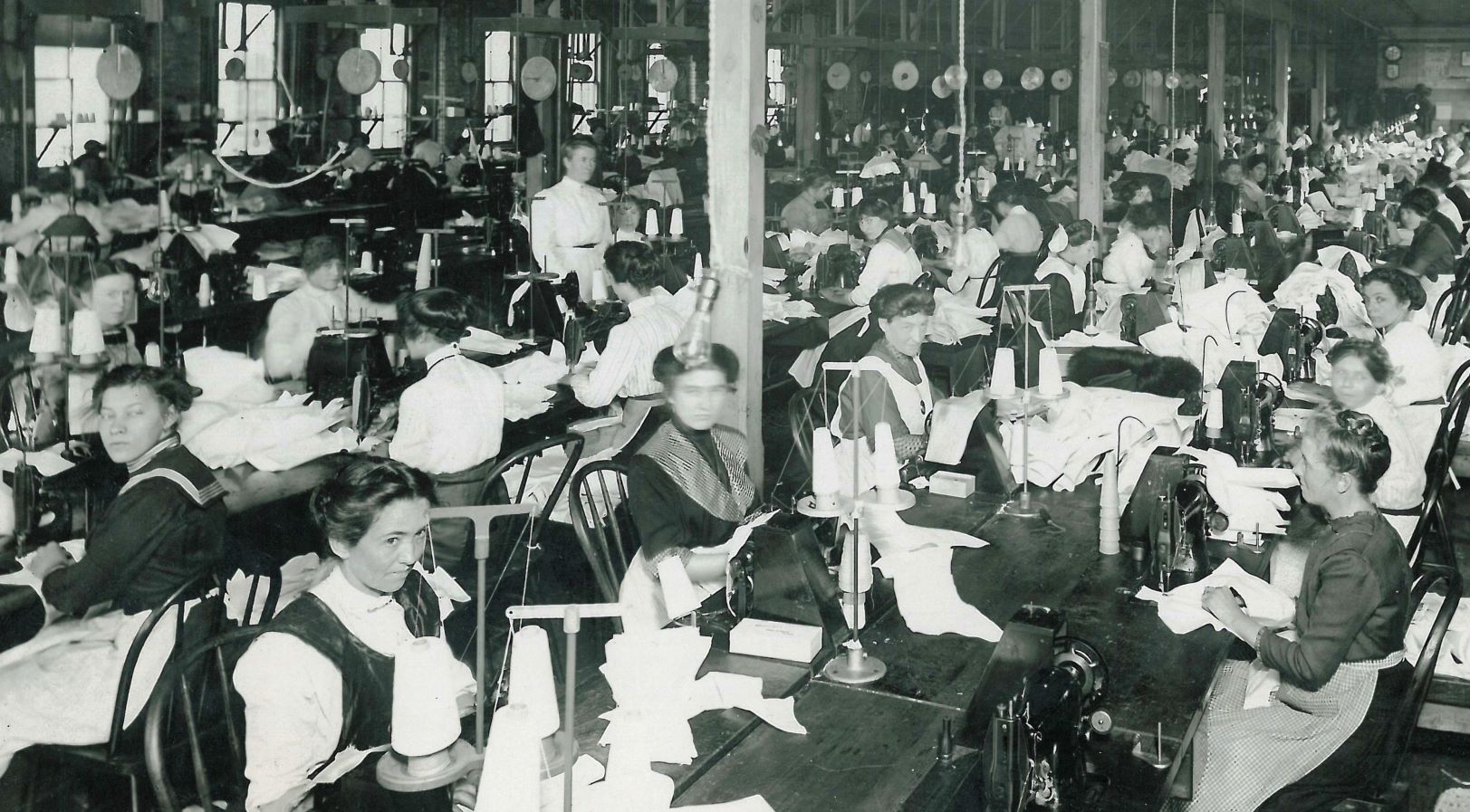
A struggle that should be more widely known. The then general organizer of the International Ladies Garment Workers Union, Newman continues her report on one of the most remarkable strikes of its time, the organization and 1912 walk-out of the Kalamazoo Corset Workers’ Union, Local 82 of I.L.G.W.U. At the core of the dispute was the rebellion of the women, and girls, employees against systemic sexual harassment, assault, and exchange by managers of the factory. Defying an injunction to return to work, strikers were jailed for refusing to be assaulted. Isolated geographically, socially, and organizationally, with its most important reflection in a near total lack determined support from of Michigan’s A.F.L. almost entirely male and craft concerned, the struggle eventually went down to ‘defeat’. Though not without educating, organizing, and politicizing a group of working-class women.
‘More on the Kalamazoo Strike’ by Pauline M. Newman from The Progressive Woman. Vol. 6 No. 62. August, 1912.
It is because of the fact that the public in general, and the readers of The Progressive Woman in particular, are interested in the outcome of the corset workers’ strike, that we present to them the present status of affairs:
The agreement between our union and the Kalamazoo Corset Company was accepted and signed in good faith on our part and with a determination to carry out its provisions if permitted to do so.
The agreement was ratified by us over the protest of a large number of our members, but we felt that we owed it to the general public to permit the conciliation board to put its plans into execution.
In compliance with the terms of the agreement, one of our members returned to work. While this girl was waiting for work at her machine, the employes in the factory to the number of two or three hundred gathered around her and heaped upon her all sorts of abuse. The general superintendent was told of the situation and appeared upon the scene while the demonstration was in progress. He then stopped the machinery, mounted a box and delivered a speech to the employes and made the statement that the “union can go to the dickens.” He then asked the employes to decide as to whether the girl should be given work or not and the vote was in the negative.
The girl was then called to the office and asked to tell what she intended to do under the circumstances and she replied that she had come to the factory to work and that she was willing to work if permitted to do so. The general superintendent told her that if she was willing to work under the circumstances, he did not want her and she was discharged.
The above statement of facts was admitted by the general superintendent of the corset company at a meeting of the conciliation hoard.
Another girl reported for work and was asked to sign a paper not to belong to an industrial organization, and being met with a refusal to sign, the manager put her to new work, where she was met with the same reception as referred to above. The girl was finally called to the office and was told that she had better go home now and that her case would be attended to later.
Still another reported for work and before promising anything the general superintendent sent the forelady to have the employes say whether she should be given work or not.
When these facts were reported, Pauline M. Newman, general organizer, called a meeting of the sanitation board, which under the terms of the agreement is to act upon all such cases. The meeting was attended by the general superintendent and his assistant. One of the girls appeared before the so-called arbitration board and told the above story, which story was not disputed by the officials of the corset company.
At that meeting the general superintendent promised that he would try and straighten matters out in the future, the committee accepted his promise and held that there was nothing before them for action.
The committee urged our side to have more patience and that the company be given more time to make good.
It was at that meeting that the general superintendent stated that he “hardly thought it possible to carry out the agreement by reinstating all former employes by the 17th of July.”
That the company is not sincere in its attempt to carry out this phase of the agreement is borne out by the fact that new girls are being employed from time to time while the strikers are compelled to await the pleasure of the management for reinstatement. The company is also running extensive advertisements for help.
The gentleman who was to enforce the agreement is out of town, and is not apt to return so very soon. We have been forced to the conclusion that the committee is nothing more than a farce, having neither power nor authority.
The company has proven conclusively that there is no intention on its part to comply with the agreement and so we have declared it broken and decided to renew the strike.
We are planning to put about twenty-four girls on the road and to advertise the strike and to solicit funds to carry on the work.
We intend to let the merchants who trade with the Kalamazoo Corset Company, and who by this time we presume are aware of the so-called settlement, know that the agreement was broken by the company and that the strike is still on.
And now, dear reader, think about the facts we give you and think twice before you form an opinion one way or the other. Remember that the company had agreed to reinstate all former employes under any circumstances and it has failed to do so.
Who ever heard of a manager who would let the employes run the business? Who would think the corset company would leave it to their employes to decide as to whether the strikers should be taken back? Does it not look as if there was a motive behind it? Why could not the general superintendent tell his employes to behave instead of putting it up to them and giving them the power to decide? But we know why, and that is our reason for renewing the strike.
Furthermore, the company has agreed not to discriminate against any of its former employes for belonging to an industrial organization and yet the first thing the general superintendent did was to ask one of the girls to sign such a paper. Is not this an open violation of the agreement? Talk about relying upon the word of an employer!
We intend to carry on this fight to a finish and it is only a question of time when the Kalamazoo Corset company will regret exceedingly its stubborn attitude toward its former employes.
The girls are now imbued with the fighting spirit more than ever before. It took them quite some time, but they are awake now and ready for the new fight. They understand now what it all means; they understand that a job means life, and that the employer who owns the job, owns the very life of the man or woman who is forced to hunt for a job in minister, professor, sociologist, or whoever order to live: they understand now, that the it may be, are all acting under the supervision of the master class. And it is out of their understanding that the workers, men and women, will put a stop to the inhuman working conditions and the causes that produce them.
The Socialist Woman was a monthly magazine edited by Josephine Conger-Kaneko from 1907 with this aim: “The Socialist Woman exists for the sole purpose of bringing women into touch with the Socialist idea. We intend to make this paper a forum for the discussion of problems that lie closest to women’s lives, from the Socialist standpoint”. In 1908, Conger-Kaneko and her husband Japanese socialist Kiichi Kaneko moved to Girard, Kansas home of Appeal to Reason, which would print Socialist Woman. In 1909 it was renamed The Progressive Woman, and The Coming Nation in 1913. Its contributors included Socialist Party activist Kate Richards O’Hare, Alice Stone Blackwell, Eugene V. Debs, Ella Wheeler Wilcox, and others. A treat of the journal was the For Kiddies in Socialist Homes column by Elizabeth Vincent.The Progressive Woman lasted until 1916.
PDF of original issue: https://www.marxists.org/history/usa/pubs/socialist-woman/120800-progressivewoman-v6w62.pdf

