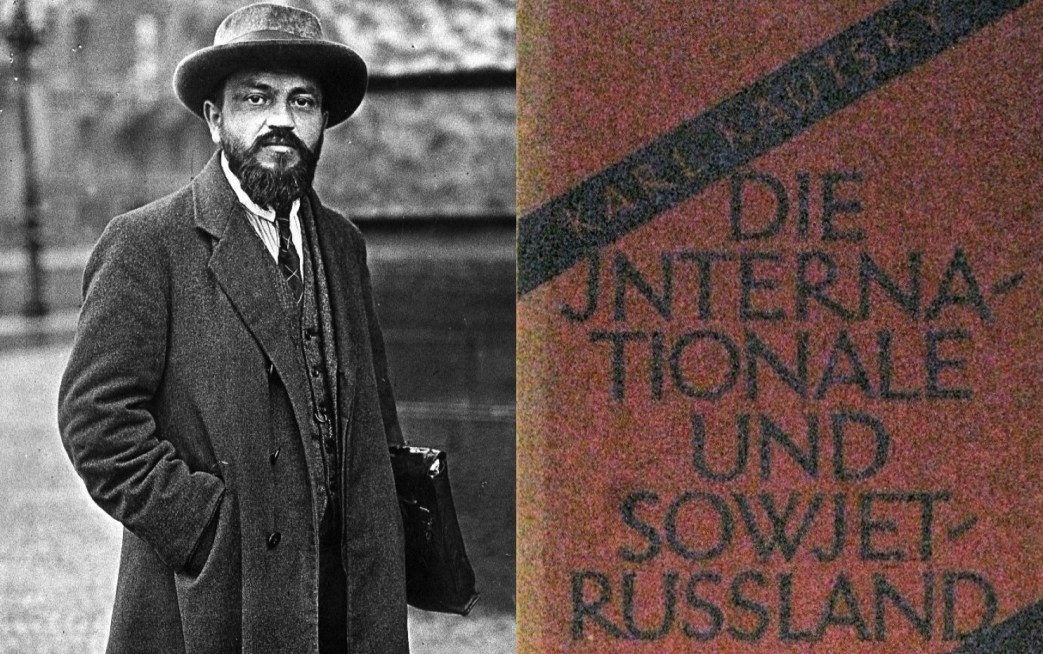
Veteran revolutionary Paul Frölich refutes with derision Kautsky’s 1925 pamphlet, ‘The International and Soviet Russia’ (Die Internationale und Sowjetrussland). Taken from his report to the Bureau of the Second International, Kautsky asserts that is not imperialism, not fascism, not colonialism, but Communism which posed the greatest threat to the working class, with the apostate further claiming that ‘Socialists’ might unite with bourgeois democrats in overthrowing Bolsheviks ‘by force.’
‘Kautsky Incites to War’ By Paul Frölich from International Press Correspondence. Vol. 5 N0. 48. June 5, 1925.
Six years ago, Kautsky saw a picture of Bolshevism: a gorilla with a knife between its bared teeth. At that time it was posted up by hundreds of thousands at all street corners in Germany, in order to inspire the German man in the street with fear of Spartacus, and to prepare him for the blessings of the Noske regime. It was published by the Anti-Bolshevist League which was a direct descendant of the National League against social democracy, but was then used by Ebert and Scheidemann as a weapon against the German working class and kept going with Government money (home service!).
Since Kautsky became childish, this bogey has pursued him in his dreams. Thousands and thousands of German proletarians may be slaughtered–even amid the thunder of the guns, Kautsky will preach alliance with the Noske party. In Hungary and in Italy, the bloodiest terror may reign, the Esthonian and Bulgarian peoples may be driven to despair–Kautsky will have no word, no thought left against blood and terror. Though Germany be turned into a national penitentiary in which only the national bands of murderers enjoy the protection of the Republic, though Hindenburg mount Ébert’s throne–Kautsky will crow: it is a joy to live! Though the whole German people be enslaved, though the whole world be threatened by American Trust capital with plunder, war and subjugation–Kautsky will have but one aim: Death to the Bolsheviki!
He has now again raised this cry in a pamphlet: “The International and Soviet Russia” (published by I.H.W. Dietz’ Successors, Berlin). It ought to be possible to publish the whole pamphlet so as to expose its author to the derision and contempt of the whole world. For it is one huge tissue of lies, so shameless, that they need only be pronounced to be exposed as such. There is no recent inflammatory article against Soviet Russia which is so impudently and stupidly mendacious.
If we are to believe Kautsky, the Russian proletariat is sighing under the heavy yoke of its own party, it dreams of nothing but liberation from this yoke, being prepared to sell its soul to the devil; but again and again it is routed by machine guns. Further, even now that the civil war is ended and the Koltschaks, Kaledins, Wrangels and the boon companions of the Menscheviki are defeated, Russia is tearing at full speed towards disaster, and everyone who has witnessed the contrary with his own eyes is either a deceiver or deceived. Further, Russia is ruled by “a small clique”, “strong enough to serve the interests of no single class (a splendid Marxist, this Kautsky!), to treat every class as its docile tool”, “a conspiracy against the Russian people, against workers and peasants as well as against the intellectuals and the remains and beginnings of a capitalist class”. A clique “which has now got so far that it lives by ruling and exploiting the proletariat”, “has for years chiefly been engaged in subjugating, corrupting, enervating and blunting the intellect of the proletariat within and without Russia”, which “has become the most dangerous enemy of the proletariat itself” so that “the proletariat of the world is hopelessly prevented from developing its full force as long as Russia is governed by the modern methods of Bolshevism”. Briefly: in Kautsky’s eyes, Bolshevism continues to exist as an anti-Bolshevist poster.
Having painted Bolshevism, Soviet Russia and in the same way the Communist International in such colours, Kautsky easily arrives at a conclusion. He who, since 1908 (since the publication of the “Way to Power”) has carefully avoided being consistent, who adopted no other attitude towards imperialism, the war, the counter-revolution than one of disgusting quietism, is for once consistent: Soviet Russia must be annihilated! Of course Karl Marx must be called as witness, he who in the “Inaugural Address” preached war against “the encroachment of the barbaric power which has its seat in St. Petersburg” the Soviet Government of course is a still worse “barbaric power” which indeed “no longer has its seat in Petrograd but in Moscow, further from Europe, nearer to Tartary”. Since the Bolsheviki consummated the will of Karl Marx as regards Czarism, the will of Karl Kautsky as regards the Bolsheviki must be consummated.
But in what way? Kautsky examines in detail how it could be done. The result of his enquiry is recklessly contradictory, but just for that reason it leaves no doubt as to what he means, as we shall see. At first he enquires into “peaceful means”. His answer is “it is simply hopeless to try to exercise a moral influence on them (the Communists!)” “Like every other military despotism, like the military monarchies of the Romanoffs, the Habsburgs and the Hohenzollerns, it (Bolshevism) will probably only be overcome by force.”
Prepare then for armed insurrection! But that is a delicate matter. First of all there is no prospect of success against a good army. Secondly, the Bolsheviki understand the matter too well and their police are too good. It is therefore better for MacDonald, Vandervelde, Adler, Scheidemann and Abramowitsch to keep their fingers out of the pie.
“Peaceful means” again then. Yes indeed! And now Kautsky is theorising at random. What wrecked Czarism? The fact that it had to increase traffic, to promote business for the benefit of its military system. Thus it prepared the ground for its fall.
Now indeed, according to Kautsky, the Soviet State is doomed to steady decline, which destroys all prospects for democracy. But perhaps the Bolsheviki want nevertheless to improve the economic position of Russia. They give concessions, they try to obtain loans, they develop the system of traffic. According to Kautsky, the Soviet regime is still in power because the proletariat is weak. If the economic situation improves, the proletariat will become strong and can then cast off the Soviet system, that bloodthirsty rule of the “clique”. In Kautsky’s opinion therefore, the anti-bolshevist International should by no means oppose international loans to Russia, but should on the contrary encourage them. But it should demand as a condition for these loans the promise of “reforms”, which is also good because these “reforms” are demanded by the international stockjobbers.
Kautsky himself apparently only believed implicitly in his bogey of Bolshevism and in the despotism of the “clique” over the Russian proletariat when he was in a condition of complete mental derangement. For that reason he is now secretly doubting whether it is reasonable to build his hopes on the Russian proletariat becoming stronger. And it is thus that he arrives at the idea which is most elaborately developed in his article, which forms its core.
Not preparations for armed insurrection but–speculation upon a general, spontaneous revolt. Kautsky suddenly discovers that he had counted on revolts of this kind “which would put an end to the three military monarchies of East Europe”. More than that! He knows that the majority of social democrats have refused to hope that “we should by gradually increasing in strength, imperceptibly grow over the head of military monarchy and into a Republic”. In Germany, Austria and Russia this has happened (as is well known against the majority of those social democrats). Why should it then not happen again–in Russia?
But how is a spontaneous revolt of this kind possible in Soviet Rusia? By a severe shock to the State, by its being defeated in war. Kautsky is building on this foundation, and he discusses whether the Menschevist International should take part in such a revolt. And he answers this question very decidedly in the affirmative. “It might be disastrous”, he says, “were our International to condemn from the beginning any organised armed putch against Bolshevism as counter-revolutionary action and forbid its members in Russia to take part in such an insurrection, on the ground that it, the International, had refused to have anything to do with the armed putch against Bolshevism”.
The fact that reactionary elements would make use of such a revolt to serve their own purposes should not deter, but rather stimulate “the social democrats to strive with all their power to gain a decisive influence in the revolt–certainly not to frustrate it”. Even Kautsky must have learnt enough from the history of the last eight years to know that when it comes to deeds, the Mensheviki could only gain such an influence in the revolt against the Bolsheviki by allying themselves with reaction or rather by unreservedly submitting themselves to the counter-revolutionary generals. But even this makes no difference to him, for he considers that “everything that is possible in the way of reaction in Russia, is already practiced by the Bolsheviki in such a measure that it cannot be surpassed”. He accepts the worst white-guardist reaction, he is prepared to promote it and, with this end in view, he speaks of revolt almost like a Bolshevik.
All this, Kautsky asseverates, it is true–whether it be hypocrisy or relapse into old Kautskysm–that he preaches neither intervention against Russia, nor revolt, but peaceful means only. But his pals, the leaders of the II. International, will quite well understand. As is his intention, they will speak in favour of credits to Russia if their capitalists expect that it would be to their advantage. They will not however, for one moment, delude themselves into believing, that they can overthrow the Soviet power by furthering the general economic development of Russia. They know that better than Kautsky with his idee fixe. But they will be thankful to learn from Kautsky’s article that a weapon against the abhorred Soviet Russia and the Communist International has been found in the world war against Soviet Russia, and in the subsequent rising of the whole counter-revolution from the pretender Romanov to Tchernov and Abramovitch.
Karl Kautsky’s sermon came just at the right moment. Kautsky’s article was published immediately after the English Conservative government had compelled the capitalist powers to form a holy alliance against Soviet Russia, at the moment when the crusade against the land of revolution is again to the fore. In these circumstances this pamphlet has a definite political significance. Briefly expressed, it is: Gentlemen of the II. International, be on the watch! Your corn is beginning to ripen. You have once more the opportunity to win laurels in helping the cause of the capitalists in all countries. The coterie of international exploiters is anxious for war against Soviet Russia. Make yourselves useful to them, for that is your business!
Kautsky will not have to tell them twice. It will not be long before they will resolve to carry out what Kautsky demands of them today: resolutely and with all the means in their power to work for the defeat of Russia in a war, resolutely and with all determination to take part in a general rising against the Soviet State in alliance with the reactionary powers and, in order to hasten this ardently longed-for opportunity, to facilitate the attack of the capitalist powers, to inaugurate a systematic campaign against Soviet Russia in the social democratic press of the whole world.
If this demand of Kautsky’s is fulfilled, if social democracy now enters on a campaign of agitation against Russia, let us see that the workers of the whole world understand its true significance: a war of the whole counter-revolutionary world against Russia the workers’ and peasants’ State! It is a good thing that Kautsky has already let the cat out of the bag as to where the II. International would be if the capitalist campaign against Russia would materialise. The workers of the whole world should learn their lesson from this, they must be on their guard against any surprise and should, without a moment’s delay, start a campaign against not only the danger of war but also against the social democratic war mongers and for the Workers’ and Peasants’ Soviet Republic!
International Press Correspondence, widely known as”Inprecorr” was published by the Executive Committee of the Communist International (ECCI) regularly in German and English, occasionally in many other languages, beginning in 1921 and lasting in English until 1938. Inprecorr’s role was to supply translated articles to the English-speaking press of the International from the Comintern’s different sections, as well as news and statements from the ECCI. Many ‘Daily Worker’ and ‘Communist’ articles originated in Inprecorr, and it also published articles by American comrades for use in other countries. It was published at least weekly, and often thrice weekly. A major contributor to the Communist press in the U.S., Inprecorr is an invaluable English-language source on the history of the Communist International and its sections.
PDF of full issue: https://www.marxists.org/history/international/comintern/inprecor/1925/v05n48-jun-05-1925-inprecor.pdf

