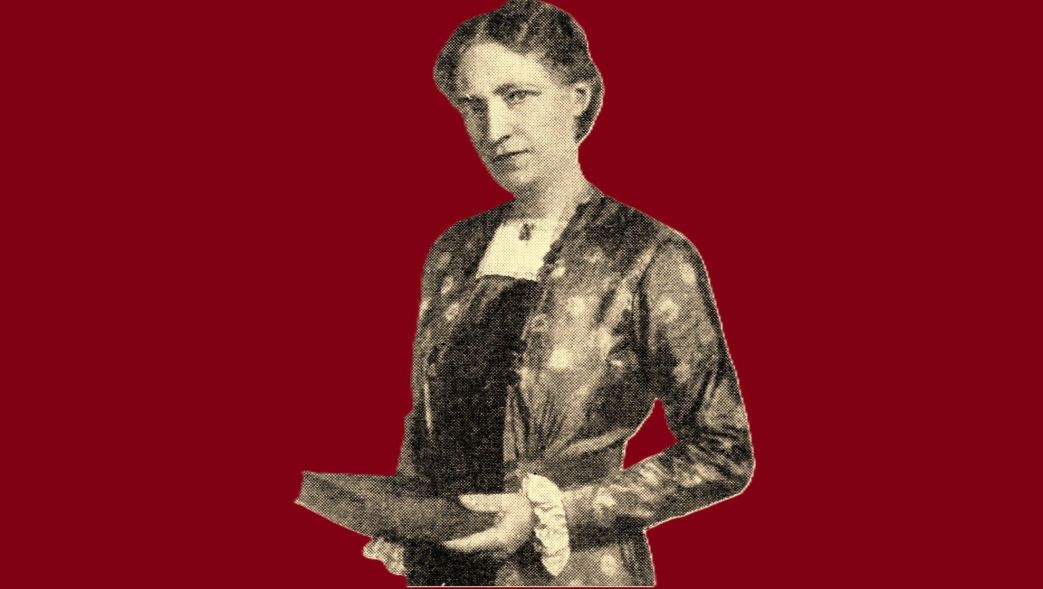
Meet Comrade Lida Parce
Readers of this site may be familiar with the name of Lida (née) Parce Robinson (1867-1923) from her robust ‘socialist-feminist’ articles in The Progressive Woman, the ISR, and other periodicals. Examining, sometimes denouncing, the role of women’s status and gender dynamics within the Socialist Party and larger progressive movement, Parce was the most trenchant, consistent, and eloquent challengers to male domination of the Socialist Party in the Debs era.
Her voice confirms the relative vibrancy of Socialist Party’s discussion by Party women activists in contrast to that of the later Communist and other left parties.
Born in 1867 in St. Joseph, Michigan to well-to-farmers, Parce would complete a full public education, then enroll and graduate with a degree education from nearby Albion College, an early co-educational school. Soon after, Lida moved to the Southwest, and in 1889 would marry while in Tempe, the Illinois-born Herbert Fulwiler Robinson, a general in the Arizona National Guard.
Locating in Phoenix, Arizona (also being the most industrial and politically organized state of the region), Lida taught school while Herbert got work as a civil engineer. Parce soon became a leading suffrage campaigner and member of the newly formed Socialist Party. In 1901, she was elected president of the Phoenix suffrage club, became president of the Arizona territorial suffrage association, and then he National American Woman Suffrage Association.
Following her divorce around 1907, she moved to Chicago where she continued to teach, write, lecture, and campaign, publishing in a wide variety of Socialist, labor, and women’s press and lecturing on the Socialist circuit. Parce was not simply a pamphleteer, but a serious materialist thinker who attempted to apply the work of Bebel, Engels, along with more recent feminists into a cohesive understanding the place of women in society in general, and working-class women in particular. Her critical eye turned to all aspects of gender’s role in power’s assertion, with some articles presaging today’s ‘Social Reproduction Theory.’
A consistent denouncer of the dangers of ‘exclusive masculinism’ in the Debs’ era Socialist Party, one its leading theoreticians of women’s liberation and the material transformation of gender roles, Lida Parce—if not unique—is an exemplary figure in our movement and one that is deserving of recognition and understanding.
And while it is true that much of Parce’s analysis remains of her time, often limited in its applications for today, if not occasionally obsolete, there is much that is illuminating and affirming. The value for revolutionaries in understanding the ideas, decisions, and experiences of our progenitors—is obvious. Parce’s prolific voice—what must be hundreds of articles–can at times not only sound modern, by prophetic to our own times.
In practical politics, Parce did not align herself with the Party’s Left Wing and seems to have stayed with the Socialists after the 1919 split. Her activity as she got older seemed to have waned, at least in the written record, though she continued to teach in Chicago until her death from breast cancer on October 16, 1923 at age 53. Comrade Parce is buried at that city’s Mt. Auburn Cemetery.

