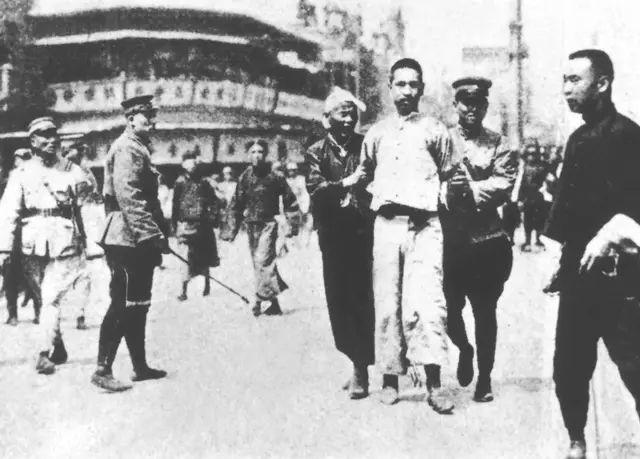
A discussion of obvious importance for the history of the Chinese Revolution. The aftermath of the multiple disasters for the world Communist movement occurring in 1927’s China would have to be addressed at the following year’s Sixth World Congress. Already the colonial revolution was a main theme Congress held in 1928 as China, of course, loomed over the proceedings. The debacle of ’27 was a turning point as the First United Front devolved into civil war between the Communists and Kuomintang. The important report on China at the Congress was given by Qu Qiubai (Strakhov), who worked as a journalist and translator in Moscow, closely associated with Chinese Communist circles in Russia. He attended the 3rd and 4th Comintern Congresses, teaching at the University of the East before returning to China where he would soon rise to the C.C.P.’s Politburo in 1925. Escaping after 1927’s failed Guangzhou Uprising, he arrived in Moscow in early 1928 where he served as head of China’s Comintern delegation. While others addressed the topic of China, below are the interventions in response to Strakhov’s report from the other seated Chinese delegates; Vatslav Vorovsky, Chu Cho-mei (Qiu Zhumo), Lyu Wan, Chen Kwang, then followed by Qu Qiubai’s response to the discussion. Quibai, associated with Li Li-San, would lose power to Wang Ming’s faction around 1930. Qiubai was captured by Kuomintang forces and executed on June 18, 1935 at age 36.
‘Discussion of the Chinese Revolution at the Sixth World Congress’ by Vatslav Vorovsky, Chu Cho-mei, Lyu Wan, Chen Kwang, & Qu Qiubai from International Press Correspondence. Vol. Vol. 8 Nos. 68 & 69. October 4 & 11, 1928.
***
DISCUSSION
Comrade VOROVSKY (China): Comrades, I shall speak today on the Canton uprising and the opportunist and putschist danger in the Chinese Party.
The Canton uprising is especially important because it was the first Soviet established in the East. It has exercised in fact the functions of a Soviet in the organisation of the uprising, in the leading of the uprising and the establishment of power in the form of Soviets. The Canton uprising has been tremendously depreciated by Comrade Pepper and shamefully calumniated by the Trotskyists and the opportunists of all colours. Some have said that the time was premature; others said that the social basis was insufficient; and still others, the Trotskyists, say it was a pure adventure. It is for the Congress to defend the uprising because the Canton uprising is of the greatest importance in the revolutionary history of the East. We as Communists should fight against all these opportunist declarations.
Firstly, the Canton uprising grew out of the struggles of the Canton workers and peasants. It took place at a time when the Soviet Government had been established in the Heilufun districts, that is the East of the City of Canton, for three months already. It took place after a series of peasant uprisings in the Eastern River regions of Kwantung province, and in the North River region of the Kwantung province. It took place at the time when a Soviet Government had already been established in the Island of Hainan.
Ever since October 14th, we have seen strong mass struggles of the Canton workers. There was the seamen’s strike on October 14th, when the seamen gathered in open meetings in spite of the white terror and succeeded in calling a general one-day strike of all the seamen in Canton. They recaptured their union, drove away the reorganisation committee which was appointed by Li Ti-sin, and held a demonstration in which not only 5000 seamen took part but another 5000 of Canton strikers and workers. On that day, the Red banners of all the unions of Canton were carried through the streets of Canton, past the Government houses, past the police stations, under the slogans: “Release the political prisoners”, “Freedom to the workers and peasants unions”, “Restoration of all rights which had been won”, “Maintenance of the privileges of the Strikers”, “Down with the new militarists Li Ti-sin, Chang Kai-shek, Fupei”, “Down with the organisation committees”. This movement started as a seamen’s strike and developed to a movement of all workers in Canton and the peasants around Canton.
The yellow reorganisation committees of all the unions fled into hiding. Three of the committee members who did not escape were killed by the masses in the demonstrations. From this day on began a movement of the Canton workers for the ousting of all the reorganisation committees of the unions, for the release of the political prisoners, for the legal existence of the unions. It continued until more than 90 unions gathered at open meetings under the name of the “Canton workers delegates assembly” which had been underground till then. There it was decided to set up again the Canton workers delegates and drive out the reorganisation committees. These 90 unions represented at least a mass of 100,000 workers. Chang Fa-kuei began to arrest the workers and to suppress our movement, but in spite of this persecution the railway workers of Canton again demonstrated and demanded the reinstatement of the railway workers who had been dismissed by Li Ti-sin. When Wang Chin-wei came to Canton with a special instruction to pacify the masses, they turned against him. In that demonstration about 60 workers were arrested. In spite of that, on November 7th, the anniversary of the October Revolution, the workers again gathered at a demonstration in Canton under the Red Flag and even invited the Soviet Representative to deliver a speech. The militarists waited for the arrival of the Soviet Consul, and then stopped him from attending the meeting. But from that moment we see that the counter-revolutionary militarist Government already could not control the masses. From this moment on we see demonstrations in the streets; the sabotage of the chauffeurs in Canton; the strike of the mechanics; the restoration of the printers’ union. We have seen meetings in the countryside and suburbs of Canton. This movement developed without interruption till the moment of the Canton uprising.
Secondly, the uprising was organised before April 14th, that is before the counter-revolution of Li Ti-sin in Canton. Li Ti-sin had crushed the uprising before it took place. After that, the Cantonese were preparing for an uprising in the expectation that the Wuhan Government would come to their assistance. But when the Wuhan Government also became reactionary, they again expected that Li Ti-sin’s army would come to Canton. But this again did not happen, and only then the Cantonese workers began to realise that they could not expect anything from outside, and that they would have to rely on themselves. From that moment a more serious organisation was started, first only as a district organisation, and afterwards it was changed into an organisation of the Red Guards on the basis of the trade unions.
At first 5000 Red Guards were organised, but as a result of the defeat of the “Canton Hong-Kong strike Committee” by Wan Chin-wei, only 2500 Red Guards were left. This was the great tragedy of the Canton workers. They organised automobile groups, groups to destroy the organisation of the secret police, and a special organisation to make bombs and collect other war material. They also had their organisation among the troops. The organisation was very weak, it was limited to one regiment which participated in the strike. In addition, Manifestoes and literature were distributed among other troops.
Before the strike, preparations for an uprising were also made among the peasants. First an instruction was sent to Hailufeng telling them to be prepared to advance on Canton. Second, the peasants in Tonkan were also told to make an uprising about September 13th. Then the peasants in the West River region were told to make their preparations. Then about 1000 soldiers, under Communist leadership, were told to advance on Canton. We can say that these peasants actually made uprisings. Only they made them two days later when the Canton uprising had already been defeated. There were uprisings in Huanshin and also in the city of Kongmoon, a big city near Canton. There were also disturbances in Fatshan, a city west of Canton.
We have to refute another assertion, that is, that the Canton Soviet was not elected. The Canton Soviet was elected three days before the uprising at a meeting to which 70 trade unions sent delegates. This was very difficult to organise because to hold a meeting of about 80 men in the city of Canton under the white terror is something unusual. If anybody says that such a meeting is not representative, then we reply that it was the most representative meeting which was ever held under the circumstances.
It is true, the Canton uprising suffered from weak leadership, both politically and especially militarily. There was not a military organ which could organise the masses and the red guards immediately after the uprising. After the uprising, we paid too much attention to the police headquarters, and neglected the military headquarters. Therefore, the military headquarters were never captured. Our military leadership, instead of concentrating all its attention on the military headquarters, neglected the most important point; it ought to have organised one or two divisions of troops to start an offensive immediately in Honan, i.e. through the river of Tsukiang. It was not done. Therefore, instead of adopting an offensive position, we made an attack only on a part of the city. It went on for two days, because in the small streets of Canton, it is very difficult to operate. Owing to this mistake, the militarists were able to concentrate their troops in the North, South, East and West, which crushed us. This was due to the fact that we had not organised the troops, and had not made a plan for the retreat. This was a criminal mistake. Secondly, before the Canton uprising, not enough was done in arousing the masses. As a result the great masses did not fake part in the Canton uprising. Comrade Pepper says only about two or three thousand people took part in the uprising. This is absolutely wrong.
It is said that after the correction of the opportunist mistakes the Chinese Communist Party went to another extreme, to putschism. This is not in accordance however, with the facts, because we say that even now we have very strong right tendencies in the Party and very influential forces are still working in this direction. For instance, in Shanghai, there are comrades who put forward such a theory, that the revolution has been defeated.
“There is a great danger in the peasant uprisings because they are anarchistic and the proletariat may lose hegemony in the revolution.”
They put forward such slogans that the time is not suitable for big struggles, even economic struggles. This is wrong. There were other comrades who opposed this. They declared that the big struggles must involve the big masses, then we are for these struggles. But if the big struggles are only to lead to radical demands being set up then we are against it. But we must say we are against those comrades who say that the time is not suitable for big struggles and that we must only concentrate on small struggles. This is an opportunist mistake.
These comrades also said that we have to join in a movement for the restoration of a mass movement of the Kuomintang. They say there are unions already demanding the restoration of a mass movement. But this is not a real movement of the masses. Other comrades are against this slogan. They say it is not a slogan of the masses, the textile and industrial workers of Shanghai did not put it forward because they know that the Kuomintang cannot give them a mass movement. To give them enough freedom for a mass movement would mean to give the workers an opportunity to develop forces which would eventually overthrow the Kuomintang. These opportunistic comrades have even brought out such a slogan as a united front, because they said that the unions are demanding it. In fact this is not a demand of the masses. It is a slogan put forward by the Kuomintang trade unionists because there exist two rival unions in the Kuomintang at present.
These opportunistic tendencies emanate from very influential comrades, and have even crept into the Central Committee and the Political Bureau because the Political Bureau passed a resolution that we should put forward the slogan to convene a rural national assembly and to demand the restoration of a mass movement.
I do not agree with those comrades who say that previously there were opportunistic mistakes and that they do not exist any more now. We will have to fight against these opportunist tendencies.
Comrade CHU CHO-MEI (China):
It is believed by many that the influence of our Party has waned since the Canton revolt, and that our movement has become stranded. In reality, however, such is not the case. The influence of the C.P. of China has increased among the masses since the Canton revolt, and this was demonstrated among other things by the influx of new members immediately after the Canton revolt. The membership of the Party has increased as compared with what it was immediately prior to the Canton revolt. Similarly, the labour movement has begun to revive. Proof of this is furnished by the unceasing strikes among the textile workers in Shanghai. This movement grows incessantly in spite of the unheard-of terrorism exercised by the Kuomintang authorities.
A growing activity is to be observed among the large masses of the petty-bourgeoisie. In recent weeks, an anti-imperialist movement emerged among the petty-bourgeoisie on the grounds of their discontent with the compromising policies of the Kuomintang. The illusions of the petty-bourgeoisie concerning the Kuomintang are dying out as a result of the open surrender of the latter to the imperialist Powers.
The fact that the Kuomintang and its Government are in need of large funds for the maintenance of their growing armies and bureaucratic apparatus, causes the generals to increase the burden of taxation. In this connection a movement has started among the urban petty-bourgeoisie against paying taxes. The financial crisis of the Kuomintang Government has been revealed in the fact that the troops have not been getting any pay for months, and in some cases for years. As you probably know, there were numerous mutinies of soldiers against their generals and officers upon these grounds. The struggle of the masses of the soldiers for payment of arrears of their pay is going to increase, for the generals are extorting the taxes not in order to pay the soldiers, but in order to fill their own pockets. On these grounds the disaffection of the soldiery will be found to grow apace. We also see how the mutinies of the soldiers extend from one company to another. There were also cases when soldiers brought out to crush a rising of the peasants had thrown in their lot with the latter. This movement of the soldiers will no doubt continue to develop, assuming more and more a class-conscious character.
There is also a growth of the peasant movement in North China. It is true, such primitive peasant movements like those of the “Red Spears”, “Big Knives”, etc., are insufficiently organised; nevertheless, by their ceaseless fight against the taxes, they are undermining the foundations of the capitalist domination. You know that in South China the guerilla warfare of the peasantry is still going on. It is becoming more and more transformed into organised movements led by the peasant unions, in the course of which the power of the gentry has been overthrown in some places and Soviets established. Notwithstanding the difficult conditions, there is already a whole number of districts in South China which have established Soviet rule and which are extending their sphere of influence.
All these are tokens of the revival of the mass movement, indicating at the same time the steady growth of the influence wielded by the Communist Party. Although this does not yet show that we have to deal already with a new revolutionary tide we have not yet progressed so far–nevertheless, this new tide is bound to rise, and precisely for the following reasons:
In the first place, the objective tasks of the revolution have not yet been solved. The unification of China now being carried out by the Kuomintang is a mere sham. In reality, the Kuomintang, in which the different groups of generals are represented, is not in a position to bring about the unification of China. Secondly, the Kuomintang is not in a position to solve the agrarian problem. Even such a modest demand of the peasants as a 25% reduction in the land rent could not be fulfilled by the Kuomintang. On the other hand, the bourgeoisie cannot solve the agrarian problem by means of reformism of the kind carried out by Stolypin in Tsarist Russia, because China has no extensive areas of unoccupied land as was the case in Tsarist Russia. At the same time, the peasant masses are allying themselves more and more with the urban proletariat whose representatives are leading their struggle and gaining their ever-increasing confidence. Thirdly, the Kuomintang regime represents nothing else but a dictatorship of the bloc formed by the gentry, the landlords, the feudal elements, and the bourgeoisie. Nevertheless the Kuomintang Government does not constitute a solid body. It is split, each group of generals has its own government and is anxious to become independent of the central government. This, I believe, renders the Kuomintang dictatorship different from the Fascist dictatorship in Europe. There can be no talk of stabilisation of the Kuomintang, since the inward strife is inevitably bound to grow among the component groups of the Kuomintang. These are the principal circumstances which will lead to an inevitable revival of the Chinese Revolution.
Nevertheless, it would be wrong to assume that there are no chances at all for reformism in China. On the contrary, just because there is as yet no resurgence of the revolutionary wave in China, there are still great possibilities for the development of a national reformism.
The imperialist powers, particularly the United States, are trying to support the national bourgeoisie by extending petty concessions in order to “pacify”, and in reality to hoodwink the masses. The petty-bourgeois opposition to the Kuomintang Government is by no means imbued with a consistent revolutionary character. The anti-imperialist movement, the fight against exorbitant taxes, etc., all these things are due to a certain discontent with the Kuomintang regime; nevertheless this movement is not sufficiently energetic and determined and can easily end in a compromise with the Kuomintang. This points to the absolute necessity for the working class to maintain a determined and independent tactical line in the actual struggle. The Party must develop the everyday struggles of the working masses, creating stronger trade unions and leading their struggle for emancipation, at the same time refraining from raising the slogan of “restoration of liberties” which would only serve the ends of the Kuomintang. The Party must stand at the head of the anti-imperialist movement and of the struggle of the petty-bourgeois masses against taxes, etc…It must also lead the mutinies in the army, endeavouring to develop them into a progressive economic movement, into an open alliance of the soldiers with the revolutionary workers and peasants. It should devote particular attention to the struggle of the peasants against the militarists, as well as to their struggle against excessive taxes, for the confiscation of the big estates, for the overthrow of the power of the gentry and the feudal elements. The Party must give more systematic assistance and leadership to the guerilla movement of the peasants, taking all steps to help in building up the existing Soviet districts. The Party must develop a wide agitation and propaganda for the armed insurrection as the only means towards the overthrow of the Kuomintang rule, i.e. the feudal elements and the bourgeoisie. It must carry on a campaign of exposing the national reformists, and also against the so-called Third Party. (This party is by no means a workers’ and peasants’ party, but rather the representative of the Left-wing of the Kuomintang whose spokesmen are Tyn Il-ta, Cheng Kun-Po and others.)
This party befuddles the revolutionary intelligence of the large masses and plays therefore a reactionary role. The Party will not be able to carry out its line of winning the large masses and preparing them for the organised armed insurrection unless it successfully carries out these slogans.
A few words about the role of the women in the revolutionary movement in China. There is no need for me to point out how considerable that role is. Our women in China are taking the most active part in the movement. The working women in Shanghai have taken a most active part in the three revolts of the Shanghai proletariat, whilst numerous women have stood in the ranks of the Workers’ Guards who waged a bitter fight against the troops of Chang Kai-shek. In the strike movement of Shanghai, the working women frequently play a leading role. The same is true in regard to the rural districts. Not only do the peasant women take part in the struggle for the division of the land, but also in the active guerilla warfare. They are very valuable in the liaison, sentry, sanitation services, and so on. In the Kwantung Province, in the districts of Hailotyn, Hainam, Chenfa, where Soviets have been established, the peasant women participate in the various activities of the Soviets. This women’s movement, unparalleled in Chinese history, has uprooted in the Sovietized districts all the old prejudices and traditions of the degradation and enslavement of the woman in the family. Nevertheless the Party should devote even greater attention than hitherto to the organisational and educational activities among the working women. The central slogan of the women’s movement to-day should be: the participation of all the working women in the struggle for the overthrow of the power of the gentry, the feudal elements and the bourgeoisie; the participation of the women in the agrarian revolution. It should be observed that the working women, particularly the peasant women, are already fighting under this slogan. This activity of the women is essentially due to the measures which have been carried out in the Sovietized districts (the women’s right to land tenure, participation in the Soviets, equal rights in the domain of popular education, the abolition of family subjugation traditions, etc.).
In conclusion, a few words on the inner Party situation. I believe that not only the C.P. of China, but the Communist Party of all the colonies generally are still too young. Frequently, the Communist Parties of the colonial and semi-colonial countries do not grasp the decisions of the C.I. and they fail to carry them out. The opportunistic tendencies in these countries are still great, and experience has shown that the opportunistic mistakes, say, of the Chinese Communist Party, have the same roots as the oppositional ideology in the C.P.S.U. I fully support the idea that this Congress should particularly emphasise the question of strengthening the Communist Parties in the colonial and semi-colonial countries.
Comrade LYU WAN (China):
Comrades, the very fact that the question of the colonial and semi-colonial countries has been put before the Congress in its full scope shows that the national liberation movement plays a colossal role especially now when world capitalism is experiencing an acute crisis. The importance of the colonial an sem. colonial countries has been emphasised already by the Second Congress of the Comintern. The liberation movement of the oppressed peoples is an inseparable and constituent part of the world Socialist revolution. But an important role in the national liberation movement is played by the youth. Comrade Kuusinen’s theses and the speeches of many other comrades do not deal with the youth movement in the colonial and semi-colonial countries properly. To my mind this is one of the greatest shortcomings of the theses and speeches on the colonial question.
The basic policy of the imperialist powers in the colonial and semi-colonial countries is that of systematic hampering the development of industry so as to preserve their monopolist position. This fact is so clear and undoubted that there is no need for any special discussions on the matter. The hampering of the development of industry retards the development of the productive forces. This, however, does not mean that there is no industrial development in the colonial countries whatever. On the contrary, we see in China, especially during the war, a development of light industry. It has developed only to an extent commensurate with the requirements of the metropolis. To the extent that light industry develops (the production of cotton goods, silk, etc.), the number of young workers in industry increases. The youth has been playing a colossal part in the struggle of the working class in China. It has taken a most active part in the strike movement. The entire history of the labour movement in China during the last five years bears this out. It would therefore be wrong for the Communists to ignore the role. and importance of the youth in the struggle of the working class and the struggle for emancipation of the oppressed peoples in general.
There is to be observed a pauperisation of the peasantry in the colonial and semi-colonial countries as a result of which there is a vast number of unemployed youths. This circumstance gives the capitalists a chance to intensify their exploitation of the youth. The employers hire unemployed youth whom they keep in their homes as slaves. This is now known as the system of “youth training”. The masses of unemployed youths find no work in the towns owing to the scanty development of industry. The latter is due to the imperialist policy of hampering the development of industry. In view of this the masses of young workers are becoming declassed. They remain outside of the process of production, and fall into the hands of the militarists as soldiers or become ordinary bandits. That is why the question of the young workers becomes of such vital importance for the development of the Communist movement in the colonies, and especially in China.
As to the petty-bourgeois intellectuals of the colonial and semi-colonial countries, they are somewhat different from the intellectuals of the independent capitalist countries. The colonial and semi-colonial intellectuals play a revolutionary role in the first phase of the revolutionary liberation movement of the masses against imperialist oppression. But the Chinese Revolution has shown that the upper strata of the petty bourgeois intellectuals often vacillate between the forces of reaction and revolution and go over to the side of the counter-revolutionaries when the revolution takes a sharp turn. This experience must be taken into account by all Communist Parties of the colonies and semi-colonies.
During the united front of the national movement, the bourgeoisie attempted to split up the revolutionary youth. Thus, for instance, the Youth Department of the Kuomintang in 1925-26 tried to set up its own youth organisation to compete with the Young Communist League. Of course, it did not succeed. But we already know that the bourgeoisie is trying to do that. From this it follows that the Young Communist League must fight against every effort at organisation of a parallel independent youth organisation as this would greatly hamper the development of Communist influence among the youth.
The first phase of development of the Chinese Revolution is rich not only in positive experience of revolutionary struggle, but also in experience of a negative character. I will take the liberty to remind you of the fact that the Communist leadership in China committed grave errors in that period. It did not wage a determined struggle for the hegemony of the proletariat; it did not stimulate, but, on the contrary, hampered the development of the mass movement; it did not understand the transition of one phase of the revolution into the other; it did not do the necessary preparatory work for that transition; it did not alter its slogans at the proper moment, etc. That was one of the main causes of the defeat of the Chinese Revolution. It goes without saying that the defeat of the Chinese Revolution is also due to numerous objective causes. But the subjective causes of the defeat must be stressed lest the Communist Parties of the colonies and semi-colonies in general commit the same mistakes in as much as they are still young and have not much experience in leading mass struggles.
Comrades, the experience of the past struggles show us that the young workers, peasants and soldiers take most active part in the revolutionary struggle of the colonial and semi-colonial countries. The importance of the soldiers’ participation in the revolutionary movement is very great. Unfortunately, the work done by our Party in this sphere was inadequate. This lesson must be learned so that the necessary measures may be taken in the future. Experience has shown that the youth movement in the colonies and semi-colonies can be widely developed only on the basis of the specific interests and demands of the youth in their daily struggle for existence. It shows that the development of a Young Communist organisation and the creation of a real strong proletarian basis is inconceivable without an energetic struggle for an improvement of the economic and labour conditions of the youth. Notwithstanding the fact that numerous youth organisations have been destroyed by the white terror the organisation of the young workers and peasants is growing and the influence of the Communists among them is increasing.
We agree with the main theses on the colonial and semi-colonial countries. On the whole it is correct. But this notwithstanding, it has some deficiencies. The experiences and lessons of the past struggle of the Chinese Revolution, for instance, have not been taken into account in the theses. It seems to me that this is very important because these lessons are of great value for the Communist Parties of all colonial and semi-colonial countries.
I want to emphasise also that in the first place the question of the tasks of the youth movement has not been dealt with in the theses, and, secondly, the part dealing with the tasks of the Communist Parties in the colonial and semi-colonial countries at the present time does not formulate the question clearly enough. Nothing is said about the tasks of the anti-imperialist movement. This is also one of the major shortcomings of the theses. I think the Congress will take all this into consideration and will properly define the tasks of the Communist Parties in the colonial and semi-colonial countries and outline the correct course of development and consolidation of the youth movement.
Comrade CHEN KWANG (China):
The question that requires our closest attention in the nationalist movements in the colonial countries is that of the participation of the bourgeoisie in the revolution. The experience of the rise and the failure of the Chinese Revolution prove that at a certain stage of the development of the revolution the bourgeoisie can play a revolutionary role. At the same time it is inevitable that the bourgeoisie in the colonial countries will ultimately pursue a counter-revolutionary path, but during the process of the transformation of the bourgeoisie in the revolution, partly because objectively the tasks of the bourgeois-democratic revolution have not yet been completed, and partly because the bourgeoisie, in its attempt to hold political power, makes radical gestures such as putting forward the slogan for the unity of the country, the demobilisation of
the soldiers and the demand for tariff autonomy, there are comrades who fail to understand the real situation and who raise the question of the possibility of a further revolutionary role of the bourgeoisie. After the occupation of Peking by the Kuomintang forces some Chinese as well as foreign comrades raised the following questions;
1. Whether the Kuomintang can still play a considerable revolutionary role in the anti-imperialist movement in China.
2. Whether there is a possibility for the Kuomintang power to consolidate itself and to carry out a reformist programme.
3. Whether there is under the Kuomintang regime a possibility for the development not only of a “third party”, but even a possibility for the Communist Party and the revolutionary workers’ and peasants’ organisations to carry on their activities legally.
In answering these questions we cannot consider the nationalist movements in the colonies apart from the world revolutionary movement, nor can we consider a counter-revolutionary national bourgeoisie in the colonies apart from the imperialists. After the betrayal of the revolution by the national bourgeoisie in the colonies, the tasks of the bourgeois democratic revolution will inevitably fall upon the shoulders of the worker and peasant masses who are under the leadership of the proletariat. The revolutionary tasks consist in driving away the imperialists, in carrying out the agrarian revolution, in bringing about the 8-hour day, establishing Soviet political power and in completing the national independence of the colonies. In the carrying out of these tasks the proletariat cannot for one moment neglect its class struggle. Therefore, notwithstanding the fact that there are still contradictions between the national bourgeoisie and the imperialists, between the national bourgeoisie and the feudal forces and new militarists; that the national bourgeoisie objectively still demands national independence the national bourgeoisie will inevitably adopt the policy of suppressing the workers’ movement and capitulation to the imperialists. This is because the national bourgeoisie in the colonies is weak, and in the face of either the bribery or the pressure of the imperialists and the developing class struggle of the proletariat, it will inevitably turn to the side of counter-revolution. Not only the Indian national bourgeoisie which is dominated by one imperialist country is acting this way, but the Chinese national bourgeoisie, which is controlled by many imperialist countries, also acts this way in the face of the policy of Japan’s threats and the policy of bribery of the United Stated of America.
Therefore, I think to say that the national bourgeoisie which has already betrayed the revolution can still play an anti-imperialist role. is to show a lack of understanding of the transition and the progress of revolutionary stages in the colonies and the role which the imperialists play in the, revolutionary movement in the colonies. This mistake is the result of a mechanical understanding of the revolutionary role which the different classes play in the revolution.
The second and the third questions should be answered together. If we admit that there is a possibility for the stabilisation of the Kuomintang political power, then 1. Either the imperialist policy of the division of China has been successful and has completely turned China into a colony. In this event the Kuomintang would be simply a tool of the imperialist rule in China; 2. or the strength of the Chinese national bourgeoisie is great enough to maintain its independent political power; 3. or the Chinese workers’ and peasants’ revolution has completely failed and there is no possibility of any development in the near future.
But facts tell us that first of all the world revolution has already reached its third period, that capitalism has its own new internal contradictions, that imperialism is confronted with new conflicts for the re-division of the colonies, and that a new world war, especially a Pacific War, is imminent. There is a Leftward movement of the working class of the world and a forward development of national revolutionary movements in the colonies. If we cannot disprove these facts, then there is no reason to believe that the imperialists can safely turn China into a complete colony. And further, the conflicts between Japan and the United States of America, in China as well as in the Pacific area, are becoming more and more serious every day.
The between the Right wing and the Left wing at the V Plenum of the Kuomintang which recently met in Nanking reflect this very clearly. The Left wing is pro-American and maintains that the boycott movement against Japanese goods encouraged. The Right wing and the Centrists are compromising with Japanese and British imperialism, and they are in favour of suppressing the popular anti-Japanese movement. This conflict is a symptom of the coming war between the new Chinese militarists which will be instigated and utilised by the imperialists. Secondly, the semi-colonial status of China, the fact that the Chinese Kuomintang represents the political power of the landed gentry and bourgeoisie under the shelter of the imperialists, and the fact that the Chinese national bourgeoisie is not yet developed and is infected with provincialism, all prove that the Chinese national bourgeoisie has absolutely no possibility of independently maintaining its political power. Thirdly, not only is the world revolutionary movement developing rapidly, the Chinese revolution is still progressing in spite of the tremendous defeat it suffered. The agrarian revolution is developing rapidly in the villages. The revolutionary movement among the soldiers is progressing. The internal conflicts and the struggles in the army are assuming a revolutionary character. The city poor are gradually adopting an anti-Kuomintang position because of their experience in the anti-Japanese movement. In spite of the capitalist offensive and the reign of white terror, the working class is again consolidating its forces and is preparing for the coming new revolutionary wave. Under the banner of the revolution which the Canton uprising proletariat is developing revolution. These facts may not yet be comrades of our brother Parties who live far but if we open even imperialist newspapers we will find much news about peasant uprisings, the revolt of soldiers, and the slaughter of city workers. All these facts prove that the Chinese revolution has not yet been completely defeated, that it is still undermining the political power of the Kuomintang, of Chinese landed gentry and the bourgeoisie. All these facts prove that there is no possibility for the Kuomintang to carry out a reformist programme. The conditions in China are such that not only the living conditions of the workers are getting worse every day, that the workers enjoy absolutely no freedom in political and trade union activities and that the struggles between the peasants and the landlords are becoming sharper and sharper, but even the anti-imperialist movements are prohibited by the Kuomintang government. This shows that there is not the slightest sign of reformism in the Kuomintang rule.
Precisely at this moment the II International has invited the Kuomintang to take part in its Congress. The II International is evidently carrying out the diplomacy of the imperialists by drawing the hangmen of the Chinese and workers and peasants into the ranks of the II International. By doing this the II International is recognising the activities of the Kuomintang in helping the imperialists in the exploitation of China, the results of which are, of course, shared by the labour aristocrats.
Next, let us come to the question of the “third party”. This organisation is the inevitable consequence of the polarisation of the forces of revolution and counter-revolution in China. Since the Kuomintang Government is becoming more and more reactionary and the Soviet revolution is developing rapidly, and since there is a pause between the two revolutionary waves, it is inevitable that a portion of the petty bourgeoisie should come out to organise a “third party”. But since its policy is to prevent the Soviet revolution, it cannot have any real revolutionary policy. It refuses to stand for the agrarian revolution, but advocates local self-government for the villages (our comrade Pepper once also advocated such a policy). In spite of preparing the workers for the armed uprising, it only asks for the reinstitution of the mass movement and hopes for the realisation of a reformist programme. If the “third party” will be able to carry on its activities openly, its policy of compromise will objectively make it a Left wing of the Kuomintang. The results of this policy have already been revealed by the recent activities of the Left wing of the Kuomintang. Let us suppose that the “third party” refused to become the Left wing of the Kuomintang, then it must oppose the Kuomintang. Considered from this standpoint the prospects of the “third party” are also very bad. Because when a new revolutionary wave rises a portion of the petty bourgeoisie will naturally come under the leadership of the proletariat, and the possibilities of the development of the “third party” will be reduced to a minimum.
Having shown the impossibility of the imperialists to turn China into a complete colony, having proved the impossibility for the national bourgeoisie to stabilise itself, and having shown the bad prospects of the “third party”, I think we can safely say that there is no possibility for the Communist Party and the revolutionary workers’ and peasants’ organisations to carry out a legal movement. Only opportunists can draw an opposite conclusion.
Basing our observations on the fact that the world revolution has already reached its third stage and that the Chinese Revolution is still progressing, we can clearly see that there is no other way for the Chinese Communist Party but to organise hundreds and millions of Chinese toilers, preparing them for the coming revolutionary wave, carrying out the armed uprising, overthrowing the rule of the Kuomintang of the landed gentry and bourgeoisie, and establishing the political power of the Soviets.
The world proletariat and our brother parties must recognise the fact that the reactionary role which the Kuomintang plays in the colonies is similar to the role of the Fascisti in Europe. 310,000 of the Chinese workers and peasant masses, of whom 6,000 were Communists, fell as victims of the Kuomintang. Its brutality excels the record of all the Fascists in the world. The Kuomintang not only governs China on behalf of its imperialist masters, but its counter-revolutionary position is affecting the bourgeoisie of other colonial countries in the East, and is influencing them in the same direction of counter-revolution. Therefore, one of the important tasks of the Communists is not only to fight against the fascists in the West, but also to fight against the Fascists in the East the Kuomintang!
***
Concluding Speech by Comrade Strakhov (Qu Qiubai)
Comrades, I began my report with a description of Asiatic. methods of production, and I will begin my concluding speech with a description of Asiatic methods of terrorism. The white terror which broke out after the defeat of the Chinese revolution, must teach us something. We know that in no other country has there been such brutal terrorism and such cruel dictatorship. And yet, when we discussed the colonial question, we paid very little attention to the lessons of the Chinese revolution. I therefore want to divide my speech into three parts: 1. lessons of the Chinese revolution; 2. a short announcement which I have to make on behalf of the Chinese delegation and 3. a few general points in the colonial question with which I would like to deal.

One of the discussion speakers pointed out that we do not pay sufficient attention to the defeats of the Chinese Communist Party in regard to the organisational question. This is based on a misunderstanding. We know very well our errors and defects. I did not touch upon them in my oral report, considering that I had presented a corresponding written report. These defects and errors are also mentioned in my pamphlet “Contentious Questions of the Chinese Revolution”. But as this material has not yet been published in the foreign languages, I will fill in this gap now.
We know that opportunism and putschism are rife in our Party. The main defect of our organisational work was that we did not approach the masses as well as the petty-bourgeoisie did, that we approached them in the gentry–Kuomintang style. Owing to opportunist leadership, we ordered the workers not to strike and to disarm the pickets; we ordered them to come to an agreement with Van Tsin-yei, so as not to disturb him. During the putschist period, the same methods were used. We wanted to strike and played the role of the magnanimous lord who wants to make a revolution and thinks that one can go on strike any day. Orders were issued wholesale to instigate “insurrections” and declare strikes. By approaching the masses, and the working class in this manner, we dissociated the Party from the masses. As a result of this, we witness now in the Chinese Communist Party in spite of the growth and extension of its political influence on the masses a certain organisational isolation from the masses. As to the composition of the Communist Party of China, it is true that we have a too big percentage of peasants in its ranks. But this does not mean that we must give up admitting peasants to the Party. On the contrary, we must do our utmost to draw the peasant masses into peasant organisations, peasants unions, soviets etc., extending of course at the same time the labour organisations. Only by such means will we be able to guarantee the proletarian composition of our Party.
Such are the main defects which I can point out. I think that this is useful and instructive for the other Parties because we know that excessive bureaucratic centralism exists also in other Parties, which develops in the Party the tendency to take the place of mass organisations. But one cannot of course say that everything is bad in our Party, that formerly we had Sun-Yat-Senism and that we are having Trotskyism now, that Bolshevism is conspicuous by its absence.
On the instructions of the Chinese delegation, I want to make the following statement: Pepper says that formerly we had Sun-Yat-Senism and that now we are having Trotskyism in our Party. This is slanderous and not correct. Why? Because, don’t you see, if we speak of Trotskyism and if Pepper even says that after the Wuhan Coup d’Etat we committed the error of permanent revolution, what does this mean? Did we rouse the Canton Insurrection a la Trotsky? Trotsky is saying now: what happened in Canton was nothing but an adventure, a putsch. But he says nevertheless that this putsch, this adventure took, according to him, “immediately the form of proletarian dictatorship”. If Comrade Pepper thinks that we were carrying on a permanent revolution in Canton, he is himself a Trotskyist. We know that Pepper accuses us of not having paid attention to the anti-imperialist movement. What does this mean? What is the anti-imperialist movement? True, in the past period the Chinese Party was weak organisationally and could not pay sufficient attention to the development and guidance of the anti-imperialist movement among the masses. But if this question is raised as Pepper does it, it appears that we paid too much attention to the agrarian revolution and that one should pay more attention to the anti-imperialist movement.
What is the anti-imperialist movement? It is boycott, demonstration, meeting and then strike. We had a strike in Hongkong which lasted nearly 2 years. We had a series of demonstrations etc. But this did not put an end to imperialism, and we cannot say that we will overthrow imperialist rule in China if we continue to fight only by such methods. Imperialism can be really overthrown only if the proletariat can rouse the millions strong peasantry under the slogan of agrarian revolution.
Comrade Pepper is quoting Comrade Stalin. Comrade Stalin said that the peculiarity of the Chinese revolution consists in it being an anti-imperialist and a bourgeois-democratic revolution: its main substance is agrarian revolution, an agrarian coup d’Etat. But Comrade Pepper does not go on quoting. And yet Comrade Stalin repeatedly said that struggle against imperialist rule cannot be separated from struggle for land.
Comrade Pepper does not want to say this. Why? He himself proposed to state in the programme of the Comintern that in China or in the East in general, we have only relics of Asiatic methods of production and not feudalism. If this is his view he should be more consistent following Plekhanov’s example, who justified his opposition to the nationalisation of land by saying that in Russia land relations were not unlike those in ancient China, i.e. land was already nationalised, why then nationalise it once more? Pepper should have come forward as frankly as an opponent of land nationalisation and agrarian revolution in China. He sets agrarian revolution against the imperialist movement. He also quoted Comrade Bukharin, where Bukharin praises him. But the showed no. inclination to give another quotation which says:
“One cannot say: either armed insurrection or trade union work and struggle against putschism.”
“Thus, energetic struggle against all who reject the insurrection slogan or have even the least inclination to reject it.”
Another saying is:
“What are the mistakes in Comrade Pepper’s estimate? They are as follows: 1. one cannot clearly understand. what is, in his opinion, the extension of the peasant movement (or rather what is the role of the peasant struggle in the anti-imperialist revolution); 2. his attempts to bring forward the artificial watchwords and slogans of the minimum programme in regard to governmental power.
“Namely, Pepper proposes: to elect local self-government organs in the ruling districts on a democratic basis” etc.
According to Bukharin, this “can be interpreted as annulment of the slogan of Soviets.”
This shows you how consistent Pepper is, more consistent than Trotsky because Trotsky says that we have now in China the period of counter-revolution, that in China “revolution is on the downward grade” etc., but he does not want to make the deduction in regard to the constitution. Such is Trotsky by nature, but Comrade Pepper is by nature different. He arrives at a political deduction: since agrarian revolution cannot give anything in China, let us have a “constitution”, let us elect democratic self-government organs for the peasants.
Given a correct understanding and a decision of the colonial question, the lessons of the Chinese revolution play an important role. Owing to this experience, we learn to understand the Chinese revolution and the revolution in India and other colonial countries. This revolution is bourgeois-democratic only because the tasks of overthrowing imperialism are closely connected with the tasks of destroying feudal land relations. This revolution cannot be carried to a conclusion except under the hegemony of the proletariat, only by the establishment of proletarian and peasant dictatorship.
The experience of the Chinese revolution shows us that when the revolution in the colonies reaches a decisive moment, the question takes the following form: either landlord and bourgeois dictatorship or proletarian and peasant dictatorship. There can be no constitutional, no rural self-government way (hear, hear).
In the rural districts of China landlords and peasants flay each other, cut each others’ throats, how could one introduce their self-government together with the gentry? How is this possible?
I think therefore that, for the discussion of the colonial question, we must take into account more than we have hitherto done the lessons of the Chinese revolution. The main question is; what is our attitude and tactic in regard to the national bourgeoisie and the peasantry.
If we allow ourselves to be carried away by the oppositional attitude of the national and petty-bourgeoisie, by the so-called anti-imperialist movement instead of turning our attention to the revolution, the struggle, we will naturally be unable to establish such relations with the peasantry as we need.
We must make this also the starting point for the question of industrialisation and decolonisation. Why do we raise this question? To determine to what extent the national bourgeoisie is revolutionary, oppositional or venal. During the European war industry developed in India and China owing to that trade capital the development of which was promoted by imperialism. But at the end of the war, when imperialism increased its pressure on China and India, a terrible crisis set in in agriculture, a terrible pauperisation fostered also by the internecine wars which have been going on in our country for decades. Even if we put up one or two new factories in Shanghai while at the same time war is raging within the country, millions of people are dying, trade comes to a standstill and railways are destroyed, what chance is there for industrialisation? Therefore, the phenomenon we witness after the Chinese wars and revolution is the “denationalisation” of the Chinese national bourgeoisie. A section of the national bourgeoisie has already given up its factories, being unable to stand the competition, and has become again comprador. Our comrades can give many examples of this. Another section of the national bourgeoisie has given itself up to political speculation, i.e. political usury. It gives big loans to the provincial governments because it cannot derive any profits from industry. Yet another section of the national bourgeoisie has gone to the country, i.e. has begun to buy up land in provinces where no insurrections have taken place. This develops feudal methods of exploitation, feudal dependence, on the one hand, and dependence of the national bourgeoisie itself on imperialism, on the other hand.
There is also the interesting fact that in Shanghai several former manufacturers have secretly sold their factories to foreigners. The national question plays an important role in China; articles which are called national articles are in great demand. But in reality they are no longer national articles, because these factories are no longer national. The management of the factories is no longer in the hands of the national bourgeoisie but in the hands of foreigners. We know ourselves that, in this state of affairs not only the political but also the economic treachery of the national bourgeoisie is historically inevitable, in as far as this bourgeoisie has deteriorated economically after the wars and the revolution.
It is said in the theses that such and such conditions are necessary for the participation of the national bourgeoisie in the revolution. This is correct. But one should show at first what economic causes, for instance, development of some branches of industry in China and India after the war, create the possibility of a certain degree of revolutionary spirit in the national bourgeoisie.
Another period is beginning now. We have entered upon the period when the national bourgeoisie is deteriorating, when it is inevitably veering towards treachery, and has already betrayed the national revolution in China. It is said now that probably the national bourgeoisie has already established its reign in China. But this is not so, because it is so weak that even when it engages in counter-revolution, it does so with the help of the gentry and all sorts of other riff raff and what is the main thing under the leadership of the imperialists. This is particularly important. We have therefore in Nanking the Chang-Kai-Shek government. We read in todays papers that this government cannot do anything with the militarists. Feng- Yu-Hsiang did not go the Plenum, he did not want to compromise, which means that Chang-Kai-Shek will have to compromise with him, the gentry and the landlords. What does this mean? It means that in regard to the leadership, the hegemony of the bourgeoisie, one can see that it is, so to speak, “like a man kept by a woman”.
You will understand than with such a state of affairs, one cannot speak of a revolutionary attitude of the national bourgeoisie. We have here material according to which the Chinese bourgeoisie recently called a conference and placed the demands before the national government, the chief demand being restitution of the sums taken from them by the militarists. None of the demands was of a national character, no Customs. autonomy, no unification. If there were some national demands, they were only for show. This is what the “revolutionary spirit” and oppositional nature of the national bourgeoisie comes to.
I say that this applies not only to China but also to India. The entire colonial bourgeoisie acts in this manner. In as far as the masses have already risen, it wants to get something out of the imperialists. But when the masses begin to move too quickly, its interests urge it to go over to the side of the imperialists and to support them. Even if the demands of the present Chinese bourgeoisie be directed against the imperialists, they are after all demands such as the social democrats address today to the European bourgeoisie. The Chinese bourgeoisie says now to the imperialists and landlords that, if they do not make concessions, do not reduce their armies and do not give them a certain share of the Customs revenue, it will not be able to cope with the Bolsheviks, to suppress the insurrection and to solve this problem, and that then the rebellious workers and peasants will throw out the landlords and imperialists. Therefore, the bourgeoisie advises the latter to make a few concessions. Is this a revoltionary role? It is a counter-revolutionary role. We therefore witness a similar state of affairs also in the campaign against the Simon Commission in India. This must be verified by facts. I therefore think that the foremost question is that of national reformism. It has its roots in the economic development of the colonies, This national reformism has a tendency of developing into national fascism. We must take up a definite attitude to this tendency.
We must struggle against national fascism not only be cause it leads to the suppression of the most elementary class struggle in the name of the nation, but because it has also another side. National fascism will always declare that it is for reforms, for the improvement of the international position of China, the colonies etc. By this it wants to deceive the petty-bourgeois masses which it wants to utilise so as to prevent revolution.
Therefore the next important question is our attitude to the petty-bourgeois parties. We can lead the petty-bourgeois masses in the struggle against imperialism as long as it keeps within the primary limits of such anti-imperialist struggle: demonstrations, meetings etc. We can shout with them “down with imperialism”, what Chang-Kai-Shek and Li-Ti-Sin are always shouting. We must lead the petty-bourgeois masses in this movement, but we must not have the stupidity of rousing the mass of the poorest urban and rural population only for demonstrations, we must rouse them for something more serious. Although we begin with elementary methods and actions, we must not stop short at them. Therefore, as long as it is a question of demonstrations, meetings etc., we can always depend on the petty-bourgeoisie, but when it comes really to an insurrection, an agrarian revolution, we must take care that our Communist Party does not succumb to the influence of the petty-bourgeois parties. We must have independent organisations and an independent policy; we must freely criticise not only the national-fascist bourgeoisie, we must also criticise and expose the illusions of the petty-bourgeoisie and its parties. All these are definite and important matters. In this connection, it should be also pointed out that in eastern countries where the petty-bourgeois masses are very strong, we must turn our attention to struggle against ideologies such as Gandhism, Confucionism, the golden mean, non-resistance to violence etc. All this, together with nationalism, plays an important role and has at times considerable influence even among the workers.
Therefore struggle against the national bourgeoisie, against petty-bourgeois illusions must be our foremost task in the colonies.
I think that we must make the following conclusion:
1, where the national bourgeoisie has not yet seized power, we must initiate the struggle against its influence, we must paralyse it. Where the national bourgeoisie is already participating in the government, our only task is overthrow of this government. No support whatever.
2. We must have an independent organisation, an independent proletarian policy to counterbalance the petty-bourgeoisie. All ideas of “constitution”, co-operation with bourgeois national reformism are inadmissible.
3. We must impress all Communist Parties with the necessity of giving real support to the Chinese revolution and all Chinese insurrections. We must support not only in the I.R.A. way, not only by struggling against the white terror. We must strengthen our real work. We must study all questions as they affect individual countries: Pacific questions, the question of coordinating actions in the West and in the East, of linking up our work, so that the European proletariat should simultaneously support insurrections in the colonies against the imperialists and carry on the struggle against the national reformists and the national-fascist bourgeoisie.
The revolutionary workers in the West should be told definitely that they must be against the Kuomintang, we want to know that this is the case. This is not sufficiently clear at present. Is Kuomintang terrorism less violent than fascist terrorism? Is Kuomintang terrorism any better than lynch law. against Negroes? The national-fascist nature of the national bourgeoisie must be shown up.
4. I think after all that the problem of the national revolution consists in the fact that the colonies are the world rural district. If one takes into consideration that, on the whole, all these colonies are agrarian and peasant countries, we must realise that a definite tactic in regard to the colonial peasantry as a whole is necessary. It is only from this view point that we can elaborate proper tactics for the revolutionary movement in the East. We are of course against the national bourgeoisie, against national-reformism, but this does not mean that we are against national liberation, that we have gone to the other extreme denial of the nation and of national liberation. Most decidedly not. Now is the time to say that the proletariat and the peasantry and the working masses in general are the bearers of the national revolution in the colonies. On this basis we will support the movement and insurrections against the national bourgeoisie, the native ruling classes of landlords, gentry etc. I think that this is the only right way of putting the question. The national programme of the Marxists consists in standing up for:
1. “Equality of national and language rights, no privileges whatever in regard to this (also right to national self-determination).
2. The principle of Internationalism and relentless struggle against the infection of the proletariat by bourgeois nationalism, even if it be the most refined nationalism.” (Lenin.)
“To imagine that social revolution is possible without insurrections of small nations in the colonies, without revolutionary outbursts in Europe of a section of the petty-bourgeoisie with all its prejudices, without movements of the unconscious proletariat and semi-proletarian masses against the landlord, clerical, monarchist, national etc. yoke, to imagine this, is tantamount to revoking the socialist revolution…Only from such a pedantically ludicrous view point was it possible to call the Irish insurrection a “putsch”. Those who wait for the “pure” social revolution, will wait for it in vain. They are people who do lip service to the revolution without understanding real revolution.” (Lenin.)
Marx said that in Germany everything will depend on the possibility of support for the proletarian revolution by some sort of second edition of the peasant war. Marx’s idea has now become a reality, and even on an international scale. At present we have or will have a second edition of the German peasant war in China, India and in all Eastern countries. This was Marx’ attitude to peasant wars. I think that he indicated thereby what the attitude of the international proletariat should be to the Chinese revolution. The VI. Congress of the Communist International has already expressed its attitude to the Canton Insurrection and to the Chinese revolution. With your permission, I will close my speech thus:
The Canton Insurrection has impressed itself on the mind of the masses as a sample of maximum heroism on the part of the Chinese workers. Let the future insurrection of the mass of the workers and peasants, organised on the basis of the sound and tested principles of Leninism, supported by the international proletariat, be a victorious October for China.
Long live the independent federated Chinese Soviet Republic!
Long live the victorious insurrection of the oppressed peoples!
Long live the world proletarian revolution!
International Press Correspondence, widely known as”Inprecorr” was published by the Executive Committee of the Communist International (ECCI) regularly in German and English, occasionally in many other languages, beginning in 1921 and lasting in English until 1938. Inprecorr’s role was to supply translated articles to the English-speaking press of the International from the Comintern’s different sections, as well as news and statements from the ECCI. Many ‘Daily Worker’ and ‘Communist’ articles originated in Inprecorr, and it also published articles by American comrades for use in other countries. It was published at least weekly, and often thrice weekly.
PDF of full issue: https://www.marxists.org/history/international/comintern/inprecor/1928/v08n68-oct-04-1928-inprecor-op.pdf
PDF of full issue: https://www.marxists.org/history/international/comintern/inprecor/1928/v08n70-oct-09-1928-inprecor-op.pdf
 Revolution's Newsstand
Chen Kwang==Chow En-lai 周恩来
LikeLike
Many thanks!
LikeLike