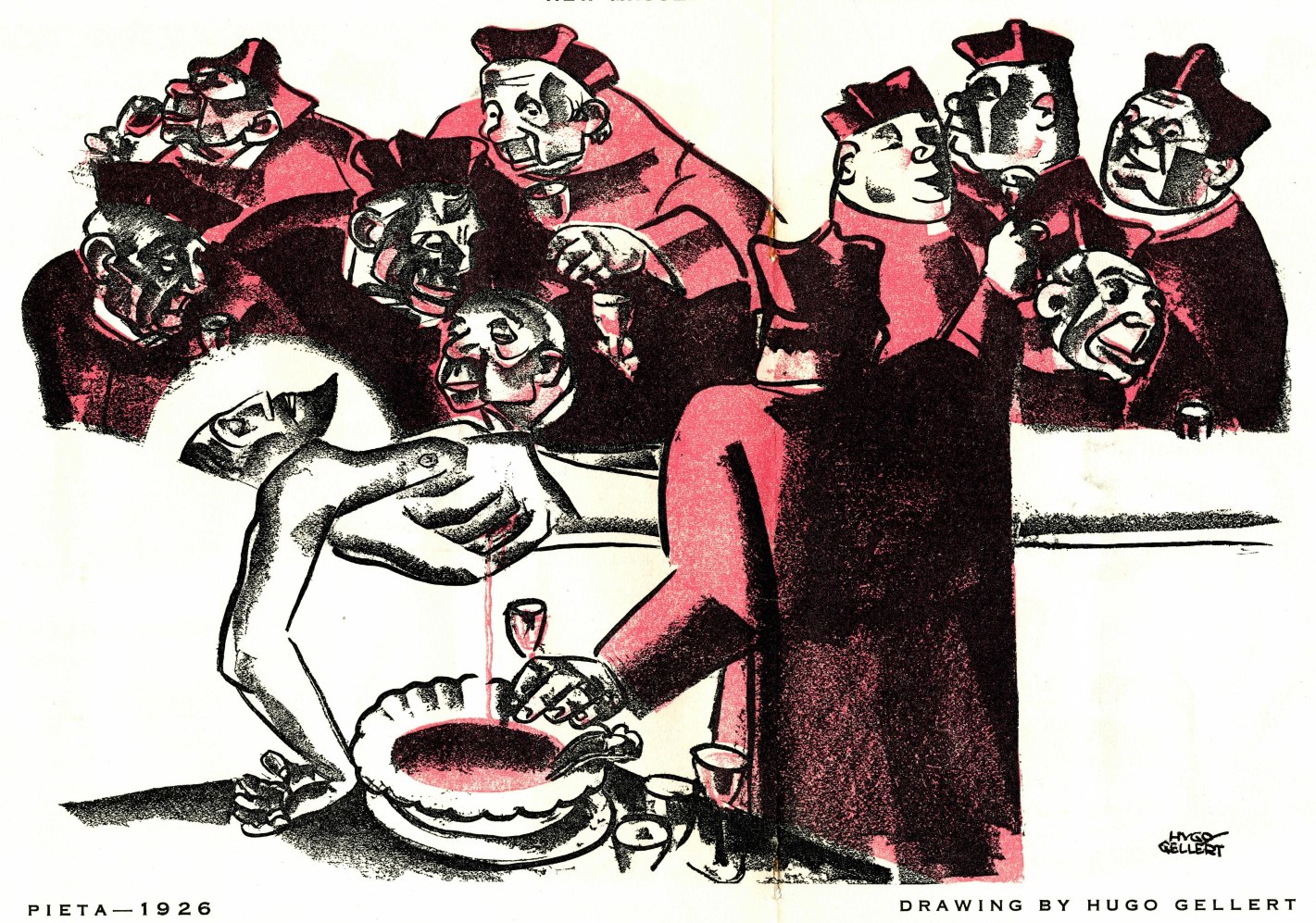
Thurber Lewis on the vulgar and base, snake-oil spectacle of profitable piety grandly displayed at 1926’s Vatican Eucharist Congress involving a million ‘faithful’ gathered as Chicago’s Soldier’s Field. Challenged by the European revolutions, increasing secularism, and mass loss of working-class practitioners, the Vatican made an unlikely pivot in the 1920s to the historically Protestant-dominated, but still deeply religious and reactionary, United States. With moral appeals to both Presbyterian bankers and millions of conservative Catholics, all in the framework of Crusade against Communism. A sort of ‘coming out party’ for legitimizing the role of the Catholic Church and its influence over U.S. politics.
‘Body & Blood of Christ, Inc.’ by Thurber Lewis from New Masses. Vol. 1 No. 4 August, 1926.
COCA COLA, Socony, Wrigley and Fisk Tires can take a tip from the catholic church. They are mere national advertisers; their ubiquitous poster panels, one-sheets, painted displays and subway cards have been put in the shade. No, sir, these are days of international advertising. You can flash a hot slogan on every roof-top from the Battery to the Golden Gate but you’re not in the running unless you can get a president, at least two governors, a rear admiral and a justice of the supreme court to help sell your stuff to the world. That’s the way the church handles its publicity.
The 28th International Eucharistic Congress was the biggest publicity stunt ever pulled. And wasn’t it meet that Chicago, where bullets serve as ballots and “Scarface” Al Caponi helps pick the County Attorney, should be the show ground? Here was a show in adoration of the holy sacrament. Here a million pilgrims were to gather to confess their faith before mankind. The best part of the Sacred College was coming to put it over big. The Congress opened on the 20th of June. On the 19th the bootleggers were complaining that Chief Collins was going too strong on the clean-up. The chief was purifying the town so the pilgrims and the resident flock could confess their faith before man with a clear conscience.
Never was anything better press-agented. The boys in Europe were told to pep it up months in advance and the wires were kept hot from the Vatican, from Cardinal Faulhauber’s Bavarian rectory, from the little parish in Slovenia that was sending ten of its flock to Chicago and from every other place where the boys could dig up an advance story. The princes of the church were landed together to be kissed by Al Smith and Jimmy Walker. Marshall Field’s Pullman Co. gave them a “Red Special” and they whirled into Chicago with the World’s Greatest Newspaper forgetting its Methodism long enough to shout eight-column lines about the papal legate.
From the first high mass in Holy Name Cathedral to the grand procession of the Eucharist at St. Mary’s-on-the-Lake, Hearst’s Herald and Examiner and Evening American ran an agate line race with McCormick’s Tribune for picture and news space. The W.G.N. fell back on its reliable old catholic scribe, James O’Donnell Bennett, who gushed in pious competition with, of all people, Damon Runyon, brought in by Hearst to fill in between World Baseball Series. Hearst won. In two successive days he pulled a double-truck picture, sixteen columns, of the cardinals and the rites.
No one will ever know how many people came for the Congress. In their exuberance, the press exaggerations contradicted each other by hundreds of thousands. The church itself was too modest to say which of the estimates from a half a million to a million and a half was more nearly correct. But there were enough to enrich Samuel Insull’s utilities companies, the hotel men, Marshall Field, the real estate group, of which Cardinal Mundelein is no insignificant member, and the commission houses, by a good many millions.
Papal colors fluttered everywhere. Now and again a limousine was sirened through the loop at a mad pace by a motorcycle corps. You knew that here was a cardinal or an archbishop. Hundreds of thousands stampeded Soldier’s Field for a glimpse of the mitered prelates going through their masses every morning at ten. Thousands of the faithful were lucky enough to get near a bless-bestowing member of the hierarchy long enough to kiss his episcopal ring. (Did they think of the germs? No.) Women fainted, 62,000 children sang a seventh century Gregorian. The Pope sent three messages. Coolidge sent one; he also sent Secretary of Labor Davis, a born Presbyterian Welshman, as a proxy. Pierce Butler, the corporation lawyer. Justice of the Supreme Court, made a speech in the grand manner which he uses in handing down anti-labor decisions. The papal legate dropped his mitre at the crowning ceremony at St. Mary’s, more women fainted, it rained cats and dogs and several hundred were hurt in the crush for cover from the good Lord’s wrath. Such was the Congress.
And then again, such was not the Congress. It was several things much more important.
One of these was Mexico. The new Mexico no longer wishes to tolerate the tyranny, the land-lordism, the educational and political hegemony of the Roman church. The church is fighting back. One of the objects of the Eucharistic Congress being held in the United States was to bring pressure to bear on Mexico through a show of strength and a mustering of influence in the land of the Monroe Doctrine. The secretary of the Eucharistic Congress, Count D’Yanville admitted this. During the congress, “high and revered prelates,” who withheld their precious names, made scathing attacks upon the Calles government and told weird tales of persecution.
Another reason for the congress: Europe is on the skids. The center of the world is where the dollar is minted. The holding of the congress in the United States was reciprocal: the church took advantage of the superior position of the United States as the leading imperialist nation of the world; and the capitalists of the United States welcomed the church with open arms because their worldwide imperialism requires the sustaining influence of a faith that stultifies the masses on an international scale.
The industrial slaves in heavy industry in this country, the Italians, the Slav races, the Mexicans are, for the most part, catholic. Morgan, Gary, Schwab, et al, want them to remain so. The faith needs to be spread. It needs to be spread to avoid a repetition of Homestead and the great steel strike of 1919. The spiritual exaltation that emanates from the Holy See must penetrate the ranks of the American workers, spreading the doctrine of servility and the deadening superstitious hang-overs of the Dark Ages.
The vast majority of the catholics throughout the rest of the world are tillers of the soil. They are the peasants of the Latin countries, most of the Slav nations and a good share of the German-speaking people. In those countries the church is a power. It is a political power as well as a moral and educational power. And it is invariably a power for reaction. By the sheer momentum of its universal grip, cinched tightly during feudalism, it has carried on over into another age. Capitalism does not will its extinction. Quite the contrary. In this, its decrepit period, capitalism needs a great purveyor of ignorance and blind faith for its own maintenance. There are almost twenty million catholics in the United States. A good part of these catholics are, unlike their sisters and brothers of other lands, the muscles that move the key industries of the nation, the peasants in modern industry. Is it any wonder the Eucharistic Congress is welcomed? Is it any wonder the ground was tilled in advance for sowing the seeds of the faith?
The Eucharist, the adoration of wine and wafers that are devoutly believed to be the actual, the real body and blood of Christ, is an abysmal hoax that has no part in a world that talks from continent to continent. Such flummery should be left only to pretty mystic poetry books, just as stoles, mitres and croziers belong only in museums. But capitalism needs these stage tricks, as feudalism needed them. The Eucharistic Congress was a great International Mass that testified to the social dry rot inherent not only in the weaker nations but in the strongest capitalist nation of the world.
But there was another nation that had its “Little Father.” Millions of slaves bowed before Ikons. That “Little Father” and those ikons were swept away before the mighty rush of a class no longer willing to be slaves to a master either on this earth or the next. When a similar collapse and a similar rush occurs in other climates Eucharistic Congresses and episcopal ring-kissing will go the way of the Ikons.
The New Masses was the continuation of Workers Monthly which began publishing in 1924 as a merger of the ‘Liberator’, the Trade Union Educational League magazine ‘Labor Herald’, and Friends of Soviet Russia’s monthly ‘Soviet Russia Pictorial’ as an explicitly Communist Party publication, but drawing in a wide range of contributors and sympathizers. In 1927 Workers Monthly ceased and The New Masses began. A major left cultural magazine of the late 1920s and early 1940s, the early editors of The New Masses included Hugo Gellert, John F. Sloan, Max Eastman, Mike Gold, and Joseph Freeman. Writers included William Carlos Williams, Theodore Dreiser, John Dos Passos, Upton Sinclair, Richard Wright, Ralph Ellison, Dorothy Parker, Dorothy Day, John Breecher, Langston Hughes, Eugene O’Neill, Rex Stout and Ernest Hemingway. Artists included Hugo Gellert, Stuart Davis, Boardman Robinson, Wanda Gag, William Gropper and Otto Soglow. Over time, the New Masses became narrower politically and the articles more commentary than comment. However, particularly in it first years, New Masses was the epitome of the era’s finest revolutionary cultural and artistic traditions.
For PDF of full issue: https://www.marxists.org/history/usa/pubs/new-masses/1926/v01n04-aug-1926-New-Masses-2nd-rev.pdf

