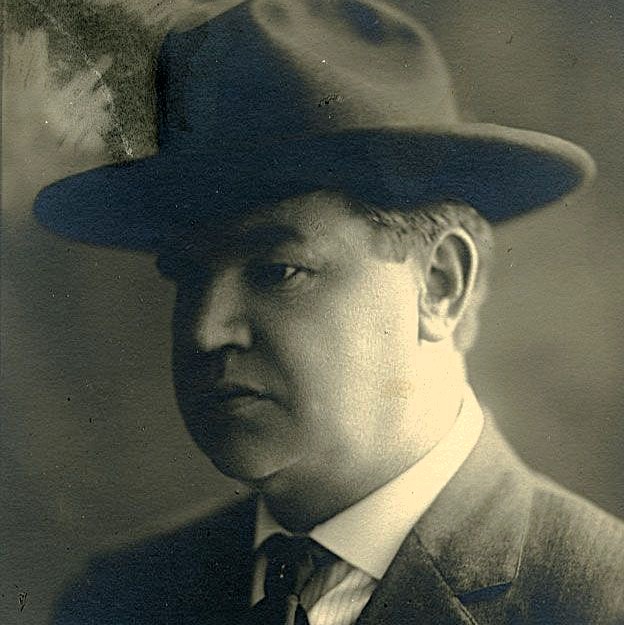
After his September, 1917 arrest under the Espionage Act and subsequent trial, William D. Haywood was forced to relinquish his leading role as the I.W.W.’s General Secretary-Treasurer (briefly returning to the position between February and December, 1918). Instead, Haywood turned his attention to building and leading the General Defense Committee formed shortly after the 1917 raids in support the thousands of wobblies under threat of persecution and deportation during the Red Scare. In his capacity as Secretary of the G.D.C. Haywood gave this valuable report to the I.W.W.’s 12th National Convention in 1920 on the state of political cases and the work of solidarity.
‘Report of the General Defense Committee’ by William D. Haywood from Industrial Worker. Vol. (new) 1 Nos. 58 & 59. May 29 & June 5, 1920.
Prosecution unprecedented fails to block the onward sweep of the Industrial Workers of the World, as the following striking report made by William D. Haywood, Secretary-Treasurer of the General Defense Committee, to the Twelfth Convention, Friday morning, shows:
Following the nationwide raids by the Department of Justice in September, 1917, it was decided to organize a General Defense Committee.
The continued outrages perpetrated against the Industrial Workers of the World and its members seemed to make such a committee imperative; the lynching of Frank Little, General Executive Board member, by A.C.M. Thugs in the employ of the mining companies at Butte, Montana; the deportation of 1,164 miners from Bisbee, Arizona, by the business element and politicians of that mining camp; the wanton imprisonment of hundreds of members incident to strikes; fights to reestablish the rights of free speech, and innumerable instances of imprisonment of I.W.W. members where no offense had been charged.
Branch offices, main offices of the Industrial Unions, meeting halls, homes of members, and the General Headquarters had been violently raided and deliberately robbed. A preconcerted plan had been adopted by those in temporary power, and at the given hour on September 5, 1917, the vultures, vested with little or no authority but their badges and guns, swooped down upon us at nearly every point where we were located throughout the country and carried off everything they could lay their foul hands upon. They shook the organization as a bulldog shakes an empty sack, leaving the organization badly crippled, but the membership was as determined as ever and started in to rebuild.
The master class had determined to wipe out the organization, root and branch. It was at this period that we knew we would be compelled to fight for our existence.
Publicity and defense were needed. Herbert Mahler and C.E. Payne were brought on to headquarters from Seattle, Washington, as secretary and publicity agent, respectively. These men had had some considerable experience, having acted in similar capacities during the great Everett trial of 1917, when seventy-four members of the I.W.W. were charged with murder. The trial resulted in the acquittal of the accused, and the I.W.W. is still keeping green in its memory those who were killed during the free speech demonstration, when the Verona was fired upon by Sherig Me-Rae and his band of hirelings, augmented by the members of the Commercial Club. The month of September, 1917, was one of expectancy. Members everywhere knew that there was a black conspiracy afoot. The terrible blow fell on September 28th, a federal grand jury in Chicago having found an indictment against 166 members. There were five counts in this disgraceful indictment. Among the most serious of the overt acts that we had been charged with committing was the printing of our own preamble.
Millions of copies of the preamble had been printed before the war. Naturally, we continue to publish it, and it is our purpose to circulate the preamble until the principles it contains permeate the working class of the world. The trial, which took place in the District Court of the United States at Chicago, Illinois, with Judge Kenesaw Mountain Landis presiding, was the most woeful travesty upon justice that had ever taken place in a court of law. There was scant evidence presented against us, though the organization was torn from stem to stern in the search for tangible material. Nevertheless, we were convicted and were sentenced to terms in the penitentiary ranging from one to twenty years, with fines of from twenty to thirty thousand dollars imposed upon each defendant. The manner in which the trial was infamous in the extreme. When a jury had been almost selected Judge Landis, on a slight pretext, dismissed this jury, that may have been favorable to us, and arbitrarily issued another venire. There were men, viz.: Pietro Nigra, Charles Jacobson and Albert B. Prashner, who were on trial but on account of sickness were absent from the courtroom where they were being tried day after day. In the case of Fellow Worker Prashner, he was confined in a hospital for more than a month while being tried for an offense for which he later was sentenced to ten years’ imprisonment. Another instance that will show the viciousness of the court was that of Clyde Hough, who was taken from the Bridwell Prison, put on trial with us and convicted of violating the espionage law, though this measure was passed by Congress and became a law during the time that Hough was confined at the Bridwell.
Rapidly following the big Chicago case came the indictments at Sacramento, Cal.; Wichita, Kansas; Omaha, Neb.; Spokane, Wash.
The Golden State, after the most remarkable trial staged in an American court, where the defendants remained silent, made Its contribution of thirty-seven men to the Leavenworth Penitentiary. At Sacramento the defendants went on trial without counsel and had no word to say during the progress of the trial. At Kansas City, Kansas, twenty-six men were convicted, though nothing was shown against them except their membership in the Industrial Workers of the World. Here, as in Sacramento, save for the difference of having lawyers to represent them, the defendants refused to take the stand, as their conviction seemed already to be a foregone conclusion.
The federal case at Spokane, Wash., was dismissed. All of the men under the Omaha Indictment have been out on bond; most of them have been released, the indictments against them having been dismissed.
The success of the national government in securing conviction of the members of the members of the Industrial Workers of the World under the super-extraordinary laws enacted during the period when some of the people were lashed into convulsions over the world war inspired state legislatures to do some enacting on their own account.
Criminal syndicalism laws were their first abortive effort. These repressive measures have been adopted in no less than seventeen states. Capitalists, great and small, with their political henchmen, particularly in Washington and California, suffered a frenzied attack of red dementia. Such pernicious legislation coupled with ignorant and vicious officials, administering the laws, caused many hundreds of earnest, conscientious working men to spend long periods in jail waiting trial. Many have been convicted under the criminal syndicalist laws on the flimsiest kind of evidence and sentenced to terms of from one to fourteen years in penitentiaries.
The Centralia affair was a hideous culmination of the frightful antipathy that had been aroused against the I.W.W., chiefly by newspapers, which are but the mouthpieces of the Chamber of Commerce and Commercial Clubs of the country. In this great trial it was shown what a defense committee can do for the protection of its members. After the attack on the I.W.W. hall, when some of the uniformed hooligans had been killed, the business and political element of that section determined to have the life’s blood of every I.W.W. member that they could lay hands on. The black-hearted murderers killed in cold blood a man, Wesley Everest, emasculating him before they lynched him. Everest had been their buddy in the trenches of Flanders.
II.
They caused the trial of others, four of whom were overseas men, on charges of murder. The convicted men had been brave enough to defend their lives, their principles, and their property. For this and not because they had killed one of the invaders, called Walter Grimm, they were sentenced in the state penitentiary. Were it not for the energetic activity of the Northwestern Defense Committee the members involved at Centralia would have suffered the death penalty.
These are some of the many things for which the United States and various state governments are responsible, and for which those of us who happen to be born in this country have no reason to be proud but should hang our heads in humiliation and shame when we look a foreign-born member in the face.
It has ever been the boast of freeborn Americans that the shores of this land were the haven of political refugees. In the past offending exiles of other countries have been welcomed with open arms. It mattered little from what clime they may have hailed; hospitality was extended.
In the recent blood-soaked years this congenial spirit has been changed and the blackest pages of the United States history has been written. Mob rule, raids, invasions, seizures, arrests without warrant, imprisonment without charge, throttling of the press, destruction of mail, violation of assembly, denial of speech, all the work of besotted, putrid politicians, planned by their economic masters.
Conspicuous has been the infamous work of the Department of Labor, under the secretaryship of Wm. B. Wilson, at one time a coal miner, in conjunction with the Department of Justice, causing the frightful desolation of hundreds of homes. Fathers, and in some instances mothers, have been arrested on specious charges, dragged from homes and families, held for long terms in vile county jails, interned in prison barracks, or rushed in red specials across country to be held imprisoned at Ellis Island or other detention stations until deported. One of the most contemptible pieces of this kind of work was the deportation of the Roy sisters, two working girls who had been busily engaged in textile factories and printing plants, from almost the day of their landing in the United States. They were arrested in Seattle, held for months in the detention station; finally shipped to Ellis Island, then deported to Scotland.
Not only have we suffered at the hands of government, state and county officials, but in two instances lawyers in the employ of the organization have violated the trust reposed in them.
Now comes Fred H. Moore, who by deliberate and malicious negligence causes the default of the appeal in the case of twenty-seven members who were convicted last December at Kansas City, Kansas; but of this I will have something to say later. On July 28th, 1919, I was released from the Leavenworth Penitentiary on $15,000.00 bail.
Coming direct to headquarters, I found that the General Defense Committee had been allowed to lapse. Little or nothing was being done in the way of publicity. The financial condition of both the General Organization and the General Defense Committee was at a low ebb. It was my intention when leaving the penitentiary to make a speaking tour of the United States, beginning at New York City. In keeping with this plan I first called a meeting of the secretaries of the Industrial Unions, the acting General Secretary-Treasurer and the editors of the several papers at headquarters, outlining to them the plans I had in view, and impressing upon this conference the urgent necessity of having a General Defense Committee to care for the interests of members in several penitentiaries, and those who were in jail yet to be tried. It was decided at this conference to organize a General Defense Committee, to be composed of the General Executive Board of the I.W.W., including the General Secretary-Treasurer, the secretaries of the different Industrial Unions, the editors of all I.W.W. papers, secretaries of Defense Committees and secretaries of the Bail and Bond Committees. I was urged to accept the secretaryship.
The General Defense Committee from the time of its formation has met regularly once each week, and on occasions held special meetings when defense matters of importance arose for discussion. The General Defense Committee has endeavored to provide an adequate defense for all members under arrest on charges that have anything to do with organization work. Many hundreds of thousands of circulars have been distributed, one in particular–“With Drops of Blood”–has been translated into various languages and scattered all over the world. For nearly two years previous to organizing the General Defense Committee there had been but few public meetings held by the organization. Arrangements were almost immediately made for lecture tours by all available speakers; several members released on bond from the Leavenworth Penitentiary were routed east and west; E.F. Dorce was followed by Ragnar Johanson, John Panener, Ralph H. Chaplin, George Speed, Charles Plahn, Harry Lloyd, Grover H. Perry, George Andreytchine, J.H. Beyer, C.H. MacKinnon, Wm. Tanner and John Baldazzi. Some of these men did excellent work in arousing publicity and securing funds for the defense, while all of them more than paid their expenses. J.T. Doran has been speaking under the auspices of the Northwest Defense Committee, James Rowan has made some speeches, and Frank Westerlund has done splendid work in raising funds and support.
An effort was made to organize bail and bond and defense committees in the important cities of the country. There has been a splendid response from some of the defense committees. Several members have been released from the penitentiary through the efforts of the Bail and Bond Committee of Seattle. Other defense committees have gained the liberty of members who have been confined in county jails.
The New York Defense Committee has done remarkable work on behalf of the deportees who are being held at Ellis Island. It was through the efforts of this committee that hearings were secured for many members who were transported across country and eventually secured the release of most of them, some few of whom are yet being held on bail.
The foreign agitation developed through the General Defense Committees with the assistance of the Scandinavian and Italian element have brought splendid results. The Defense Committees have been organized throughout Sweden, Denmark and Norway, and considerable sums of money have been received from these countries. In Italy the financial returns had not been as large, but the agitation has been even greater, for which Fellow Worker Angelo Faggi is in a measure responsible. Faggi being held for deportation, he arranged to have his bonds released; his fare and sufficient funds were provided him by the Italian Defense Committee, it being understood that he was to start an I.W.W. paper when he arrived in Italy, but he was almost immediately arrested. When his release was secured real agitation began, as indicated by the recent meeting at Milano, where one of the greatest demonstrations that the country. had ever known took place before the headquarters of the American ambassador; resolutions were adopted demanding the release of I.W.W. prisoners in the United States and other resolutions to the effect that no United States boats would be allowed in Italian ports until I.W.W. prisoners were released.
Shortly after the formation of the General Defense Committee, it was agreed between the Committee and General Headquarters to send George Hardy, one of the Leavenworth prisoners who had served his term, to England on a mission of publicity. This trip was made by Fellow Worker Hardy, and was attended with some success. He addressed eighty-four meetings in Great Britain and caused to be circulated considerable organization and defense literature.
The General Defense Committee as now constituted has rendered assistance to many members under arrest and has provided to appeal all of the big cases, has paid the expense of printing assignment of errors, bills of exception and briefs in the Chicago and Sacramento cases. Five thousand dollars has been set aside to carry these cases to the United States Supreme Court in the event of adverse decisions by either of the Appellate Courts to where the appeals have been taken.
After the Wichita trial at Kansas City, Kansas, arrangements were made with Fred H. Moore to appeal that case and pending the decision to have bond set for the twenty-six members now languishing in the Leavenworth Penitentiary. During the ninety days which Judge Pollock had given Moore to prepare the appeal he, Moore, had asserted to the General Defense Committee time and again that his case would be ready before the time expired. If more time had been required the court had informed Moore that he could secure sufficient time to complete his record simply by making the request. The date of expiration was allowed to lapse without a motion being filed in the court, although Fred Moore was a few days prior to the date, March 18th, in Kansas City. He neglected to attend to this all-important matter on behalf of his clients. Without attempting to criticize Moore’s delinquency we leave it to the convention to form their opinion of the kind of a man that we had reposed our confidence in and which has now been so seriously betrayed. Suffice to say that Moore has entirely severed his connections with the General Defence Committee. An effort is being made to get an extension of time in the Wichita appeal, and we have some little reason to believe that we will meet with success.
With this report I am presenting a complete financial report, beginning with September, 1917, itemizing every item of receipts, which includes donations, assessments, loans and contributions for bail. This does not include the amount loaned to the General Defense Committee in Liberty Bonds. While the statement will show over $340,000 in receipts from all sources, it embodies an itemized statement of the expenditures. A review will show the largest item to have been for counsel fees; so great indeed is the sum paid to lawyers that one hesitates at times and wonders if the good they do is worth the candle. However, we cannot fail to appreciate the splendid professional work done by George F. Vanderveer, Otto Christensen and Caroline A. Lowe.
The General Defense Committee has endeavored to be of value to the General Organization through its propaganda work, and has spent many thousands of dollars for the publication of circulars, leaflets and pamphlets, the returns of which have gone to the General Office–that is, so far as returns have come in.
As secretary-treasurer of the General Defense Committee, having been in touch with cases all over the country and realizing the advantage to be gained with the support that we are in a position to render members who would otherwise be victimized, I would recommend the continuance of the General Defense Committee, though it is an added burden to the secretaries of the industrial unions and the editors of the papers. This defense work gives them a human touch with what is now an important phase of the organization’s work. That defense and propaganda work may become less of a direct burden on the membership, I would suggest that contributors’ awards be arranged and held monthly in as many places as possible. The returns from such a venture will bring considerable revenue would also suggest that the General Defense Committee be encouraged in holding meetings of propaganda and educational value,–which, to begin with, will require the equipment of moving picture machines, stereopticon slides and forceful speakers to address the meeting. The income, or a large proportion of it, to go for General Defense work. With these and other methods that lean be developed, the proceeds will be regular and permanent. When there is no occasion for defense the educational work can be continued.
The hour has arrived for action, agitation, education; and organization must be made effective.
With best wishes, I am, Yours for Industrial Freedom,
WM. D. HAYWOOD, Secretary.
The Industrial Union Bulletin, and the Industrial Worker were newspapers published by the Industrial Workers of the World (IWW) from 1907 until 1913. First printed in Joliet, Illinois, IUB incorporated The Voice of Labor, the newspaper of the American Labor Union which had joined the IWW, and another IWW affiliate, International Metal Worker.The Trautmann-DeLeon faction issued its weekly from March 1907. Soon after, De Leon would be expelled and Trautmann would continue IUB until March 1909. It was edited by A. S. Edwards. 1909, production moved to Spokane, Washington and became The Industrial Worker, “the voice of revolutionary industrial unionism.” A victim of finances and internal disputes, the IW ceased publication in 1913, only to be revived in 1916 and surviving as a weekly, sometimes more, until 1931. Easily among the most important working class newspapers in U.S. history and an essential resource on the wobbly, and larger radical labor experience
PDF of full issue: https://washingtondigitalnewspapers.org/?a=d&d=IWW19200529
PDF of full issue 2: https://washingtondigitalnewspapers.org/?a=d&d=IWW19200605

