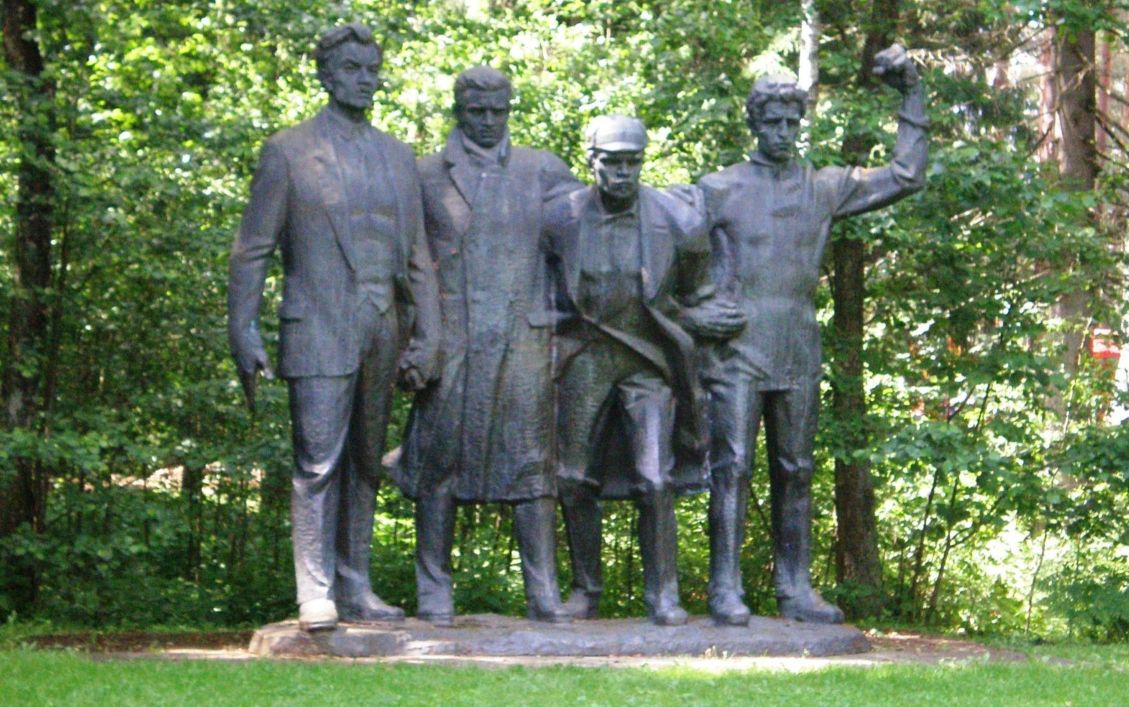
‘The Four Communards’–Karl Pozela, Kazys Giedris, Josef Greifenberger and Rafael Tchorny–affirm their Communist convictions before being shot on December 27, 1926 by Lithuanian fascists who took power in a coup weeks before.
‘The Last Words of Four Communists’ by Anton Bimba from The Daily worker Magazine. Vol. 4 No. 38. February 26, 1927.
BRAVE were the comrades who died in the hands of the Lithuanian fascist executioners. They went to death in the prime of their lives. Still they would not refuse to pay the highest for their ideals for the ideals of the working class. As long as there was a spark of life in them they continued to challenge the fascist murderers and to hail the struggle of the proletariat for its emancipation.
The four comrades who were executed in Kovno on December 27th, shortly before they were shot down by the fascisti wrote the following address to the workers:
“Comrades! We four Communists, Karl Pozela, Kazys Giedris, Josef Greifenberger and Rafael Tchorny, were sentenced to death by the field court. Only comrade Faivusch Abramovitch was sentenced to prison for life and Comrade Sheluga to eight years imprisonment.
“We have addressed a request to the president, that our case should be transferred to the district court or the tribunal, pointing out that the time in question is under amnesty.
“However, the fact that we have been tried by a field court makes it certain that we will be executed.
“The best wishes to all our comrades! Live, work and attain your aim, comrades.”
In his last letter to the comrades on Dec. 25th, Comrade Pozela wrote:
“On Dec. 24, 1926, four of us, Karl Pozela, Joseph Greifenberger, Mazys Giedris and Rafael Tehorny, were sentenced to death by the field court. The process of the trial showed that the government had decided in advance to exterminate us in spite of everything. They tried us for the past times which had been covered by the amnesty law and they did not even follow their own laws. The accusation alleging that we are supposed to have conspired to overthrow the government on Christmas or on New Year’s is a pure provocation. All the state witnesses, Norvaisha, Shavinis, Tamashauskas and others, who did not even know how to play the role of provocateurs well, were secret service men. We exposed the provocative character of their charges during the trial, especially pertaining to the accusation that we made preparations to overthrow the government on Christmas. As to the charge alleging that we fought against the independence of Lithuania, we pointed out that we were exactly the ones who fought against those who wanted to sell out Lithuania to the imperialists of Poland. But our speeches were unnecessary, because as it appears, the verdict was prepared in advance. As soon as the verdict was declared they proposed to us that we write to the president begging him for pardon. But we decided not to beg for pardon. Instead we wrote a statement demanding to transfer our case to the army court or to the Supreme Tribunal in view of the fact that we were condemned for that period of our activity for which according to the laws of Lithuania we could no longer be prosecuted. I think that our statement will mean nothing because the farce of the trial shows that the decision was made long ago.
“All comrades heard the verdict calmly and courageously. Saying nothing about others, Comrade Tehorny also is holding out heroically.
“Greetings to all. Work and win, comrades.”
Comrade Kazys Giedris wrote on Dec. 26, 1926, as follows:
“Dear comrades, today I am addressing you my last word. My path of struggle for truth and for the interests of the oppressed and exploited has ended–the field court which took place on Dee. 24, 1926, condemned me to be shot. But I will die full of hope that this struggle will not stop until it is won. I have nothing to regret, except that I did not accomplish much, that there were moments in my life which I did not know how to fill with work. Therefore my only wish is do not have moments not filled with work; struggle and win. I step to my death courageously and firmly; you, comrades, be firm and brave also.”
Comrade Joseph Greifenberger in his last letter written on Dec. 27, 1926, 2 p.m., among other things says the following:
“…If the ruling bourgeoisie would satisfy itself with the blood of only four comrades, it would not be much to worry about. But this is only a beginning. The dungeons are filled to overflowing not only in Kovno but also in all other parts of the country. Hand in hand with the persecution of the active workers goes the destruction of all the class organizations. The working class will realize the whole weight of the burden only then when its organizations will be destroyed and when it will be weakened and left without a leadership. The bourgeoisie will snatch from the workers all the improvements, as small as they are, which were won by the workers during the last few months. The economic pressure will increase enormously. The terrible suffering of the unemployed, the hardships of winter, the yoke of taxation–all of these problems will not be solved by the ruling parties; they will not show even a desire to solve these problems in the interest of the toiling masses. And all this happened on account of the dastardly treachery of the parties of the petty bourgeois populists and social democrats. The present deplorable events of the last few days before the coup d’etat proved beyond a shadow of doubt that the petty bourgeois parties are hopeless. They were warned against the approaching danger again and again. Any rank and file worker could see the danger clearly, but the leaders of the social democrats did not want to see it. The tragedy of the petty bourgeoisie is also in the fact that it poses as a government while it has no ground under its feet. This fact has been clearly demonstrated by the ease with which the coalition government was overthrown.
“In their desire to appease the rising reaction they persecuted the militant workers and their organizations. They cleared the road for the reaction of the big capitalists, for the bourgeois dictatorship by tattling about “democracy.”
“And it must be said that it is very clear now that the leaders of these parties such as the Slezeviches and the Kairysis are perfectly satisfied with the events. In order to satisfy the masses they should have severed their relations (with the bourgeoisie) and fought the capitalists, but they could not do this for their very petty bourgeois character would not permit them to do it. This explains their dastardly treachery. They did not use any means whatsoever to defend themselves. Even more than that; they did the best they could to restore the innocence of the constitution which had been trampled upon and raped by the fascisti. But the innocence cannot be restored in polities just as it cannot be done in medical surgery.
“The masses are thinking. They did not get rid of their democratic illusions that have bound them hand and foot yet. But this lesson, as hard as it is, will not pass in vain. After having learned the character of the petty bourgeoisie and the role of their parties and after having broken themselves loose from their influence, the masses will clear the road to their final emancipation from the yoke of capital.”
The blood of the four communards was not spilled in vain. We will continue their noble work. Their courageous death in the hands of the fascist murderers for the cause of the suffering humanity, I will be cherished and remembered in the hearts of the multitudes long after their executioners have been forgotten. New fighters are taking the places of those who have fallen. We bow our heads before the grave of Pozela, Greifenberger, Giedris and Tehorny and solemnly declare that we will not rest in our struggle until the fascist hangmen of Lithuania as well as of other countries will be brought before the bar of proletarian justice and forced to pay the full price for their crimes.
The Saturday Supplement, later changed to a Sunday Supplement, of the Daily Worker was a place for longer articles with debate, international focus, literature, and documents presented. The Daily Worker began in 1924 and was published in New York City by the Communist Party US and its predecessor organizations. Among the most long-lasting and important left publications in US history, it had a circulation of 35,000 at its peak. The Daily Worker came from The Ohio Socialist, published by the Left Wing-dominated Socialist Party of Ohio in Cleveland from 1917 to November 1919, when it became became The Toiler, paper of the Communist Labor Party. In December 1921 the above-ground Workers Party of America merged the Toiler with the paper Workers Council to found The Worker, which became The Daily Worker beginning January 13, 1924.
PDF of full issue: https://www.marxists.org/history/usa/pubs/dailyworker/1927/1927-ny/v04-n038-new-magazine-feb-26-1927-DW-LOC.pdf

