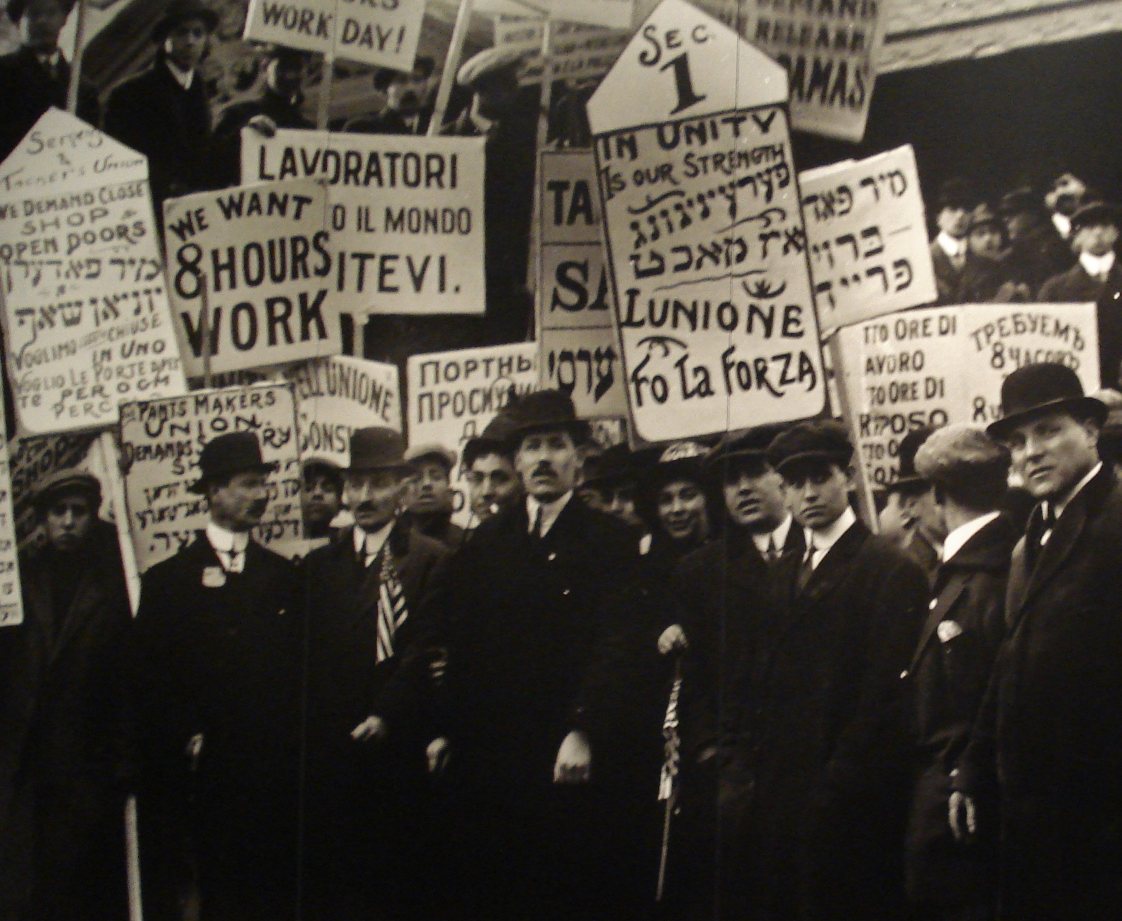
In one of his varied roles, the idiosyncratic Isaac Hourwich speaks here as Chair of Mediation Committee of the Cloak Makers’ Union during the massive 1913 garment strike, giving an inside glimpse of the union bureaucracy and the total disdain by New York’s mayor for that city’s working class.
‘The Garment Workers’ Strike’ by Isaac A. Hourwich from New Review. Vol. 1 No. 14. April 5, 1913.
The strike of the men’s garment industries is over. The tailors have gained a reduction of working hours from sixty and over to fifty-three per week, with a slight advance in wages. It will take, however, a couple of years before the increase in wages will have compensated them for the loss of earnings during the nine weeks of idleness. The union has failed to secure recognition from the large manufacturers, instead of which Mr. Benjamin, leader of the organized manufacturers, appointed a commission to settle the question of hours. The commission promised the strikers that in serious controversies it would act as mediator between the employers and the workers, and as a pledge of good faith it chose Meyer London, the legal adviser of the strikers, to fill the vacancy opportunely created by the resignation of one of its members, Mr. Robert Fulton Cutting. There can be no doubt of the good intentions of the commission; it remains to be seen, however, what it may be able to accomplish with its vaguely defined authority. This is the only shadow of recognition which the leading manufacturers have conceded to the union. They have promised to make no discrimination against any of the strikers who will return to work, i.e., their employes will be at liberty to belong to the union.
But the factories will be conducted as “open shops” and the employers will not deal with representatives of the union, or even of their own employes. Each of the workers will have to face the employer individually, except on important occasions when the commission will undertake to speak on behalf of the workers.
In the smaller shops, the strikers have been able to secure better terms. Each manufacturer or contractor individually signed an agreement with the union, giving the officers of the union access to the shop for the purpose of organizing the workers. A few of the larger manufacturers also settled individually with the union. These individual agreements contain a provision for a fifty-hour week.
It is doubtful, however, whether this provision will stand after the settlement with Mr. Benjamin’s association on a fifty-three hour basis. In the first place, some of the agreements contain a sort of “most favored nation” clause, under which those manufacturers who settled with the union at an earlier stage of the strike are entitled to share in the benefits secured by their competitors who held out longer. Moreover, many of those who settled earlier are contractors for the manufacturers affiliated with Mr. Benjamin’s association, and the terms of his proposal, which was accepted by the strikers, extend to the contractors as well as to the manufacturers themselves.
But the resources of the strikers had given out, and this was the best settlement they could make under the circumstances. The terms of this settlement compare very unfavorably with those which were secured by the strikers in the cloak industry in 1910. The strikers in both branches of the garment industry were of the same racial stocks: Most of them were Jewish and Italian immigrants, with a sprinkling of Russians and Poles. The duration of both strikes was the same, about nine weeks.
Until the sham settlement by President Rickert of the United Garment Workers, after the eighth week of the strike, few, if any, of the strikers had returned to any shop where the strike was on, and notwithstanding very poor picketing there were scarcely any strikebreakers to be had. The strikers gave a remarkable exhibition of firmness of purpose and perseverance in the face of want bordering on starvation. Why then was the outcome of the strike in the men’s garment industry so different from the outcome of the cloakmakers’ strike?
There is, in the first place, the purely objective fact that the men’s garment industry is more concentrated than the cloak industry. Men’s garments are more uniform and lend themselves far better to standardization, which is indispensable to production on a large scale, than women’s garments with their greater individuality of style. As a result, there are few very rich manufacturers in the cloak industry, whereas the leading manufacturers of men’s garments are millionaires, who can afford to lose a season, if necessary, in order to reduce their employes to the status of mere “hands.” Still, it will be remembered that the woolen mills of Lawrence are controlled by multi-millionaires, popularly known as the “woolen trust,” and yet they were forced to yield to the unskilled strikers who could presumably have been replaced by strike-breakers. Concentration of capital alone would therefore seem to be insufficient to account for the failure of the strikers in the men’s garment industry to gain the principal demand for which they held out to the last–recognition of the union.
The reason why the strikers were unable to break the feudal attitude of the lords of the clothing industry must be sought in the poor organization of the strike. Ostensibly the strike was conducted under the flag of the United Garment Workers. In reality, however, hardly ten per cent. of the strikers had been affiliated with that organization previous to the strike. The tens of thousands of workers who obeyed the call to strike and stayed out to the last were unorganized. It was the obvious duty of those who assumed the leadership of the strike to organize the unorganized masses of the strikers. That was not done. Various strike committees were created from time to time, but they had a purely nominal existence; they were seldom, if ever, consulted on any subject, and the management of the strike was assumed by President Rickert, who was especially imported from Chicago, and a few national officers.
It is not my purpose to discuss the advantages of centralization in war time, although there are good military authorities who emphasize the importance of individual initiative in modern warfare. However it may be, it is plain that the most successful strike is bound to turn into failure without an organization of the workers ready to preserve the fruits of victory. For this reason alone, if for no other, the leaders ought to have kept in close touch with the masses of the strikers. But President Rickert surrounded himself with an air of mystery befitting the Mikado, forgetting that nine-tenths of the strikers owed him no allegiance, not being even nominally affiliated with his organization. The following incident is characteristic of the attitude maintained by Mr. Rickert and his aides:
About the middle of February, Mr. Rickert made a settlement with one of the largest manufacturers upon terms unsatisfactory to one of the local unions involved, and ordered the strikers back to work without so much as submitting the terms of the proposed settlement for their approval. The officers of the union, dissatisfied with Mr. Rickert’s action, called a conference of representatives of various labor organizations not involved in the strike and of other “prominent citizens” (of whom the writer was one), to devise some plan how to approach President Rickert and gain an audience with him. The conference elected a committee of benevolent strangers to wait upon President Rickert and to use their good offices in order to induce him to give some form of recognition to the officers of the unions affiliated with his national organization. It was a regular case of “mediation” between a “boss” and the officers of the union.
So grotesque did the situation appear to me, that I rose to inquire of the chairman of the conference whether Mr. Rickert was an autocrat ruling by divine right, or a mere elected officer subject to recall or impeachment for cause. But the prevailing sentiment was in favor of “harmony” at any cost, for fear lest an open revolt against the national officers might hurt the strike. Subsequent events proved that the revolt could not be avoided, but was only postponed; and the damage to the cause of the strikers would have been far less had Mr. Rickert been told to go before he had the opportunity to make the settlement with Mr. Benjamin.
The trouble with Mr. Rickert was that he did not understand the people whom he undertook to lead. The native American trade-unionist is mostly a highly-paid skilled mechanic with middle class habits of life, unwilling to forego his customary comforts for any length of time. He shuns a protracted strike, and is ever ready for a compromise. The Jewish, the Italian, and the Slav immigrant, on the other hand, has been hardened in the school of privation at home, and can starve, if need be, in order to win a strike. You have here a practical demonstration of the difference between the Epicurean and the Stoic view of life. Mr. Rickert, judging the fighting qualities of the foreign strikers by his experience with native American trade-unionists, honestly believed, I take it, that he was serving the best interests of the strikers by a policy of humility. Had he, at least, had the good sense to do as the leaders of the Lawrence strike did, vis., to submit every proposed settlement for the ratification of the strikers, or at least, in urgent cases, of an elected strike committee, it is very likely that after a thorough discussion his arguments might have carried. But his dictatorial manner aroused resentment and distrust among the strikers.
In American trade unions the dictatorship of the president is accepted as a matter of course. In fact, boss rule is universal in all American institutions, be it a political party, a reform convention, a fraternal order, a professional association, or a scientific society. But those “ignorant foreigners who do not understand the spirit of American institutions” have a naive conception of democracy as a government by the people. They regard an elected officer as a mere delegate accountable to his constituency, and they want to have a final say in all matters affecting their vital interests. They can be led, no doubt, but they would not be driven.
Still Mr. Rickert can be excused for misunderstanding foreign strikers. This excuse, however, will not avail the Jewish Daily Forward, which assumed the leadership of the Jewish strikers and supported Mr. Rickert through thick and thin, until the strikers rebelled against his settlement and incidentally smashed the windows of the Forward building with stones.
That the reader may understand this outbreak of the strikers against “their own” paper, it should be noted that at the inception of the strike, Mr. Rickert appointed the president of the Forward Association organizer for the United Garment Workers. This appointment gave the Forward the leadership of the strike, and incidentally advanced its circulation. These relations between the Forward and Mr. Rickert closed its columns to any criticism of his conduct.
On February 28, Mr. Rickert accepted the terms of settlement offered to the strikers by Mr. Benjamin. The latter would not deal directly with Mr. Rickert, but addressed himself to Mr. Marcus M. Marks, and appointed him one of a commission of three to fix the hours of labor. Mr. Benjamin did not deem it necessary to accord a place on his commission to any man regarded as a representative of labor. It was said that these terms had been offered to the strikers a couple of weeks before, but had been rejected by them. The acceptance of such terms by Mr. Rickert, without a preliminary consultation with any of the local officers of the union, was clearly an act of usurpation. No attorney would settle a case without first submitting the terms of the proposed settlement to his client. But the Forward endorsed this usurpation of authority by Mr. Rickert and advised the strikers to return to work. Stone throwing is, certainly, no argument in a free discussion. Unfortunately, however, this “sermon in stone” was the only criticism that could find its way to the Forward.
It was but natural that the repudiation of Mr. Rickert’s settlement by the strikers should have hurt his feelings, yet his subsequent conduct was indefensible, to put it mildly. He aroused public opinion against the strikers, representing them as rebels against duly constituted authority. Mayor Gaynor’s order to Commissioner Waldo to disperse the pickets of the strikers was clearly the result of prejudice created by the utterances of Mr. Rickert.
Considered from any point of view, his letter to Commissioner Waldo showed poor logic. The Mayor said in effect that inasmuch as the strike was over, picketing and violence should no longer be tolerated. Now, it is plain, that the police, as guardians of the law, must not tolerate violence whether a strike is on or off. A malicious person might infer from the Mayor’s letter that prior to Mr. Rickert’s settlement the police had winked at acts of violence committed by the strikers. Likewise, if picketing is an unlawful interference with an employer’s business, then it should have been suppressed during the strike as well as after the strike had been called off by Mr. Rickert. If on the other hand, peaceful picketing is perfectly lawful, it is an invasion of personal liberty to interfere with it, strike or no strike. At all events, the Mayor is not vested with the power to declare a strike off.
For reasons of expediency, the leaders of the strike refrained from giving out any public statement in reply to Mayor Gaynor’s letter. But they appointed a committee (of which the writer was one) to wait on the Mayor and present to him their side of the case. As spokesman for the committee I endeavored, in the most courteous language, to present to the Mayor the reasons why his order against picketing should be recalled. But Mr. Gaynor was hostile to the committee from the very beginning. He was seated at his desk; there were a few chairs in his room, but he did not ask us to be seated.
“My letter referred only to the bums and ruffians who commit violence,” interrupted he gruffly my argument.
“We do not represent them,” said I, “we represent the strikers, and we maintain that under the laws of this state, as interpreted by the Court of Appeals, peaceful picketing is permitted.”
“If any one of those fellows who come with the intention to commit violence will hang around the factories, they will be arrested. The police know them all.” (This from the champion of the Duffy boy who was “mugged” by the police under Mr. Bingham.)
“But,” I inquired, “how will the police distinguish a peaceable picket from one who comes with the intention to commit violence?”
The Mayor suggested that the strikers should issue identification cards to the pickets. That our pickets might not be harassed by the police, we were willing to submit to the Russian I passport system about to be inaugurated by the Mayor of the City of New York. The object of our interview was accomplished. But the Mayor still wanted to talk:
“I tell you, the strike is over,” said he.
“This is a matter of opinion,” I answered, “but the men are out.”
“What is the use of having leaders, if you don’t want to abide by the settlement they have made?”
“Mr. Rickert had no authority to settle the strike. He exceeded his authority…”
“You people don’t recognize any authority over you,” blurted out the Mayor. “I tell you, if you don’t want to obey the law, you had better go back to the countries you came from, and the sooner the better.”
I attempted to say something, but Mr. Gaynor interrupted again:
“Why don’t you go to arbitration?”
“The manufacturers have refused to go to arbitration,” said I in reply. “They rejected the offer of the State Board of Mediation. We did want to go to arbitration.”
The Mayor took from his desk a memorandum containing the terms of Mr. Rickert’s settlement and asked: “What are your wages?”
I referred him to the secretary of the District Council of the U.G.W., who was one of the committee.
“They are varying,” replied the secretary in embarrassment Anyone familiar with the clothing industry knows that this question cannot be answered with any degree of accuracy. There is a wide division of labor within the factory. Some occupations require a high degree of skill, others can be learned in a short time. There are week workers and piece workers; in busy times the earnings of the piece workers vary according to skill; when work is scarce, the weekly earnings decline. These conditions are by no means peculiar to the clothing industry. Statisticians know it and fight shy of “average wages.” But the Mayor pressed his question, and the secretary of the District Council ventured a guess:
“Some get $12, some $14.”
“You fellows are damned tricky,” burst out the Mayor in an angry mood. “Why didn’t you answer my question at once? It was a simple thing. You could have said that before.”
He was visibly losing control of himself, and after another insulting remark of his we left.
Fortunately, the Mayor had no opportunity to vent his spleen on the strikers. The strike was settled the next day.
To go back one week, after repudiating Mr. Rickert’s settlement, the officers of the Brotherhood of Tailors immediately called a conference of representatives of labor organizations to devise ways and means for continuing the strike until a more satisfactory settlement could be reached. The conference elected a committee to confer with the commission named by Mr. Benjamin, and as the result of the negotiations the manufacturers granted a reduction of one hour a week during the current year, and two hours thereafter, and recognized Meyer London as a representative of labor. Meagre as these concessions may appear, they are an improvement upon the terms secured by Mr. Rickert. Withal, the strikers were willing to hold out for their original demand of fifty hours a week, provided they were assured that those who had returned to work in the smaller shops on a fifty-hour basis would keep them from starving. But the men in the smaller shops had themselves been out several weeks. Their resources were exhausted. Moreover, there was no adequate organization for collecting the money which the workers who were back in the shops had pledged for the support of the strike. At a conference of the officers of the unions of the striking garment workers with representatives of other labor organizations, it was therefore unanimously agreed to recommend to the strikers the acceptance of the terms offered by the manufacturers. A committee was selected to call shop meetings of the strikers and submit the recommendations of the conference to a vote. The strikers voted in favor of the recommendations, and returned in high spirits to their machines.
The work of building up a permanent organization of the tailors must now begin. If they are to profit by the lesson of this strike, they must rid themselves of boss rule–if need be, by cutting loose from the national organization. The strike clearly demonstrated that the benefits derived by the tailors’ unions of New York from their affiliation with the National Office are, at best, speculative, while the disadvantage of being dominated by a machine is very real.
The New Review: A Critical Survey of International Socialism was a New York-based, explicitly Marxist, sometimes weekly/sometimes monthly theoretical journal begun in 1913 and was an important vehicle for left discussion in the period before World War One. Bases in New York it declared in its aim the first issue: “The intellectual achievements of Marx and his successors have become the guiding star of the awakened, self-conscious proletariat on the toilsome road that leads to its emancipation. And it will be one of the principal tasks of The NEW REVIEW to make known these achievements,to the Socialists of America, so that we may attain to that fundamental unity of thought without which unity of action is impossible.” In the world of the East Coast Socialist Party, it included Max Eastman, Floyd Dell, Herman Simpson, Louis Boudin, William English Walling, Moses Oppenheimer, Robert Rives La Monte, Walter Lippmann, William Bohn, Frank Bohn, John Spargo, Austin Lewis, WEB DuBois, Arturo Giovannitti, Harry W. Laidler, Austin Lewis, and Isaac Hourwich as editors. Louis Fraina played an increasing role from 1914 and lead the journal in a leftward direction as New Review addressed many of the leading international questions facing Marxists. International writers in New Review included Rosa Luxemburg, James Connolly, Karl Kautsky, Anton Pannekoek, Lajpat Rai, Alexandra Kollontai, Tom Quelch, S.J. Rutgers, Edward Bernstein, and H.M. Hyndman, The journal folded in June, 1916 for financial reasons. Its issues are a formidable and invaluable archive of Marxist and Socialist discussion of the time.
PDF of full issue: https://www.marxists.org/history/usa/pubs/newreview/1913/v1n14-apr-05-1913.pdf

