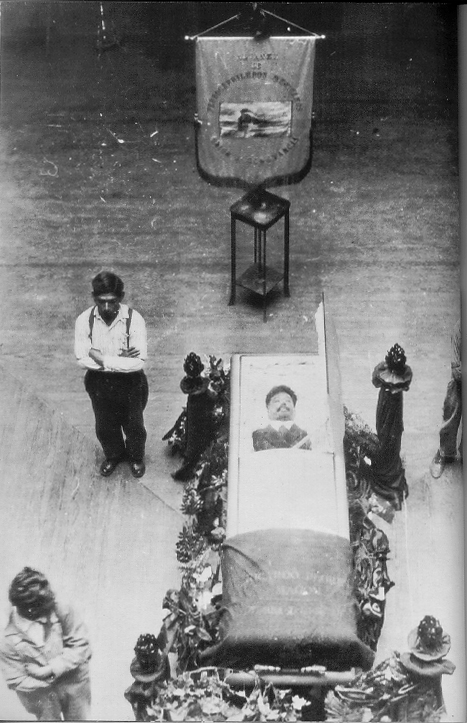
The story of the last journey of Ricardo Flores Magon as his remains travel to Mexico City from Leavenworth Federal Penitentiary, where he died in the prison on November 21, 1922. The official explanation of his death convinced no one. If Magon was murdered by the U.S. prison regime, he would not have been the first, and certainly not the last.
‘Return to Mexico of Ricardo Flores Magon’ by R.B. Garcia from Industrial Worker. Vol. 4 No. 49. February 24, 1923.
It is known to all that Ricardo Flores Magon died in Leavenworth penitentiary, where he was serving a 20-year sentence, on the 21st of November, 1922. To this day his death remains a mystery, although it is generally believed that he was murdered in some underhanded manner. At any rate, the Harding administration has been held responsible for his death by all liberal elements, for it stubbornly refused to admit an unbiased physician to examine Ricardo, who had been ill for a long time, notwithstanding the persistent efforts of his friends and Attorney Harry Weinberger to secure such permission.
Some of those who viewed Ricardo’s body in Los Angeles, state that it had contusions in the face and shoulders and marks of strangulation on the throat. The nature and character of the Magon brothers has always been such, that even prison authorities and jail officials have invariably held them in courteous respect, and aside from struggling with abusive detectives at different times, they never have been corporally punished in prison. However, a recently released prisoner from Leavenworth, who is a railroad man in Mexico, states that, some three weeks before Ricardo’s death, he, Rivera and other prisoners had been unmercifully beaten by order of the prison authorities because they were accused of leading a protest against poor food, in which some dishes were broken in the mess hall. Whether this has any connection with Ricardo’s contusions or not, it would be hard to believe that he had been violently murdered, when there are so many ways of doing the same thing without leaving traces of murder.
However, Ricardo is now dead, and as his ideals and personality had become well known among the masses of Mexico, the Mexican government found it convenient (politically) to claim his body for the purpose of bringing it to Mexico and giving it burial at the expense and honor of the country. Therefore, as soon as Ricardo’s death was known, the government ordered its consul at Kansas City to take possession of the remains and arrange to have them sent to Mexico. The Chamber of Deputies at once wired Magon’s widow, asking her for the body, “in the name of the Mexican proletariat.” The body, in the meantime, had been shipped to Los Angeles at the request of the widow who, believing the claims of the deputies, had complied with their request.
But, as Ricardo had been the eternal enemy of all governments, and since the so-called Socialist government of Mexico has imprisoned and deported a good number of men for propagating the very principles that Ricardo advocated, a decided protest at once arose from the radical elements of Mexico against delivering his remains to the government. In the meantime Enrique Flores Magon had interceded with the widow in an effort to dissuade her from complying with the request of the Chamber of Deputies. Being convinced that it was a ruse on their part to play the occasion for political ends, she then refused their request.
In the ensuing confusion, the labor organizations in Mexico had neglected to claim the remains, many of them believing that the government was bringing them to Mexico, as it had already been announced, while some of the more radical bodies were opposed to the transfer in any manner, holding that this would be making a fetich of Ricardo’s remains and memory. In view of all this, and as time was passing, it was decided to cremate the body in Los Angeles by those in charge there. However, at the last moment it was found that the body could be kept in a vault for some time, the idea being to let the confusion clear away and await the order of the workers in Mexico to claim it, as the family and radical friends disliked to see the remains of Ricardo laid to rest in the country that had hounded him to death.
Enrique Flores Magon, whose delicate state of health had confined him to bed after the death of Ricardo, owing to his activities before and after his demise, notified the three main labor organizations of Mexico City that his brother’s body was at their disposal. As soon as the Confederation of Railway Unions learned of this, they had a meeting to consider the transportation of Ricardo’s remains to Mexico City. (The railroad men had been reading many of Ricardo’s writings of late, which are now being published in pamphlet form.) It was at once decided to send a special train to the border to await the arrival of the body there and then proceed with it to Mexico City, where the Magon brothers had started their fight to dethrone the tyrant Diaz. The plan was to have the train stop at all the large cities on the way that the masses might greet and view the remains.
A delegate was sent to Los Angeles to arrange for the transfer of the remains, and a commission of railroad men was sent to the border to accompany the convey to Mexico City. On the 6th of January the body left Los Angeles accompanied by the delegate, Ricardo’s widow and her daughter, a niece and a young lady friend. They had no difficulty in crossing the border line, and the first reception to the dead Ricardo in Mexico was accorded him across the line from El Paso in Ciudad Juarez. It was a lively affair, even the mayor, who was elected from a “red” ticket, took part in the demonstration.
From Juarez the train went to Chihuahua City, where a great reception and demonstration took place. The labor elements and Campesinos (land workers or peasants) had been notified in due time that the train bearing Ricardo’s body would stop in the city, and they had prepared for the occasion. Likewise, all the labor organizations along the route had been told of the dates on which the train would stop at the different cities, and they were ready all along the line to receive it. At Torreon, a large railroad center, another big demonstration was held. At all the large cities the body was taken from the train, parading the streets and stopping for the night where it would be in state, while revolutionary speeches and services took place; and the next day it would proceed on its way. At Torreon a large protest demonstration was held in front of the American Consulate. The consul came out and stood on the balcony listening to the speeches for a while, but when the accusations and protests against American imperialism grew very strong, Mr. Consul made a dash for the inside, slamming the door after him. The greatest demonstration before arriving in Mexico City took place in Aguasalientes, another railroad and industrial center. During the parade the streets were choked with people and enthusiasm ran high. All industrial activity was stopped and the workers declared the occasion a holiday out of respect for one whom they regarded a great libertarian. At the smaller places as the train arrived at the station the workers would drop their tools to run to the depot to greet and review the remains for the minutes or hours the convey would stop there. And at the many stations where no stops were made, the people congregated there to greet the passing train and honor the dead passenger.
At last, on Monday, Jan. 15, the train arrived in Mexico City. It must be said that, because of differences among the various labor organizations, there had been no cooperation among them for the purpose of bringing Ricardo’s remains, and the railroad men alone had undertaken this. Up to the time of the announcement that the train would arrive in the city, no plans, outside of those of the railway workers had been made for the reception. However, on Saturday the railroad men announced that the train could reach the city on Sunday, but that they preferred to give all labor organizations an opportunity to show their solidarity by stopping work on Monday, holding the arrival of the train for that day that they might meet it at the station.
It was too late to make proper arrangements, but a good number of organizations sent delegations to the station, and still others quit work altogether to march in a body there. The train was to arrive at 8 o’clock in the morning, but at this time a message announced a delay of two hours. At 10 o’clock another message announced that, as the people in some of the small stations were anxious to have the train stop for a few minutes, it would not arrive in Mexico City until 12 o’clock, in order to comply with this wish. The lack of preparation had prevented a big crowd at the station and the people there were not over 2,000, being composed of about 40 labor delegations with their respective standards, and the usual number of sympathizers.
It was a little before 12 when a locomotive, bearing a large red and black banner in front, hove in sight at a curve some four blocks from the station. The crowd had been waiting impatiently for the arrival of the train, and as it was sighted a suppressed exclamation arose from those present, a large number of whom ran towards the train that was coming in slowly, the crowd marching on both sides as it entered the station. The train was composed of the locomotive, a box car, a chair car and a Pullman car, in which the delegation traveled. The casket with the body was in the box ear. The car had two large red and black streamers on the sides and decorations of the same color inside. A red lantern stood at each corner of the metal coffin, which was inside of a wooden enclosure. A profusion of wreaths and flowers covered the casket. The crowd surrounded the box car, anxious to view the remains. The casket was taken out with difficulty amidst the pressing mass. Six of the railroad men bore the casket on their shoulders, surrounded by a guard of honor that accompanied them and followed by the crowd.
Outside of the station a hearse awaited the body, but those who carried it refused to place it there, saying they would bear it on foot to the Railwaymen’s hall–some 25 blocks away. This they did, arriving there quite tired, but much pleased with their load. Upon leaving the station all the labor delegations formed in line and also many of the spectators. A column of railroad men marched at the head of the procession; the empty hearse followed, and the delegates that had accompanied the body from the border fell in behind, followed by reporters and other workers. Behind these marched those who bore the body on their shoulders. By the time the hall was reached the procession was about eight blocks in length and the streets were crowded with people.
A path was opened to enter the building and the casket with the remains was placed in the middle of the hall, which was decorated in black. The people surged in to view the body which was half exposed, the coffin having a glass cover after the lid was lifted. Ricardo’s features were entirely different from what they had been in life. Almost two months had elapsed since his death and his light brown complexion had turned to almost black. A doctor, who examined the exposed part of the body to ascertain the extent of the contusions, reported that, with the repeated treatments to preserve the corpse, it was hard as rock, and almost petrified; that it would remain in that state for a long time and that it was no longer possible to diagnose the bruises, although they were very noticeable.
The burial was decided for the next day after the arrival, and all the labor organizations began to make preparations at once. Some of the conservative elements were for a silent funeral, while others favored a demonstration of protest against American autocracy. The more radical elements favored a strong manifestation of protest, and as some of their proposals were refused by the funeral committee, they failed to stop work for the day. As their organization controls the street car system and other vital industries, which they had decided to stop, this was not done because of the refusal of their proposals, some of which were to exclude all political elements from the program and to bar the wreaths that had been sent to the dead Magon by President Obregon and some members of his cabinet, as well as by the Senate and the Chamber of Deputies. (All of these politicians found it convenient to make such remembrances of the man who had always fought them and their kind). In view of this refusal, only a few of these radical organizations stopped work for the day, confining themselves to sending delegations and participating individually.
However, the Confederation Regional declared a half-day stop for the funeral and its attendance was almost unanimous. (The Regional is the so-called A. F. of L. of Mexico). During the 27 hours that the body was in state, a continuous stream of people came in and out to view it. A guard of honor, composed of four men, made vigil during all of this time, a new shift taking its place every half hour or so. Many women, anxious to do the same, also took their turns. By the time the funeral procession was ready to start, the walls of the hall were entirely surrounded with wreaths of all kinds and sizes, ranging from three to ten feet in diameter. These were so numerous that they had to be placed in double rows.
The procession formed and marched tor the American Embassy, which is only four blocks from the hall. A veritable sea of people stood in front. The ambassador and his wife stood on the balcony, and one of the two orators who spoke began to deliver a vigorous flow of protest. After a few minutes of hearing this, Mr. Ambassador and wife turned to the inside, closing the door behind. The orators scored American imperialism and referred to Magon as a victim of the same that would cost American autocracy very dear.
The throng marched towards the center of the city and the National Palace. By the time it reached there it was no longer a procession; it was a packed mass that surged and moved, filling the streets from one side to the other, with a stream of banners and red flags in the middle that formed a line about a mile in length. It was dark when the parade reached the cemetery and many revolutionary speeches were pronounced as the railroad men lighted the scene with their lanterns, the wreaths forming a monument over the grave when all was over. Such was the earthly end of Ricardo Flores Magon.
The Industrial Union Bulletin, and the Industrial Worker were newspapers published by the Industrial Workers of the World (IWW) from 1907 until 1913. First printed in Joliet, Illinois, IUB incorporated The Voice of Labor, the newspaper of the American Labor Union which had joined the IWW, and another IWW affiliate, International Metal Worker.The Trautmann-DeLeon faction issued its weekly from March 1907. Soon after, De Leon would be expelled and Trautmann would continue IUB until March 1909. It was edited by A. S. Edwards. 1909, production moved to Spokane, Washington and became The Industrial Worker, “the voice of revolutionary industrial unionism.” A victim of finances and internal disputes, the IW ceased publication in 1913, only to be revived in 1916 and surviving as a weekly, sometimes more, until 1931. Easily among the most important working class newspapers in U.S. history and an essential resource on the wobbly, and larger radical labor experience
PDF of full issue: https://washingtondigitalnewspapers.org/?a=d&d=IWW19230224

