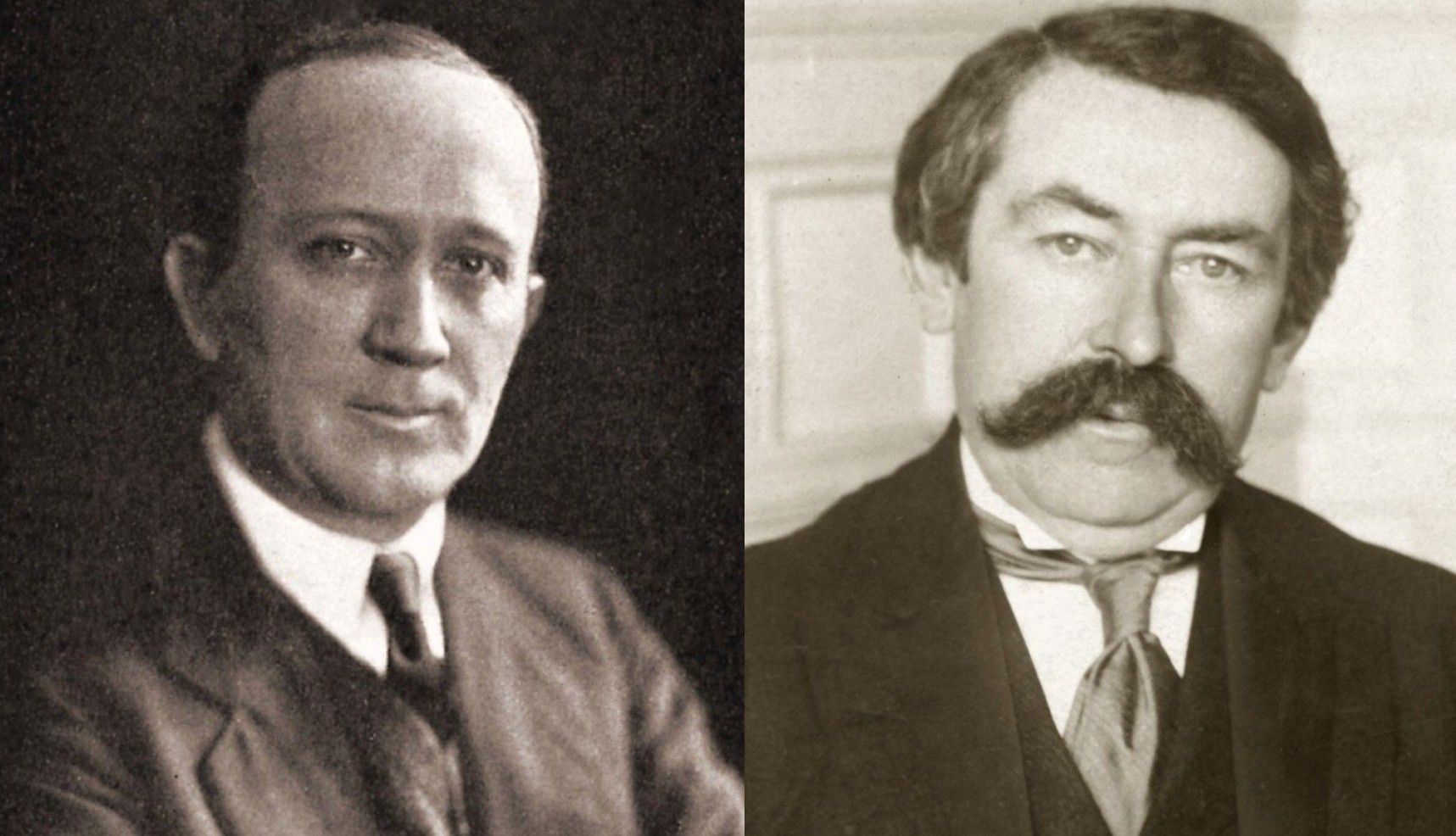
Foster continues his fantastic series reporting from the European class struggle. This edition has him describing the French government of Briand learning from the recent mass rail strike and institutionalizing methods to deal with the next one, with the British ruling class looking over their shoulder and taking notes.
‘News from France’ by William Z. Foster from The Industrial Worker. Vol. 2 No. 36. November 24, 1910.
Paris, France, Nov. 2, 1910.
Editor Industrial Worker.
Fellow Worker: The tyrannical measures of Briant, the French dictator, during the recent railroad strike have received the hearty approval of the capitalist class. By an overwhelming majority, the Chamber of Deputies has adopted a resolution indorsing his methods of strike breaking.
The Chamber was convened about 10 days ago, and, no sooner was the deputies called to order than the Socialists launched a vigorous campaign against Briand, aimed to force him to resign. But after a week of the most violent oratory and spectacular gallery playing, they went down to a well merited defeat. Brind and his ministry were accorded a vote of confidence by a vote of 329 to 183. The workers, defeated in their direct action tactics, have found no better when they came to use their “other” tactics in political action.
It was with a mingled disgust and interest that I followed the proceedings. What a monument the whole affair was to the ignorance of the working class. Here were Socialist administrators ridden into power on the strength of their revolutionary (?) views, being bitterly criticized for “illegally” breaking the railroad strike, by a bunch of their erstwhile Socialist comrades who, themselves, BY UNDERHAND WORK, probably did as much to cause its failure as any other agency. During the strike the Socialist politician reasoned thus: If the railroad strike is a success and the workers succeed in openly taunting the, until now respected and feared, government, political action for the French working class, already weakened, will receive a blow that may prove mortal. Because workers who have a labor organization more powerful than the government will never bother to send representatives to the latter. In the event of this calamity, what would become of our meal tickets, our nice seats in the Chamber of Deputies, etc.? We must needs secretly to work against the winning of this strike and humiliate or even break the autocratic, anti-statist, C.G.T., which has so often humiliated us and which has seriously hindered the desired fuller development of our meal tickets. After the strike has been defeated, then we can carry on a spectacular fight in the Chamber of Deputies, bloodless, “legal” and at a good rate per day, and point to ourselves as the GREAT CHAMPIONS OF THE WORKING CLASS. No doubt, a gratifying increase in the number of PROTESTS at the polls will be the result of this line of tactics. This course has been followed, the C.G.T. has been humiliated, the spectacular fight has been put up in the Chamber of Deputies, and now Jean Jaures’ paper “Humanite,” says: “The party of the working class has fulfilled its mission.”
This statement is true, though hardly in the sense intended. THE WORKING CLASS PARTY HAS ACCOMPLISHED ITS MISSION DURING THE RAILROAD STRIKE, as it has in every strike, in every country where it exists–BY AIDING TO defeat THE WORKING CLASS IN ITS DIRECT ACTION TACTICS, and steering it into the barren desert of political action.
During the course of the PARLIAMENTARY BATTLE, many times the debates were interesting and comical. The Socialists raked up the unfortunate past of Briand and heaped coals of fire upon his devotedˆ head, Jaures in particular, with his customary eloquence, took a great delight in quoting “Briand’s speeches.” Briand was made the laughing stock of Europe. He must surely have felt proud of himself when GEMS like the following (from a speech of several years ago) were quoted. GO TO THE BATTLE WITH THE BALLOT IF YOU THINK IT GOOD: I HAVE NOTHING TO SAY AGAINST IT: GO THERE WITH PIKES, SABERS, PISTOLS, RIFLES; AND, FAR FROM DISAPPROVING, I WOULD CONSIDER IT MY DUTY TO JOIN YOUR RANKS–BUT DON’T DISCOURAGE THE WORKERS. Briand got sore at all this, and when he got the floor he literally raked his one-time comrades fore and aft. He defended his course in the strike as being absolutely necessary to the safeguarding of the beloved France, and stated that, in the measures he had taken, he had used LEGAL MEANS ONLY. Then, turning squarely to the Socialist bunch, he said that if it had been necessary he would have proceeded to any lengths, LAW OR NO LAW.
Immediately he had delivered himself of this expression a tumult arose. The Socialists raised an uproar of protest, and he could go no further in his speech. The session was ended in the midst of a semi-riot. Briand was almost carried from the Chambers in a limp condition by a bunch of dukes and pork-butchers-deputies.
Needless to say, the capitalist papers indorsed Briand’s statement, that in a crisis the government was superior to any of the laws upon the statute books. Those deputies who, the following day were hardy enough to advocate the antique principle that the duty of the executive and judicial branches of the government are, to simply enforce the laws, were ridiculed and laughed at, as a lot of sentimental dreamers.
Briand continued his speech the day following the “riot” in the Chamber of Deputies and in asking the house to indorse his conduct, he proudly exhibited his hand, upon which “there is not a drop of blood.” The house responded favorably to him and he got his VOTE OF CONFIDENCE, to the deep disgust of the Socialists.
Having thus been indorsed and doubtless being well provided with the all needful, Briand and his whole ministry have today seen fit to startle all Paris by resigning their offices in a body. By this stroke of statesmanship much ill feeling between the rival factions in the Chamber over the personality of Briand will be avoided. They can now proceed to the election of a new ministry, and in the cutting of this rich “melon” surely the Socialists have much of a pleasing nature to hope for.
Perhaps, since their comrade, Briand, has proved to be such a willing tool, the powers that be will seek again in the prolific garden, where he grew, and choose another Socialist to take his place. If not this great blessing, at any rate the Socialists can expect at least three or four of the vacant positions to be placed at their disposal. Surely this rich vein won’t “pinch out” after it has paid so well to Briand and the others. There are some more defenders of the working class who are willing, though poor. They must be given a chance also. If they could only get a majority in the ministry, then we would see what we would see. As a writer in “Le Temps Nouveau” says: “After all there are only three comrades in the government (i.e. ministry–Briand, Millerand and Viviani, the three arch rogues). What can they do but wait until we get a dozen?” And so goes the farce, a new set of thieves will be elected and held ready for the next grand stroke of statesmanship. One of the best of the many lessons taught by this strike to the French workers is that when the government deems it necessary it will proceed to any length, regardless of law. The old-time conceptions, that the government is their government, and that the law is a sort of holy thing has received a severe jolt. It should be much easier for the anti-statists to make the scissor bills understand on whose side of the barricade the government always fights. Briand’s statement will come in very handy to give an official touch to the anti-statist argument. The working class of other nations would do will to examine a little closely this cat that Briand has so frankly let out of the bog. But will they? Hardly. Then must learn from a long line of bitter experiences before they finally understand that every governmental law or edict is aimed against them. I have just received a copy of the report of the Parliamentary Committee (ye gods!) of the Trades Union Congress of Great Britain, and in it there is a very interesting tit-bit. At a previous congress the London glass blowers introduced a motion condemning any direct or indirect compulsory enlistment of the workers into the “Territorial Forces” (the latest scheme to militarize Great Britain), and condemning the regulations which permitted the use of these forces against strikers in trades disputes. This caused a great dissatisfaction at the congress and the Hon. Secretary of the state of war, ever watchful of the interest of the worker, hastily wrote a letter to the congress denying that the “Territorial Forces” could be used in labor troubles. The provisions of the following gem of law FORBIDS IT “DUTIES IN AID OF THE CIVIL POWERS.
(Not to aid the civil power.)
“212. Officers and soldiers of the Territorial Force are not liable to be called out in aid of the civil powers as a military body in the preservation of peace.
Special Constables.
“213. His Majesty’s subjects are bound, in case of the existence of riots, to use all reasonable endeavors according to the necessity of the occasion, to suppress and quell such riots. Soldiers of the “Territorial Force” are NOT EXEMPT FOR THIS GENERAL OBLIGATION, and they may, in common with all other subjects of His Majesty, be required by the civil authority to act as special constables for such purposes. When so employed they will be armed with the ordinary constable’s staff and will not wear uniform.
Cases in Which Weapons May Be Used.
“214. In all cases of serious or dangerous riots and disturbances, the civil authority may require His Majesty’s subjects generally, including soldiers of the Territorial Force, to arm themselves with and use other weapons suitable to the occasion, and such weapons may be used accordingly by soldiers of the Territorial Force, according to the necessity of the case.
Defense of Storehouses and Armories.
“215. In the event of an attack upon the storehouses and armories, soldiers of the Territorial Force may combine and avail themselves of their organization to resist, and may use arms if the necessity of the occasion requires it…”
Oh, the beautiful innocence and duplicity of this law. The workers are to be kindly allowed to arm themselves and to be drilled, etc., so as to be able to protest THEIR storehouses and armories. The report doesn’t state what action was taken on the glass blowers’ motion or the Secretary’s letter. Will the British workers as a class believe the frank statement of Briand that a government in difficulty knows no law, or the lying one of the British Secretary, that it is impossible to use the Territorial Forces in “trades disputes,” because the law FORBIDS it? The answer is almost too easy. The political gods of the British labor movement will be careful that the extremely injudicious statement of Briand does not reach the ears of their ignorant followers. They have a choice morsel to pick in parliament, specially if they can secure the passage of the state payment of members of parliament law, and they would much rather have the workers believe the Honorable British Secretary Haldane than the French Comrade Briand.
Yours for a DIRECT ACTION movement,
W.Z. FOSTER.
The Industrial Union Bulletin, and the Industrial Worker were newspapers published by the Industrial Workers of the World (IWW) from 1907 until 1913. First printed in Joliet, Illinois, IUB incorporated The Voice of Labor, the newspaper of the American Labor Union which had joined the IWW, and another IWW affiliate, International Metal Worker.The Trautmann-DeLeon faction issued its weekly from March 1907. Soon after, De Leon would be expelled and Trautmann would continue IUB until March 1909. It was edited by A. S. Edwards. 1909, production moved to Spokane, Washington and became The Industrial Worker, “the voice of revolutionary industrial unionism.”
PDF of full issue: https://www.marxists.org/history/usa/pubs/industrialworker/iw/v2n36-w88-nov-24-1910-IW.pdf

