An investigation into the conditions that allowed for immense profits in the canning industry.
‘What Goes into the Canned Food You Eat’ by James D. Graham from New Leader. Vol. 3 No. 33. August 28, 1926.
ORGANIZED labor of New York had a bill before the last session of the legislature to make 48 hours the legal work week for women and children. Before the bill was killed, representatives of organized labor at Albany agreed with the committee of the legislature, which had the bill under consideration, that the bill be amended so as not to include women and children employed in the fruit and vegetable canneries of the state.
It is surprising that the labor lobby at Albany should have agreed to such a proposition. There is always an over-supply of workers seeking employment at the canneries during the canning season.
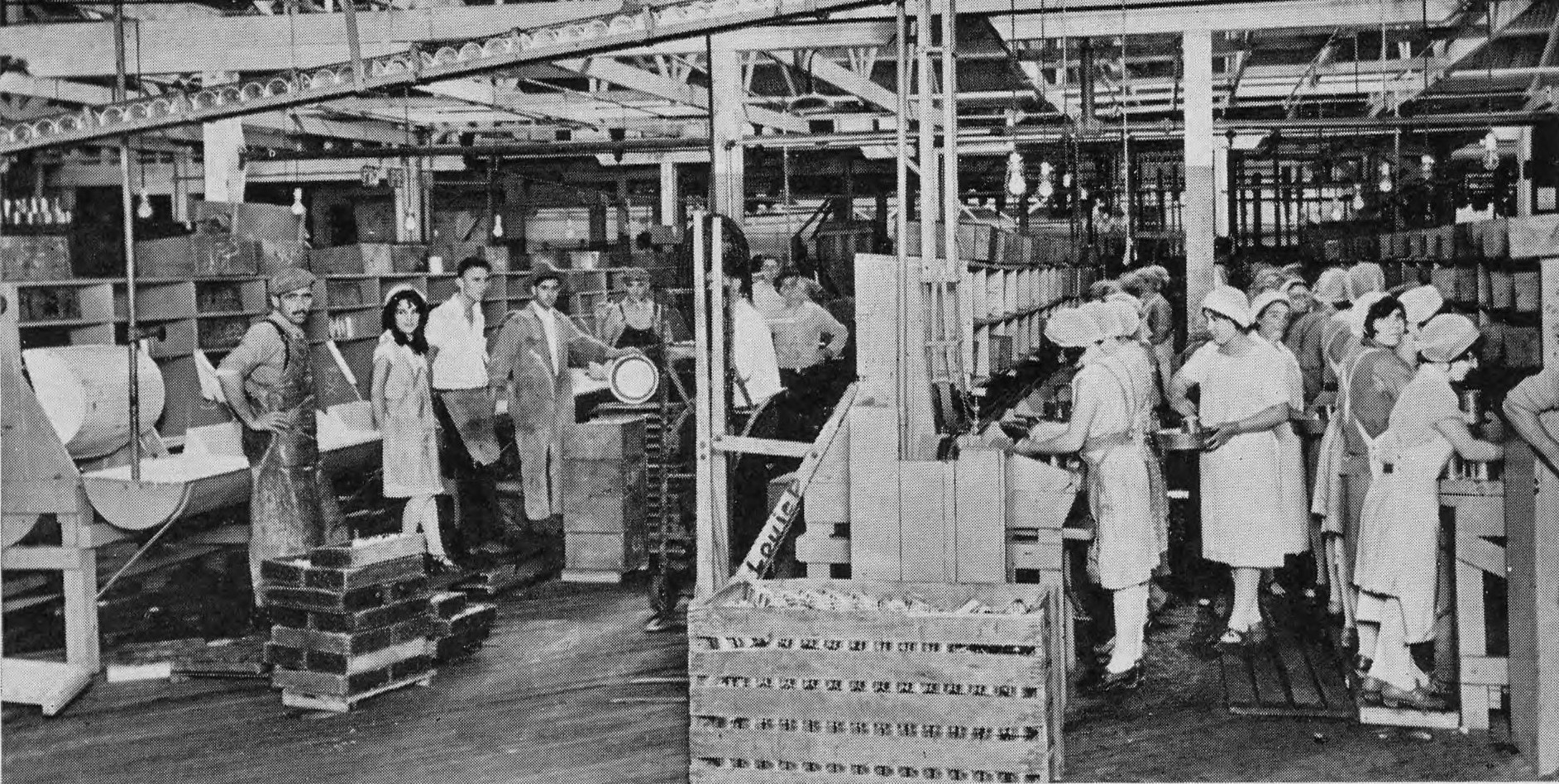
Last summer the writer had an opportunity to make a thorough investigation of the conditions, work and wages of cannery employes and found a state of affairs equal to all the evils of the sweating system.
The wages in the canneries of New York and most other states are outrageously low, and the only way that those employed can make a living wage is by working twelve and sixteen hours a day, The working conditions are such as few organized workers would stand for, and the sanitary conditions are in many cases abominable.
The work in the canneries being seasonal and limited to twelve weeks in the year at most, the workers are, therefore, unorganized. Women and children employed in canneries from twelve to sixteen hours a day cannot produce sanitary food for the consumers, and it is time that the organized workers who consume canned fruit and vegetables were taking cognizance of this fact.
New York is not the only state where the unions and legislators have been hoaxed by cannery operators into waiving shorter work day.
The usual plea made by the owners is that fruit and vegetables ripen rapidly and that unless they are allowed to work their employes sixteen hours a day, there will be a heavy loss to themselves and the farmers. This plea is about 100 per cent bunk.
No one has tried to limit the time that the canneries shall be operated; they can be operated every hour of the day if desired. All that is asked is that 48 hours shall be the maximum time any employe shall be worked in any week and that no employe shall be compelled to work more than eight hours in any twenty-four hours. No objections have been raised to the canneries working two or three shifts a day if the operators so desire.
The main reason for opposing the eight-hour-day is because a reduction of the working hours will mean an increase in wages and a reduction of profits. California appears to be the only state where the cannery operators have not been able to bluff. That state has a minimum wage law for women, and while the Industrial Commission allows the canneries to work women and children more than eight hours, it fixes the wages paid for overtime at time and one-quarter for all time worked over eight hours to the twelfth hour, and double time for all time worked over twelve hours. This tends to make the operators work two shifts of eight hours each instead of one shift working fourteen or sixteen hours.
In getting the raw material, the canneries do not indulge in guesswork; they are operated at capacity, and to maintain output. Contracts are made with farmers to grow acreage of vegetables, or the output of the orchard’s entire crop is contracted for in advance of the growing season. The canneries in this way know beforehand, climatic conditions being favorable, just what amount of fruit or vegetables to expect for canning, and it is very rare that the canneries contract for more than the capacity of their plants. The farmers are told by the operators when to commence harvesting the vegetables and the weather dictates the time to stop; the farmers take the loss, and if the operators give the orders to commence harvesting before the vegetables are ripe, the farmer has a small yield for his labor. Especially is this true of beans and peas. The operators see to it that the farmer never brings more raw material to the canneries than the plant can consume before spoiling, and the farmer, only gets paid for what he delivers to the cannery, minus dockage. The operator dictates the dockage.
All over the country, as a general rule, the contracts between the farmers and the canneries have a clause which reads that in the event of a strike of cannery employes or the cannery being destroyed by fire the operators are not obligated to take the farmers’ crop. The farmers stand to lose in the event of a strike, therefore uses his influence against cannery employes organizing. On the other hand, if the farmer shows signs of not going through with the contract, which he signed, the operators are empowered by the contract to cultivate the number of acres on the farm called for in the contract, take the crop and give the farmer the difference between the cost of cultivating and harvesting and the price agreed upon in the contract between the grower and the canning company.
Immense profits are made by the canneries all over the country. Investigations made by the writer showed that canned peas which retailed for 15 and 18 cents a can contained peas for which the farmer received three-fourths of a cent, and peas that sold for 35 cents a can netted the farmer less than 4 cents. The labor cost of canning peas, including the labeling of the cans, packing the cans in cases and loading in box cars, was one-half a cent per can, making a total of one and one-fourth cents for the peas and labor of canning for a can of peas that retailed for 15 and 18 cents each. This did not include the cost of the tin can.
In one instance of where women working in a cannery made a request for an increase in wages of 50 cents a day, which was refused, the increase, had it been granted, would have added to the labor cost of canning vegetables only one-twentieth of a cent per can. This will give an idea of the low labor cost of canning.
An investigation showed one cannery engaged in canning peas and beans which paid an income tax in March, 1925, of $15,500. This cannery employed less than 400 men, women and children an average of twelve weeks in the year.
Another investigation showed a cannery making an estimated profit (based on income tax returns) of $137,500 in a year, employing an average of 375 adults and children eleven weeks in the year.
The profits did not include those made on the cans. These cans are made by the American Can Company and a profit is made by that company in manufacturing the empty cans.
Another profit that was not considered in the investigation, is the one made by the owners of the machines in the cannery. The canning machines of a modern cannery are not sold to canning companies, but are leaned on a royalty basis, the owner being paid a royalty on the output of the machines. Therefore, the corporation which leased the machines had a profit from the operation of the cannery and from the labor of the employes over and above the profits made by the operators of the canneries investigated.
New York is the greatest canning state in the country, employing over 12,000 people in that industry; Wisconsin follows. This state employs over 11,000, exclusive of the farm workers who provide the raw material. The products of the New York canneries are sold all over the country, including Louisiana and California. The export is great, the peas canned in New York being sold in Japan.
When the bill for the shorter work week for women and children comes before the next legislature at Albany, it is to be hoped that the workers will have enough representatives there with sufficient stamina to put over a bill that includes the workers in the canneries.
New Leader was the most important Socialist Party-aligned paper from much of the 1920s and 1930s. Begun in 1924 after the S.P. created the Conference for Progressive Political Action, it was edited by James Oneal. With Oneal, and William M. Feigenbaum as manager, the paper hosted such historic Party figures as Debs, Abraham Cahan, Lena Morrow Lewis, Isaac Hourwich, John Work, Algernon Lee, Morris Hillquit, and new-comers like Norman Thomas. Published weekly in New York City, the paper followed Oneal’s constructivist Marxism and political anti-Communism. The paper would move to the right in the mid 30s and become the voice of the ‘Old Guard’ of the S.P. After Oneal retired in 1940, the paper became a liberal anti-communist paper under editor Sol Levitas. However, in the 1920s and for much of the 1930s the paper contained a gold mine of information about the Party, its activities, and most importantly for labor historians, its insiders coverage of the union movement in a crucial period.
PDF of full issue: https://www.marxists.org/history/usa/pubs/new-leader/1926/v03n33-aug-28-1926-NL.pdf

