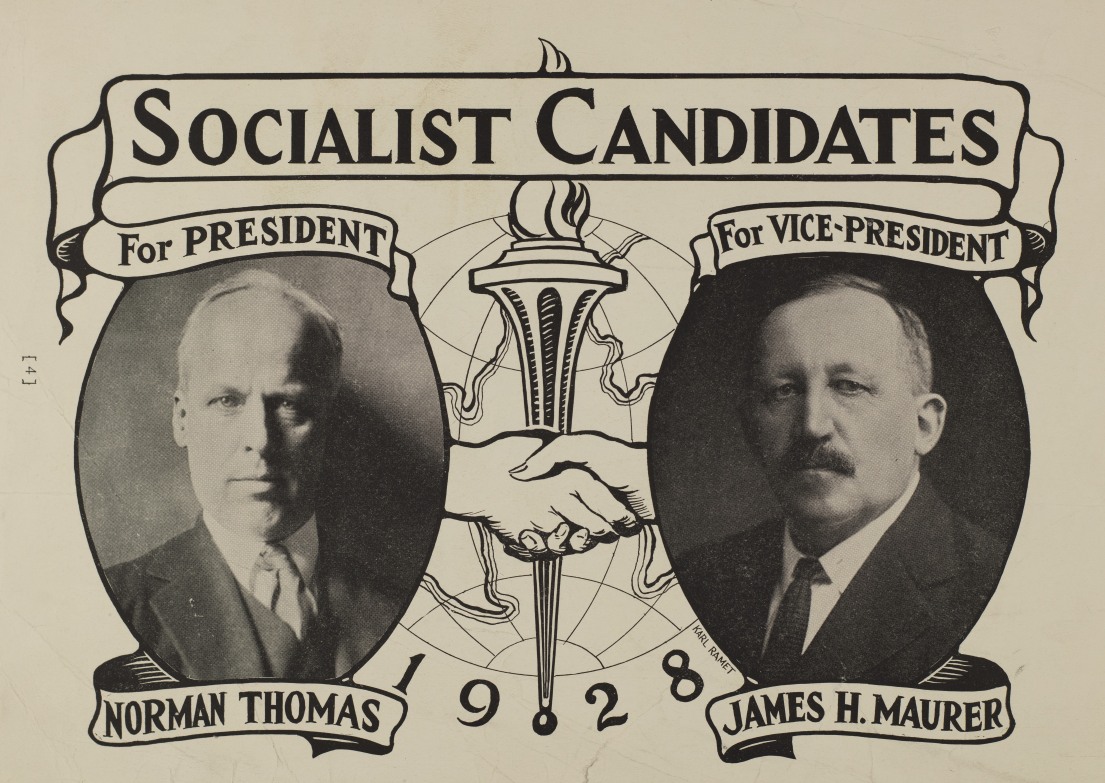
The original Socialist Party was born in 1901 as an opposition to Progressivism, and the specific U.S. liberalism then emerging into political dominance. While the S.P. long contained a middle-class, compromising wing, in he 1920s with Communists absorbing the political space on the left, the Socialist Party under the pastorage of Norman Thomas began a concerted effort to appeal to ‘progressive; and liberal opinion and those in middle class who held them. Olgin, a veteran of the Debs’ S.P., describes and denounces the move as it was around the 1928 Presidential campaign.
“The Socialist Party Offers Itself” by Moissaye J. Olgin from The Communist. Vol. 7 No. 10. October, 1928.
Norman Thomas, the Socialist candidate for President, “does not use language set in the accepted crusading pattern,” says the official 1928 campaign book of the Socialist Party. “‘Proletariat’ and ‘bourgeoise’ are words that rarely appear in his speeches. He has somehow got hold of the idea that farmers in Iowa, and workers in Detroit factories, are a bit uneasy when they are addressed as ‘the oppressed masses’…He refuses to talk to them about their troubles in the manner of Marx preparing Das Kapital in the British Museum in 1867.” (W.E. Woodward on Thomas, in The Intelligent Voter’s Guide, p. 18).
This may be pleasing to Mr. Woodward, a retired millionaire business man, whom it would hardly be fair to class among the oppressed masses. Mr. Woodward does not like the odious term “bourgeoisie,” to be sure. He is very happy to state that Mr. Thomas makes no “wordy denunciations” of the status quo, and that his speeches to the voters are on “bread-and-butter topics.” As a practical man of affairs, Mr. Woodward is certainly justified in praising Mr. Thomas for such campaign activities. Still, if he were less innocent about socialism, if he knew, what an all-embracing truth about the Socialist Party he revealed in those few words, he probably would have kept to himself his gushing enthusiasm (which so badly becomes the author of Bunk).
The Socialist Party has not only abandoned Marxism; it has repudiated the Communist Manifesto, and thrown overboard the Marxian terminology; it has done more, particularly in this campaign. Throughout the 310 pages of its official campaign book, there is no mention of the miners’ strike of 1927-28; there is no mention of the New Bedford strike (outside of one photograph); there is no mention of the collapse of the miners’ union under John L. Lewis; there is no mention of the fact that the overwhelming majority of the American workers are unorganized and therefore incapable of waging successful struggles against capitalism; there is no mention of the disfranchisement of the Negroes and other race discrimination; there is hardly any mention of the word “capitalism” or of the capitalist system (for which “the owning classes” are modestly substituted); there is certainly no mention of the class struggle; there is no mention of the capitalist state. Neither are these things mentioned in the campaign speeches of Messrs. Thomas, Laidler, et al. nor in the other campaign literature of the Socialist Party.
“The Socialist Party offers itself as the political party of the producing classes, the workers in farm, factory, mine or office,” says the Socialist platform. This would indicate that the Socialist Party wishes to stand on a proletarian basis. Yet the very title of the campaign handbook, The Intelligent Voter’s Guide, belies this contention. In a campaign leaflet addressed to the progressive voters, Mr. Thomas says: “Now I content myself with asking them simply as progressives who fought with LaFollette on his program in 1924 how they can be true to their progressive faith and vote with any other than the socialist ticket in the year 1928.” (An Open Letter to Progressives). Mr. Thomas knows that the LaFollette campaign was not a class campaign. Those who voted for LaFollette voted for a better capitalist system. In persuading the LaFollette progressives to lay aside all scruples and vote for the Socialist Party, Mr. Thomas does not ask them to change their political convictions; on the contrary, he assumes that they remain true to their bourgeois “progressive faith.” He thus states clearly that there is no difference between LaFolletism in 1924 and S.P.ism in 1928.
The Socialist Party is completely adapted to this “intelligent” and “progressive” voter. The socialist campaigners have in mind a man who is neither a manipulator of large-scale industry or banking, nor a proletarian in the active sense of the word. This hypothetical “citizen” has a critical attitude towards the “magnates”, but he also dislikes the masses. He is incensed by the fact that the trusts and banks dictate the policies of the government, but he would also be offended if he were called “exploited” or “downtrodden.” He is ordinarily a man of some (bourgeois) culture, and his ideal is a comfortable bourgeois existence. He is in favor of “progress,” “honest government,” “decency and sanity in administration” and against “special privilege” and “corruption,” but he is decisively against “forcible methods” “mob action” and “sudden changes.” He is essentially a man of good manners who is very proud of his reputation and would not stake his “standing in the community” on an act that would displease the respectable and wealthy.
Who is this odd type? His class qualifications are very hazy. He may be a manufacturer, or he may belong to the upper strata of the working class. The socialists model their “voter” after their own image: something in between an “enlightened” business man, a union bureaucrat, a lawyer, a preacher, an owner of real-estate, an office worker of the “better type,” and a college professor. The socialists assume that there is enough of this kind of “citizen” to make the socialists a “success.” They consider this type of “citizen” their particular domain.
The Socialist Party campaign is determined by this hypothetical voter. It is to him that Mr. Thomas says in another leaflet: “Even if it hurts your wealthy friends to be criticized by your vote, vote for the Socialist Party,” forgetting that the actual workers “in farm, factory, mine, or office, have no “wealthy friends.” It is for his benefit that the biographer of Mr. Thomas, in the campaign book, lauds him for helping organize the purely bourgeois-progressive Civil Liberties Union and the Progressive League for Industrial Democracy, for having been an Associate Editor of The Nation, for having been the editor of a liberal Christian magazine, The World Tomorrow, and for not being given to Marxism and to “windy” denunciation. It is for this fictitious “voter” that Mr. Thomas’s services as a preacher are strongly emphasized. It is for this imaginary “progressive” that the official campaign book calls The Nation, “that weekly journal in which truth shines candle-like in the darkness;” that among the authors contributing to the campaign book there are a number of liberals who have never had anything to do with the socialist movement; that out of 310 pages, the campaign book devotes less than 100 to topics that have a direct bearing upon the interests of the workers and poor farmers, while the bulk of the book is devoted to a progressive criticism of the old parties and their issues. It is for this “voter” that Mr. Thomas addresses himself in his letter of acceptance “to my fellow-citizens” and that a Times editorial praising Mr. Maurer is triumphantly quoted (Campaign Book p. 74).
The reward of such an appeal is already apparent. A committee of educators—college professors, among them teachers of religion, was formed to aid the Socialist Party campaign. A committee of ministers of all denominations also appeals “to the nation” on behalf of Thomas.
The main features of the campaign may be grouped as follows:
1. The socialists are unequivocally in favor of the capitalist state. “The socialist is the mainstay of republican and democratic institutions” says the official campaign book (p. 296). By “republican” and “democratic” they do not mean any order of the future, but the existing system of government. Thus the biographer of Mr. Maurer, in telling of his participation in a committee that had an interview with Woodrow Wilson, adds boastfully: “It is notable that a number of arguments made by Maurer and his colleagues on that committee were later incorporated by the President in his famous ‘fourteen points’ and became a part of world diplomacy” (Campaign Book, p. 73). It is in this way that the socialists illustrate their influence on the “republican and democratic institutions.” (It is noteworthy that Mr. Charles Beard in his Rise of American Civilization says that the fourteen points were a direct reply to the Soviet peace proposals and framed after their pattern—but of course the socialists wish to know nothing about such revolutionary methods of influencing “democracy.”)
The socialists wish to make their voters believe that it is a very easy task to transform this state into an instrument of “real democracy.” That is why their platform says that “our alleged democracy” is “largely an illusion;”—largely, but not wholly! That is why their platform demands the calling of a constitutional convention to “modernize” the American political system. The “voter” is made to believe that direct election of the President as it is done in Germany and proportional representation (as it is done in Belgium) would do away with the evils of inequality of political influence springing out of inequality of possession. The socialists say so directly in a leaflet entitled Woman and Politics: “Social privilege and its twin brother, graft, must be abolished before real social progress can be made.” Social privilege must first be abolished before social progress can be made; in other words, social privilege, according to the socialists, can be abolished by parliamentary means while the foundation of social privilege remains. This is a parliamentary illusion that suits and soothes the “progressives.”
2. The socialists are openly imperialistic. Their platform demands independence of the Philippines “on terms agreed upon in negotiations with the Filipinos;” which means retention of U.S. privileges, since “negotiations” between a giant imperialist power and a small colonial people can lead to nothing else. The socialists recognize “that there is some truth in the conventional assertion that American rule in these Caribbean and Central American areas has occasionally improved the material culture and the administrative efficiency of these states.” The socialists are in favor of retaining the immigration laws with “modifications”—“to permit the uniting of families and offer a refuge for those fleeing from political or religious persecution!” The socialists are in favor of the League of Nations which, they say, only has to be “democratized.” The socialists give their full approval to the Kellogg pact: “Sincerely meant and properly followed up it will have an impressive psychological weight in world opinion on the side of peace” says Mr. Thomas in the New Leader of August 4th. Here, too, the socialists are breeding dangerous illusions. They wish to create the impression that militarism is alien to the nature of the United States (“reform and reorganization in domestic policies are obstructed or denied through the oppressive and alien system of militarism.” (Campaign Book, p. 277). They wish to create the illusion that the capitalist system can exist without imperialism and that the interference of the United States in other countries is an abnormality which can be terminated through democratic efforts. Moreover, they contend that even imperialist wars can be averted through “democratic” influences within the framework of the existing capitalist state institutions. “We can avert particular wars while we change the system that breeds wars” says Mr. Thomas in his letter of acceptance. The socialists have outlined a number of demands, like the “abandonment of the policy of intervention” in other countries and the like, but knowing that persuasion alone will not force finance capital to abandon its policy dictated by international economic competition, and indicating no other way of fighting the war danger outside of the League of Nations and the Kellogg pact, the socialists actually lull the masses into disregarding the significance of imperialism and the threat of new imperialist wars. By doing so they again mean to please the “progressives.”
One instance may be cited. The bourgeois historian, Harry Elmer Barnes, who was honored by the socialists with the task of exploiting their international relations program, tries to convince his readers that international competition and the protection of investments in foreign countries need not necessarily go hand in hand. “It is as illogical and indefensible to expect the government of the United States to protect private loans and investments in foreign countries as it would be to propose that the Federal Army or the National Guard of the several states should be called out to collect domestic debts within the boundaries of our country.” (C.B., p. 267)
The eminent professor forgets that it is the principal task of the army to protect the economic interests of the capitalists “within the boundaries of our country;” that its “domestic debts” are collected through police force only is because no armies are necessary for this task and because there is no real line of demarcation between police and army; that, however, when “investments” are threatened by workers’ strikes “within the boundaries of our country,” the federal and state soldiers are promptly called. The dear pacifist professor spreads illusions both about the nature of the state and the nature of international capitalism—illusions that serve to embellish and protect the ugly face of imperialism.
3. The socialists make water power their main issue. “Water Power Declared Leading Socialist Issue” says a six-column headline in the New Leader of September 1st. Water power occupies the attention of the socialists vastly more than unemployment, or the cutting of wages (which is hardly mentioned) or even militarism and the war. Mr. Thomas has written long tracts about water power in the New Leader as if the control of the sources of electric power were more important than the control of iron, steel, building, railroads, etc. The reason for this preference is contained in a leaflet entitled “Drudgery or Electricity” which says: “Lower rates (for electricity) mean labor-saving machinery, less hard work and more leisure for the women in the home.” The socialists, by promising low rates for electricity, hope to capture the middle class women who stay at home and can afford electrical apparatus to do their work. Another reason for stressing the water power issue is contained in a New York Times dispatch from Denver, Colorado, saying: “Governor Smith tonight made water power development a major issue in his western campaign.” A third reason is that the small manufacturers using power are very much concerned with the growth of the power monopoly and its fusion with big industry.
4. The socialists make much of “public ownership of natural resources.” The latter, they say, should pass into the hands of “public agencies” in order that the consumers be guaranteed against exploitation by the trusts. Public ownership they understand as ownership by the capitalist state. That this is so, may be seen from Mr. Thomas’s explanations. “Even in war,” Mr. Thomas says, “much public ownership and control does work…Even in our capitalist society government agencies are not all inefficient nor private agencies efficient. As for corruption, it was in the end the government which uncovered the oil scandals and protected the stock-holders who had been robbed in the Continental oil deal, not the other way around.” (!) Mr. Thomas has no quarrel with the government as far as management of publicly owned productive forces is concerned. He only forgets that of the two shining examples quoted by the socialists, the Post Office and the management of the railways during the war, one has nothing to do with production of commodities and the other only proved that public management by capitalist states is a safeguard for capitalist profits. When natural resources are “publicly managed,” the rate of profit for the capitalists (whether former owners or the capitalist government) is obviously to be determined by the “public agency,” which is an agency of the capitalist state. The executive committee of the trustified capitalist forces is to curb capitalist exploitation. The devil is to be made harmless by his grandmother!
5. The socialists, as far as they appeal to the workers, are spreading innumerable falsehoods which can only have a befuddling influence. In the appeal of their convention “to organized labor” they maintain the long-exploded fiction that “labor,” in fighting the employers, wishes to rely on “economic might” alone, i.e., on the force of strikes (this piece of wisdom has been repeated in a special Labor Day supplement to the New Leader), and they forget to inform the workers that, so far as the present leadership of “labor” is concerned, it does not want to fight the employers at all. They further spread the falsehood that communism and fascism are the same thing (“reaction of the extreme right or the menace of the extreme left”). “In every land where the fascism of the whites or the communism of the reds has reared its head, the Socialist International and its affiliated parties oppose them with all their might” (Campaign Book, p. 294). Mr. Thomas wants to make us believe that communism means only “salvation by catastrophe” (a minister always thinks in terms of salvation) hiding from his audience the fact that communism means first of all the class struggle in all its phases. The socialists, as usual, make believe that the ballot can save humanity from all evils. “No Messiah can save us. We must have our own party,” says a leaflet addressed to the farmers. In other words, there is no remedy against social evils but voting for the Socialist Party. “A vote for the Socialist Party is a vote for a job” says the official campaign book (p. 213) knowing very well that even a whole Congressful of socialists could not secure a job for everyone as long as the means of production are in the hands of private owners.
The entire socialist campaign is conducted under the slogan: Peace, Freedom and Plenty. (This slogan, which is a modification of McKinley’s full dinner-pail slogan, is contained once in the platform, twice in the letter of acceptance, once in a leaflet addressed to the farmers, and many times in Thomas’ speeches, among them the speech of August 4th in Ulmer Park with which he started his campaign). The socialists wish to make their audience believe that actual peace, actual freedom and plenty for all can be attained under the capitalist system. In this as in all other respects they follow the example of the capitalist parties, adding to the lie of capitalist promises the falsehood of an insignificant group acting as if it had a chance of becoming a leading power in the state.
The promise of “a vote for the S.P. is a vote for a job” stands out in all its ludicrous falsity in the light of a statement adorning the pages of the official socialist campaign book. The statement by a talkative socialist named Paul Blanshard, a figure in the socialist camp, and one of the editors of The Nation, is printed on p. 307 and reads as follows:
“Since Jehovah is constantly being thwarted by ungodly Republicans and Democrats, it is not likely that He will decree the people’s ownership of land in 2028. As Socialists, therefore, we must be content for the time being with intermediate measures.”
The official campaign book admits, though in a jesting form, that the socialists do not believe in the coming of socialism even in a hundred years. Then they come out and tell the people that a vote for the Socialist Party is a vote for a job.
No sadder commentary on their betrayal of socialism could be found. “The Socialist Party offers itself” to anybody who will buy it. It demands nothing but a vote. It has given up in return everything: principles, clarity of vision, truth, reality itself; it has given up connections with the working class.
Space does not permit any exhaustive comparison of the Socialist Party campaign and platform with that of the Workers (Communist) Party. The difference between the former and the latter is the difference between petit-bourgeois pro-capitalist “progressivism” and proletarian class struggle. While no real comparison can be made within the limits of this article, indication of a few characteristics of the communist electoral activity will serve to suggest to the reader the basic difference between the two parties and to make clear the fact that they are really lined up on two opposing sides in the class struggle;—that the Workers (Communist) Party is the leader of the working class and the Socialist Party is one of the enemies of the working class:
1. While the election campaign is being conducted, communists intensively participate in the struggles of the miners, textile workers, needle-trades workers, automobile workers and others; they take responsible parts in building the new unions of the miners, textile workers, cloakmakers, and furriers; they organize relief action for the Chinese workers, etc. They combine activities with the election campaign. They draw no line of demarcation between the various phases of their work. They permeate the workers’ everyday struggles with political understanding and political protest. They bring into the political campaign the actual sufferings and daily struggles of the working masses whose interests demand the abolition of the capitalist system.
2. “We are not going into the national election campaign solely for the purpose of getting votes,” said Comrade Foster in his acceptance speech. “It is of course important that we register the extent of our Party’s support in the working class…But we also have other, bigger objectives. Our aim must be to arouse the class-consciousness of the masses in a political sense and to mobilize them for struggle on all fronts.” The political campaign proper, the vote-getting activities, are only one part of the general work of mobilizing the working masses, they are one of its facets, inseparable from all the others.
3. The communists do not refrain from struggling for improvements in the life of the masses. On the contrary, they are leading in all the struggles that may force the capitalists to concede one or the other reform. They know, however, that such concessions in themselves do not free the workers. “Permanent improvements in the conditions of the workers under capitalism are impossible,” said Comrade Foster in his acceptance speech. “The inevitable crisis, born of the contradictions of the capitalist system…sweeps away like chaff such reforms.” The communists emphasize that the real remedy against the sufferings of the masses is the overthrow of the capitalist system, the establishment of a Soviet system.
4. The communists are untiringly pointing out the war danger, and are mobilizing the masses against the imperialist war and for the defense of the Soviet Union. This is the center of the communist electoral campaign. “Our Party,” said Comrade Gitlow in his acceptance speech, “joins hands with the workers and toilers of all countries in defense of the exploited and toiling masses everywhere, and we declare that in the event of a war we will utilize the war to mobilize the workers, to mobilize the farmers, to mobilize the masses to make the war the burial-ground of capitalism.”
5. The Communist Party conducts a working-class campaign in that its literature and its speakers deal with every phase of the class struggle and every class and section of society from the standpoint of the interests of the working class and the exploited masses whose leader it is.
6. The Communist Party declares in its election platform that “it constitutes itself not only the party of the working class generally, but also the champion of the Negroes as an oppressed race and especially the organizer of the Negro working-class elements. The Communist Party is the party of the liberation of the Negro race from all white oppression. The Communist Party considers it as its historic duty to unite all workers regardless of their color, against the common enemy, against the master class. The Negro race must understand that capitalism means racial oppression and communism means social and racial equality.”
It is in the spirit of this quotation from the platform that the Communist Party has put the oppression of the Negro masses by American imperialism in the foreground of its activity.
7. Our candidates are veterans of the labor movement, symbols of the spirit of class struggle, which is the spirit of every activity of the Communist Party. The campaign is not a personal campaign for Foster and Gitlow. Comrade Minor declared in his nominating speech at the National Nominating Convention: “In reality it is not individuals but our Party itself, which is the candidate.” It is characteristic of the communist campaign that its slogan is not “Vote for Foster and Gitlow” but “Vote Communist.”
8. Our campaign is a campaign of uncovering the economic and political realities, dispelling illusions, enlightening the masses, organizing them, giving them a fighting program, arousing them to revolutionary struggle, and pointing the way towards their liberation.
9. Our platform, entitled “The Platform of the Class Struggle” is a manual for the understanding of present-day America, of its economic structure, its government, its political parties, its class divisions, its internal and foreign policies, the tendencies of its further development, the position of the working masses, workers, poor farmers, foreign-born workers, Negroes, working-class women, youth and children, etc. It is a guide to political education and to political action.
There are a number of journals with this name in the history of the movement. This Communist was the main theoretical journal of the Communist Party from 1927 until 1944. Its origins lie with the folding of The Liberator, Soviet Russia Pictorial, and Labor Herald together into Workers Monthly as the new unified Communist Party’s official cultural and discussion magazine in November, 1924. Workers Monthly became The Communist in March ,1927 and was also published monthly. The Communist contains the most thorough archive of the Communist Party’s positions and thinking during its run. The New Masses became the main cultural vehicle for the CP and the Communist, though it began with with more vibrancy and discussion, became increasingly an organ of Comintern and CP program. Over its run the tagline went from “A Theoretical Magazine for the Discussion of Revolutionary Problems” to “A Magazine of the Theory and Practice of Marxism-Leninism” to “A Marxist Magazine Devoted to Advancement of Democratic Thought and Action.” The aesthetic of the journal also changed dramatically over its years. Editors included Earl Browder, Alex Bittelman, Max Bedacht, and Bertram D. Wolfe.
PDF of full issue: https://www.marxists.org/history/usa/pubs/communist/v07n10-oct-1928-communist.pdf

