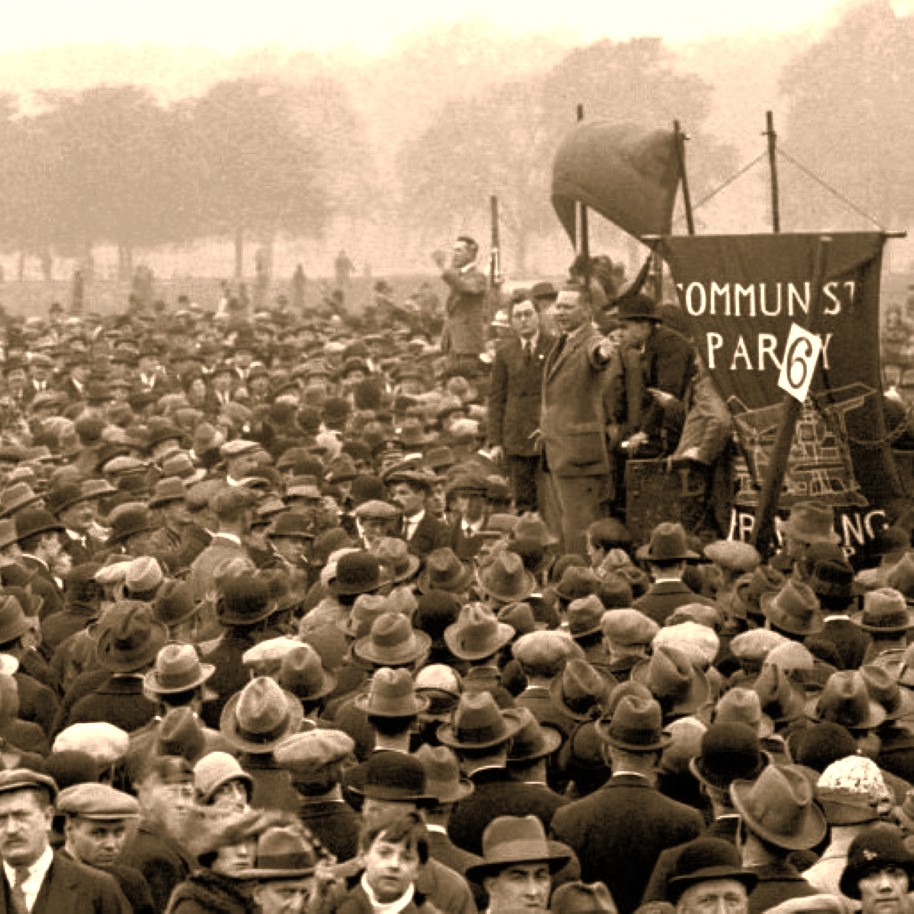
Dunne gives a sense of the stakes as he is engrossed by the heady days of the British General Strike and the hated Empire totters inside and out.
‘What Price the British Empire?’ by William F. Dunne from Workers Monthly. Vol. 5 No. 8. June, 1926.
ON Friday, April 30, the Workers’ Weekly, official organ of the Communist Party of Great Britain, said to its 60,000 readers:
“May day comes at a time when the Miners and with them the whole working class—are confronted with the most brutal capitalist attack in history.
“The government has ranged itself with the mine-owners in their attempt to force down the miners’ standards. Every weapon—including, if necessary, that of naked force—will be used against the workers.”
On April 27, the Central Executive Committee of the Communist Party had issued a statement to the Special Conference of Trade Union Executives called by the Trades Union Congress of which I quote the following:
“We call upon the Conference of Executives to reaffirm the policy of class solidarity. It is its plain duty, alike to the miners and to their class, to issue a call to every worker in Britain to stand solidly behind the miners in the struggle, and to issue a similar appeal to the workers of the world, to give the British miners every possible backing.
“Declare for a United Front, and we are confident that every section of the working class of Britain will give you whole-hearted and willing support.”
The enthusiastic determination with which the masses of the British workers have rallied to the miners, the stoppage of British industry, the world-wide boycott established by international labor against coal and shipments of other goods to Britain is stern and convincing proof that the confidence of the British Communists in British labor and the masses of workers in other lands was fully justified.
The confidence of the British Communists in the desire of the workers in England to aid the miners and engage in an open struggle to check the offensive of British capital against the trade unions and the living standards of the workers was no product of sentimentality.
The belief of the Communists in the willingness of international labor to aid the British labor movement was likewise founded on knowledge and understanding of recent developments in the ranks of labor, continental labor especially, as well as knowledge that the international political situation was favorable.
There was one danger in the situation. It was that the right wing leaders of the trade unions and the Labor Party would, by delay and a series of compromises with the Baldwin government, succeed in destroying the morale of the masses and dissipate their will to fight into channels harmless to the ruling class.
That the trade union membership had been swinging to the left ever since the Liverpool conference of the Labor Party which, under the leadership of MacDonald, excluded the Communists and opened the way for the prosecution and imprisonment under the Mutiny Act of 1797 of 12 members of the Central Executive Committee, there was no doubt.
First, the entire labor movement—with some negligible exceptions—came to their defense in spite of the fact that they were accused and convicted of attempting to “cause mutiny and disaffection in the armed forces of the Crown,” by circulating among soldiers and sailors a leaflet calling upon them to refuse to fire on workers.
The release of Bell, Murphy, McManus, Cant, Campbell, Arnot and Wintringham on the expiration of their six months sentences on April 12 was the occasion for one of the most unique and significant demonstrations ever seen in London.
Twenty thousand workers of all shades of opinion marched to the gates of Wandsworth Prison where five Communists were still imprisoned and remained there for two hours making the prison walls shake with the impact of mass cheering carried on under the direction of a single chairman in the most disciplined fashion.
Second, at the special conference of the National Minority Movement—the organized left wing in the trade unions—held in the Battersea district of London on March 21, 950,000 workers were represented.
Seventy per cent of the organizations sending delegates had been represented at the first conference held last year and there was a gain of 47 1/2% in new organizations (262 trade union branches, trade councils, etc.).
Moreover, the biggest section of workers represented was from heavy industry—mining, metal, and transport.
At this conference the main resolution was on “The Capitalist Offensive.” Adopted unanimously it instructed the affiliated membership to:
“1. Urge each Trade Council to constitute itself a Council of Action by mobilizing all the forces of the working class movement in its locality.
“2. Urge the General Council (of the Trades Union Congress) to convene a National Congress of Action.”
In short, thru the Minority Movement, approximately 1,000,000 members of the trade unions, more than one-fifth of the British labor movement, had adopted the left wing program for support of the miners, in the miners’ union itself the left wing program went over with a bang.
The majority of the executive board of the Miners’ Federation of Great Britain were wavering previous to the Minority Conference and were following the lead of the conservative leadership of the trade unions and the tabor party.
But A.J. Cook, the militant secretary of the Federation, went into the coal fields and huge mass meetings and delegate conferences at which the report of the Royal Coal Commission was rejected and the left wing program endorsed by overwhelming majorities brought Herbert Smiht, president of the union, and the rest of the executive into line.
Fifth, a number of spontaneous strikes in the transport and metal industries and the rapid development of the wage struggle in the entire engineering industry showed that the workers were determined to accept no reductions in wages or increases in hours.
Sixth, the refusal of influential sections of the Labor Party to obey the Liverpool mandate and exclude the Communists. Such important districts as Rhondda, in the heart of the mining industry, voted for the affiliation of the Communist Party by a majority of 10,718 out of the 18,923 votes cast. The right of Communists to become Labor Party candidates and their individual membership was voted for by a majority of 15,650.
The indisputable leftward tendency of the British masses shown by the above events was the fact on which the Communist Party based its program of immediate struggle.
In the international arena there was the collapse of the Locarno pact and the defeat of Chamberlain which would have resulted in the discrediting of the Baldwin government had the right wing of the labor party not sabotaged the struggle in the House of Commons.
There was the Russo-German treaty which caused consternation in the European capitals.
There was the new militant spirit of the masses shown in Germany by the great wave of sympathy and support for the Soviet Union, the Communist victory in the Berlin elections and the immense increase in the prestige of the C.P.G. as a result of its campaign for the expropriation of the princes coupled with the rapidly worsening economic position of the German workers.
In France the Communist victory in the elections held in the ten largest districts of Paris and the critical financial position of the French government amounting to a chronic crisis increasing the burden on the Masses was a guarantee that the French workers were on the march.
British capitalist diplomacy and pressure had failed to bring stability to Europe, Chamberlain had suffered the most humiliating defeat ever administered to a British foreign minister and the world position of the British ruling class had been weakened greatly.
Only the reformist leadership of Labor Party and the trade unions hesitated to base their policy on a situation which the masses sensed and the Communists and the left wing saw and understood.
May Day, the Saturday preceding the Monday on which the general strike was declared, saw the biggest working class parade and demonstration ever witnessed in London.
An incident occurred which, in the light of recent developments, was of the greatest significance. I quote from a dispatch sent by the London correspondent of the United Press to Canadian papers:
“Shapurji Saklatvala is the only Communist in the House of Commons. His constituency is Battersea, a London working class district. Normally the Battersea May Day marchers are relegated to the rear of the processions, for Communism and socialism do not mix well. TODAY, HOWEVER, THE REDS FROM BATTERSEA PROUDLY LED OFF THE PROCESSION. THEY SIMPLY TOOK THE LEAD, NONE SAID THEM NAY AND THEY MARCHED IN
PLACE OF THE USUALLY ACKNOWLEDGED LEADERS.”
It is my opinion that the government had intended to continue the subsidy to the coal owners for the two weeks or so and frighten and cajole the reformist leaders into a compromise by its customary methods but that the temper of the trade union membership frustrated this delightful scheme.
As late as April 17, not even the left wing leaders and others closely in touch with the situation believed that a strike would result. Everyone looked for some sort of a compromise which would postpone the crisis.
Early in April a conference of left wing British trade union officials, continental union officials and heads of the All-Russian unions had been held in Paris to consider the British mining situation.
The unanimous opinion at this meeting was that no strike would take place and that if it did it would receive only half-hearted support from the Trade Union Congress.
But the less articulate masses in between the organized left wing and the reformist leadership had the last word.
The signal that the British working class had the will to challenge British capitalism was not given by a trade union official but by members of the Printers’ Union who shut down the Daily Mail rather than set up an editorial attacking the trade unions.
The British printers are listed as conservative and their spontaneous action therefore was all the more important.
It may be that Premier Baldwin lost his head and helped precipitate the crisis by breaking off negotiations, but the decisive factor was the temper of the trade union membership.
This temper is the joint result of the decline of British capitalism which can only maintain itself by lowering the living standard of the workers and the ceaseless agitational and organizational work of the National Movement and the Communist Party.
What burdens the decline of British capitalism has placed on the workers and the additional burdens the ruling class are striving to place on them is best shown by the present wage scale of the miners and the reductions proposed by the bosses. The following table gives the wage scale and the proposed reductions by districts in shillings:
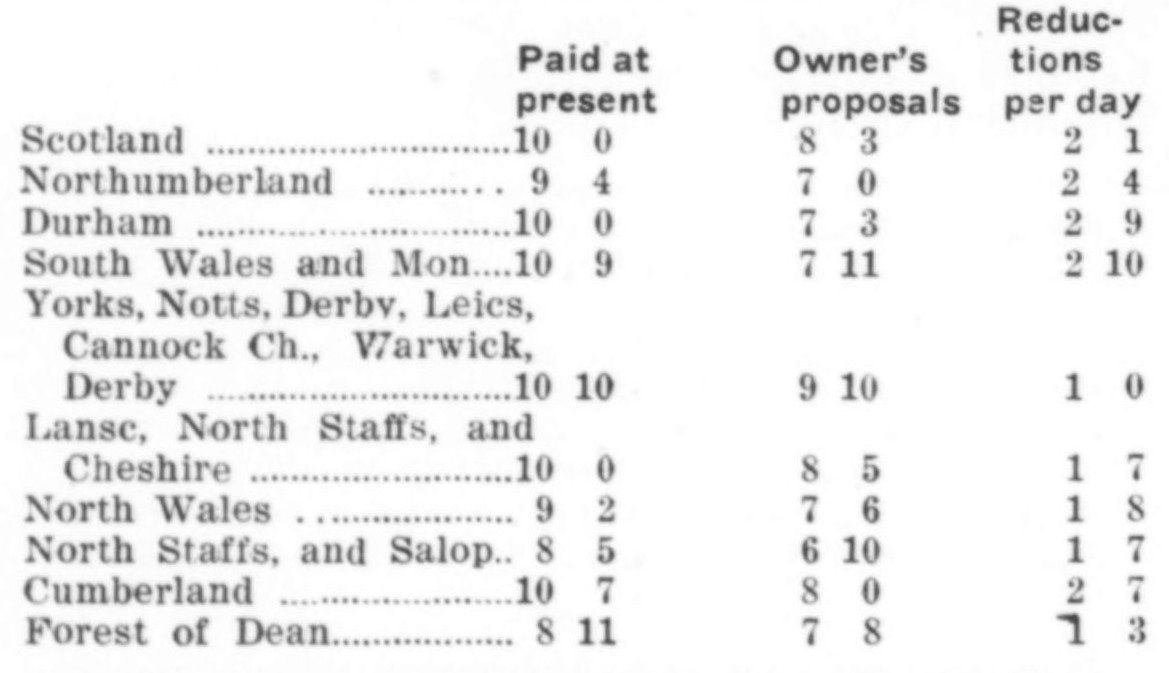
In the largest coal fields such as South Wales and Durham, the proposed reductions would bring down the wages to approximately 14 per cent over the 1914 wages while the present cost of living is 76 per cent above the 1914 index.
The Communist Party has from the very first interpreted the attack on the miners as the first blow in a general attack on the whole trade union movement and the general strike is proof that the trade unions so regarded it.
The implications of the gigantic struggle in Britain cannot be concealed in spite of the quite truthful protestations of the trade union and labor party leaders to the effect that they were not fighting the British government, and their feverish efforts to confine the struggle strictly to the questions of wages and hours.
The British strike is a classic example of how, in the period of declining capitalism, purely “trade union” issues and the struggles centering around them take on a revolutionary character.
The capitalists of the world and their press are not deceived. They see and feel clearly that since the Russian revolution all the struggles of labor combined have not shaken world capitalism as has the British general strike.
In the so-called Anglo-Saxon countries, the British colonies and the United States—the stimulating effect on the working class is even more apparent than that of the Russian revolution.
It could not be otherwise.
Before the war the British trade union movement was excelled in conservatism only by the American Federation of Labor. It was saturated thru and thru with the ideology of imperialism. Its outlook was that of a working class which had lifted itself on the backs of millions of colonial slaves from the mire of misery which early capitalism brought to Britain.
When British ships carried the trade of the world, when the British pound sterling was the world’s standard of value, when British iron and steel were sold in the four quarters of the globe in the “dear dead days before the war,” when a golden sun—and not an orb seen only thru the red mist of revolution—never set on the British Empire, the American capitalist press had nothing but words of praise for the “safe and sane” British labor movement.
What price the safe and sane British labor movement now as its general strike grips Britain and the empire writhes in convulsions which shake the whole capitalist world?
As this is written the Trade Union Congress is calling out its second line of reserves—food workers, gas and electric workers in reply to the flooding of all industrial centers with troops with full war equipment.
The tie-up is the greatest in history, yet two million workers can still be called out.
It is obvious from this distance that the strike can be broken only by the government making war upon the working class—crushing all resistance by military methods.
The labor movement is splendidly disciplined and moves like one vast army altho as yet it is only trade union and not revolutionary discipline.
What will the outcome be?
First of all the tremendous impetus given by the force of the British example to the working class of all the capitalist world and especially to the working class in the western nations.
Secondly, the British labor movement itself will take on a more revolutionary character. There will be a rise of the left wing in the Labor Party and the trade unions and added prestige and influence for the British Communist Party.
Barring an outright betrayal by the reformist leaders, there will be a big increase in the Labor Party representation in the House of Commons with the possibility of a Labor majority and a Labor government.
Another labor government, by virtue of the strength of the proletarian left wing whose opposition to British imperialism was expressed in the historic Scarborough resolution, will make extremely difficult the maintenance of a world empire by force of arms, will under left pressure be forced to take steps to apply the lessons of the general strike by drastic reorganization of the army and navy or take up the struggle directly against the masses.
The general strike will have more than an echo in India, Egypt and China. It will give new hope and life to the national liberation movements. Henceforth colonial and British workers will stand together in the struggle for the overthrow of British imperialism—the struggle for which the general strike is marshaling, drilling and steeling the whole British working class from Glasgow to Southampton, from Liverpool to London.
It is a glorious sight—these unbroken ranks of British workers backed by labor in all lands. Even the American Federation of Labor officials have expressed a willingness to aid the strike and this alone is testimony enough to convince one of its world-wide powerful sweep.
IN Moscow seventy-year-old Tom Mann, fifty-five of those years spent in organizing workers, preaching the general strike and the social revolution, enters the mausoleum where the body of Lenin lies with a Red soldier standing by.
The face of the old fighter is aglow and his heart near to bursting with pride. Tears of joy fill his eyes as he whispers: “Ilyitch, it’s come. You lived to see your beloved workers marching down the road to victory. I’ve lived to see the boys I organized swing into action in one solid mass against the might of British capitalism. My seventieth birthday is a few days past, but now I believe that I shall live to see the Union of the Soviet Republics of England, Ireland, Scotland and Wales.”
The red soldier at the head of the bier salutes the old revolutionist and old Tom Mann dashes for a train that carries him toward England and the struggle.
The Workers Monthly began publishing in 1924 as a merger of the ‘Liberator’, the Trade Union Educational League magazine ‘Labor Herald’, and Friends of Soviet Russia’s monthly ‘Soviet Russia Pictorial’ as an explicitly Party publication. In 1927 Workers Monthly ceased and the Communist Party began publishing The Communist as its theoretical magazine. Editors included Earl Browder and Max Bedacht as the magazine continued the Liberator’s use of graphics and art.
PDF of full issue: https://www.marxists.org/history/usa/culture/pubs/wm/1926/v5n08-jun-1926-1B-WM.pdf

