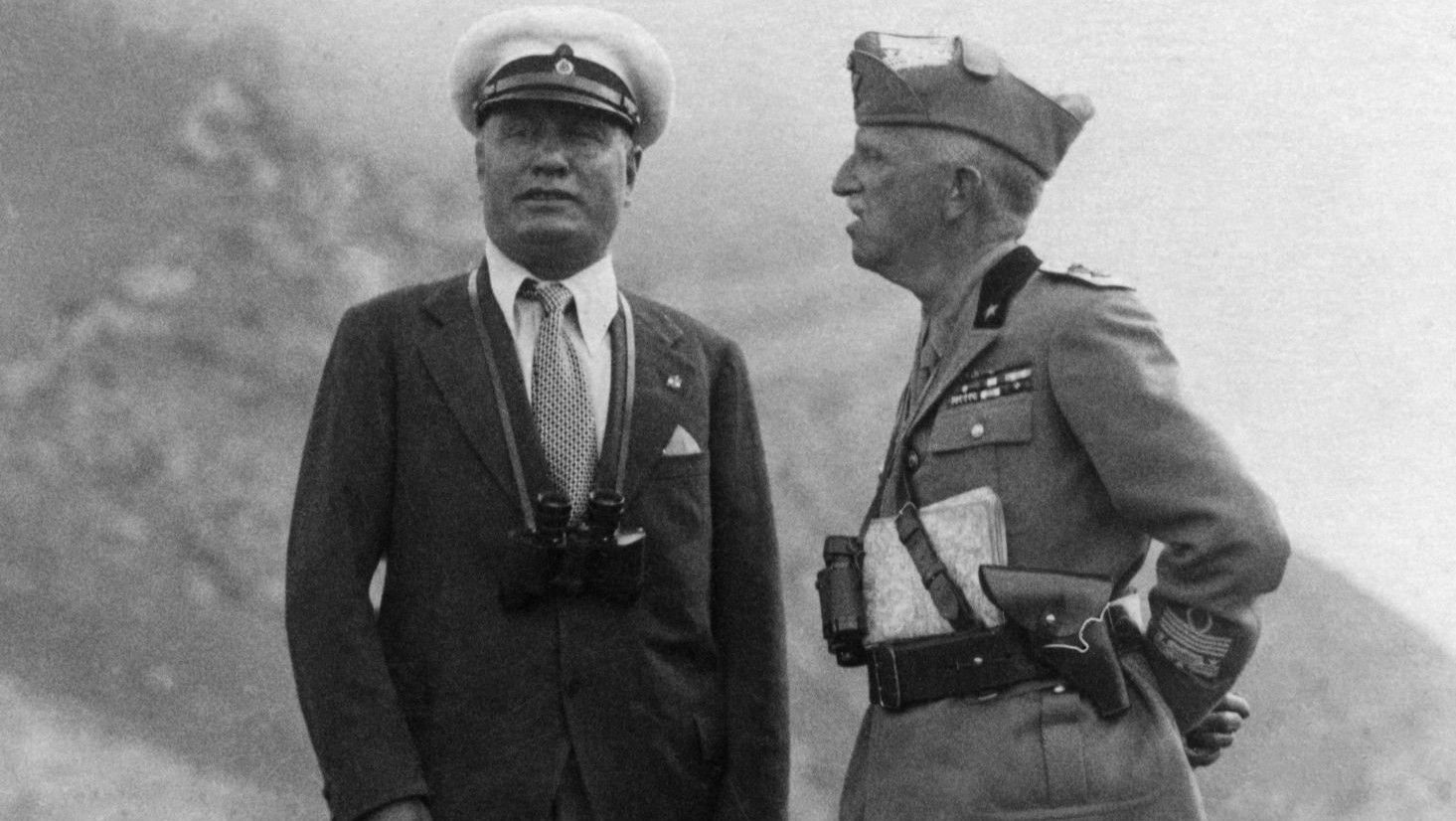
Tresca on the relations of the two rather ridiculous representatives of Italy’s ruling class as they attempt to make an Empire in Africa.
‘Mussolini and the King’ by Carlo Tresca from The Fight Against War and Fascism. Vol. 3 No. 5. March, 1936.
THAT THIS is eminently Mussolini’s war there can be no doubt. However, it would be childish and illogical to overlook the fact that it is also the Italian capitalists’ war.
There may be Italian industrialists, bankers, merchants who would rather carry on their hand-to-mouth existence and avoid all changes which might bring about the downfall of the tottering régime. But the historic, basic truth is that fascism, which served for the moneyed men the convenient purpose of enslaving the Italian workmen, is now acting as a tool of the same class for the realization of imperialistic dreams.
It is convenient to say that Mussolini’s ambition, Mussolini’s calculations today coincide with the ambition and the calculations of the Italian upper class.
The Rulers United
But the interests of the reigning house, too, harmonize with those of the capitalists. To be more accurate, it must be said that it is the first time since 1870 that the ancient, deep-rooted desire of the Savoy monarchy for domination, for possession and expansion, is not in conflict with the interests of the capitalist class. National unity once effected, the Italian upper class found itself under the necessity of solving quickly and to its exclusive advantage the problem of the organization of the state.
Prime Minister Mancini, and Crispi after him, were “Africanist,” not because they, as the representatives of the bourgeoisie, had developed a colonial consciousness impelling them to follow in the wake of the imperialistic powers. In effect, after the defeat of the Italian troops at Dogali, Crispi, who thought that the honor of the reigning house had been seriously impaired, did not hesitate to plunge headlong into an adventure in which the Italian bourgeoisie did not feel that its interests were at stake.
Doubtless, the blame for the disastrous war of 1896, which climaxed at Adowa and brought about Crispi’s downfall, is to be laid at the door of the king.
King Humberto’s personal ambition and his craving for an emperor’s crown, which led him to order the minting of new coins bearing his imperial effigy even before victory could be achieved, were the main causes of the disaster.
Humberto had clear and well defined aims.
His objects were: to deprive the Italian people of its constitutional liberties; to organize the state along the lines of the German empire, namely, on a militaristic and feudalistic basis; to create a kind of absolute monarchy, and to invade Africa in order to gain the coveted imperial crown.
The reactionary general Pelloux was his man, as Crispi had been before him. Humberto gave orders; they were obeyed, until the sudden death of the king opened in the national life a new interlude which was closed by the coming of fascism to power.
A Perfect Set Up
What Humberto had been unable to accomplish, his son did, and in a larger measure. Absolute power is now vested in the monarchy; the Italian state is totalitarian; the people have lost their liberty.
It is a mistake to believe that Mussolini is the sole master of an enchained people. The fact is that the king, although preferring, and at times being obliged to hide behind the curtain, is always “on the job.” The king needs Mussolini just as much as Mussolini needs the king.
Historically there is this difference between Victor Emmanuel and Humberto: under Humberto the African wars were predominantly and almost exclusively dynastic; under Victor Emmanuel, with the colonial consciousness of the Italian bourgeoisie already formed, the Ethiopian war is both dynastic and capitalistic.
Mussolini, as dictator, is driving the nation to war with the knowledge that by so doing he is not only satisfying his ambition and his necessity of prestige, but is also serving the monarchy and the capitalistic class. He knows that his fall will be their fall, and so he holds them bound to himself by reminding them that revolution will spare neither men nor institutions. The spectre of revolution keeps them together.
King Victor Emmanuel is trying hard to keep himself and his family aloof, so as to be able to say, when the time comes: “I am not to blame; I did my best.” The King is always preparing himself, and his house, for any eventuality; he strives to avoid being too closely identified with Mussolini and his henchmen.
Let no one be deceived by a resourceful and well organized propaganda carried on in the interest of the reigning house. The king, it is said, is not answerable for the murders, the abuses and the violences committed by the fascists; the king is said to be a prisoner of the régime.
As a result of this propaganda, not a few, we should say a majority of the students of Italian life and history, are inclined to consider the king of Italy as a feeble, a vacillating, a powerless ruler, a kind of pawn in Mussolini’s hands. What a travesty of the truth!
The Deciding Factor
Reports are spread that the army staff is opposed to Mussolini’s African adventure. Since the superior officers of the Italian regular army are as royalist as the king, the implication would be that the king, too, is averse to the war. This is nonsense! The truth is that this is Mussolini’s and Victor Emmanuel’s war, and it is also the war of the Italian imperialists. Victor Emmanuel is directly participating in the bloody adventure. We need only recall, to be convinced, his recent, spectacular trip through Eritrea and Somaliland.
Fully aware of this, Mussolini is eager to dispatch royal princes to Africa and to parade the king through the peninsula in these days of militaristic exaltation.
For Mussolini is nobody’s fool. He does not want to be Victor Emmanuel’s scapegoat. If he falls, he wants to drag the monarchy with him in his fall.
But Italy’s fate does not rest in Mussolini’s hands. The Italian people will be the deciding factor.
FIGHT Against War and Fascism was the monthly newspaper of the broad-based, but Communist-inspired, American League Against War and Fascism formed in 1933 as Nazism came to power in Germany. The paper and the League attracted fairly wide support and hosted many events in the 1930s. In 1937, reflecting the Popular Front turn, the name of the group was changed to the American League for Peace and Democracy and the journal to The Fight for Peace and Democracy. Both the paper and the organization closed in the wake of 1939’s Molotov–Ribbentrop Pact.
PDF of full issue: https://www.marxists.org/history/usa/pubs/fight/v3n05-mar-1935-fight.pdf

