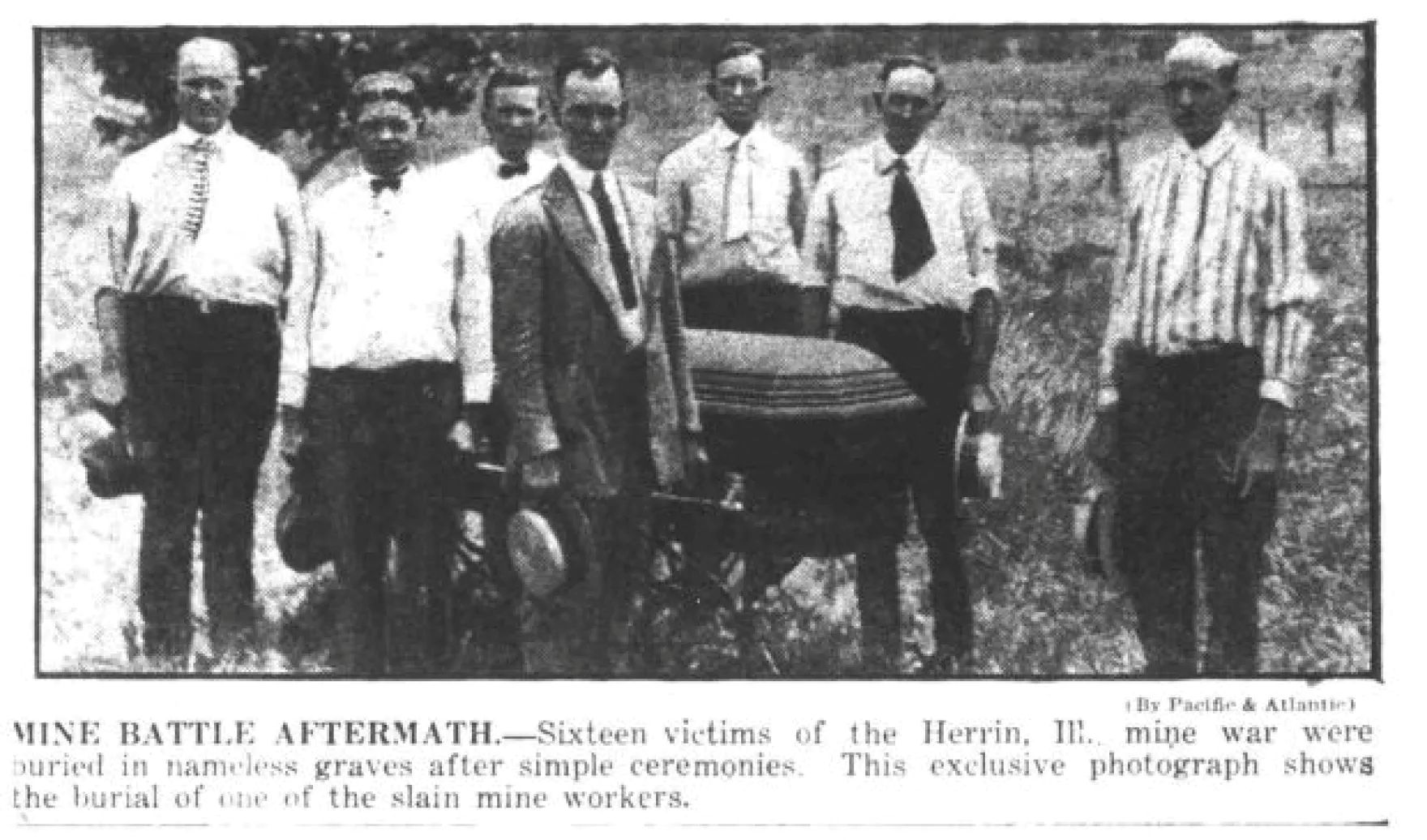
Original reporting on a crucial event in U.S. class war history. Usually articles posted here on strike violence has workers being murdered by gun thugs and the state. Well, Herrin, Illinois in 1922 and the tables were turned. During 1922’s national U.M.W.A. strike, in disregard to a previous agreement, 50 armed scabs were brought into the mines at Herrin commanded by notorious strike-breaker C.K. McDowell. Those gun thugs killed several strikers shortly after their arrival and were subsequently met with a terror equal to their crimes. Armed miners surrounded the scabs in a fierce gunfight, took their surrender, burned down the mine, and then meted out an enraged justice on the survivors. At least 20 scabs, including McDowell died on June 21, 1922 showing that our side could strike real fear as well as theirs.
‘Coal Operators Start Killing; Herrin Strikers Win Battle’ by George Williams from Industrial Worker, Vol. 4 Nos. 12 & 13. July 8 & 15, 1922.
Defense News Service Staff Correspondent.
I.
HERRIN, Ill. They have buried the dead–all the dead they could find–the two union miners with honor and a great surging march, and the 19 strikebreakers and gunmen in graves marked only with a number. In the beginning of the trouble Superintendent C.K. McDowell of the Southern Illinois Coal Company killed Geo. Henderson, a striker, and the killing was murder, a coroner’s jury found.
McDowell had boasted that he had broken other strikes, and that he would break this one. But in the end McDowell died, and the strikebreakers and gunmen died unless they could run faster than the miners’ bullets–and it would be hard to find anyone in Williamson county who is sorry about McDowell or the thugs. There is sadness, though, about some of the others who were killed; they were innocents, trapped, men who came here to do legitimate work and who then were used as a battle screen.
What was behind the outbreak of the coal-diggers? Some of the facts have been told by the press, but not all.
The thing happened because of a desperate and audacious attempt by the Southern Company to mine and ship coal in a community solidly behind the striking miners. Most of the population of the southern Illinois coal district are miners who live in the towns, and small farmers who at times work in some capacity in the coal industry. Southern Illinois is dotted with mines, small and large, strip mines and shaft mines.
Storekeepers and the professional classes, usually the strongest supporters of the higher strata of the existing form of society elsewhere are in the southern Illinois coal country bound by their political and material interests to the cause of the miners. They are small in number and depend entirely on the community in which they are located.
Most of the population is native born and of the Kentuckian type which is a strong fighting element. Italians come in numbers, with a liberal sprinkling of Negroes, some Hungarians, a few of Slavic origin and some Finns. Of the native born element and the negroes, it cannot be said that they are even tinged with any revolutionary principles. From a trade union measurement, however, they are strongly and unanimously for unionism as they understand it. The principles of more radical programs are strange to them.
They have the rural psychology strongly. To them there is no injustice in a wage system. Thus the battle at the strip mine was regarded by them not as a part of a class war, but as an act of retribution meted out to individuals who had offended the morals of the community. The abusive attitude of the mine guards together with the killing of two miners aroused more The bitter feelings than anything else. Italians and other foreign elements, on the other hand, are more revolutionary. To them the battle is regarded from a class war standpoint.
Considering these things, plus the fact that the strip mine with its few guards was distant from any point whence help might reach them quickly, one can realize the foolhardiness of the attempt to mine coal in Williamson County. And the community knowing as it does its strength pays small attention to any possible effort to bring anyone into a court to be tried for the killings.
To those outside, familiar only with seeing labor mangled and crushed in past labor wars, the action of the union miners here appears as an event that can only bring swift and more severe retaliation. But from all indications the affair is closed, and it only waits the elapse of time to mark it, perhaps, as an unpleasant incident.
The Southern Company is a corporation extensively engaged in what is called strip mining, an operation in which coal lying near the surface is uncovered by steam shovels which pile the dirt to one side in large mounds. After the vein of coal is bared it is then loaded on cars by another steam shovel. When the vein is cleaned up the excavation resulting from the removal of the earth and coal is then filled in again with dirt taken from off the other coal. This method is swift and promising of huge profits, especially at this time when all shaft mines are closed and the demand for fuel is great.
At the property where the battle occurred a steam shovel loaded a fifty-ton railroad car in six minutes. Another and larger shovel was uncovering the vein at the rate of 120 yards an hour. Vast quantities of coal had already been uncovered and great preparations have been made to load it on cars for shipment.
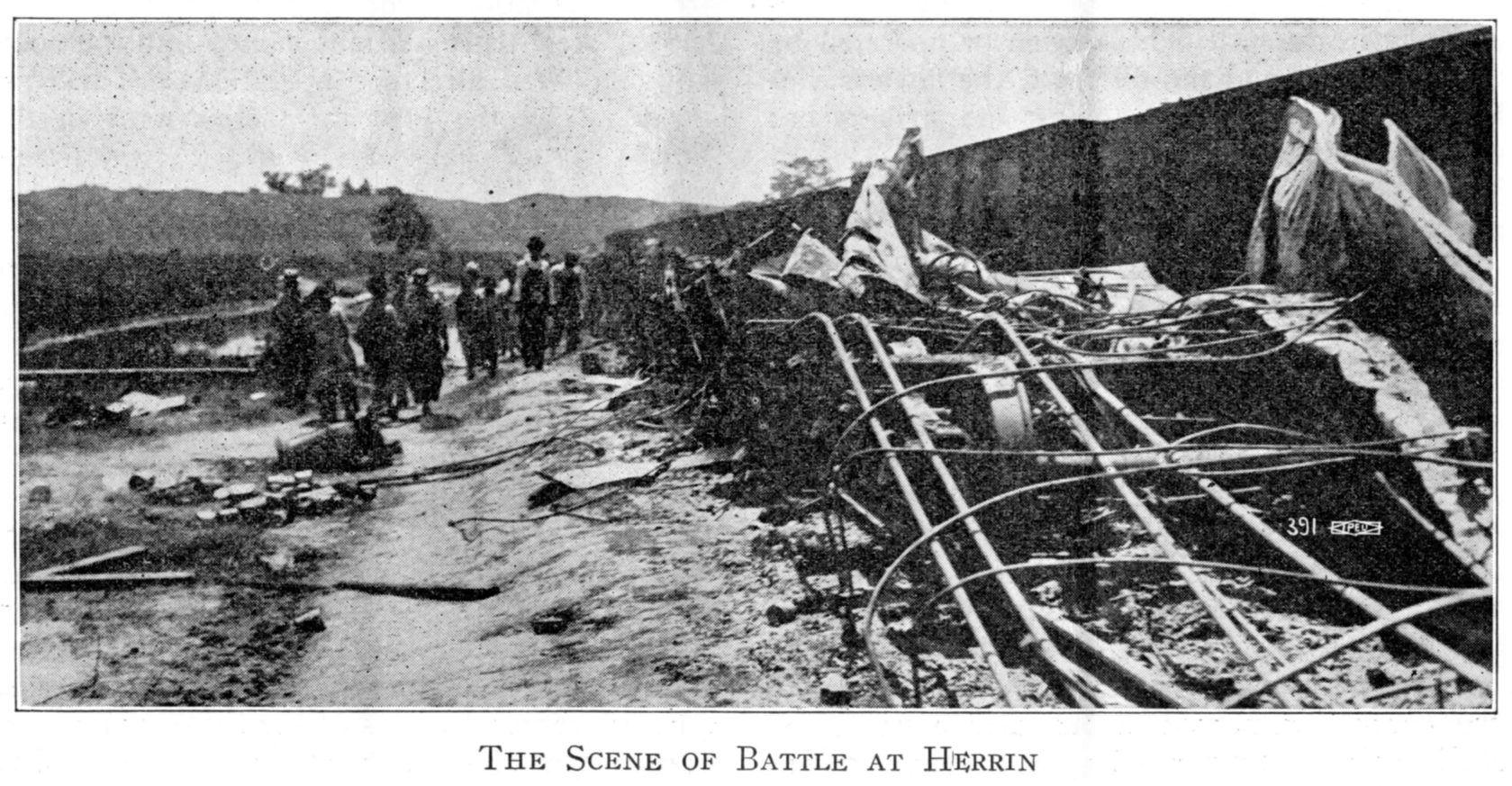
But what was once the largest and most expensive equipment ever assembled on a strip mine is now a ruin and beyond all repair; a carefully wrought destruction was effected after the works had fallen into the hands of the victorious miners. What were once eating and sleeping cars for the men and guards are now a mass of twisted iron. Loaded coal cars burning alongside of a ditch full of water, and apparently none of the hundreds that idle around the works care enough to put the fires out. Four dinky engines are forever out of commission; only charred embers mark the sites where the houses of various kinds stood before.
The whole aspect of what remains of the Southern Illinois Coal Company’s strip mine is best described by a miner who said, “The only thing left is the coal.”
II.
HERRIN. The trouble here came because the Southern Illinois Coal Company tried to ship coal in violation of an agreement, according to information from reliable sources. When the strike was inaugurated on April 1 the status of the strip mines was different from that of the shaft mines.
Strip mines were permitted by the unions to proceed with the removing of dirt from the coal vein. But outside of piling up some coal for local consumption none was to be loaded on cars for industrial purposes. The concession of removing the dirt from the veins was granted against the time when the strike would end and the company would then be at no disadvantage in mining coal for the market along with the shaft mines. With all companies operating strip mines an agreement was entered into on this basis.
The Southern company had agreed to these conditions and from the beginning of the strike until a few weeks before the battle, union miners were engaged by the company to uncover the coal. Suddenly the union miners were asked to work at mining the coal and loading it on railroad cars for shipment. This they refused to do. They were discharged and several days later strikebreakers arrived from Chicago and other points and the actual work of loading the coal began. With the discharge. of the union miners W.J. Lester, the president of the Southern company, announced that his company would no longer recognize the agreement with the union covering the operations of strip mines.
As soon as the strikebreakers were brought in the union miners did everything in their power to induce the company and the men to refrain from operating the mine under strikebreaking conditions. Delegations of business men from surrounding towns pointed out to Superintendent McDowell that attempt to operate in the face of a hostile community would be futile and dangerous. To such warnings McDowell is said to have replied: “We’re going ahead. I have broken other strikes and I can break this one.”
Putting the mine on a strikebreaking basis necessitated placing guards around the property. These guards, furnished by a Chicago strikebreaking agency and heavily armed, posted themselves on nearby roads and closed all traffic even to the farmers who lived in the vicinity, making necessary a wide detour over bad roads. Women were insulted and menaced, thus creating a situation extremely provocative which the entire community resented to a man.
Conditions inside the ring of gunmen were even worse, according to the tales of two men who escaped the fury of the mob. There the steam-shovel workers, many of whom came to the mine unaware of the real conditions, were virtually trapped. They were denied permission to leave after becoming familiar with the real conditions, and even had they the privilege of departing, they would have had to face the vengeful people who waited on the outside of the ring of guards, too impatient for impartial investigation. To them the danger, after they were once on the mine, was as great from one source as from the other.
It is said by many persons in the trouble zone that the wholesale killings would never have occurred but for the killing of two union miners on the preceding day. These men, in company with several hundred others, had gone to the strip mine Wednesday afternoon to plead with the strikebreakers to lay down their tools and leave the job. The men were proceeding up the main road on the west side of the mine and were still nearly a half mile away when the guards opened fire and the two miners fell mortally wounded.
This shooting aroused the marchers to fever heat. The news spread with the swiftness of the telegraph and before long on the same day people began to pour in from the various surrounding towns and mining camps by trucks, busses and any other conveyance available. Many came long distances on foot.
Stores in all the nearby towns were stripped of arms and ammunition and hurried to the scene of the trouble. The battle which had started with the killing of the two miners gathered force with the constant arrival of more and more miners and sympathizers. All Wednesday night the firing continued between the opposing forces. More than 1,500 people surrounded the mine and cut off all possible escape for those inside.
Thirty guards with two machine guns defended the mine as best they could. The steam-shovel men, according to one, took little part, taking refuge in the iron coal cars that stood on the track near their boarding cars. From the woods outside and across open fields the miners poured in a never-ceasing fire on the few guards who answered from behind the high mounds of dirt placed there by steam-shovel operations.
It is said that the superintendent, seeing the hopelessness of further resistance, telephoned Col. Sam Hunter, of the state militia, and was advised by him to display the white flag and endeavor to establish a truce. Whatever the reason, the white flag was hoisted by the gunmen inside and they surrendered shortly after daybreak on Thursday.
When the mine was captured next morning the entire countryside was, to quote an eyewitness, “fairly alive with people.” Numberless women and children came to the scene, so great was the indignation over the unprovoked killing of the miners, Nearby towns were practically emptied of people. And wrought up as they were, it is small wonder that their wrath fell on all alike–the dupes as well as the principals.
Surrender of the gunmen was a clamorous affair. Everyone swarmed to the point where they marched out with hands upraised. According to some, they were tied in pairs; others maintain that none were tied. The procession started for Herrin proper and it was generally agreed that after reaching town the prisoners would be placed on trains and deported from the community.
During the march, however, a severe harangue had been kept up between the gunmen element among the prisoners and the union miners. Against Superintendent McDowell and the chief of the gunmen the anger of thee mob was mainly directed and their defiant attitude more than anything else inflamed the miners into the mood which led to the slaying.
McDowell was the first to be shot, because, according to eyewitnesses, he refused to go further and resisted attempts to be forced along. At this time the rest of the prisoners made a break for the woods. A barbed-wire fence lay across their path and in their frantic endeavors to get through it they became entangled. A hail of bullets followed them. The mob closed in and killed indiscriminately. Some of the prisoners escaped; some were captured some miles from the scene of the battle and hanged. Others met death in a pond.
Listening to discussions carried on by many groups in the streets and hotels here, and by both business men and workers, I have yet to meet any who has assumed a boastful attitude toward the affair. It is entirely untrue, as reported in the Chicago and St. Louis papers, that the population regards the matter exultantly. General opinion is that innocent workers ignorant of the situation were trapped into paying the penalty while those who were higher up sat safe at distant points ready to reap the profits if by any chance the plan of breaking the strike worked.
True, the gunmen element were not of the innocent kind. To them the game was an old one and a game at which continual success had made them certain of still further success. They tackled the wrong community and they lost.
The Industrial Union Bulletin, and the Industrial Worker were newspapers published by the Industrial Workers of the World (IWW) from 1907 until 1913. First printed in Joliet, Illinois, IUB incorporated The Voice of Labor, the newspaper of the American Labor Union which had joined the IWW, and another IWW affiliate, International Metal Worker.The Trautmann-DeLeon faction issued its weekly from March 1907. Soon after, De Leon would be expelled and Trautmann would continue IUB until March 1909. It was edited by A. S. Edwards. 1909, production moved to Spokane, Washington and became The Industrial Worker, “the voice of revolutionary industrial unionism.” A victim of finances and internal disputes, the IW ceased publication in 1913, only to be revived in 1916 and surviving as a weekly, sometimes more, until 1931. Easily among the most important working class newspapers in U.S. history and an essential resource on the wobbly, and larger radical labor experience
PDF of full issue: https://washingtondigitalnewspapers.org/?a=d&d=IWW19220708
PDF of issue 2: https://washingtondigitalnewspapers.org/?a=d&d=IWW19220715

