The majority and minority (championed by Laura B. Payne) positions over participation in the suffrage movement on the National Woman’s Committee of the Socialist Party are brought to the 1908 National Convention for a vote. The texts of both are included in the report below.
‘The National Conference on the Woman Question’ from Socialist Woman. Vol. 2 No. 13. June, 1908.
The Committee on the Relation of Women to the Socialist Movement brought in the following report, at the last session of the National Convention:
“The national committee of the Socialist Party has already provided for a special organizer and lecturer to work for equal civil and political rights in connection with the Socialist propaganda among women, and their organization in the Socialist Party.
“This direct effort to secure the suffrage to women increases the party membership and opens up a field of work entirely new in the American Socialist party. That it has with it great possibilities and value for the party, our comrades in Germany, Finland and other countries have abundantly demonstrated.
“The work of organization among women is much broader and more far-reaching than the mere arrangement of tours for speakers. It should consist of investigation and education among women and children, particularly those in the rank in or out of labor unions and to the publication of books, pamphlets and leaflets especially adapted to this field of activity.
“To plan such activity requires experience that comes from direct contact with an absorbing interest in the distinct feature of woman’s economic and social conditions, and the problem arising therefrom.
“For this reason the committee hereby requests this convention to take definite action on this hitherto neglected question. We ask that it make provision to assist the Socialist women of the party in explaining and stimulating the growing interest in Socialism among women and to aid the women comrades in their efforts to bring the message of Socialism to the children of the proletariat, we recommend the following:

“1st, that a special committee of five be elected to care for and manage the work of organization among women.
“2d, that sufficient funds be supplied by the party to that committee to maintain a woman organizer constantly in the field as already voted.
“3d, that this committee co-operate directly with the national headquarters and be under the supervision of the national party.
“4th, that this committee be elected by this national convention, its members to consist not necessarily of delegates to this convention.
“5th, that all other moneys needed to carry on the work of the woman’s committee outside of the maintenance of the special organizers, be raised by the committee.
“6th. that during the campaign of 1908 the women appointed as organizers be employed in States now possessing the franchise.
“MILA TUPPER MAYNARD, “WINNIE E. BRANSTETTER, JOSEPHINE R. COLE, GRACE BREWER, MRS. M.T. PREVEY, SOL. FIELDMAN, ANTOINETTE KONIKOW, GERTRUDE BRESLAU HUNT,
“Standing Committee, as constituted by the Convention.”
Laura Payne, of Texas, presented a minority report, saying: “The committee was appointed to ascertain what relation the women bear to the Socialist movement. That was the idea I had of it, and I was surprised that they brought up any such questions as are contained in the majority report. On that committee I seem to be the only dissenting voice.
“I may be wrong, but I am going to read my minority report, with your consent, and you can do with it what you please, but I want to say to you now that I hope you will consider this thing clearly before you adopt the majority report, for it contains more disasters to our movement than you have imagined.”
The Payne minority report is as follows:
“The Socialist movement is the political expression of the working class regardless of sex, and its platform and program furnish ample opportunity for propaganda work both by and among men and women when we are ready to take advantage of it. The same blow necessary to strike the chains from the hands of the working man will also strike them from the hands of the working woman.

“Industrial development and the private ownership and control of the means of production and distribution of wealth have forced women and children into the mills and factories, mines, workshops and fields along with the men, dependent for job and wage on the master class. Into that mart of trade they go to sell their labor power, and when for no reason whatever they cannot find a market for It they must seek other means of support. Driven to the last resort, men often become criminals or vagabonds, while women, for food, clothing and shelter, sell themselves and go to recruit the ranks of the fallen.
“Whether it be economic slavery to this extent or whether it be within the bounds of the possibility of an honorable life–the cause is the same, namely, the private ownership of the means by which they must live.
“It is contended by some that women because of their disfranchisement their and because of economic dependence on men, bear a different relationship to the Socialist movement from that of the men. That is not so. The economic dependence of our men, women and children–whether to a greater or less extent–can be traced to the same cause, which Socialism will alone remove.
“In regard to the ballot in some of our States the men are disfranchised, or practically so, by property qualifications and other requirements for voting, and it seems to this committee that you would just as well waste time in trying to regulate those things as in waging a special suffrage campaign for women.
“There is only one thing, and one only, that will remove these evils and that is Socialism, and the nearest way to it is to concentrate all our efforts–men and women working together side by side in the different States and locals, with an eye single to the main issue. The Class Struggle!
“Therefore, my comrades of this convention, I respectfully submit the following resolution:
“Resolved, That there be a special effort on the part of the speakers and organizers in the Socialist party of America to interest the women and induce them to work in the locals of the respective States, side by side with the men as provided in our platform, and constitution; and be it further
“Resolved, That great care shall be taken not to discriminate between men and women or take any steps which would result in a waste of energy and perhaps in a separate woman’s movement.
“Respectfully submitted, Laura B. Payne, a minority committee.”
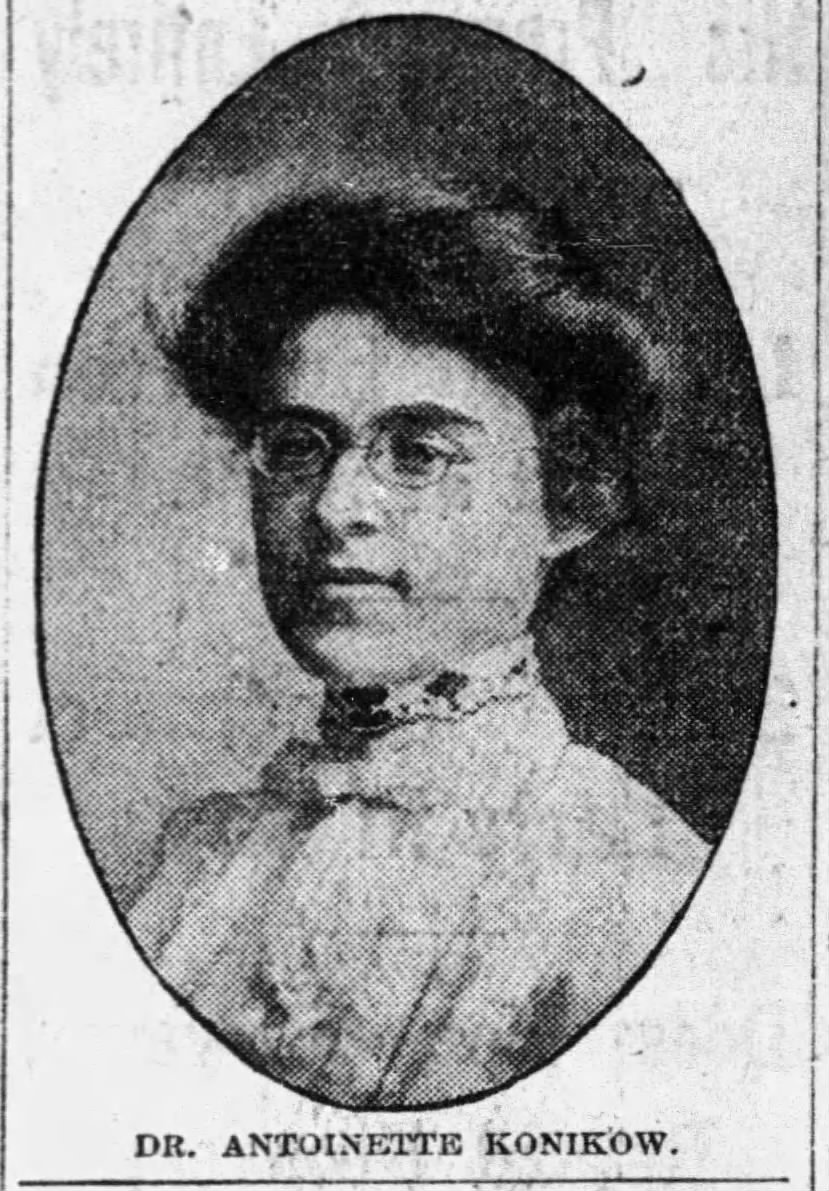
Konikow, of Massachusetts, said: “The report is divided into three parts. The first is a general statement that the economic condition of women will be solved only with the coming of Socialism. The second part commits the party to an entirely new policy, which really would demand a reconsideration of the declaration of principles already adopted in our platform. The minority report states that no special effort in the direction of woman suffrage should be taken at the present time; that woman suffrage cannot come until Socialism is a reality.
“Comrade Payne takes the stand that there is no use for Socialists to do anything in the direction of woman suffrage; that woman suffrage will only come with Socialism, and therefore that we should concentrate all our efforts only upon the realization of Socialism and pay no attention to the demands of hundreds and hundreds of women to do something now, if possible, to get the suffrage. I am afraid you may be caught by some of the general phrases in the minority report which are of no importance at all. If you accept the minority report, that means that you decide to do nothing at all for woman suffrage.
“The third part is that nothing should be done for woman; that woman Is in the same condition as man and that we should go along in the same old way. I think we should give them a chance to do something. We decided to have a committee of five under the direction of the National Committee on the subject of the farmers, and as you put farmers on that committee, so we should have a committee on the subject of women with women on that committee.”
May Wood Simons, of Illinois, said: “Eleven years ago when I was new in the Socialist movement and had little experience, I might have taken the position that is taken by the minority report. Today I realize that the Socialist movement if it is to amount to anything, must deal with the conditions as they are today. We cannot ignore the question of how to carry on the propaganda among women. If you will recall, our comrade across the ocean, Keir Hardie, when the proposition was put to him, made the statement that while Socialism came first for the working class, first for the men in the working class, that suffrage was an all important question for the women, and he threatened then to leave if the Socialist party did not indorse the suffrage of women.
The majority report simply asks that the question of suffrage be emphasized. It does not ask for any separate organization. Anyone who comes before this convention and says that the economic condition of men and women is identical has little experience in conditions as they actually are. I ask the convention to adopt the report of the majority.
“You cannot ignore this question any longer. I believe If you go out of this convention having ignored it, you will have put yourself on record as not having any appreciation for all the work that has been done across the water by our comrades in Europe. Our women comrades in Finland have already received the ballot, and they are more efficient workers in the Socialist party than they were before. The women and the men who have formulated the majority report have seen years of experience in the Socialist movement, and they know that we must have a definite plan of propaganda among women.”
Fieldman, of New York, the one man on the woman’s committee, said: “I want to emphasize the statement of Comrade Simons. We thoroughly agree with the preamble of the minority report, but we do not think it necessary for us to define the relation of men to women and of women to men; we believe that we understand that relation. We do not believe that the Socialist movement needs to waste Its energy in order to define that relation.
“We understand that the only difference between men and women in America is that the men have votes and the women have not. Therefore, it is necessary that we should make a special effort, particularly as a working class movement, as a Socialist movement, to secure for women now under the capitalist system the same rights that men now enjoy. Therefore, while we recognize the principles expressed in the minority report, we do not agree with the stand that the reporter of the minority report has taken.”
The minority report was then rejected by a vote of 35 for and 70 against.
Mila Tupper Maynard, in closing the discussion, said: “We have already committee and the adoption of its resettled, by the action of the platform port that the Socialists of America are committed to the enfranchisement of women in the same positive, unequivocal manner that the international movement is committed to the suffrage of all people. That much is settled. We do not intend to reopen the question. All that we have provided for is a means by which you can increase the propaganda of our principles among political principles and the general women. These principles are both the principles of Socialism. The position of this party at this convention is that we are outlining a definite program.

“It is a program that we all know ought to be fulfilled, and the reason we can hope to fulfill it as no other party can, is because our demand for all these things and our demand for the suffrage is backed up by a working class party that knows what it wants and has the power to enforce it. All these matters that you call in a way opportunism are virtually practical ways of reaching our end.
“The philosophy of our party means victory in the end. We are not asking that the old theoretical arguments for suffrage go on Interminably, but that the great half of the working class be put on an equality in political power with their brothers.”
The majority report was then adopted.
A resolution by Slobodin of New York was adopted, providing that the woman’s committee shall report annually to and its members may be removed or vacancies filled by the national committee.
The woman’s committee was then elected, consisting of May Wood Simons, Konikow, Prevey, Winnie Branstetter and Meta Stern of New York.
Progressive Woman replaced The Socialist Woman. The Socialist Woman was a monthly magazine edited by Josephine Conger-Kaneko from 1907 with this aim: “The Socialist Woman exists for the sole purpose of bringing women into touch with the Socialist idea. We intend to make this paper a forum for the discussion of problems that lie closest to women’s lives, from the Socialist standpoint”. In 1908, Conger-Kaneko and her husband Japanese socialist Kiichi Kaneko moved to Girard, Kansas home of Appeal to Reason, which would print Socialist Woman. In 1909 it was renamed The Progressive Woman, and The Coming Nation in 1913. Its contributors included Socialist Party activist Kate Richards O’Hare, Alice Stone Blackwell, Eugene V. Debs, Ella Wheeler Wilcox, and others. A treat of the journal was the For Kiddies in Socialist Homes column by Elizabeth Vincent.The Progressive Woman lasted until 1916.
PDF of full issue: https://www.marxists.org/history/usa/pubs/socialist-woman/080600-socialistwoman-v2w13.pdf

