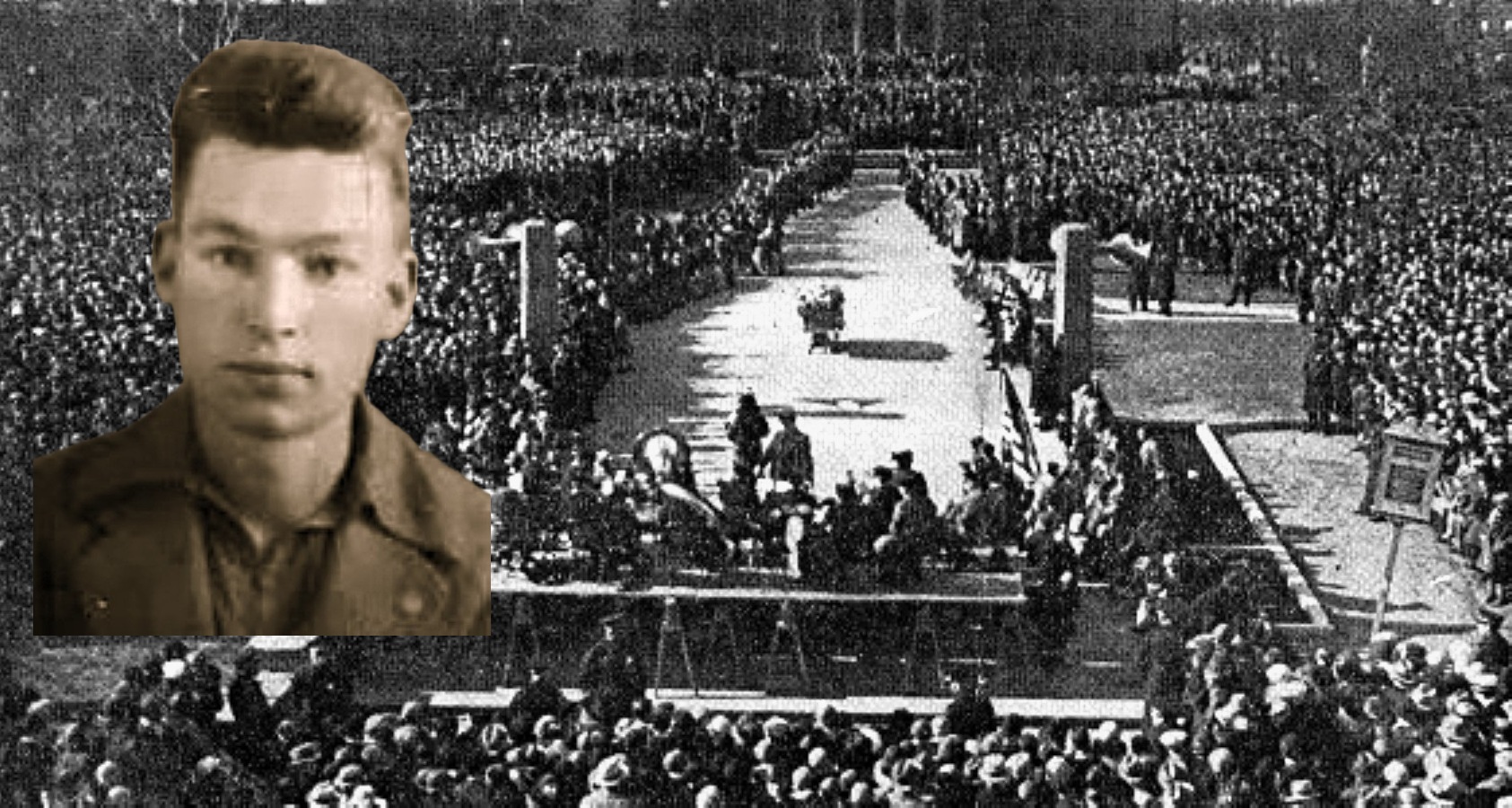
The weight of the struggle against the Aberle Hosiery Mill is encapsulated by the 35,000 workers of the city that followed the casket of Carl Mackley, a strike supporter shot by police on March 6, 1930. Centered on the Kensington section of the city, the author laments that past factionalism has prevented a proper Communist presence in the hardscrabble, proletarian neighborhood. A later housing project in the area would be named for Mackley.
‘The Aberle Mill Strike in Philly’ by M.K. Whitten from The Militant. Vol. 3 No. 12. March 22, 1930.
The greatest labor demonstration in this city since the Battle of Broad Street in 1910 between the police and thousands of striking street car men, took place on March 9th, when a crowd estimated by the capitalist papers at 35,000, met at the open air funeral of Carl Mackley, 23 year old textile worker of Kensington. In McPherson Square, in the heart of that great working class district, this vast crowd gathered to pay its last respects to the murdered strike picket. His death occurred on March 6th when he was shot by a strikebreaker employed in the Aberle Mill, where a strike involving more than a thousand workers has been stubbornly fought for over a month. Despite the vicious injunction issued by Judge McDevitt, which prohibited more than 4 pickets, despite the utmost brutality of the police who arrested persons living in the neighborhood, merely for being on their own steps when ordered to go indoors, and who have even stopped school children from passing the mill, the strike has been fought with all the vigor and courage that the workers of Kensington are noted for.
Since the demonstration before the bier of Carl Mackley, the striking workers have maintained their militant fighting spirit. Within a week another shooting has taken place. A strikebreaker, Peter Marpone, fired three times into a crowd about his home to protest his scabbing. Fourteen persons were wounded.
Militancy of Strikers Outstanding
Fighting took place also at the Rogers Hosiery Mill in Germantown where nearly a hundred strikers, half of them girls, were arrested. The Rogers strike is called in sympathy with the Aberle strike. The Aberle Mill textile strike is led by the A. F. of L. The militancy of the strikers has had the A. F. of L. officials worried. The bureaucrats are cooperating with the politicians in every way to get the strike “arbitrated”. The mayor has appointed an “impartial arbitrator” and is endeavoring to settle the matter. At the time of this writing, the Aberle Mill bosses had agreed to arbitration which will no doubt result in a sellout of these militant strikers.
The demonstration at the funeral of Mackley was handled very gingerly by the authorities. They realize the possibilities of what might happen if the thousands of unemployed desperate workers in that district become aroused. The A. F. of L. bureaucrats have all the while acted their usual role of lightning rods to divert the wrath and militancy of the workers. Yet the significance of this tremendous gathering, as well as the continued fighting spirit of the strikers, is a lesson that should be of great value to class conscious workers and to Communists.
Kensington is the very heart of industrial Philadelphia, but the Communist party here has never discovered this.
Lovestone and Foster yesmen, who as District Organizers, have so gallantly paraded through this city-Bentall, Tallentire, Weisbord, Jakira, Bail, Benjamin and now Gardos, never penetrated into this vast unknown hinterland. Yet, every nationally known Philadelphia product, except Baldwin Locomotives, Kirschbaum Clothes and Scott’s Sanitissue, is manufactured in Kensington. Miles of streets are lined with textile mills and the homes of textile workers. Here Stetson Hats are made which are carried around the world by ships built in Cramps Shipyard. The vast coal and grain piers of the Reading R.R. and the world-known Disston Saw works are both manned by Kensington workers. There is probably no larger nor more fully proletarian unit in America.
Kensington is very largely populated by the descendants of Scotch, Irish and English textile emigrants, for, before the Southward movement, it was the greatest textile center in the country. There is a scattering of other nationalities, but it is typically American in its entirety. It is the proper base for the working class movement in the Philadelphia industrial area.
Philadelphia’s Labor Record
It is generally believed outside of Philadelphia that it is a city of scabs. Whatever truth there may be in this, certainly does not apply to Kensington. It has always been strongly union, the textile industry was in its prime there were probably 75,000 organized workers in that industry most of whom lived and worked in Kensington. This had its natural reflex in helping other workers, such as barbers, bartenders, store clerks to unite. During the great car strike, Kensington was an armed camp. Police, state constabulary, National Guard, occupied the streets of the section, and riots were continuous. Ashwagon drivers dumped their loads upon the tracks while women from nearby houses brought oil and gasoline out to burn the stalled cars to the ground. The Cumberland Street carbarn was only comparable to a Belgian fortress on the German frontier. IF THE A. F. OF L. HAD HAD A CLASS VIEW INSTEAD OF A CRAFT OUTLOOK, Kensington could have been organized 100%. Hundreds of lesser struggles attest the fighting qualities of these workers. The outlaw railway strike closed the Reading shops in Kensington, while the last strike at Cramps is a labor classic.
The pitifully inadequate leadership and the wrong policies of the Communist party are here most clearly shown. After ten years of existence in Philadelphia they have absolutely no connection with its most militant workers. Hand picked D.O.s sent here to keep in order political fences have never troubled themselves with little things like this. The handful who did realize the importance of Kensington were given no aid or encouragement. In fact some who were too insistent in demanding that real work be done were driven from the Party.
Left Wing Isolated; Fakers Pleased
Where is the National Textile Union in a situation of such magnitude? If it has any existence, except on paper, in this great textile city, the writer is unaware of it. It has not appeared in the Aberle strike.
It has doubtless been a great relief to the A. F. of L. fatboys, McMahon and Co, that the Communists have so kindly withdrawn from the field. It’s tough enough to try to keep in hand a bunch like these Kensington workers, who, despite all the advice of their officials, have insisted on making this strike real, who, in defiance of injunctions have made mass demonstrations around the mill, 60 of them being arrested recently at one time. It’s worth a $10,000 yearly salary to work that hard, without having a lot of Communists in the union counteracting every effort toward peaceful class collaboration. One can almost hear them breathe, “Thank thee, oh God, for the blessed third period.”
Of course, if one reads the Daily Worker, another impression might be gotten. At first the Party press virtually ignored the strike. Now, to cover up the inactivity of the Party and the N.T.W., stupid and lying stories are carried. This gets nobody anywhere. For instance, the Dally Worker captioned, “Thousands led by N.T.W.U. fight Aberle scabs.” An untruth out of the whole cloth, concocted presumably by the Party to cover up the failure of the N.T.W. textile organizer, Murdock. On a few occasions, Party members, not textile workers, have made futile gestures by distributing denunciatory leaflets. The capitalist press has not even mentioned them, and the capitalist is not likely to overlook any bets to scare up a RED issue in the strike. Of the 92 strikers arrested, none are reported as being members of the Party or N.T.W.U. The funeral demonstration, sadly enough, was an A. F. of L. affair entirely. The Mayor, the police and the A. F. of L. fatboys realize the volcano underlying the situation and cooperate in every way to provide a safety valve that would harmlessly–for them–let off steam.
The rest of the Daily Worker reports are in line with the above quotation. As for an occasional leaflet distribution, this is not the equivalent or substitute for persistent, solid, systematic work among the workers.
Establish Roots among the Workers
What’s to be done? There is but one possible course. The Party must be reorientated. Its roots must be firmly planted in Kensington. The work that should have been done years ago, must be begun at this time. The policy of working also within the A. F. of L. must be revived.
If the Party in Philadelphia had adopted a correct attitude years ago, it would have established bases in Kensington and picked up the broken threads of the S.P. It would have built an influence, that, by the time of the Passaic textile strike would have enabled it to have reached masses of Philadelphia textile workers, and have secured their hearty cooperation, both organizationally and financially. The Party today would be in a position to have occupied a leading position in the recent great demonstration. When Weisbord finally came to Philly, he spent his time in factional politics, as did all the other apparatus men who followed him.
If such preparatory work had been properly carried out during the past years, so-called unemployment demonstrations staged here lately at the City Hall, could have been real. There are tens of thousands of unemployed in Kensington. Whole families are unemployed and starving. Thousands of them have lost the equities they had in homes sold out at sheriff’s sales.
Will the value of this lesson be lost? It is for the Communist and the Left wing to turn seriously to the task of obtaining a base among the most exploited sections of the Philadelphia working class, especially in the Kensington area.
The Militant was a weekly newspaper begun by supporters of the International Left Opposition recently expelled from the Communist Party in 1928 and published in New York City. Led by James P Cannon, Max Schacthman, Martin Abern, and others, the new organization called itself the Communist League of America (Opposition) and saw itself as an outside faction of both the Communist Party and the Comintern. After 1933, the group dropped ‘Opposition’ and advocated a new party and International. When the CLA fused with AJ Muste’s American Workers Party in late 1934, the paper became the New Militant as the organ of the newly formed Workers Party of the United States.
PDF of full issue: https://www.marxists.org/history/etol/newspape/themilitant/1930/22mar1930.pdf
 Revolution's Newsstand