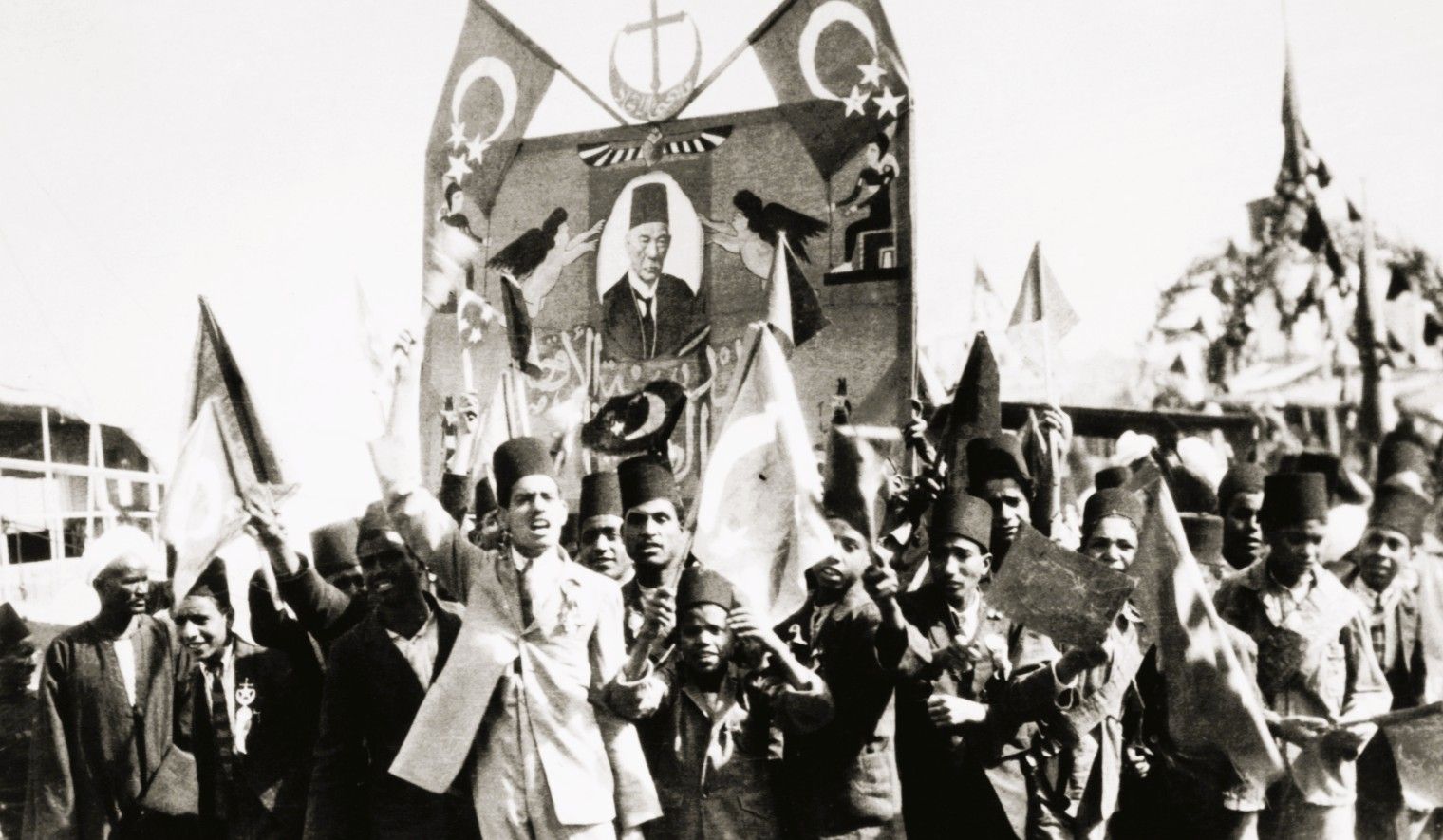
Joseph Berger on the passing of the central figure of early Egyptian nationalism, Saad Zaghloul Pacha.
‘The Death of Zaghlul Pasha and its Importance for Egypt’ by Joseph Berger from International Press Correspondence. Vol. 7 No. 53. September 15, 1927.
The Egyptian nationalist movement has sustained an irreplaceable loss by the death of Zaghlul Pasha. Saad Pasha Zaghlul (1860-1927). Chief dates of his life: 1882 participated in the revolution of Arabi Pasha, then entered the State service, became Minister of Education 1907, 1919 leader of the Egyptian delegation which demanded complete independence, 1921-1923 persecuted and exiled, 1924 Egyptian Prime Minister, 1925 leader of the coalition of all the Egyptian parties, 1926 President of the Egyptian Parliament), idolised by the Egyptian masses as the “Father of the Nation”, the founder and head of the largest Egyptian nationalist party, became especially in the last years the embodiment of the will to freedom of the country of the Nile oppressed by imperialism. All personalities of Egyptian political life had to submit to his authority, his leadership held together with firm hand a following consisting of all possible classes and strata of the Egyptian people and whose interests landowners, and land- holding peasants, employers and workers, were diametrically opposed. Zaghlul Pasha knew how to concentrate the attention of the suppressed masses of Egypt on their deadly enemy, British imperialism, and placed himself at the head of this fight against this imperialism. The demand of “complete independence of Egypt” as a programme, combined with a number of outstanding personal qualities with the help of which. Zaghlul knew how again and again to bewitch the masses, were the secret of his almost unbounded influence on the fate of Egypt.
Against the personality of Zaghlul all the means and tricks of British imperialism failed to achieve anything. The more he was persecuted and the more British propaganda attempted to slander and discredit him, the more his reputation grew in the eyes of the population and the more the entire national. movement rendered him unconditional allegiance.
It would be a mistake, however, to assume that Saad Pasha Zaghlul really represented entirely the interests of the broad mass of the people who placed such great confidence in him. He was rather the representative of that class the beginning of the development of which occurred in Egypt at the time of the commencement of his career, and which to the extent to which it increased in strength and importance came more and more into fierce opposition to British imperialism. This class was the Egyptian bourgeoisie. This fact was to be recognised not only in the typical bourgeois nationalist demands which Zaghlul had inscribed on his flag, but it found expression before all during the short time when Zaghlul himself was at the helm: he suppressed with draconic means every expression of the labour movement, dissolved the trade unions and introduced laws for the protection of property and the bourgeois State apparatus. At the same time there was revealed precisely at that period in the year 1924 and with great clearness the limits of the revolutionary sincerity of the Egyptian bourgeoisie. Zaghlul Pasha concluded a Pact with the British bourgeoisie (represented at that time by MacDonald), and if the imperialists had not been so obstinate there would undoubtedly have come about an alliance between the British and Egyptian bourgeoisie at the expense of the masses. of the Egyptian people.
When with the coming into power of the Baldwin government the policy of England become one of brutally suppressing the national movement even in its bourgeois form (the British imperialists wanted the entire monopoly of the exploitation of the Sudan), Zaghlul was again forced into opposition and was able to bring rapidly again under his power the masses. who had become disappointed during his period of government. Since that time he aimed on the one hand at obtaining certain concessions from the English by “constitutional” means, without giving up the programme demands, and on the other hand at maintaining his influence over the masses.
For this purpose Zaghlul Pasha created the coalition of the three great parties: the Liberal-Constitutional Party, which as openly in favour of “peaceable collaboration” with the British; the Nationalist Party, which recognises only revoltionary methods of struggle; and his own powerful Wafd Party, which has no clear programme except that which Zaghlul Pasha embodied in himself. He succeeded by means of enormous efforts, and after he had overthrown the Zivar government which was directly in the service of the British, in manoeuvring between the contradictions which were becoming more and more acute. He would not permit anything which could lead to an open conflict with England, as an open conflict could have brought Parliament, in which the Zaghlulists possess the great majority, and the Cabinet, which was actually ruled by Zaghlul, in danger. But Zaghlul Pasha regarded the “constitutional institutions” as a basis for a later fight for complete independence, or of a compromise with England.
He endeavoured to bridge over the antagonism between the various political parties. He did everything in order to set up as broad a platform as possible for the maintenance of the coalition and to cover the growing antagonistic interests within his own “Wafd” between the Left radical and the Right compromising wings. In order at the same time to blunt the class struggles which were becoming more and more acute (between the peasants and the landowners, and the workers and the capitalists), he attempted to carry out social economic reforms and to form nationalist peasants unions in the villages and labour unions in the towns.
In all these efforts he achieved only partial success. It came to a conflict with England (the question of army reform and the naval demonstration before Alexandria in May last), to growing antagonisms between the parties (temporary going over of the Watanists to the opposition, threats of a breach on the part of the Liberal-Constitutional Party), to strikes in industrial undertakings and the protest movements of the peasants. Everywhere the personality of Zaghlul Pasha had to intervene in order to smooth over and to settle differences,
Now, after the death of Zaghlul, the Egyptian national movement has no personality at its disposal which could take over this role. And the question of a successor to Zaghlul is giving rise to a fierce conflict. Although the memory of Zaghlul will undoubtedly continue for a long time to have. effect, the fact that the numerous contradictions in Zaghlul’s work, which were determined by his connection with the bourgeois class, cause the conception of a Zaghlulism to be unclear and confused, offers for various persons and groups the possibility of attaching Zaghlul’s label to their special interests.
These are the interests which will determine the further development of the nationalist movement in a much clearer form than was possible in Zaghlul’s time. Fight against imperialism, or compromise; united revolutionary mass party, or political cliques thrown together by personal connections; leading role to be played by the organised working masses, paying regard to the interests of the peasants, or hegemony of the bourgeoisie and domination of the landowners. These are the problems to which the national-revolutionary movement in Egypt must now give a clear answer.
International Press Correspondence, widely known as”Inprecorr” was published by the Executive Committee of the Communist International (ECCI) regularly in German and English, occasionally in many other languages, beginning in 1921 and lasting in English until 1938. Inprecorr’s role was to supply translated articles to the English-speaking press of the International from the Comintern’s different sections, as well as news and statements from the ECCI. Many ‘Daily Worker’ and ‘Communist’ articles originated in Inprecorr, and it also published articles by American comrades for use in other countries. It was published at least weekly, and often thrice weekly.
PDF of full issue: https://www.marxists.org/history/international/comintern/inprecor/1927/v07n53-sep-15-1927-inprecor-op.pdf

