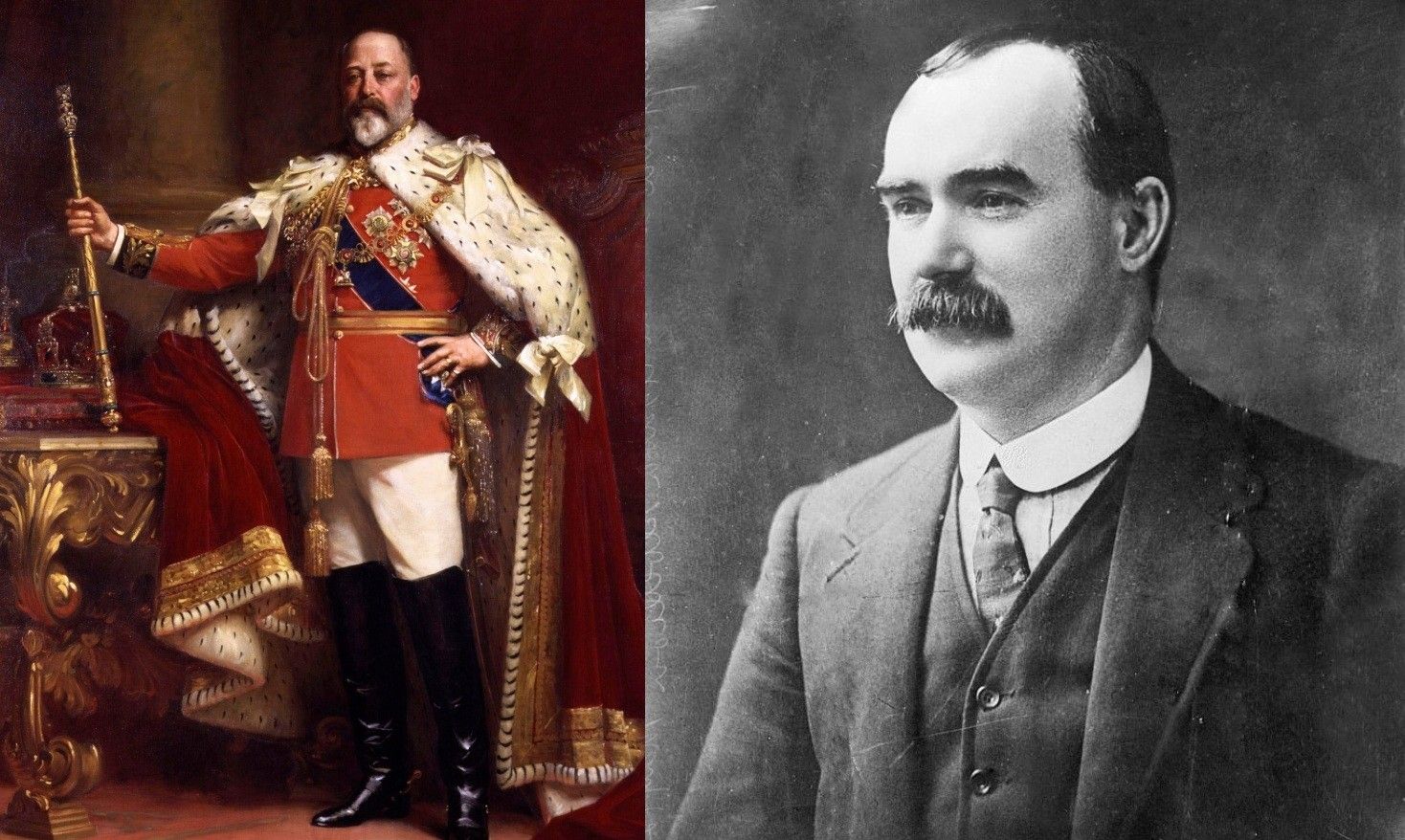
The blessings of the Edwardian Age are delayed a month due to a bout of appendicitis. James Connolly in brilliant form with this manifesto of the Irish Socialist Republican Party denouncing the rule of all monarchs distributed throughout Dublin on Coronation Day, 1902. A month later Connolly would sail for New York and his U.S. tour.
‘The Coronation Fiasco’ by James Connolly from The Weekly People. Vol. 12 No. 18. August 2, 1902.
IRISH MANIFESTO.
On the Coronation Fiasco–Distributed Throughout Dublin.
The last issue of “The Workers’ Republic,” of Ireland, contains the following manifesto on the coronation fiasco.
THE CORONATION FIASCO.
The following manifesto was distributed in thousands throughout Dublin during the week preceding June 26:
Our Manifesto.
Unless unforeseen accidents intervene to prevent the consummation, His Majesty Edward VII, King and Emperor, will be crowned on Thursday, June 26. Were we able to follow our own inclinations in the matter we would be inclined to treat it with contempt as being of but little importance to the Cause for which we stand, or to the workers with whose interests we are concerned. To us as Socialists it is but of little moment who may for the time being wear the trappings of royalty: that we are compelled to acquiesce in his rule by the bayonets of his hireling soldiery and police, is for us sufficient; and to us as workers the personality of the head of the capitalist system in these islands, is of small concern when we realize that our exploitation by the master class would proceed apace, even if King Edward VII was a christian gentleman instead of a—-But although we would rather treat the matter thus philosophically we find that the machinations of those in power do not leave us that possibility; with them and because of them, the festivities attending the Coronation have taken on the aspect, not merely of a huge parade of pomp and magnificence–cloaking the festering sores of that slave society on which it is built–but have also become an elaborately contrived and astutely worked piece of royalist and capitalist propaganda designed to captivate the imagination of the unthinking multitude, and thus lead them to look askance upon every movement which would set up as an ideal to work for something less gorgeously spectacular even if more solidly real. The evil effects of private ownership of industries is thus illustrated once more in a manner that ought to appeal to those patriots in our midst who still dread the innovation effects of Socialism upon the national spirit of the Irish people. Because of this private ownership and control of our newspapers, of our shops, of our manufacturers, we find our Home Rule press devoting columns to descriptions of all the preparations for the Coronation, nauseating the thinking portion of its readers, but insidiously sapping the manhood of the weak and vulgar and preparing their minds for the worship of the foul gods of imperialism; we find our shops stocked with every kind of article, from the toy of the babe in arms, to the dress patterns of our womanhood, and all dedicated by name to the Coronation, and we find our manufacturers able by their economic power over the bread and butter of their employees to enforce observance of this saturnalia of tyranny even upon those workers whose whole beings are hot with revolt against it.
Here we are compelled to speak lest by those who have trusted us by their adherence, or by those who have honored us by their hatred for our unflinching championship of the workers’ cause, our silence should be construed either into approval, or even into weakness in front of this demonstration if the power of the enemy, or the imbecility of its slaves.
We are Socialist Republicans; we work for the realization of that coming time when Kings and Emperors will be no more, when they will only be remembered by mankind as the strong man remembers the hideous nightmare which oppressed him as he slept. As Socialist Republicans we desire the application of society to the freest republican principles, we unceasingly devote our energies to awakening in the minds of the workers a consciousness of the sufficiency of their own manhood, and of the dignity of their class, and we hope and believe in the rapid approach of that time when those ideas and that consciousness will have so far leavened the minds of the workers as to justify us in calling upon them to rally up for that final struggle, the issue of which will assuredly usher in the era of free and enfranchised labor instead of the barbaric splendor of military and financial castles. Meanwhile, animated by such hopes, inspired by such principles, looking forward impatiently to that time of glorious struggle, in those days when the eyes of the world are turned upon that city of London, when Capital and its cringing slaves are united in adoration of the monarch, who has been successful in uniting in his per son all the baser attributes of the mediaeval monarch and modern stock-jobbing capitalist, we also hasten in immigration thither in order to offer to King Edward in the name of ourselves and our class, the only homage we owe him, viz., OUR HATRED.
We are neither awed by the magnificence of the robbers, daunted by the bayonets of the hired assassins, nor dismayed by the plaudits of the multitude. The magnificence of the robbers but serves to fire our hearts with the greater hatred when we think of the squalid surroundings and miserable homes of our class: the glitter of the sunlight upon the bayonets of the hired assassins reveal to the vision of the humanist the moral hideousness of a society proposed by such means, and the, plaudits of the multitude are but useful to he who desires a plummet to sound the depths to which a system can degrade a people.
Let those who are pleased and those who are dismayed by the presence of gaping crowds of witless ones remember the pregnant words of Cromwell in the same city on a similar occasion.
“My Lord Protector,” said one of his attendants as Cromwell rode through London, how the people crowd to see you!” “Yes” replied Cromwell, “but how many thousands more would crowd to see me hanged?”
New York Labor News Company was the publishing house of the Socialist Labor Party and their paper The People. The People was the official paper of the Socialist Labor Party of America (SLP), established in New York City in 1891 as a weekly. The New York SLP, and The People, were dominated Daniel De Leon and his supporters, the dominant ideological leader of the SLP from the 1890s until the time of his death. The People became a daily in 1900. It’s first editor was the French socialist Lucien Sanial who was quickly replaced by De Leon who held the position until his death in 1914. Morris Hillquit and Henry Slobodin, future leaders of the Socialist Party of America were writers before their split from the SLP in 1899. For a while there were two SLPs and two Peoples, requiring a legal case to determine ownership. Eventual the anti-De Leonist produced what would become the New York Call and became the Social Democratic, later Socialist, Party. The De Leonist The People continued publishing until 2008.
PDF of full issue: https://www.marxists.org/history/usa/pubs/the-people-slp/020802-weeklypeople-v12n18.pdf

