Working for the Comintern and later an academic, Vladimir Balabushevitch was the leading Soviet Indian scholar of his generation. Here, he provides a valuable introduction to the economy and growing workers’ movement in colonial British India of the 1920s.
‘The Labor Movement of India’ by Balabushevitch from The Daily Worker. Vol. 4 Nos. 130 & 1931. June 15 & 16, 1927.
I.
Before speaking of the most important events in the Indian labor movement during 1926, it is necessary if only briefly, to characterize the position of the chief branches of industry in India.
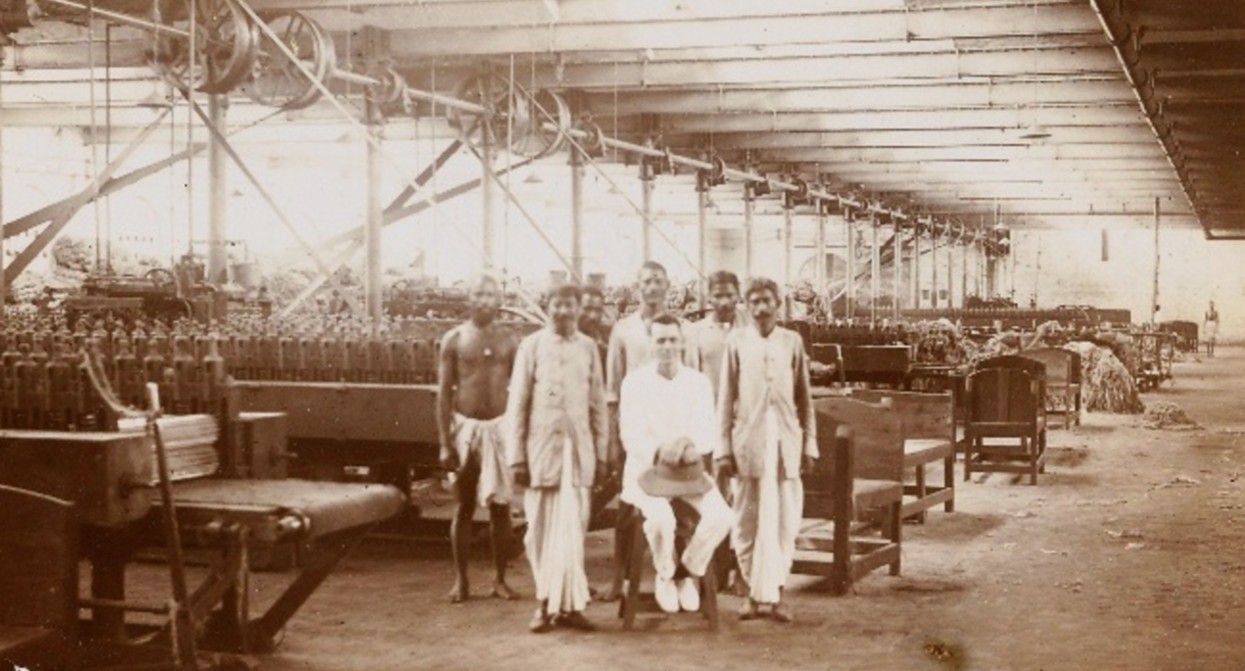
The condition of depression in the Indian cotton industry, which first made itself felt as far back as 1923, has during the period under survey finally and definitely become very marked. Many cotton factories in Bombay were forced either to completely shut down operations, or to introduce a short week not working at full capacity. The manufacturers, not satisfied with the annulment of the 3% per cent excise duty on Indian manufactured goods demanded the protection of the Indian cotton industry by introducing high import duties. This measure was to be directed, mainly, against Japan, whose products have been successfully competing with Indian and British goods in the Indian markets.
The question of imposing duties is now being considered by a special tariff committee set up to ascertain the reasons for the depression. It is to be expected that the British-India government will not hasten to set up high import duties on Japanese cotton products. This measure would lead to a bitter tariff war between Japan and India and in a considerable) degree would aggravate Anglo-Japanese relations. Besides this, an influential group of the Bengal bourgeoisie would definitely be against a tariff war with Japan since they, having a large metal trade turn-over with Japan, and desire to preserve normal trading relations.
The Jute Industry.
Up to the present time the jute industry has been one of the most favorable and profitable in India. At the present, however, this has changed somewhat. A sharp discrepancy was discovered between the comparatively small reserves of raw jute and the demands of the developing jute industry. To this was added also the threat of losing some external markets which up to the present time had been monopolized by the Indian jute industry, and which are now trying to free themselves from this high-costing dependency. In view of the foregoing circumstances the working week in the Bengal jute industry was shortened to 4-5 days, while a considerable number of Bengal textile workers were dismissed.
Bad Coal Trade.
The position of the Indian coal industry up to the present time cannot be considered as being very bright. For many reasons Indian coal could not find external markets. In the internal market (chiefly in Bombay and Karatechi) unsuccessful competition was observed with South African coal, which is of better quality and cheaper. As a result large reserves of unsold coal gathered in India, which held up the further development of the coal industry. Recently, however, in connection with the British miners’ strike, the position in the Indian coal industry improved considerably, as many ports on the Red Sea, which previously were coaled by Britain, placed large orders for Indian coal. These demands proved to be so large that they could not be fully satisfied owing to absence of transportation.
The demand of the Mine Owners’ Federation on imposing high duties for South African coals has been rejected by the Indian government.
The Steel Industry.
The validity of the “Act on Protection of Indian Steel Industry” expires in March, 1927. At the present time the Indian tariff committee is investigating the position of the steel industry in view of the demands of the steel magnates, that the present government policy should be continued by further setting up high import duties on certain steels and iron ware as well as by putting a premium on articles manufactured in India. There is not a shadow of doubt that the Indian government will appease the demands of the owners of the steel industry, which in a great degree works for war supplies, while for the time being this would not be a special danger to British exports to India.
The Labor Movement of India.
Very interesting to note, by the way, that as a result of rationalization of production, now being carried out at the large steel and iron works in Djepchedpure a large decrease in the numbers engaged in expected.
Lowered Standard of Life for the Working Class and the Strike Movement.
The difficulties experienced by the chief branches of Indian industry first of all affected the working class, at whose expense the Indian bourgeoisie endeavored to preserve the former level of their profits. The attack on wages was especially insistent and stubborn in the cotton and jute industries. In many cases despite the total absence of any lowering in the cost of living wages one way or another were considerably decreased (chiefly in the jute industry of Bengal). The cost of living index for December, 1925, equaled 155; in January, 1926, 155; in July, 1926, 157; in November, 1926, 154.
The attempts of the employers to lower the standard of life of the working class naturally brought about a series of stubborn strikes. We have information on the strike movement only for the first nine months of 1926. According to this information during January September, 1926, there were 103 strikes in India, 140,879 workers participating with a loss of 842,557 working days. As could be expected the majority of the strikes took place in the textile industry (cotton and jute). During nine months of 1926 there were 68 strikes with 108,507 workers participating, (which formed approximately 70 per cent of total number that struck in 1926). The greatest number of strikes took place in the biggest textile industrial centers–Bombay and Calcutta. Generally it is necessary to note, that an analysis of the strike movement during the last five years shows the exceptional role of the Indian textile workers, who, throughout, have been among the foremost to fight for improved living conditions for the Indian proletariat.
The majority of the strikes during the period under survey were due to the attack on wages (45 strikes out of 103) and also to dismissals and general decreases of workers engaged, etc. (28 strikes).
As regards results achieved by the strikes, we give the following figures: Of 103 strikes 7 were won outright, by the workers, 8 compromises and 83 strikes were lost. (In 1922 21 per cent of strikes ended successfully or in compromise for the workers, in 1923 26 per cent, in 1924 20 per cent, in 1925 31 per cent, and for the first nine months of 1926 15 per cent).
On Defensive.
We see therefore that the struggle of the Indian proletariat during the current year was chiefly one of defense and that in the majority of cases the workers lost the strikes. (Lower percentage of successful strikes in comparison with previous years.)
This was due chiefly to the difficulties now being experienced by the basic industries of India. Likewise we must keep in view the general conditions of the present state of the Indian labor movement–its growth, insufficient experience for the struggle, absence of a class lead, the strength of a well-organized Anglo-Indian bourgeoisie, etc.
Unemployment.
The past year brought no improvements in the position of the unemployed. As before there are colossal numbers of agricultural workers who have employment only during a few months in the year, as previously the question of unemployment is very severe among the middle strata of the population (Indian intelligentsia). And finally, in 1926 large numbers of the industrial proletariat were thrown on the streets as a result of the depression in the cotton industry and the difficulties experienced in the jute industry. Committees to study the causes of unemployment have been set up in a few provinces (Bombay and Madras). These committees give no concrete help to the unemployed.
The Labor Movement.
During the period under survey existing unions have increased numerically and a large number of new unions have been formed. The Indian trade union movement by the end of 1926 was as follows: Altogether there were approximately 200 trade unions with 360 locals in India, with a general total of more than 300,000 members or 10 per cent of the general number of industrial workers (considering enterprises where more than 10 workers are engaged). The postal and telegraph workers are organized better than any (50 per cent organized). The railwaymen are organized 14.5 per cent and the workers in the cotton industries 10.5 per cent. The largest union organized numerically is the railwaymen’s union (100,000 members), then come the sailors’ and dockers’ union (72,567 members), textile workers (45,000 members), and postal and telegraph workers (38,000) members).
The metal workers are only 3 per cent organized (about 10,000 members), miners 2 per cent (700 members), jute workers 1.3 per cent (4,000) members). In many branches of industry, food products, glass, building, clothing and wood working trades, there are no unions organized whatever.
There was a considerable increase in the percentage of organized textile workers during 1926 chiefly in the Bombay district, which suffered greatest from the depression. And so, for instance, a textile union arose in Bombay which in the short period of a few months recruited more than 10,000 members. Such a tempo for India is exceptional. During the past year much work has been done to organize workers engaged in the arsenals and ammunition and repairing shops, and also to unite existing dockers’ unions. Much activity was observed among the sailors (demand to abolish system of engaging men thru agents) and the railwaymen, who asked that a committee be formed to investigate the position of workers on the railroads.
II.
Activities of All-India Trade Union Congress.
With the general increase of organized workers in India, the last year shows us a certain numerical strengthening of the trade union center, the All-India Trade Union Congress and its five provincial departments. At the 6th Trade Union Congress held in January, 1926, 52 unions with a general membership of 125,000 were represented. (At the 5th Congress, February, 1925, 37 unions with 90,000 members were represented.) At the present moment the numerical strength represented by the congress is considerably greater than the foregoing figure of 125,000 workers.
At the 6th Congress held, as stated earlier, in January, 1926, many resolutions were taken, the most important of which are as follows:
I. To find out whether the unions desire the formation of an Indian Labor Party.
II. To demand the introduction of an 8-hour day in India.
III. To demand that women be prohibited from working, underground.
IV. To insist that workers’ organizations have the right of electing their representatives in the legislative organs of the country.
At the present time there is a system by which workers’ representatives are appointed in the Indian Legislative Assembly and in the provincial Legislative Councils.
A few salient features distinguish the Congress. For instance President Gini in his speech gave a fairly exhaustive account of the trade union movement of India as developed in the different branches of industry, which can be considered a novelty in the history of these congresses. It was at the 6th Congress and for the first time that the question of the necessity and importance of organizing the agricultural workers of India was raised. The number of agricultural workers reaches 21,676,107.
In the current work of the congress we notice that during the past year a stubborn fight was put up by the congress to have workers’ unions recognized by government institutions and private enterprises. Much work was also done to put into effect and to introduce in the government legislative organs the scheme worked out by the congress on a labor government. It is necessary to point out here that actually the congress plays an unsignificant role in the trade union life of India, although lately it is moving slowly ahead to widen its sphere of influence.
Labor Legislation.
After having been dragged out for two years, after prolonged discussions the Legislative Assembly and the India State Council finally confirmed the “law on registration of trade! unions” on the 2nd of February, 1926. The new law legalizing the registration of trade unions (the law admits the principle of “revolutionary” registration) giving certain advantages (for example, the right of forming special funds for political objects), actually has set up a careful government control on registration of workers’ organizations and in a most dishonest fashion limits their freedom. (Details on this were published in our publication “International Labor Movement” No. 18-19, 1926.) But even against such a narrow and limited law–it came into force only in 2 April, 1927–the employers’ organizations fought long and stubbornly.
Besides the law on trade unions another lava is now being prepared stipulating when wages have to be paid and on fines. The law on arbitration, despite the demands of workers’ organizations, has not moved ahead up to the present time.
Employers and T.U. Movement.
After the law on trade unions had been finally adopted the employers endeavored to immediately fit in with the new situation and to get as much benefit from it as they possibly could. The new law had not yet been adopted, when in Madras n “Union of Factory Workers of Buckingham and Karatchie,” made its appearance, formed by the employers and totally under their control and influence. From the very first day of its existence this union commenced a stubborn struggle with the existing Madras Workers’ Union, and in spite of the campaign carried on against this employers’ union, the All-India Congress and Bengal Trade Union Federation continues to exist.
Similar cases were reported from the Great Indian Railroad where the management stubbornly and continually endeavored to organize “councils of employes” to be under its influence, to take the place of the existing trade unions.
Labor Movement in the Local Governments.
A wide strike movement among the most backward and oppressed strata of the Indian proletariat characterized 1920, which movement was chiefly taken up by the workers of the local governments. For an example of this, we draw the attention of the reader to the textile strikes in the provincial governments of Indor and Maysor (see No. 48, “International Labor Movement,” 1926). Both these strikes were well organized and carried out in a comradely fashion. This evidently bespeaks the break now taking place in the temper of the backward and oppressed working masses, and demonstrates the growth of their class-consciousness. In both strikes, despite the fact that experience and a proper lead were lacking, the workers nevertheless achieved tangible results: In Indor the 14-hour working-day was abolished, in Maysor, wages were partially increased. As a result of these strikes strong unions have been organized in Maysor and Indor, which immediately drew in comparatively large numbers of workers.
Repression Grows.
The growing activity of the working class and the stubbornness with which they defend themselves against the onslaught of capital, was counteracted by the government with ruthless and oppressive measures. The following facts will illustrate this:
(1) Large numbers of striking metal workers in Bombay were arrested in August, 1926. (See “International Labor Movement” No. 43, 1926.)
(2) A peaceful gathering of striking workers were shot down in Bengalor (4 killed and 14 wounded).
(3) The raid on the building of the Railwaymen’s Union in Negapatam, where documents were rifled and members of the union management arrested.
Attitude To British Miners’ Strike.
News of the British miners’ strike was welcomed by the workers of India. Throughout the country meetings were held at which resolutions of sympathy and collections were made. Especially active were workers’ organizations in Bombay. To help the British striking miners a committee of action was formed by the Bengal miners, which, by the way, suggested a solidarity strike, but were unable to carry it out.
The Amsterdam International, British Reformists and the Indian Labor Movement.
Especially during the last year, have the activities of the British reformists in India, which have a comparatively long history, been energetically carried out, The British Labor Party took all measures to control the developing British trade union movement and to guide it through reformist channels, During 1926 the following leaders of the British labor party and Trade Union Congress visited India: Graham Paul, Johnstone, Byme and Rosenford. At the present time a delegation of the International Federation of Textile Workers, headed by its secretary, Tom Shaw, is visiting India. Also member of British Labor Party and member of parliament, Lawrence is on a visit too. The chief purpose of all these visits to India is to study the political and industrial position of the country, labor conditions of the Indian workers, trade union development in India and, mainly, to set up connections with the Indian labor movement and guide it into reformist channels.
The British reformists are using two methods to get control of the Indian trade union movement: By drawing the Indian trade unions into the Amsterdam International and by forming an Indian labor party after the model of the British “Labor Party”. It is necessary to notice that at the present time some results have been achieved by them. By the end) of 1926 the All-India Railwaymen’s Federation, Bengal Sailors’ Union and Union of Indian Sailors in Calcutta joined the Amsterdam International. Besides this a National Labor Party of India has been formed in Calcutta, which actually is not a party of the working class, but a bourgeois-philanthropic society.
The successes of reformism in India are due in great measure to the Indian “labor” leaders. The latter energetically preach the idea of close co-operation between labor and capital and take all measures to curb revolutionary activity which is rousing the Indian proletariat to take part actively in political life. Of course it reed not be said that the Indian working masses took no part in carrying the decision on entering the Amsterdam International or to create the so-called “Labor” Party. Under the directions of the British Labor Party all this “work” was carried out by the leaders of the Indian trade union moment, among whom are quite a number of direct agents of the Anglo-Indian bourgeoisie and government.
In general, the struggle between labor and capital is strengthening: and the class-consciousness of the Indian proletariat is growing. The most backward ranks of the working masses are preparing to enter the struggle and the number of workers organized is increasing, while the gap between petty-bourgeois representatives and the workers is growing wider and cutting them off from the masses. The Indian proletariat is now gathering strength, is now gathering experience for future great struggles, And today the Indian proletariat is a serious factor in the political life of the country.
The Daily Worker began in 1924 and was published in New York City by the Communist Party US and its predecessor organizations. Among the most long-lasting and important left publications in US history, it had a circulation of 35,000 at its peak. The Daily Worker came from The Ohio Socialist, published by the Left Wing-dominated Socialist Party of Ohio in Cleveland from 1917 to November 1919, when it became became The Toiler, paper of the Communist Labor Party. In December 1921 the above-ground Workers Party of America merged the Toiler with the paper Workers Council to found The Worker, which became The Daily Worker beginning January 13, 1924. National and City (New York and environs) editions exist.
PDF of full issue: https://www.marxists.org/history/usa/pubs/dailyworker/1927/1927-ny/v04-n130-NY-jun-15-1927-DW-LOC.pdf
PDF of full issue: https://www.marxists.org/history/usa/pubs/dailyworker/1927/1927-ny/v04-n131-NY-jun-16-1927-DW-LOC.pdf

