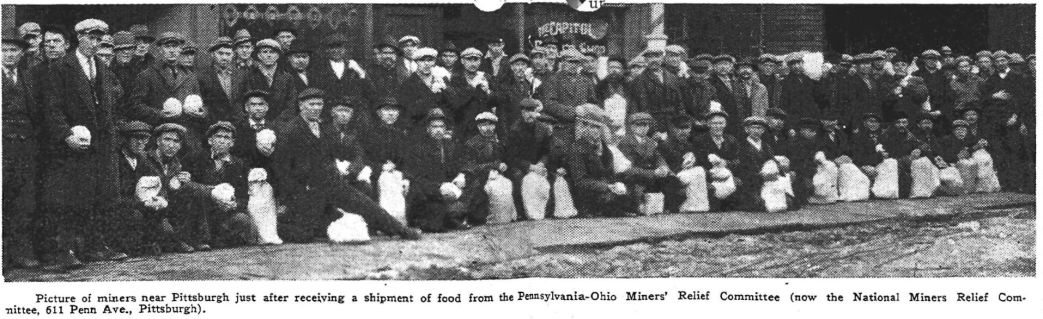
Aid can win a strike, or it can be used to discipline strikers. O’Flaherty interviews Wagenknecht, the U.S. head of the Workers International Relief, on its uses during the epic 1927-1928 mine strike.
‘The Use and Abuse of Relief as a Strike Weapon’ by Thomas J. O’Flaherty and Alfred Wagenknecht from Labor Unity. Vol. 2 No. 5. June, 1928.
AS the great bituminous strike, centering in Pennsylvania, Ohio and Illinois and including thousands in Northern West Virginia, Indiana and Kentucky, stretches out into its second year, relief for the battling coal diggers and their starving dependents becomes more than ever a first charge on the financial resources of the American working-class.
Relief, not merely to feed the hungry. Relief not as a gesture to cover the greedy rottenness of the capitalist system which starves hundreds of thousands in the midst of plenty. But relief with the definite object of winning the strike, so that those now occupying the industrial trenches in the bituminous areas will be able to hold the standards of living they won thru former struggles, and be in a position to throw their mighty collective resources on the side of the next battalions of the army of labor, in other industries that are called upon to do battle with the employing classes.
This is the gist of the opening remarks of Alfred Wagenknecht, relief director of the National Miners Relief Committee, in an interview granted to a Pittsburgh reporter to the Labor press.
Wagenknecht, who directed the great relief drive during the textile strike in Passaic in 1925-26, was called in to Pittsburgh by the executive committee of the rank and file miners’ relief organization which since then has assumed nationwide proportions under the name of the National Miners Relief Committee with offices at 611 Penn Avenue, Pittsburgh, Pennsylvania.
“Relief can lose a strike as well as win it” Wagenknecht explained. “Relief given on the basis of “strikers be gentlemen” policy results in the negation of an forms of strike mass action. The result is, no element of struggle in the strike, the strikers whiling away their time attending to personal matters and relief accepted as charity.
“For years the American Federation of Labor has based its strike policy upon round table discussions with employers or appeals to government agencies to bring about settlements. Mass actions in strikes of recent years have always been spontaneous rank and file outbursts. Not for decades has the A. F. of L. mobilized all trades in support of any trade on strike in an effective way with the object of bringing the necessary pressure to bear on the employers and on the government.”
Wagenknecht instanced as an example of his contention the backwardness shown by the officials of the United Mine Workers and of the entire organized labor movement in the conduct of the present miners’ strike.
“This strike, now more than a year old” he said “has still to record its first mass effort to win. The officials gambled their last cent, with the cards stacked against them, in the hope that they would win in the game they played with the big corporations.
“The striking miners were advised to stay at home and behave. Mass picketing was frowned upon. Injunctions were looked upon as decrees from heaven which should be obeyed under penalty of eternal damnation. The officials actually assisted in the eviction of strikers’ families from their homes. They failed to interest the miners’ wives and children in the strike. Local unions were instructed not to meet lest the rank and file might discuss the strike situation. Organizers loafed on the job from month to month, never calling a mass meeting of strikers, never reporting on the progress of the strike, never giving a single line of strategy nor planning out a single strike manouver.
This was the state? of affairs when the Pennsylvania-Ohio Miners Relief Committee, now the National Miners Relief Committee, got down to brass tacks with the task of infusing fresh vitality into the famished bodies of the strikers and their dependents and fresh militancy into their demoralized ranks.
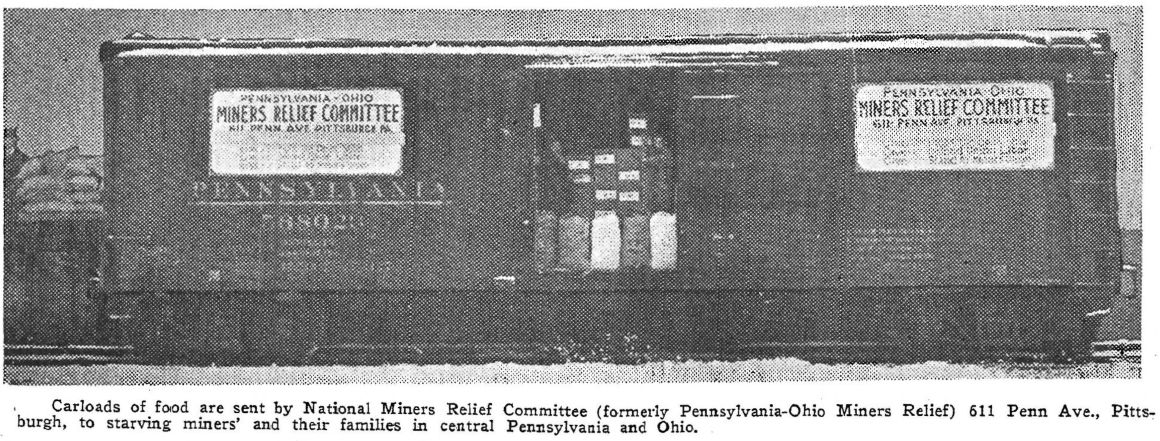
“We faced a ‘dead’ situation” Wagenknecht continued. “After distribution began lengthy conferences were held in our relief offices with local union relief committees. We severely criticised the stay-at-home and suck-your-thumb policy of the officials. We pointed out the danger in the increase of scabs in many mines. We carried on a vigorous propaganda against the sacredness of strike-breaking injunctions. We advised masses of striking miners from a number of local unions to march upon one scab mine at a time and chase the strikebreakers out of the mining areas.
“We advocated the organization of the unorganized miners, pointed out that a national strike with the stoppage of coal production would win, called to the attention of the strikers that a preposterously, high wage paid to officials while strikers only receive a couple of dollars a week per family was impermissible, insisted that action be taken to pry other international unions loose from their swollen treasuries, so that this money could be utilized for strike relief and for the winning of the struggle.
“We began holding mass meetings, distributing literature, and to ‘move’ the miners into action. The result was that the officials of the union, in rare instances, were compelled to advocate mass picketing, a policy they had hitherto condemned. They called mass meetings in some centers, usually to denounce our committee for criticising them.”
Even today, Wagenknecht said, there is no attempt on the part of the officials of the United Mine Workers of America to give directions to the strike or to induce the strikers to put forward a mass effort to win. Neither is relief to the miners on the basis of their daily appearance on the picket line.
Relief Activates Strike
“What strike activity there is” Wagenknecht continued “is what our relief committee has brought about. Our slogans encourage militancy and go into every striker’s home with every pound of flour or beans distributed. Every paper bag used in distribution states and restates our “win the strike” policies.
“Local union committees in contact with us are assuming leadership in their mine camps. Lazy, incompetent organizers of the international union are chased out of the camps when they appear. New local union officials are being! elected in the place of the fossilized ones. The women are manning the picket line. The children are organizing for strike activity.
“With ‘more at our disposal” Wagenknecht con eluded ‘much could be accomplished to turn the labor movement into more militant channels. Funds sent to our committees will encourage the miners to fight until victory is theirs. Our national campaign for relief, drawing in as it does, the workers organized and unorganized, will focus the attention of the entire American working-class on the attack being made by the open shop elements upon the trade union movement.
The entire labor movement must rally behind the striking miners to defeat the coal corporations and their allies in other great industries. The strike must be won. It can be won. And adequate relief will help greatly to secure victory”.
Labor Unity was the monthly journal of the Trade Union Educational League (TUEL), which sought to radically transform existing unions, and from 1929, the Trade Union Unity League which sought to challenge them with new “red unions.” The Leagues were industrial union organizations of the Communist Party of the United States (CPUSA) and the American affiliate to the Red International of Labor Unions. The TUUL was wound up with the Third Period and the beginning of the Popular Front era in 1935.
PDF of full issue: https://www.marxists.org/history/usa/pubs/labor-unity/v2n05-w24-jun-1928-TUUL-labor-unity.pdf

