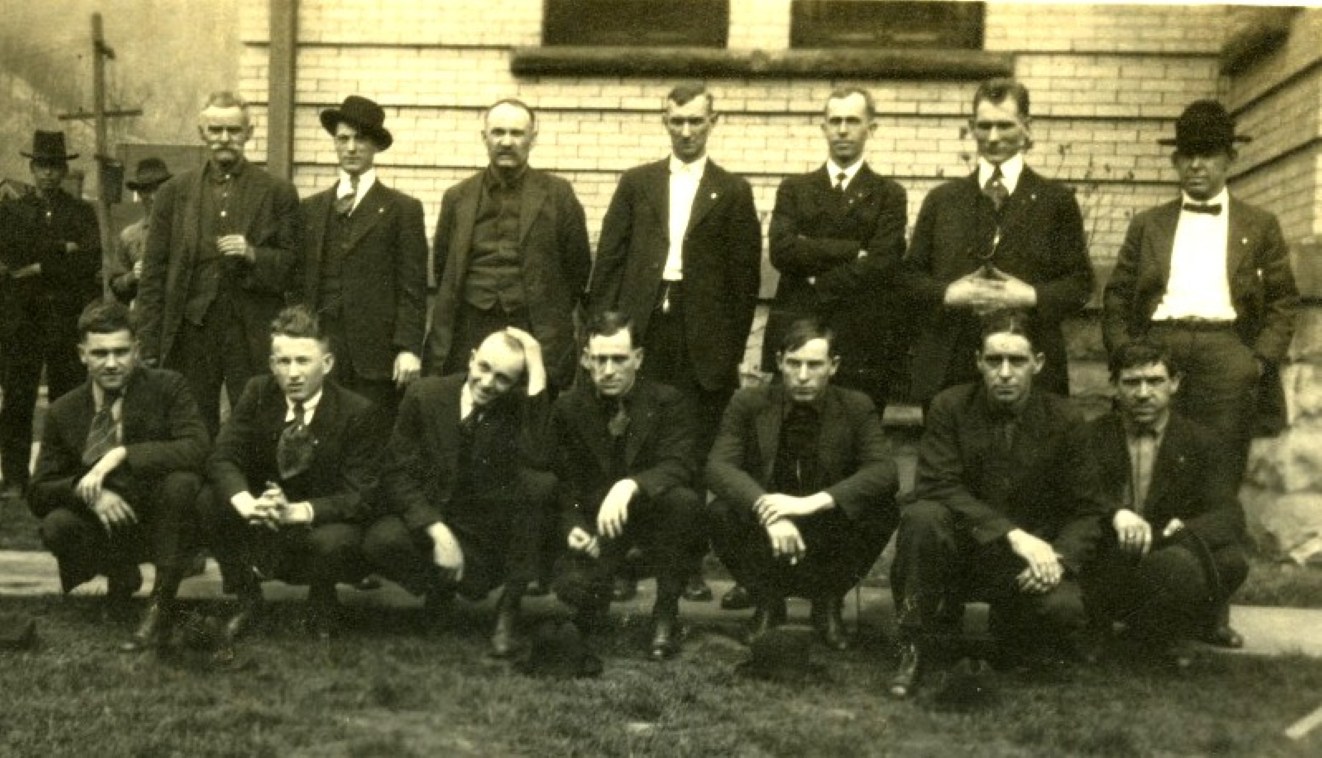
Art Shields with more of his essential reporting of the West Virginia Mine Wars, this with details from the trial of the Matewan defendants accused of murdering gun thugs of the Baldwin-Feltz detective agency in the battle on May 19, 1920. Ed Combs would not be released until 1927.
‘Coal Kings Seek Blood’ by Art Shields from Industrial Worker. Vol. 3 No. 24. October 1, 1921.
Union Miners of Mingo County Tried on Murder Charge for Killing of Baldwin-Feltz Gunmen.
Williamson, Mingo County, W. Va. State constabulary were as numerous as spectators when the state circuit court at Williamson opened recently for the first session since the jury was selected in the trial of Reece Chambers and Fred Burgraff for the killing of J.W. Ferguson, a Baldwin-Feltz detective, in the celebrated battle of Matewan of last year. Few visitors were present because it was not generally known that Major Tom Davis had relaxed his rule against them.
The state constabulary in and around the courthouse are tall young men, averaging nearly 6 feet in height. They wear a military costume of khaki trousers and army shirts and carry forty-five caliber revolvers at their sides. They are part of the state forces which hold Mingo County under martial law.
Witnesses called by the state held the floor this afternoon, but none of them strengthened the prosecution’s case. Miss Marjorie Washington, a young colored woman, who said she was brought in from Virginia by a Baldwin-Feltz man named Anderson, who paid her fare, said she was in Matewan on the day of the shooting and saw Ferguson fired on, but she said she had no recollection of the man who did the shooting.
Mrs. Mary Judy said that Ferguson ran to her house badly wounded and called for assistance. He sank on a wicker rocking chair on the porch and a little later she heard shooting. She was inside at the time, she said, and did not see the shooting.
John Akers, who kept the city pump station at the time, told of Ferguson, with a revolver in his hand, running to the pump station and getting his assistance in a boost over a fence to Mrs. Judy’s home. Men ran up and shots were fired, he said, while he was running away, and afterwards he saw one of the miners taking a gun off Ferguson’s body in an alley near the Judy place.
Dr. R.A. Salton examined Ferguson afterwards and testified in the trial that he was shot in five places, three of the wounds being mortal. The defense will later put on witnesses to show that Ferguson killed an old miner named Mullins in the fight, and then ran. When one of the miners caught up with him Ferguson continued shooting, even after he was brought to the ground.
Ferguson is the second gunman killed at Matewan for whose death murder trials have resulted. The first was Albert C. Feltz. There are five more dead Baldwin-Feltz men on the list for whom 14 miners are jointly indicted.
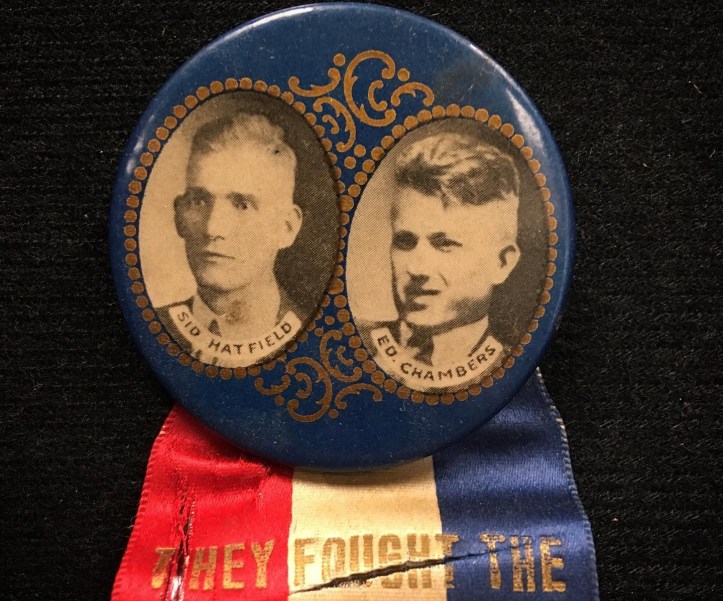
A sad-faced young woman, attired in mourning, sat inside the railing with the defense attorneys and the two defendants. This was Mrs. Ed Chambers, whose husband would have been a defendant also had he not been murdered with Sid Hatfield about five weeks ago as they were climbing the courthouse steps at Welch, county seat of McDowell County, where they were answering an indictment.
LATER.
Williamson, W. Va. Taking the stand in their own defense, Fred Burgraff and Reece Chambers, union miners, categorically denied firing any shots at J.W. Ferguson, one of the seven Baldwin-Feltz detectives killed in the attack on Matewan in May, 1920.
Ferguson’s body was found in an alley nearly 100 yards away from the post-office near the railroad tracks where most of the fighting took place. Burgraff, in his capacity as a deputized police officer, afterwards went into the alley to investigate the report of the death, and found a 38-caliber revolver on Ferguson, which he brought back to the Chambers hardware store and turned over to Chief of Police Sid Hatfield. Reece Chambers also inspected Ferguson’s body in the alley after his death, but at the time of the shooting he was near the railroad track firing back at one of the invading strangers who had started firing at him.
Chambers testified that he had procured a 38 high-power Winchester rifle earlier in the evening after Mayor Testerman had Sworn him into the special police force. When the mayor swore in the deputies he ordered them to arrest anyone violating the law, said Chambers. The mayor also ordered his deputies to arm themselves.
This was shortly before the detectives came.
Chambers is a short, heavy-set, mustached man of 56, of the hard-working family type. Ed Chambers, who was murdered on the courthouse steps at Welch with Sid Hatfield, was his son. Chambers lived in Matewan for 14 years, he said, and at Mate Creek, five miles away, before that time. He had many friends in the courtroom.
Fred Burgraff is a tall, strong-looking man of 37. When asked how long he had been mining, he said:
“Well, ever since I was a kid, just big enough to lift a small shovel,” significant of the child labor employed in the West Virginia coal mines before they were organized.
Among the character witnesses who testified for Chambers and Burgraff were: Former Sheriff Blankenship, Riley Varney, clerk of the county court, and M.G. Alley, farmer and minister of the local church at Matewan. Chambers is a member of his church.
Another of the witnesses to testify in behalf of the defendants was another preacher, Hugh Coombs, who at one time had been president of the United Mine Workers at Matewan. He worked in the coal mines up until a year ago, when he was blacklisted. He is what is known locally as an “exhorter.” He had been asked by Mayor Testerman to deputize 12 men to act as police just prior to the arrival of the detectives.
The prosecution tried to make much capital out of the fact that Chambers and Burgraff were members of the union and in joining it had sworn to stand by it and its members.
Captain Avis of the prosecution asked Coombs whether in getting his twelve men he had selected anyone who was not a member of the union.
“I don’t believe I did,” said Coombs.
Charles Kiser, one of the original defendants in the first trial, was one of the strongest witnesses for the defense. He said he saw Ferguson backing down the street discharging two revolvers at Old Man Mullins, the miner-preacher who was killed that day. Afterwards he heard shots from the alley near Mrs. Judys boarding house, where Ferguson’s body was afterwards found. At that time, he said, Reece Chambers was between the hardware store and the bank and Burgraff was in the yard of a boarding house on X street, a long distance away from the shooting.
The jury, after deliberating 48 hours, notified the court of their inability to agree upon a verdict, and were discharged. They stood 6 for conviction and 6 against.
The Industrial Union Bulletin, and the Industrial Worker were newspapers published by the Industrial Workers of the World (IWW) from 1907 until 1913. First printed in Joliet, Illinois, IUB incorporated The Voice of Labor, the newspaper of the American Labor Union which had joined the IWW, and another IWW affiliate, International Metal Worker.The Trautmann-DeLeon faction issued its weekly from March 1907. Soon after, De Leon would be expelled and Trautmann would continue IUB until March 1909. It was edited by A. S. Edwards. 1909, production moved to Spokane, Washington and became The Industrial Worker, “the voice of revolutionary industrial unionism.” A victim of finances and internal disputes, the IW ceased publication in 1913, only to be revived in 1916 and surviving as a weekly, sometimes more, until 1931. Easily among the most important working class newspapers in U.S. history and an essential resource on the wobbly, and larger radical labor experience
PDF of full issue: https://washingtondigitalnewspapers.org/?a=d&d=IWW19211001

