
A key practical problems for the U.S. workers’ movement, one closely connected with organizing the unorganized, is the division among unions in workplaces and industries. The old craft vs. industrial union debate was only partially resolved by the C.I.O., as many unions retained the philosophy, if not the form. Perhaps the industry most impacted by those divisions has been rail. The situation became critical after one of the largest strikes in U.S. history as 400,000 workers, or around half of the 16 rail unions, walked off in a massive and militant strike on July 1, 1922. The National Guard, police, and gun thugs killed around ten strikers and family members over an epic two months of mass mobilizations and struggle. There remain a dozen divided rail unions a century after the strike and the call for amalgamation by a a comrade who spent most of their active life trying to achieve what is still unfinished business for the labor movement.
‘The Railroad Amalgamation Movement’ by O.H. Wangerin from Labor Herald. Vol. 2 No. 7. September, 1923.
Secretary International Committee for Amalgamation in the Railroad Industry.
THE movement to amalgamate the 16 standard railroad trade unions into one powerful industrial organization has become a major factor in the railroad unionism of America. The railroad unions, like all social institutions today, are profoundly stirred, and are responding to the changing conditions. On the employers’ side we find a large part of the quarter-million miles of railroads in the United States concentrated into a few large systems, controlled by a few Wall Street financiers. Thus, the railroad workers are faced with a new situation. Where 15 or 20 years ago it was practical for one craft, or a group of crafts, to deal separately with the roads, making separate agreements, they are now compelled to deal with the great combinations, backed by powerful financial cliques, immeasurably more powerful. To cope with this situation new methods and forms of organization have been found necessary.
Amalgamation Born of Necessity
It was the sheer necessity, brought about by this condition, from which the amalgamation movement was born. In the “open shop,” union-smashing campaign of the united railroad capitalists, the workers found the separated craft unions entirely too weak to meet the terrific onslaughts. As an aftermath of the shopmen’s strike during the past year, when nine unions remained on the job while seven struck, hundreds of local unions (on some roads all lodges of all seven organizations), with tens of thousands of members, have been wiped off the union map, their organizations completely annihilated. If any argument had been lacking to support the demand for consolidation of the 16 railroad unions, certainly the experiences of the past year have amply furnished that argument.
For this, disastrous situation there is but one solution. No other has been suggested. All 16 railroad unions must be amalgamated into one powerful industrial organization. The railroad workers awakened to this imperative need; they have developed a great movement to bring it about. This is the story of that movement.
When the International officials blocked the efforts of the Northwest delegates, at the Railway Employees’ Convention in April, 1922, to place that body on record for amalgamation, they demanded that a definite plan of organization be presented. Little did they realize they were calling into being a great movement that has since swept the industry from coast to coast, and which is now gathering sufficient strength to compel these same officials to put amalgamation into effect.
Extent of Amalgamation Demand
It was clear that the officials would do nothing toward consolidation. If anything should be accomplished it must be done by a rank and file movement. Immediately after the Department convention, the Minnesota Shop Crafts Legislative Committee prepared to submit a plan of amalgamation to the railroad unions for their approval. On July 1st, 1922, 12,000 railroad local unions in the United States and Canada were circularized with what has since become famous as the “Minnesota Plan.”
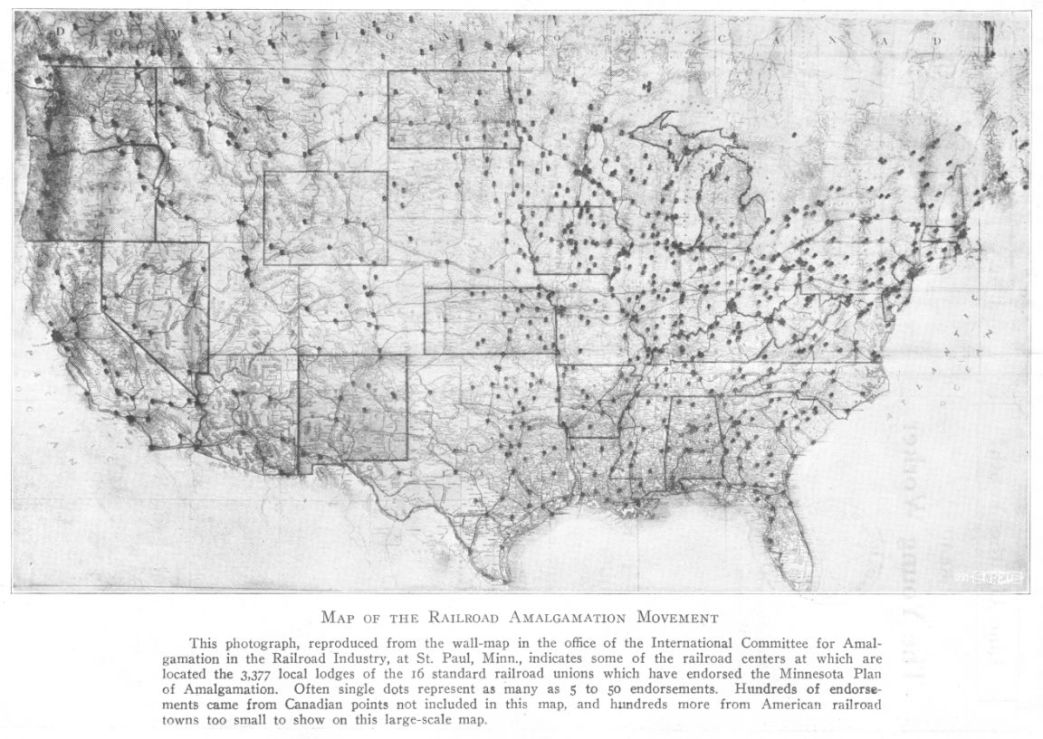
The response was beyond all expectations. Within a year the amalgamation movement has become firmly rooted in every union and in every railroad center. A glance at the map (opposite page) shows to what tremendous proportions it has grown, and will convince the blindest reactionary of the wisdom of the official slogan, “Save your money, boys; amalgamation’s coming.” From the Atlantic to the Pacific, and from the northern stretches of Canada to the Mexican border, sentiment for amalgamation has been expressed by an overwhelming majority.
At the time this is written the “Minnesota Plan” has been endorsed by 3,377 local lodges, including all 16 standard railroad unions. A strong contingent of these come from the “Big Four” Brotherhoods, but the greatest number are from the seven shop crafts, the Railway Clerks, Maintenance of Waymen, Telegraphers, and Switchmen’s Unions. It can safely be said that fully 75% of all railroad workers have approved the plan of amalgamation and are ready to unite their unions on the basis proposed.
In addition to this great number of local unions, amalgamation has been endorsed by scores of Local, District and System Federations comprising a great number of different trades. The larger organizations to take this action during the past year were District No. 2, I.A. of M., comprising all railroad machinists in Canada; the Joint Protective Board of the Railway Carmen on the Grand Trunk System; Federation No. 41, C. & O. Lines; and, during the month of June, Federation No. 76 comprising approximately 15,000 railroad workers on the C.M. & St. P. Railroad. Two great international conventions, the Railway Clerks and Maintenance of Way men, have also endorsed amalgamation. The latter organization specifically endorsed the “Minnesota Plan,” by a vote that was practically unanimous. At this convention E.F. Grable was defeated for President of the Maintenance of Way by F.H. Fljozdal on the amalgamation issue.
The Chicago Conference
Recognizing the need of the situation and in response to the widespread demand on the part of the workers for definite action on amalgamation, the provisional committee called the National Railroad Amalgamation Conference at Chicago, Ill., on Dec. 9-10, 1922. The purpose of the conference was to devise ways and means to bring about the actual consolidation of the various unions as rapidly as possible. Four hundred and eleven delegates, representing all 16 organizations, responded to the call, coming from all parts of the United States and Canada. Delegates were present from Los Angeles, Toronto, Can., Seattle, New York City and Birmingham, Ala., and many other distant cities. It was the first time in the history of railroad unionism in North America that rank and file delegates from all 16 organizations met under the same roof to discuss their common problems. It marked an epoch in the life of the railroad movement.
This conference did not merely endorse the “Minnesota Plan” of amalgamation, but formulated a practical program by which amalgamation will be accomplished. The International Committee for Amalgamation in the Railroad Industry was formed, consisting of one hundred practical railroad men of all trades and located in all parts of the United States and Canada. As measures to further the work of amalgamation the conference recommended that local committees be established in all railroad centers; to provide finances the “Amalgamation Fund” was created and all lodges favoring amalgamation urged to make a $2.00 monthly contribution to the fund, and The Railroad Amalgamation Advocate was made the official organ of the International Committee. The Conference took a clear cut and definite stand against dual unionism, and called upon all railroad unionists to stay in their present organizations and rebuild and strengthen them by amalgamation. The General Amalgamation Program adopted provided for the starting of referendums in the various unions and directed the entire movement toward the calling of a general convention of all 16 organizations where the amalgamation should be effected.
The Canadian railroad workers are also awake to the need of amalgamation. The “Minnesota Plan” has been as widely endorsed in Canada as in the United States. During the month of January of this year, one month after the Chicago Conference, a meeting of railroad workers was held in the city of Montreal, at which a provisional Canadian Amalgamation Committee was formed. It has circularized all lodges of several of the unions which are rallying to its support. Thousands of copies of the plan are being circulated by the Canadian Committee, which is also printing a French translation for circulation among the thousands of French-speaking railroad workers in eastern Canada. The Canadian Committee is working in complete harmony and co-operation with the International Committee and the program adopted at Chicago.
Referendums
As provided for in the General Amalgamation Program adopted at the Chicago Conference, individual referendums are now being initiated in the various trades. Lodge No. 299, Railway Carmen, Minneapolis, Minn., has submitted for referendum in that organization amendments to the Grand Lodge Constitution which will place the organization on record for amalgamation and provide the machinery by which it can be brought about. The constitution of that organization requires that the amendments must be endorsed by five local lodges from five different states. This proposition has received over fifty endorsements from twenty-seven states and provinces in the United States and Canada.
Despite the fact that this proposed referendum has received nearly ten times the required endorsement, the Grand Lodge of the Railway Carmen is making a desperate attempt to block it. All sorts of excuses are given as reasons for opposing the referendum. But the real reason is stated in the following words: “We want to call your attention to the fact that every advantage accruing to the membership through improved working conditions, increased pay, etc., has been brought about through the instrumentality and aggressiveness of our own Brotherhood,” and “It is our judgment that whatever benefits may accrue to you in the future will be the results of our own activity, loyalty and cooperation with our own organization.” This is the language of incorrigible craft unionists who do not believe in consolidation of the railroad unions, denying the truths of the past and refusing to acknowledge the needs of the future.
The Brotherhoods and Amalgamation
A strong tendency toward amalgamation in the “Big Four” Brotherhood organizations is indicated by the great number of endorsements of the “Minnesota Plan” coming from those organizations. This is further evidenced by the action of the rank and file of these unions during the Shopmen’s strike, when they attempted to come to the assistance of the Shopmen by joining them in the struggle. At several points throughout the Country they left their trains, completely tying up traffic, only to be driven back to work by their International officials. At different conventions the membership of these organizations have taken steps to bring about a closer working alliance, the Engineers and Firemen having passed resolutions at their last conventions to form a complete amalgamation of these two organizations. Negotiations to this end are now on. An indication of the steady growth of amalgamation sentiment was the conference held at Tacoma, Wash., July 7th and 8th, this year. A representative attendance of all classes of railroad workers was present from the states of Washington, Oregon, Montana and Idaho, while scores of local lodges were unable to send delegates on account of the depleted treasuries of their unions.
Only two obstacles stand in the way of amalgamation at the present time, namely: dual unionism and the opposition of the International officials. To a great extent the menace of dual unionism and secession has been removed. This has been done by spreading the idea of amalgamation and making clear to the workers the fallacy of breaking away from their old organizations and starting new ones. The other obstacle is the opposition, open and bitter, of the salaried officials and the so-called neutrality of others. With few exceptions they have taken a definite and determined stand against a general consolidation of the railroad unions. Having no program for the future, they are doing nothing to build up and strengthen the unions and are fighting every effort on the part of the progressive element to move forward. This opposition must be overcome by the membership themselves becoming active in the amalgamation movement everywhere. Through the action of the local unions and at the District and System Conventions, and finally at the International Conventions of each craft, these officials will be forced. into action or be removed from office and progressive leaders put in their places.
The Shopmen’s strike has had a disastrous effect on the entire railroad labor movement. A condition of disorganization and utter hopelessness exists in the shop trades.
A more brilliant and inspiring battle was never fought by union men. Enduring untold suffering and privation, sacrificing their meagre savings and many their homes, incurring huge debts to provide the necessaries of life for their families, these men stuck to the sinking ship to the bitter end. Today few of the betrayed shop men are paying dues into the old trade unions. Their heroism has been scarcely equaled in the struggles of American Labor. The tragical story of the Shopmen’s strike has not yet been told. But the day of reckoning is near at hand. The railroad workers will never again allow themselves to be led to the bloody shambles by stupid officials who persist in clinging to an outlived policy and system of organization, merely for the sake of their jobs. Of the 400,000 railway shop workers who entered the strike on July 1st, today fully one-half have been wiped out. Hundreds of their local unions, system and district organizations built up through many years of sacrifice and effort, have been completely destroyed. To rebuild this gigantic union mechanism on the old craft basis is impossible.
Our Immediate Future Task
The situation now confronting the railroad workers as a whole is a critical one, indeed. Either we railroad workers will go ahead with our antiquated unions and see them destroyed altogether, one by one or a group of them at a time, or we will consolidate them into powerful fighting machines equal to those of our employers and march on to ever greater conquests. If we are to go forward we must develop greater industrial power to combat the railroad companies. Nothing short of a complete amalgamation of all 16 unions into one industrial organization will suffice. To get the tens of thousands of workers back into the unions who were driven out during the “open shop” drive of the companies, and to induce the unorganized to come into the unions, more is necessary than to offer them the old craft form of organization. The American railroad workers want a new deal all around. To do this two things are necessary, the existing unions must be amalgamated at the earliest possible date and a drive started immediately to organize the unorganized. Henceforth our slogan is, “Amalgamate and organize the unorganized.”
The Labor Herald was the monthly publication of the Trade Union Educational League (TUEL), in immensely important link between the IWW of the 1910s and the CIO of the 1930s. It was begun by veteran labor organizer and Communist leader William Z. Foster in 1920 as an attempt to unite militants within various unions while continuing the industrial unionism tradition of the IWW, though it was opposed to “dual unionism” and favored the formation of a Labor Party. Although it would become financially supported by the Communist International and Communist Party of America, it remained autonomous, was a network and not a membership organization, and included many radicals outside the Communist Party. In 1924 Labor Herald was folded into Workers Monthly, an explicitly Party organ and in 1927 ‘Labor Unity’ became the organ of a now CP dominated TUEL. In 1929 and the turn towards Red Unions in the Third Period, TUEL was wound up and replaced by the Trade Union Unity League, a section of the Red International of Labor Unions (Profitern) and continued to publish Labor Unity until 1935. Labor Herald remains an important labor-orientated journal by revolutionaries in US left history and would be referenced by activists, along with TUEL, along after it’s heyday.
PDF of full issue: https://www.marxists.org/history/usa/pubs/laborherald/v2n07-sep-1923.pdf

