
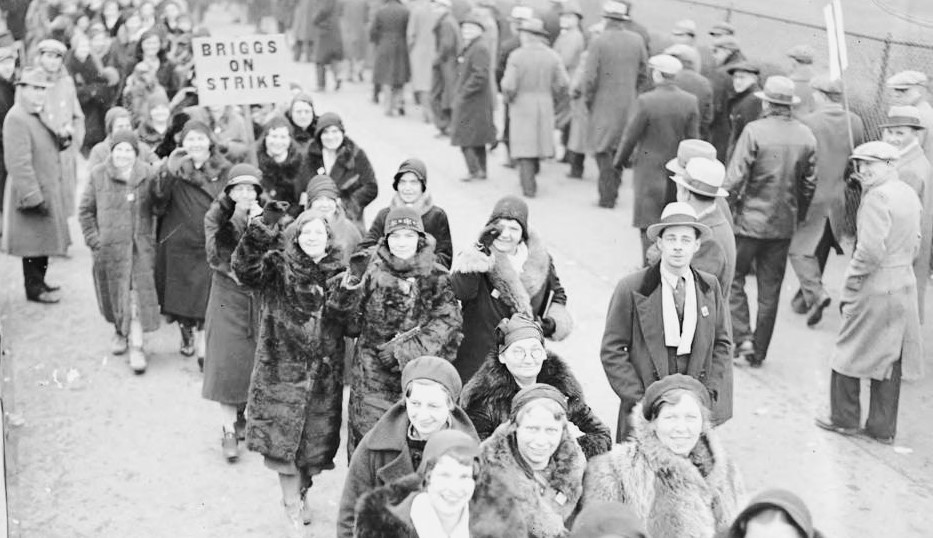
Contrary to public perceptions, women have always been in the auto plants. Anna Damon reports on their role in one of the early-30s attempts to organize the Detroit industry by the T.U.U.L.’s Auto Worker Union in January, 1933, where one-third of the six thousand Briggs workers striking were women.
‘Women Toilers in the Detroit Auto Strike’ by Anna Damon from The Daily Worker. Vol. 10 No. 55. March 6, 1933.
UNDER the leadership of the Auto Workers’ Union, four strikes in Briggs Manufacturing Plants, Motor Products, Murray Body and Hudson’s, took place during the month of January, which brought splendid victories to the auto workers. These strikes electrified the entire city–tied up Ford, Chrysler and other plants.
Inspired by the successes of the strikes in the auto plants in Detroit, workers in department stores, in dress factories and other industries, put up a struggle for higher wages and gained increases.
In all these strikes and struggles, the women factory workers played a leading role. At the Auto Workers’ Union strike call, although unorganized and with little attention by the factory groups, the women came out at a moment’s notice together with the men and joined and led militant picket demonstrations.
The women workers on strike gained substantial wage increases from 20 to 200 per cent–a minimum wage of 30 cents per hour–pay for waiting time (dead time)–bonus increases—shortening of working hours.
LABOR LAWS VIOLATED
We speak to a young girl at Motor Products. She tells us: “There is a law in Detroit which says that women are not permitted to work over 10 hours a day and not more than 54 hours per week. But we worked 60 and sometimes more hours per week, and still did not earn more than $7 or $8 per week. Sometimes we got even as low as 4 cents per hour–sometimes 10 cents. We never knew what we were going to get. The efficiency man had that all figured out.
Then there is another law which says that women are not permitted to work at night. But my mother is working on a night shift with dozens of other women. This, too, the efficiency man had all figured out. But now since we had the strike, under the leadership of the Auto Workers’ Union, we won the demands and we get a minimum of 30 cents per hour and things are a lot better.”
We talked to this girl and other women about the union. They promised to help arrange a women’s meeting to bring more women into the union and to build women’s auxiliaries.
WE go to the Mack Ave. Briggs Plant. Here over 6,000 workers are still on strike; 2,000 of them women. For the last six weeks, the workers have waged a bitter fight to improve their living conditions–a fight for the right to live, in face of the organized joint reactionary forces of the auto lords, the “liberal” city government of Mayor Murphy, the treachery of the Detroit Federation of Labor, the I.W.W. and the Socialist Party officials.
WORK BUT NO PAY
We talked to an Italian woman of 40 on the picket line. We asked her why she was on strike. She told us: “I worked here for 10 years. My husband and children worked here. Now I am the only one working and am working part time. I come here every day, hang around for 10 to 12 hours for 5 hours’ work, and I wait and wait for the job.
“I never know what I get for my work. They make us sign a paper, the price for jobs is subject to change. I make sometimes $5 a week–sometimes $6. I never know. We have no shoes. I go to the office and ask them to get me and the kids some clothes. They say O.K. And give me a slip of paper and make me sign. Now, I have worked six weeks and have received three 2-week pay checks; one for 2 cents, one for 5 cents and the other for 7 cents. They say they take it out for the shoes.” She cries out: “That is why I strike. That is why I picket. They cheat us. I tell you; they take away all we makes.”
WOMEN IN FIGHT FOR UNEMPLOYMENT INSURANCE
WE go to an Unemployed Conference in Dearborn–men and women get up one after another and tell how Ford is sapping out their life and blood. A woman speaks: “I have 10 in the family. My husband worked at Fords for 15 years. Now he has no job. They take my boy in the Ford Trade School. He is 12 years old. He is the only one that they give work to. He fainted three times in one day. His back aches, and the foreman says speed-up. We–mothers of Dearborn demand work for our husbands and against child labor, for free food, transportation and hospital care for our children.” Negro and white women in Detroit: Further your militant struggles for the right to live! Organize into the Auto Workers’ Union! Join the Women’s Auxiliaries! Working and farm women of other cities: Follow the militant struggles of the women of Detroit!
Let International Women’s Day–the historic day of struggle against misery and oppression of the working and farm women under capitalism–be a day of solidifying our forces in struggle against wage-cuts, for unemployment insurance and immediate relief, against imperialist war and for the defense of the Soviet Union and Chinese masses! All out in demonstration on March 8th–International Women’s Day!
The Daily Worker began in 1924 and was published in New York City by the Communist Party US and its predecessor organizations. Among the most long-lasting and important left publications in US history, it had a circulation of 35,000 at its peak. The Daily Worker came from The Ohio Socialist, published by the Left Wing-dominated Socialist Party of Ohio in Cleveland from 1917 to November 1919, when it became became The Toiler, paper of the Communist Labor Party. In December 1921 the above-ground Workers Party of America merged the Toiler with the paper Workers Council to found The Worker, which became The Daily Worker beginning January 13, 1924. National and City (New York and environs) editions exist.
PDF of full issue: https://www.marxists.org/history/usa/pubs/dailyworker/1933/v010-n055-NY-mar-06-1933-DW-LOC.pdf

